
Question 133 marksMedium
Draw a line segment AB = 6·5 cm. Locate a point P that is 5 cm from A and 4·6 cm from B. Through the point P, draw a perpendicular on to the line segment AB.
Confirming your payment
Sign up now and get 250 free tokens.
Constructions · Question 13 of 33
Draw a line segment AB = 6·5 cm. Locate a point P that is 5 cm from A and 4·6 cm from B. Through the point P, draw a perpendicular on to the line segment AB.
Solution:
Concept: A point at given distances from two fixed points lies where two arcs with those radii meet. To draw a perpendicular from a point P to a line, we cut the line at two points C and D with one arc about P; the point E where equal arcs from C and D meet on the other side is, like P, equally far from C and D, so PE is perpendicular to CD.
Given: AB = 6·5 cm, PA = 5 cm and PB = 4·6 cm; a ruler and a pair of compasses only.
Step 1 — Draw AB.
Draw a line segment AB, 6·5 cm long.
Step 2 — Locate P.
With A as centre and radius 5 cm, draw an arc above AB. With B as centre and radius 4·6 cm, draw another arc cutting the first at P. Then PA = 5 cm and PB = 4·6 cm.
Step 3 — Cut AB with an arc about P.
With P as centre and a radius larger than the distance of P from AB, draw an arc cutting AB at C and D. Now PC = PD.
Step 4 — Draw equal arcs below AB.
With C and D as centres and the same radius, draw arcs meeting at E on the other side of AB.
Step 5 — Draw the perpendicular.
Join PE. It meets AB at N. Both P and E are equally far from C and D, so PE is the perpendicular bisector of CD, and PN is perpendicular to AB.
Step 6 — Look at the finished figure and check it.
The finished construction is shown below, drawn to scale.
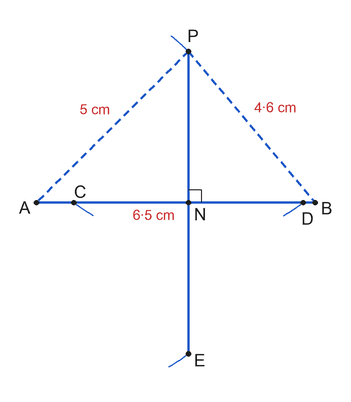
A set-square placed at N with one edge along AB fits along NP, so ∠PNB = 90°.
Watch out: The arc about P must be large enough to cut AB in two points; a small arc does not reach the line.
Therefore, PN is the required perpendicular from P on to AB, with ∠PNB = 90°.