
Opening your dashboard
Class 6 Maths Chapter 19 Constructions: Competency-Based Questions (CBQ)
40 questions on Chapter 19, each worked through on its own page with the AI tutor. Class 6 Maths, ICSE 2026-27.
40 questions
1–5 marks · Mixed difficulty
- 11 mark
Question 1
Competency: Understanding
A carpenter wants to mark the exact middle of a wooden strip AB. The numbers on his ruler have rubbed off, so he can use it only to draw straight lines. He also has a compass.
Which construction should he use?
- 21 mark
Question 2
Competency: Application
A loading ramp must make an angle of with the floor. The mason has only a ruler and a compass to draw the plan.
Which method gives him exactly ?
- 31 mark
Question 3
Competency: Analysis
A welder is asked to make a triangular frame. Four customers give him these details. With which details can he make one definite triangle?
- 41 mark
Question 4
Competency: Application
Ravi places two set-squares at a point O with one edge of each along the line OA. The corner of one and the corner of the other are both at O, one over the other, as shown. He draws rays OB and OC along the slanting edges.
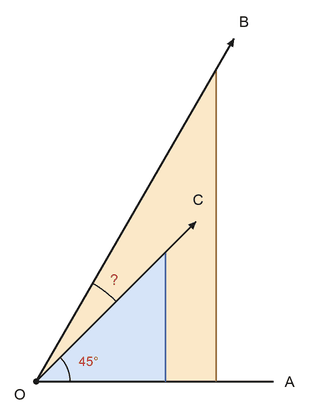
The angle BOC between the two rays is
- 51 mark
Question 5
Competency: Analysis
To draw a perpendicular to a line AB through a point P on the line, Meena first draws two arcs with P as centre and the same radius, cutting AB at X and Y. Then, with X and Y as centres, she draws arcs of equal radii that cross at Z, and joins PZ.

Why is her first step needed?
- 61 mark
Question 6
Competency: Evaluation
Assertion (A): A triangle ABC with AB cm, and cannot be constructed.
Reason (R): The sum of the three angles of a triangle is .
- 72 marks
Question 7
Competency: Application
Sunita constructs an angle with a ruler and a compass. She bisects it. Then she bisects one of the two halves. The smallest angle in her figure is now .
What was the angle she started with? How can this starting angle be constructed with a ruler and a compass?
- 82 marks
Question 8
Competency: Evaluation
On a map, two villages A and B are 8 cm apart. A well W is to be dug at the same distance from both villages.
Rahul says, "Only the mid-point of AB will do." Tanya says, "Any point on the perpendicular bisector of AB will do."
Who is right? If W is a point on the perpendicular bisector with cm, write the lengths of WB and AM, where M is the mid-point of AB.
- 92 marks
Question 9
Competency: Understanding
On a wall drawing, AB is the floor line and C is a tap above it. A plumber must draw the pipe from C straight down to the floor line, so that it meets AB at right angles. He has only a set-square and a pencil.
Explain how he should place the set-square. Along which edge does he draw the pipe line?
- 102 marks
Question 10
Competency: Analysis
The steps to construct a triangle ABC with BC cm, and AB cm are given below in a jumbled order.
- P: Join AC.
- Q: Draw BC cm.
- R: With B as centre, draw an arc of radius 4 cm to cut BX at A.
- S: At B, construct .
Write the steps in the correct order. Which single step changes if AB is to be 6 cm instead of 4 cm, and how?
- 113 marks
Question 11
Competency: Analysis & Evaluation
A gardener gets three plans for a triangular flower bed.
Plan Details given 1 One side of 5 m, with angles of and at its two ends 2 One side of 6 m, with angles of and at its two ends 3 Sides of 6 m and 8 m, with an angle of between them (a) Which plan cannot be made? Give the reason.
(b) For Plan 1, find the third angle. Without measuring, write the lengths of the other two sides and name the triangle.
(c) For Plan 3, say which case of triangle construction it is, and which side he should draw first.
- 123 marks
Question 12
Competency: Creativity
Frame your own triangle-construction question for a friend. It must follow these rules:
- Two sides and the angle between them are given.
- Both sides are whole numbers of centimetres.
- The angle can be constructed with a ruler and a compass, but it is not or .
(a) Write your question.
(b) Explain how the angle in your question is constructed with a ruler and a compass.
(c) Write the steps of construction for your triangle.
- 133 marks
Question 13
Competency: Application & Analysis
A craftsman wants to mark 8 equally spaced spokes on a round wooden wheel. All the spokes start from the centre O. He has only a ruler and a compass.
(a) What must be the angle between two neighbouring spokes?
(b) Plan how he can mark all 8 spokes. Say which constructions he uses, in order.
(c) For another wheel he needs 12 equally spaced spokes. Find the angle between neighbouring spokes and say how this angle is constructed.
- 144 marks
Question 14
Competency: Application & Analysis
Case study — Plan of a triangular park
Meera draws the plan of a triangular park ABC to the scale 1 cm 10 m. Her rough sketch shows the data she has.
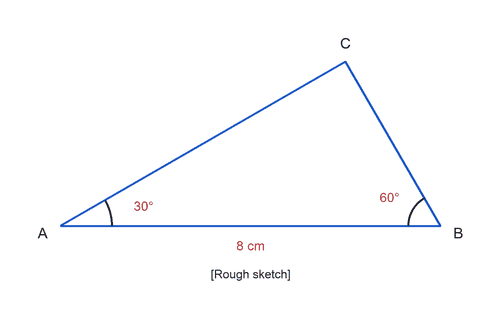
(a) Which case of triangle construction fits these data? Find without drawing.
(b) Meera has only a ruler and a compass. Write the steps to construct the triangle, saying how she gets each angle.
(c) On her accurate drawing she measures BC cm and AC cm, correct to the nearest millimetre. Find the actual lengths of the three sides of the park. A fence is put all around the park. How long is the fence?
- 155 marks
Question 15
Competency: Application & Analysis
Case study — Marking a kabaddi court
The PT teacher marks a rectangular court ABCD, 12 m long and 8 m wide, on the playground. She has pegs, lime powder and a long rope. With one end of the rope fixed at a peg, the other end marks an arc on the ground, just like a compass.
(a) She first marks the side AB m. Describe how she can use the rope to mark a line through A at right angles to AB, for the side AD.
(b) The centre line of the court starts from the mid-point M of AB. Which construction gives M? Her helper uses a rope length of 5 m from A and from B and finds that it does not work. Explain why, and say what rope length is needed.
(c) A spot P is to be marked inside the court, exactly in front of M and 3 m from the line AB. Describe how to mark P. How far is P from the opposite side DC?
- 161 mark
Question 16
Competency: Analysis
Mira constructs an angle of at O. She draws an arc of radius 4 cm with centre O, cutting OA at B. Then, by mistake, she opens her compass to 4.6 cm and, with centre B, draws an arc that cuts the first arc at C. She joins OC.
The angle BOC is now
- 171 mark
Question 17
Competency: Application
A pop-up card opens to an angle . Anil first bisects with a ray OC. Then he bisects with a ray OD. He measures .
The angle is
- 181 mark
Question 18
Competency: Understanding
The top edge AB of a paper strip is 9.6 cm long. Rohan folds the strip so that the point A falls exactly on the point B. The crease cuts AB at a point M.
Which of the following is correct?
- 191 mark
Question 19
Competency: Analysis & Evaluation
A student bisects with a ruler and a compass. An arc with centre O cuts OA at C and OB at D. Arcs of the same radius with centres C and D meet at E. The ray OE is drawn.
Assertion (A): The line OE cuts the straight line joining C and D at its mid-point and at right angles.
Reason (R): Each of the points O and E is at the same distance from C as from D.
- 201 mark
Question 20
Competency: Analysis
Zoya has only the -- set-square. She places its corners side by side at a point O on a line, with one arm in common, so that the angles add up. Which of these angles can she not draw at O?
- 211 mark
Question 21
Competency: Analysis
A beam BC is 6 m long. A rope of length 5 m is tied to B and a rope of length 4 m is tied to C. Their free ends are brought together at a point A to make a triangle. On a drawing sheet this is done with a compass: an arc of radius 5 cm from B and an arc of radius 4 cm from C, with BC cm.
How many positions of A are there on the sheet, and how do the triangles compare?
- 221 mark
Question 22
Competency: Application
A mason has a long wooden strip with no marks on it, a ruler used only to draw straight lines, and a compass. He must mark points that divide the strip into 8 equal parts. He makes every dividing point by drawing a perpendicular bisector, which cuts a piece into two equal pieces. He does not copy lengths with the compass.
The smallest number of perpendicular bisectors he must draw is
- 231 mark
Question 23
Competency: Evaluation
Assertion (A): A triangle can be constructed, using a ruler and a compass only, with two sides of 5 cm and 3 cm and an angle of between them.
Reason (R): No triangle can have an angle greater than .
- 241 mark
Question 24
Competency: Evaluation
Four students each construct a triangle with sides 6 cm, 8 cm and 10 cm, as accurately as they can. Each measures the largest angle with a protractor. (Hypothetical data.)
Student Reading of the largest angle Asha Bela Charu Dev Which conclusion is the most sensible?
- 251 mark
Question 25
Competency: Analysis
Sunil and Tina each bisect the same angle with a ruler and a compass. Sunil uses a first arc of radius 3 cm and crossing arcs of radius 2.5 cm. Tina uses a first arc of radius 5 cm and crossing arcs of radius 4 cm. All their arcs cross properly.
What can we say about the two bisectors?
- 262 marks
Question 26
Competency: Understanding
Mira draws an arc of radius 5 cm with centre O, cutting the line OA at B. With centre B and the same radius 5 cm she draws another arc that cuts the first arc at C. She joins OC and calls the angle .
Write the lengths OB, OC and BC. Name the kind of triangle OBC and give , with a reason.
- 272 marks
Question 27
Competency: Application
On the plan of a school, the two gates X and Y are 7 cm apart. A straight footpath AB crosses the line XY at a point P, 2 cm from X, running slantwise (not at right angles to XY). A cycle stand S must be put on the footpath at the same distance from gate X and from gate Y.
(a) Which construction helps? Write the steps to find S.
(b) Rohit says, "Put the stand at P, where the footpath crosses XY." Is he right? Give a reason with the distances.
- 282 marks
Question 28
Competency: Analysis
A student has two set-squares. One has corners , and . The other has corners , and . At a point O she lays one corner of each set-square one over the other, with one arm in common and both set-squares on the same side of it. She draws a ray along the other arm of each corner. The angle between these two rays is the difference of the two corner angles.
List all the different angles, other than , that she can get in this way. How many are there?
- 292 marks
Question 29
Competency: Application
A kite-maker wants a triangular flap ABC with BC cm and . He has a ruler and the -- set-square, but no compass and no protractor.
Find . Explain how he can draw the triangle.
- 302 marks
Question 30
Competency: Creativity
A craftsman makes a triangular wooden frame from a thin strip of total length 18 cm. The frame must be isosceles but not equilateral, and each side must be a whole number of centimetres.
Give one possible set of three side lengths. Show that a triangle can really be made with them.
- 312 marks
Question 31
Competency: Application
The zero end of Rina's ruler is broken, and the first mark that can be seen is 1 cm. She needs to draw a line segment AB of length 6.5 cm.
(a) At which two marks of the ruler should she put her pencil points?
(b) After drawing AB, how can she mark a point C on the line beyond B, with BC equal to AB, using a compass?
- 323 marks
Question 32
Competency: Analysis
Ravi constructs a triangle ABC with AB cm, and . Sita is given different-looking data: AB cm, and .
(a) Find in Ravi's triangle.
(b) Find in Sita's triangle.
(c) Will the two triangles be identical? Give a reason.
- 333 marks
Question 33
Competency: Analysis
Two identical -- set-squares are placed side by side so that they share the longer edge AD of the two edges that make the right angle, as shown.
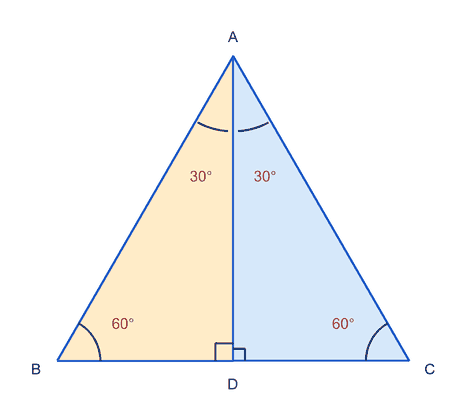
(a) Find .
(b) Show that B, D and C are on one straight line.
(c) Name the triangle ABC. How many times as long as the shortest edge BD of a set-square is its longest edge AB?
- 343 marks
Question 34
Competency: Application & Evaluation
Aarav has a square sheet of paper. At a corner O the edges OA and OB make a right angle. He folds the sheet so that OA falls exactly along OB. Then he folds again so that OA, in its new place, falls along the first crease.
(a) What angle does the first crease make with OB?
(b) What angle is formed after the second fold?
(c) Can he get exactly by folding like this? Say how can be got with a ruler and a compass.
- 353 marks
Question 35
Competency: Application
A rectangular table top is 120 cm long and 80 cm wide. Meena wants to fix a lamp at the exact centre of it. She makes a plan of the table top with the scale 1 cm 20 cm.
(a) Find the length and the width of the plan.
(b) Using a ruler and a compass, how can she find the centre on the plan?
(c) How far is the centre from a long edge and from a short edge of the actual table top?
- 363 marks
Question 36
Competency: Evaluation
Meera has to construct an angle of at a point O of a ray OA. She plans to construct with the first method of the book, which is an arc with centre O, a step of the same radius from B to C and a second step from C to D, followed by arcs from C and D that cross at E. Then she plans to add to it.
Ravi says, "In your first method, the point D is already at . Just join OD."
(a) What is the angle between OA and OD?
(b) Is Ravi right?
(c) Count the compass arcs in Ravi's plan and say whether Meera's plan needs more.
- 374 marks
Question 37
Competency: Analysis & Evaluation
Case study — Plans on a practice sheet
A teacher gives four plans for constructing angles with a ruler and a compass. The plans are in the table. Two of them are wrong.
Angle wanted Plan Construct and bisect it Construct , then add next to it Construct , then add next to it Construct , then add next to it (a) For each plan, find the angle that it really gives.
(b) Which two plans are wrong?
(c) Correct each wrong plan so that it gives the angle wanted.
- 384 marks
Question 38
Competency: Application
Case study — A shade sail
A school plans a triangular shade sail ABC over its courtyard. The architect's rough sketch, with the lengths for the plan marked on it, is shown. The plan is to be drawn with the scale 1 cm 2 m. (Hypothetical data.)

(a) Which case of construction of a triangle do these data fit?
(b) The architect has a ruler and the two set-squares only. Explain how she can draw the angle of at B and then the triangle.
(c) On the accurate drawing she measures AC cm. Find the actual lengths of the three sides of the sail and its perimeter.
- 395 marks
Question 39
Competency: Application & Analysis
Case study — The treasure hunt
For the school fair, two flagpoles A and B stand 240 m apart. A treasure T is hidden at a place which is the same distance from A as from B, and 150 m from each. The map is drawn with the scale 1 cm 20 m. (Hypothetical data.)
(a) Find the lengths AB, TA and TB on the map.
(b) Write the steps to find T on the map with a ruler and a compass. How many positions of T are there?
(c) Let M be the mid-point of AB. On the map, TM measures 4.5 cm. Find the actual distance of T from the line AB. Find also the actual distance between the two possible positions of the treasure.
- 405 marks
Question 40
Competency: Analysis & Evaluation
Case study — Hinged sticks
Zara joins two sticks of length 6 cm and 4 cm at a point P with a screw, like the arms of a compass. She opens them to different angles and, each time, joins their free ends Q and R with a thread. She measures the thread QR to the nearest millimetre. (Hypothetical data.)
Angle Length QR (cm) 3.2 5.3 7.2 8.7 9.7 (a) What happens to QR as the angle opens? For which angle in the table is QR the longest?
(b) Predict between which two readings in the table QR will lie when the angle is . What would QR be if the sticks lay in one straight line, with the angle ?
(c) Zara says that QR can be any length. Between which two lengths must QR lie for a triangle PQR to exist? Give a reason.