
Opening your dashboard
Class 6 Maths Chapter 19 Constructions: Practice Questions
41 questions on Chapter 19, each worked through on its own page with the AI tutor. Class 6 Maths, ICSE 2026-27.
41 questions
1–5 marks · Mixed difficulty
- 11 mark
Question 1
Bloom's level: Remember
In geometrical constructions, a pair of compasses is used to :
- 21 mark
Question 2
Bloom's level: Remember
The angles of the two common set-squares are :
- 31 mark
Question 3
Bloom's level: Understand
To construct an angle of with a ruler and compass, we :
- 41 mark
Question 4
Bloom's level: Apply
At a point O on a ray OA, the rays for and are constructed with a ruler and compass. The angle between these two rays is then bisected. The bisector makes an angle with OA of :
- 51 mark
Question 5
Bloom's level: Apply
Using set-squares only, a line is drawn along the corner of one set-square, and the corner of the other set-square is placed next to it at the same point, as shown in the chapter for and . The angle drawn is :
- 61 mark
Question 6
Bloom's level: Understand
To draw the perpendicular bisector of AB, arcs of equal radii are drawn from A and B; they cut each other at C and D, and CD cuts AB at M. Which of the following is not always true?
- 71 mark
Question 7
Bloom's level: Analyse
With which of the following sets of side lengths is it not possible to construct a triangle?
- 81 mark
Question 8
Bloom's level: Apply
A triangle is constructed with all three sides equal to 5.5 cm. On measuring, each of its angles will be :
- 91 mark
Question 9
Bloom's level: Understand
An angle of can be constructed as the sum of :
- 101 mark
Question 10
Bloom's level: Evaluate
Assertion (A) : A triangle ABC with AB = 6 cm, BC = 2.5 cm and CA = 3 cm can be constructed.
Reason (R) : In a triangle, the sum of any two sides must be greater than the third side.
- 111 mark
Question 11
Bloom's level: Understand
Assertion (A) : While drawing the perpendicular bisector of a line segment AB, the arcs drawn from A and B must have a radius more than half of AB.
Reason (R) : If the radius is half of AB or less, the arcs drawn from A and B do not cut each other at two points.
- 121 mark
Question 12
Bloom's level: Analyse
Assertion (A) : An angle of can be constructed using a ruler and a compass.
Reason (R) : An angle of can be constructed by cutting an arc with another arc of the same radius.
- 131 mark
Question 13
Bloom's level: Remember
Write the sign used for "is perpendicular to". Use it to write: line PQ is perpendicular to line RS.
- 141 mark
Question 14
Bloom's level: Remember
Name the three kinds of data with which you learnt to construct a triangle in this chapter.
- 152 marks
Question 15
Bloom's level: Understand
While copying an angle AOB at a point Q, the same compass radius is used for the arc at O and for the arc at Q, and then the distance between C and D (where the first arc cuts the arms) is copied from T. Explain why both of these steps are needed.
- 162 marks
Question 16
Bloom's level: Apply
Write the steps to construct an angle of at a point O of a ray OA, using a ruler and a compass only.
- 172 marks
Question 17
Bloom's level: Apply
Using set-squares only, explain how you would draw an angle of (a) and (b) .
- 182 marks
Question 18
Bloom's level: Analyse
Tanvi draws AB = 9 cm. With A and B as centres and radius 5.2 cm she draws arcs that cut at C and D, and joins CD, which cuts AB at M.
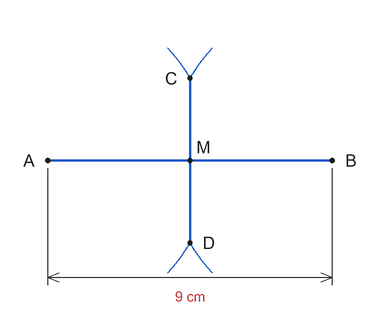
Without measuring, write the lengths CA, CB and AM and the size of . Explain each answer.
- 192 marks
Question 19
Bloom's level: Evaluate
Sanjay says, "To construct an angle of , I construct and bisect it." Neha says, "To construct , I construct and bisect it." Who is correct? Correct the wrong method.
- 202 marks
Question 20
Bloom's level: Apply
A triangle PQR has PQ = 5 cm, and . Find , and state which angles you would construct at P and Q to draw the triangle on the base PQ.
- 211 mark
Question 21
Bloom's level: Understand
Why do we prefer to construct angles such as and with a ruler and compass rather than with a protractor?
- 222 marks
Question 22
Bloom's level: Understand
Which of the following can be done with a ruler and a compass only? Give a reason for any that cannot.
copy a given angle; bisect a line segment; draw an angle of ; draw a perpendicular to a line from a point outside it.
- 233 marks
Question 23
Bloom's level: Apply
Draw XY = 6 cm. At X, construct using a ruler and a compass only. On XZ, mark W such that XW = 5 cm. Join WY and measure it. Write the steps of construction.
- 244 marks
Question 24
Bloom's level: Apply
Case study: On a map (1 cm = 200 m), a straight road is shown by a line XY, and a house H is 3 cm from the road. The family wants the shortest straight path from H to the road.
(a) Which construction gives this path?
(b) Write the steps to draw it with a ruler and a compass, and call the point where the path meets the road N.
(c) A bus stop S is on the road, 4 cm from N on the map, and HS measures 5 cm. Find the real lengths of HN and HS. How much shorter is the path HN?
- 254 marks
Question 25
Bloom's level: Apply
Construct a triangle PQR in which PQ = 6 cm, QR = 4 cm and , using a ruler and a compass only. Write the steps. Measure PR and .
- 264 marks
Question 26
Bloom's level: Analyse
Case study: Riya wants to fence a triangular flower bed using three straight pieces of fencing of lengths 4 m, 6 m and 11 m.
(a) Can she make a triangle with these pieces? Give a reason.
(b) She keeps the 4 m and 6 m pieces and replaces the 11 m piece. What whole-number lengths (in m) can the new piece have?
(c) She chooses an 8 m piece. Taking 1 cm for 1 m, construct the triangle and measure its largest angle. Where does the largest angle lie?
- 273 marks
Question 27
Bloom's level: Evaluate
Two students try to draw the perpendicular bisector of AB = 8 cm.
(a) Neha draws arcs of radius 3.5 cm from A and from B.
(b) Kabir draws an arc of radius 5 cm from A and an arc of radius 6 cm from B, and joins the two points where they cut.
Will each method work? Explain, and write the correct method.
- 285 marks
Question 28
Bloom's level: Create
Plan and construct an angle of using a ruler and a compass only. Show how is made from angles you already know how to construct, write the steps, and draw the figure.
- 294 marks
Question 29
Bloom's level: Create
Plan how to draw a square ABCD of side 4 cm using a ruler, a compass and a set-square. Then draw its diagonal AC and state, without measuring, the angle . Explain your plan.
- 303 marks
Question 30
Bloom's level: Analyse
The figure shows the construction marks left after an angle AOX was constructed at O with a ruler and a compass only.

Study the marks and answer:
(a) Which two angles are marked off by the equal steps cut on the large arc?
(b) Which angle do the first pair of crossing arcs give?
(c) What is ? Explain.
- 313 marks
Question 31
Construct a triangle ABC with AB = 6 cm, BC = 4.5 cm and AC = 5.5 cm. Write the steps of construction.
- 321 mark
Question 32
At a point on a ray , the rays and are constructed so that and . The ray is the bisector of . Then is :
- 331 mark
Question 33
Which of the following sets of data is enough to construct a unique triangle ?
- 341 mark
Question 34
A student uses the two set-squares (the -- one and the -- one), alone or together, by adding or subtracting their angles. Which of these angles cannot be drawn in this way ?
- 352 marks
Question 35
Draw a line segment cm. At the end , construct , using a ruler and a compass only. On mark a point with cm and join . Measure .
- 362 marks
Question 36
Draw a line segment cm and construct its perpendicular bisector with a ruler and a compass. Let it meet at . Take a point on the bisector with cm, join and , and measure them. What do you find ?
- 372 marks
Question 37
Using a protractor, draw . With a ruler and a compass, draw the bisector of this angle, and then the bisector of . State the measures of and .
- 382 marks
Question 38
Draw a ray . With a pair of compasses set to 3.8 cm, mark a point on with cm. Without changing the compass setting, mark a point on beyond with cm. Find , and say what the point is for the segment .
- 393 marks
Question 39
(a) Construct a triangle in which cm, cm and . Write the steps of construction.
(b) Measure , and .
(c) What kind of triangle is it, according to its angles ?
- 404 marks
Question 40
(a) Using a ruler and set-squares only, construct a triangle in which cm, and . Write the steps of construction.
(b) Measure , and .
(c) Verify that the three angles of the triangle add up to .
- 414 marks
Question 41
A triangular plot has sides 11 m, 9 m and 7 m. It is to be drawn on paper with the scale 1 cm = 2 m.
(a) Find the length of each side of the drawing.
(b) Construct the triangle on this scale and write the steps of construction.
(c) Measure the angle opposite the longest side. Is the triangle acute-angled, right-angled or obtuse-angled ?