
Opening your dashboard
Class 6 Maths Chapter 14: Fundamental Concepts (Geometry) Solutions
73 textbook questions with step-by-step answers, free to read, for ICSE 2026-27.
Get talked through Ch 14, not just shown the answer
Reading a finished solution is not the same as being able to do it. The AI tutor takes one question at a time and works it with you, in your own words, until you can.
- Ask it out loud, in your own words
- It gives you the next step, not the answer
- Stuck on part (ii)? Start there
73 questions with solutions
1–3 marks · Mixed difficulty
- 13 marks
Question 1
State true or false, if false, correct the statement :
(i) A dot has width but no length.
(ii) A ray has an infinite length only on one side of it.
(iii) A line segment PQ is written as .
(iv) represents a straight line.
(v) Three points are said to be collinear, if they lie in the same plane.
(vi) Three or more points, all lying in the same line, are called collinear points.
Solve with AIWritten solution
Solution:
Concept: A point (a dot) only marks a position: it has no length, no width and no thickness. A line goes on without end in both directions and has no end point. A ray starts at one end point and goes on without end in one direction. A line segment has two end points, so it has a definite length. Points that lie on one straight line are collinear. Exactly one straight line passes through two given points, while endlessly many lines pass through one point.
Step 1 — Part (i).
A dot shows only a position. It has no size at all: no length and no width.
So the statement is false.
Correct statement: A dot has no length and no width.
Step 2 — Part (ii).
A ray starts at its end point and goes on without end on one side only.
So the statement is true.
Step 3 — Part (iii).
The symbol with two arrow heads, , stands for the line PQ, which goes on in both directions. A line segment PQ stops at P and Q, so it is written simply as PQ (or ).
So the statement is false.
Correct statement: A line segment PQ is written as PQ (or ).
Step 4 — Part (iv).
The two arrow heads show that PQ goes on without end both ways, so is a straight line.
So the statement is true.
Step 5 — Part (v).
Any three points lie in some plane, so “in the same plane” is not enough. Collinear points must lie on the same straight line.
So the statement is false.
Correct statement: Three points are said to be collinear if they lie on the same straight line.
Step 6 — Part (vi).
This is exactly the meaning of collinear points.
So the statement is true.
Watch out: Collinear means “on one straight line”, not “in one plane”.
Therefore, (i) False; (ii) True; (iii) False; (iv) True; (v) False; (vi) True.
- 23 marks
Question 2
Write how many lines can be drawn, passing through :
(i) a given point ? (ii) two given fixed points ?
(iii) three collinear points ? (iv) three non-collinear points ?
Solve with AIWritten solution
Solution:
Concept: Points that lie on one straight line are collinear. Exactly one straight line passes through two given points, while endlessly many lines pass through one point.
Step 1 — Part (i).
Through one point we can turn a ruler in every direction and draw a line each time, so infinitely many lines pass through a given point.
Step 2 — Part (ii).
Through two fixed points the ruler can be placed in only one way, so only one line passes through them.
Step 3 — Part (iii).
Three collinear points already lie on one straight line, so only one line passes through all three.
Step 4 — Part (iv).
Three non-collinear points do not lie on one line, so no single line passes through all three of them.
Watch out: In part (iv) the question asks for lines through all three points at once.
Note: If part (iv) is read as “lines through any two of the three points”, the answer is 3 lines (AB, BC and CA for points A, B, C). The answer above reads it as lines through all three points.
Therefore, (i) infinitely many; (ii) only one; (iii) only one; (iv) none.
- 33 marks
Question 3
The shaded region of the given figure shows a plane :
(a) Name :
(i) three collinear points.
(ii) three non-collinear points.
(iii) a pair of intersecting lines.
(b) State whether true or false :
(i) Line DE is contained in the given plane P.
(ii) Lines AB and DE intersect at point C.
(iii) Points D, B and C are collinear.
(iv) Points D, B and E are collinear.
 Solve with AI
Written solution
Solution:
Concept: Points that lie on one straight line are collinear. Exactly one straight line passes through two given points, while endlessly many lines pass through one point.
Step 1 — Read the lines in the figure.
The figure shows three lines: line AC, which also passes through B; line DE, which passes through C; and a third line through A and D.
Step 2 — Part (a)(i).
A, B and C all lie on line AC, so A, B and C are collinear.
Step 3 — Part (a)(ii).
A, D and C do not lie on one line (D is not on line AC), so A, D and C are non-collinear.
Step 4 — Part (a)(iii).
Lines AC and DC meet at the point C, so AC and DC are a pair of intersecting lines.
Step 5 — Part (b)(i).
Two points of line DE (D and C) lie in the plane P, and a line through two points of a plane lies in that plane. So the statement is true.
Step 6 — Part (b)(ii).
C lies on line AB (which is line AC) and also on line DE, so they intersect at C. The statement is true.
Step 7 — Part (b)(iii).
Line DC does not pass through B, so D, B and C are not on one line. The statement is false.
Step 8 — Part (b)(iv).
B is not on line DE, so D, B and E are not collinear. The statement is false.
Watch out: Points on two different lines through C are not all collinear; check each set against one line.
Therefore, (a) (i) A, B and C; (ii) A, D and C; (iii) AC and DC. (b) (i) True; (ii) True; (iii) False; (iv) False.
- 43 marks
Question 4
Correct the statement, if it is wrong :
(i) A ray can be extended infinitely on either side.
(ii) A ray has a definite length.
(iii) A line segment has a definite length.
(iv) A line has two end points.
(v) A ray has only one end point.
Solve with AIWritten solution
Solution:
Concept: A point (a dot) only marks a position: it has no length, no width and no thickness. A line goes on without end in both directions and has no end point. A ray starts at one end point and goes on without end in one direction. A line segment has two end points, so it has a definite length.
Step 1 — Part (i).
A ray has only one end point and goes on without end in one direction, so it can be extended on one side only.
So the statement is wrong.
Correct statement: A ray can be extended infinitely on only one side of it.
Step 2 — Part (ii).
A ray never ends on one side, so it has no definite length.
So the statement is wrong.
Correct statement: A ray has an indefinite length.
Step 3 — Part (iii).
A line segment stops at its two end points, so it has a definite length that we can measure.
So the statement is correct.
Step 4 — Part (iv).
A line goes on without end in both directions, so it has no end point at all.
So the statement is wrong.
Correct statement: A line has no end point.
Step 5 — Part (v).
A ray starts at one end point and has no end on the other side.
So the statement is correct.
Watch out: Count end points: a line has none, a ray has one and a line segment has two.
Therefore, (i) wrong: a ray extends infinitely on only one side; (ii) wrong: a ray has no definite length; (iii) correct; (iv) wrong: a line has no end point; (v) correct.
- 53 marks
Question 5
State true or false, if false, give the correct statement :
(i) A line has a countable number of points in it.
(ii) Only one line can pass through a given point.
(iii) The intersection of two planes is a straight line.
Solve with AIWritten solution
Solution:
Concept: A point (a dot) only marks a position: it has no length, no width and no thickness. A line goes on without end in both directions and has no end point. A ray starts at one end point and goes on without end in one direction. A line segment has two end points, so it has a definite length. Points that lie on one straight line are collinear. Exactly one straight line passes through two given points, while endlessly many lines pass through one point.
Step 1 — Part (i).
A line is made of endlessly many points; we can never finish counting them.
So the statement is false.
Correct statement: A line has an infinite number of points in it.
Step 2 — Part (ii).
A ruler can be turned about one point into endlessly many positions, and each position gives a line.
So the statement is false.
Correct statement: An infinite number of lines can pass through a given point.
Step 3 — Part (iii).
When two different planes meet, their common part is a straight line, just as two walls of a room meet along a straight edge.
So the statement is true.
Watch out: Part (iii) is about planes that meet; two parallel planes (a floor and a ceiling) have no common line.
Therefore, (i) False: a line has an infinite number of points; (ii) False: an infinite number of lines pass through a point; (iii) True.
- 63 marks
Question 6
State whether the following pairs of lines or rays appear to be parallel or intersecting.
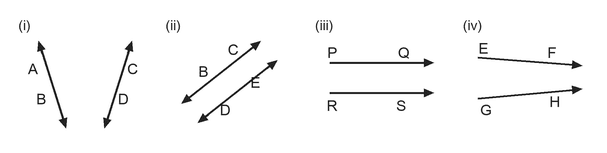
If, on extending the two lines on either side, they intersect or appear to intersect, they are intersecting lines.
Solve with AIWritten solution
Solution:
Concept: Two straight lines in the same plane that never meet, however far they are extended, are parallel. Lines that meet (or would meet when extended) are intersecting lines. Two lines that meet at a right angle (90°) are perpendicular.
Step 1 — Part (i).
The lines AB and CD come closer to each other towards the bottom, so on extending them they would meet. They are intersecting.
Step 2 — Part (ii).
The lines BC and DE keep the same gap all along their length, so they never meet. They are parallel.
Step 3 — Part (iii).
The rays PQ and RS keep the same gap all along, so they are parallel.
Step 4 — Part (iv).
The rays EF and GH come closer towards the right, so on extending them they would meet. They are intersecting.
Watch out: Lines that do not meet inside the drawing can still be intersecting; imagine extending them.
Therefore, (i) intersecting; (ii) parallel; (iii) parallel; (iv) intersecting.
- 73 marks
Question 7
Give two examples, from your surroundings, for each of the following :
(i) points (ii) line segments
(iii) plane surfaces (iv) curved surfaces.
Solve with AIWritten solution
Solution:
Concept: A point (a dot) only marks a position: it has no length, no width and no thickness. A line goes on without end in both directions and has no end point. A ray starts at one end point and goes on without end in one direction. A line segment has two end points, so it has a definite length. A plane surface is flat; a curved surface is not.
Step 1 — Part (i).
A point is a tiny mark showing a position, for example the tip of a pencil or the tip of a nail.
Step 2 — Part (ii).
A line segment is a straight path with two ends, for example a line printed on a page of a notebook or an edge of a table-top.
Step 3 — Part (iii).
A plane surface is flat, for example the top of a study table or a wall of the classroom.
Step 4 — Part (iv).
A curved surface is not flat, for example the surface of a cricket ball or of a round pen.
Note: Any other correct examples are also right.
Therefore, (i) the tip of a pencil, the tip of a nail; (ii) a line on a notebook page, the edge of a table-top; (iii) the top of a study table, a classroom wall; (iv) the surface of a cricket ball, the surface of a pen.
- 83 marks
Question 8
Under what condition will two straight lines in the same plane have :
(i) no point in common.
(ii) only one point in common.
(iii) an infinite number of points in common.
If possible, draw diagrams in support of your answer.
Solve with AIWritten solution
Solution:
Concept: Two straight lines in the same plane that never meet, however far they are extended, are parallel. Lines that meet (or would meet when extended) are intersecting lines. Two lines that meet at a right angle (90°) are perpendicular.
Step 1 — Part (i).
Two lines in one plane have no common point when they never meet, that is, when they are parallel.
Step 2 — Part (ii).
Two lines have exactly one common point when they intersect; they cross at that point.
Step 3 — Part (iii).
Two lines have infinitely many common points only when one lies exactly on the other, that is, when they coincide (they are really the same line).
Step 4 — Draw the three cases.
The diagrams show the three cases: parallel lines AB and CD, lines AB and CD crossing, and two lines lying one on top of the other (A = C, B = D).
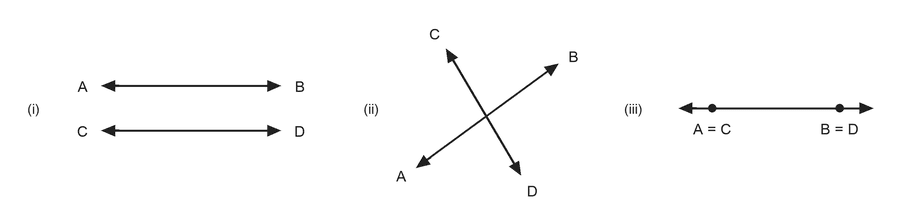
Therefore, (i) when the lines are parallel; (ii) when the lines intersect; (iii) when the lines coincide.
- 93 marks
Question 9
Mark two points A and B on a page of your exercise book. Mark a third point P such that :
(i) P lies between A and B and the three points A, P and B are collinear.
(ii) P does not lie between A and B yet the three points are collinear.
(iii) the three points do not lie in a line.
Solve with AIWritten solution
Solution:
Concept: Points that lie on one straight line are collinear. Exactly one straight line passes through two given points, while endlessly many lines pass through one point.
Step 1 — Draw the line AB.
First we draw the line through A and B, because collinear points must lie on it.
Step 2 — Part (i).
We mark P on line AB, between A and B. Then A, P and B are collinear.
Step 3 — Part (ii).
We mark P on line AB but outside the part between A and B (beyond B, or beyond A). The three points are still on one line.
Step 4 — Part (iii).
We mark P anywhere off the line AB. Now no single line passes through A, B and P.
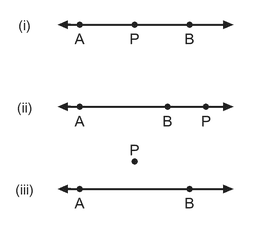
Watch out: In part (ii) P must still be ON the line AB, only outside the segment AB.
Therefore, (i) P on AB between A and B; (ii) P on line AB beyond B (or beyond A); (iii) P off the line AB.
- 103 marks
Question 10
Mark two points P and Q on a piece of paper. How many lines can you draw :
(i) passing through both the points P and Q ? (ii) passing through the point P ?
(iii) passing through the point Q ?
Solve with AIWritten solution
Solution:
Concept: Points that lie on one straight line are collinear. Exactly one straight line passes through two given points, while endlessly many lines pass through one point.
Step 1 — Part (i).
Exactly one straight line can pass through two given points, so only one line passes through P and Q.
Step 2 — Part (ii).
A line through one point can point in any direction, so infinitely many lines pass through P.
Step 3 — Part (iii).
In the same way, infinitely many lines pass through Q.
Therefore, (i) only one; (ii) infinitely many; (iii) infinitely many.
- 113 marks
Question 11
The adjoining figure shows a line AB. Draw figures to represent :
(i) ray AB, i.e. (ii) ray BA, i.e.
(iii) line segment AB.
 Solve with AI
Written solution
Solution:
Concept: A point (a dot) only marks a position: it has no length, no width and no thickness. A line goes on without end in both directions and has no end point. A ray starts at one end point and goes on without end in one direction. A line segment has two end points, so it has a definite length.
Step 1 — Part (i).
Ray AB starts at A and goes on through B without end, so we put a dot at A and an arrow head beyond B.
Step 2 — Part (ii).
Ray BA starts at B and goes on through A without end, so we put a dot at B and an arrow head beyond A.
Step 3 — Part (iii).
Line segment AB stops at A and at B, so we draw dots at both ends and no arrow heads.

Watch out: The first letter of a ray's name is its starting point: ray BA starts at B.
Therefore, (i) ray AB: arrow head beyond B only; (ii) ray BA: arrow head beyond A only; (iii) segment AB: no arrow heads.
- 123 marks
Question 12
The adjoining figure shows a ray AB. Draw figures to show :
(i) ray BA, i.e. (ii) line AB
(iii) line segment BA.
 Solve with AI
Written solution
Solution:
Concept: A point (a dot) only marks a position: it has no length, no width and no thickness. A line goes on without end in both directions and has no end point. A ray starts at one end point and goes on without end in one direction. A line segment has two end points, so it has a definite length.
Step 1 — Part (i).
Ray BA starts at B and goes on through A, so the arrow head is beyond A only.
Step 2 — Part (ii).
Line AB goes on without end both ways, so it has arrow heads at both ends.
Step 3 — Part (iii).
Line segment BA stops at B and at A, so it has no arrow heads.
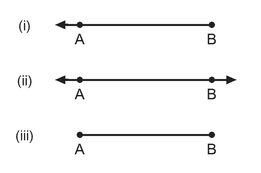
Therefore, (i) ray BA: arrow head beyond A only; (ii) line AB: arrow heads at both ends; (iii) segment BA: no arrow heads.
- 133 marks
Question 13
The adjoining figure shows a line segment AB. Draw figures to represent :
(i) ray AB, i.e. (ii) line AB, i.e.
(iii) ray BA.
 Solve with AI
Written solution
Solution:
Concept: A point (a dot) only marks a position: it has no length, no width and no thickness. A line goes on without end in both directions and has no end point. A ray starts at one end point and goes on without end in one direction. A line segment has two end points, so it has a definite length.
Step 1 — Part (i).
Ray AB starts at A and goes on through B, so we extend the segment beyond B with an arrow head.
Step 2 — Part (ii).
Line AB goes on without end both ways, so we extend it beyond both A and B, with arrow heads at both ends.
Step 3 — Part (iii).
Ray BA starts at B and goes on through A, so we extend the segment beyond A only.
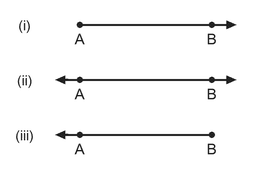
Therefore, (i) ray AB: extended beyond B; (ii) line AB: extended beyond both ends; (iii) ray BA: extended beyond A.
- 143 marks
Question 14
Use a ruler and find whether the points in the given figure are collinear or not :
(i) D, A and C (ii) A, B and C
(iii) A, B and E (iv) B, C and E
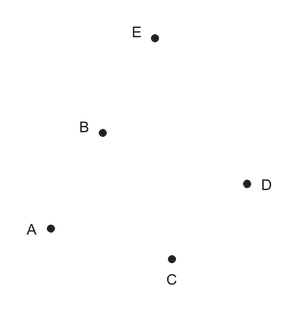 Solve with AI
Written solution
Solution:
Concept: Points that lie on one straight line are collinear. Exactly one straight line passes through two given points, while endlessly many lines pass through one point.
Step 1 — Method.
For each set we place the ruler's edge through two of the points and see whether the third point also touches the edge.
Step 2 — Part (i).
The edge through A and C does not pass through D, so D, A and C are not collinear.
Step 3 — Part (ii).
The edge through A and B misses C, so A, B and C are not collinear.
Step 4 — Part (iii).
The edge through A and B also passes through E, so A, B and E are collinear.
Step 5 — Part (iv).
The edge through B and E misses C, so B, C and E are not collinear.
Therefore, (i) no; (ii) no; (iii) yes; (iv) no.
- 153 marks
Question 15
From the adjoining figure, write :
(i) all pairs of parallel lines.
(ii) all the lines which intersect EF.
(iii) lines whose point of intersection is G.
 Solve with AI
Written solution
Solution:
Concept: Two straight lines in the same plane that never meet, however far they are extended, are parallel. Lines that meet (or would meet when extended) are intersecting lines. Two lines that meet at a right angle (90°) are perpendicular.
Step 1 — Read the figure.
The arrow marks on EF, GH and IJ show that these three lines are parallel. Line AB cuts them at E, G and I, and line CD cuts them at F, H and J.
Step 2 — Part (i).
Any two of the three marked lines form a parallel pair: EF ∥ GH, EF ∥ IJ and GH ∥ IJ.
Step 3 — Part (ii).
Line EF is crossed by AB (at E) and by CD (at F), so the lines that intersect EF are AB and CD.
Step 4 — Part (iii).
The point G lies on line AB and on line GH, so G is the point of intersection of AB and GH.
Watch out: Lines AB and CD are not parallel: they slope towards each other.
Therefore, (i) EF ∥ GH, EF ∥ IJ and GH ∥ IJ; (ii) AB and CD; (iii) AB and GH.
- 163 marks
Question 16
State which of the following is a plane closed figure :
 Solve with AI
Written solution
Solution:
Concept: A plane closed figure is fully enclosed (bounded) by its curves or line segments, and its curves or segments do not cross each other. A figure with a gap is open.
Step 1 — Check each figure.
We look for a gap in the boundary and for parts of the boundary that cross each other.
Step 2 — Figures (i), (iii), (iv), (vi), (viii).
Each of these is fully enclosed and its boundary does not cross itself, so each is a plane closed figure.
Step 3 — Figures (ii) and (vii).
Each has a gap in its boundary, so it is an open figure.
Step 4 — Figure (v).
Its line segments cross each other inside the figure, so it is not a plane closed figure.
Watch out: A figure whose segments cross each other is not a plane closed figure, even if it has no gap.
Therefore, the plane closed figures are (i), (iii), (iv), (vi) and (viii).
- 173 marks
Question 17
State which of the lines/line-segments are perpendicular to the line PQ :
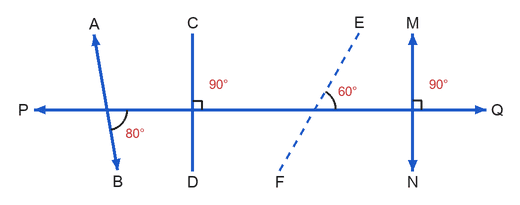 Solve with AI
Written solution
Solution:
Concept: Two straight lines in the same plane that never meet, however far they are extended, are parallel. Lines that meet (or would meet when extended) are intersecting lines. Two lines that meet at a right angle (90°) are perpendicular.
Step 1 — Read the angle of each line with PQ.
A line is perpendicular to PQ only if it meets PQ at 90°.
Step 2 — Lines AB and EF.
AB meets PQ at 80° and EF meets PQ at 60°, so neither is perpendicular to PQ.
Step 3 — Lines CD and MN.
CD and MN each meet PQ at 90° (marked with a small square), so both are perpendicular to PQ.
Watch out: A line that only looks nearly upright (like AB at 80°) is not perpendicular.
Therefore, the lines perpendicular to PQ are CD and MN.
- 183 marks
Question 18
Which of the following figures shows two mutually perpendicular lines :
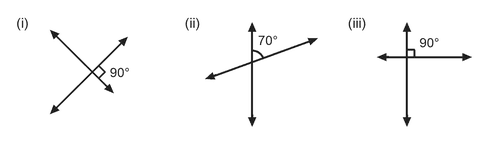 Solve with AI
Written solution
Solution:
Concept: Two straight lines in the same plane that never meet, however far they are extended, are parallel. Lines that meet (or would meet when extended) are intersecting lines. Two lines that meet at a right angle (90°) are perpendicular.
Step 1 — Figure (i).
The two lines meet at 90°, so they are mutually perpendicular.
Step 2 — Figure (ii).
The lines meet at 70°, not 90°, so they are not perpendicular.
Step 3 — Figure (iii).
The lines meet at 90°, so they are mutually perpendicular.
Therefore, figures (i) and (iii) show mutually perpendicular lines.
- 193 marks
Question 19
For each figure given below name the line segment that is perpendicular bisector of the other :
(i)

(ii)

(iii)

(iv)

(v)
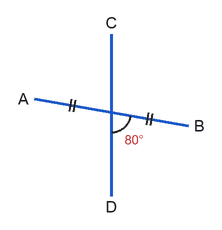 Solve with AI
Written solution
Solution:
Concept: The perpendicular bisector of a line segment passes through its mid-point (cutting it into two equal parts, shown by equal tick marks) and is perpendicular to it (meets it at 90°).
Step 1 — Part (i).
AB meets CD at P at 90°, and the tick marks show CP = PD. So AB is the perpendicular bisector of CD.
Step 2 — Part (ii).
AB meets MN at P at 90°, and the double ticks show MP = PN. So AB is the perpendicular bisector of MN.
Step 3 — Part (iii).
PQ and RS meet at O at 90°. The single ticks show PO = OQ and the double ticks show RO = OS. So each segment is the perpendicular bisector of the other: PQ of RS and RS of PQ.
Step 4 — Part (iv).
AB and CD meet at 90°, but no equal parts are marked on either segment (and AP is longer than PB). So neither is the perpendicular bisector of the other: none.
Step 5 — Part (v).
The double ticks show that CD cuts AB into equal parts, but the angle between them is 80°, not 90°. So there is none.
Watch out: Both conditions are needed: a right angle alone, or equal parts alone, is not enough.
Therefore, (i) AB of CD; (ii) AB of MN; (iii) PQ of RS and RS of PQ; (iv) none; (v) none.
- 203 marks
Question 20
Name three objects from your surroundings that contain perpendicular edges.
Solve with AIWritten solution
Solution:
Concept: Two lines (or edges) are perpendicular when they meet at a right angle (90°).
Step 1 — Look for square corners.
Perpendicular edges meet at a right angle, like the corner of a book. Such corners are everywhere around us.
Step 2 — Name three objects.
Three examples are the classroom (a wall and the floor meet at a right angle), a textbook and a notebook (the edges at each corner).
Note: Any other objects with square corners, such as a door or a blackboard, are also right.
Therefore, three such objects are the classroom (wall and floor), a textbook and a notebook.
- 213 marks
Question 21
Place a scale (ruler) on a sheet of paper and hold it firmly with one hand. Now draw two line segments AB and CD along the longer edges of the scale. State whether segment AB is parallel to or perpendicular to segment CD.
Solve with AIWritten solution
Solution:
Concept: Two straight lines in the same plane that never meet, however far they are extended, are parallel. Lines that meet (or would meet when extended) are intersecting lines. Two lines that meet at a right angle (90°) are perpendicular.
Step 1 — Compare the two edges.
The two long edges of a scale are the same distance apart along their whole length, so the segments drawn along them never meet.
Therefore, segment AB is parallel to segment CD.
- 223 marks
Question 22
Check your textbook :
(i) How many pairs of its edges are parallel to each other ?
(ii) How many pairs of its edges are perpendicular to each other ?
Solve with AIWritten solution
Solution:
Concept: Edges that run the same way are parallel; edges that meet at a square corner are perpendicular.
Step 1 — Describe the edges.
A textbook has the shape of a cuboid. It has 12 edges: 4 along its length, 4 along its breadth and 4 along its thickness (height). At each of its 8 corners three edges meet, one of each kind.
Step 2 — Part (i).
Any two of the 4 edges that run the same way are parallel. The first edge pairs with the 3 others, the second with 2 new ones and the third with 1 more, and this happens in each of the 3 directions.
Step 3 — Part (ii).
At each corner the three edges are perpendicular to each other, which gives 3 pairs at each corner.
Watch out: Do not count the same pair twice: the pair (edge 1, edge 2) is the same as (edge 2, edge 1).
Note: Part (ii) counts pairs of edges that meet at a corner. Edges in perpendicular directions that do not meet are not counted here.
Therefore, (i) 18 pairs; (ii) 24 pairs (three at each corner).
- 233 marks
Question 23
Give two examples from your surroundings for each of the following :
(i) intersecting lines (ii) parallel lines (iii) perpendicular lines.
Solve with AIWritten solution
Solution:
Concept: Two straight lines in the same plane that never meet, however far they are extended, are parallel. Lines that meet (or would meet when extended) are intersecting lines. Two lines that meet at a right angle (90°) are perpendicular.
Step 1 — Part (i).
Lines that cross each other are intersecting: for example the edges of a book that meet at one corner, or the two hands of a clock.
Step 2 — Part (ii).
Lines that never meet are parallel: for example the opposite edges of a book, or the two rails of a railway line.
Step 3 — Part (iii).
Lines that meet at a right angle are perpendicular: for example the adjacent edges at a corner of a book, or the edges at a corner of a door.
Note: Any other correct examples are also right.
Therefore, (i) edges of a book through one corner; (ii) opposite edges of a book; (iii) adjacent edges at a corner of a book.
- 243 marks
Question 24
State true or false, if false, give the correct statement :
(i) The maximum number of lines passing through three collinear points is three.
(ii) The maximum number of lines passing through three non-collinear points is three.
(iii) Two parallel lines always lie in the same plane.
(iv) Concurrent lines always meet at the same point.
(v) A surface can be plane or curved.
(vi) There are infinite number of points in a line segment of length 10 cm.
(vii) There are infinite number of points in a line.
(viii) A plane has infinite number of lines.
(ix) A plane has infinite number of points.
Solve with AIWritten solution
Solution:
Concept: A point (a dot) only marks a position: it has no length, no width and no thickness. A line goes on without end in both directions and has no end point. A ray starts at one end point and goes on without end in one direction. A line segment has two end points, so it has a definite length. Points that lie on one straight line are collinear. Exactly one straight line passes through two given points, while endlessly many lines pass through one point.
Step 1 — Part (i).
Three collinear points lie on one straight line, and that is the only line through all three of them.
So the statement is false.
Correct statement: Only one line passes through three collinear points.
Step 2 — Part (ii).
Three non-collinear points are not on one line, so no line passes through all three of them.
So the statement is false.
Correct statement: No line passes through all the three non-collinear points.
Step 3 — Part (iii).
Parallel lines are defined as lines in the same plane that never meet.
So the statement is true.
Step 4 — Part (iv).
Concurrent lines are three or more lines that all pass through one common point.
So the statement is true.
Step 5 — Part (v).
A surface is either flat (plane), like a table-top, or curved, like a ball.
So the statement is true.
Step 6 — Part (vi).
Even a short segment is made of endlessly many points.
So the statement is true.
Step 7 — Part (vii).
A line goes on without end and is made of endlessly many points.
So the statement is true.
Step 8 — Part (viii).
Through the points of a plane we can draw endlessly many lines that lie in it.
So the statement is true.
Step 9 — Part (ix).
A plane goes on without end in all its directions and has endlessly many points.
So the statement is true.
Watch out: A segment of 10 cm has a definite length, but still an infinite number of points.
Note: Part (ii) is read as “lines passing through all three points”. If it means lines through any two of the three points, there are exactly three such lines and the statement would be true.
Therefore, (i) False; (ii) False; (iii) True; (iv) True; (v) True; (vi) True; (vii) True; (viii) True; (ix) True.
- 253 marks
Question 25
For each angle given below, write the name of the vertex, the names of the arms and the name of the angle.
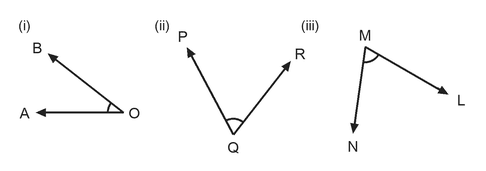 Solve with AI
Written solution
Solution:
Concept: An angle is formed by two rays (its arms) starting from the same point (its vertex). In the name of an angle the vertex letter is always written in the middle, e.g. ∠AOB has vertex O.
Step 1 — Part (i).
The two rays start from O, so the vertex is O. The arms are the rays OA and OB, and the angle is ∠AOB (or ∠BOA, or simply ∠O).
Step 2 — Part (ii).
The rays start from Q, so the vertex is Q. The arms are QP and QR, and the angle is ∠PQR (or ∠RQP, or ∠Q).
Step 3 — Part (iii).
The rays start from M, so the vertex is M. The arms are MN and ML, and the angle is ∠NML (or ∠LMN, or ∠M).
Watch out: The vertex letter always goes in the middle: ∠PQR, never ∠PRQ.
Therefore, (i) vertex O, arms OA and OB, ∠AOB; (ii) vertex Q, arms QP and QR, ∠PQR; (iii) vertex M, arms MN and ML, ∠NML.
- 263 marks
Question 26
Name the points :
(i) in the interior of the angle PQR.
(ii) in the exterior of the angle PQR.
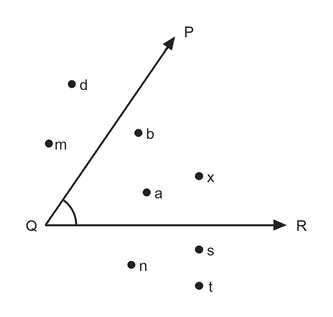 Solve with AI
Written solution
Solution:
Concept: An angle is formed by two rays (its arms) starting from the same point (its vertex). In the name of an angle the vertex letter is always written in the middle, e.g. ∠AOB has vertex O. The interior of an angle is the region between its arms; the exterior is the region outside it.
Step 1 — Find the interior.
The interior of ∠PQR is the region between its two arms QP and QR (on the side of the smaller opening).
Step 2 — Part (i).
The points a, b and x lie between the arms QP and QR, so they are in the interior.
Step 3 — Part (ii).
The points d and m lie above the arm QP, and n, s and t lie below the arm QR, so all five are in the exterior.
Watch out: A point close to an arm can still be outside it; check on which side of the arm it lies.
Therefore, (i) a, b and x; (ii) d, m, n, s and t.
- 273 marks
Question 27
In the adjoining figure, find out the number of angles formed within the arms OA and OE.
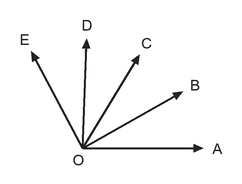 Solve with AI
Written solution
Solution:
Concept: An angle is formed by two rays (its arms) starting from the same point (its vertex). In the name of an angle the vertex letter is always written in the middle, e.g. ∠AOB has vertex O.
Step 1 — Count the angles with arm OA.
There are 5 rays: OA, OB, OC, OD and OE. Any two of them form an angle. With OA as one arm we get ∠AOB, ∠AOC, ∠AOD and ∠AOE: 4 angles.
Step 2 — Count the new angles with arm OB.
With OB as one arm (leaving out ∠AOB, already counted) we get ∠BOC, ∠BOD and ∠BOE: 3 angles.
Step 3 — Count the rest.
In the same way OC gives ∠COD and ∠COE (2 angles), and OD gives ∠DOE (1 angle).
Step 4 — Add the counts.
We add the numbers of angles found in each step.
Watch out: Count each angle once; ∠AOB and ∠BOA are the same angle.
Therefore, 10 angles are formed: ∠AOB, ∠AOC, ∠AOD, ∠AOE, ∠BOC, ∠BOD, ∠BOE, ∠COD, ∠COE and ∠DOE.
- 283 marks
Question 28
Add :
(i) 29° 16′ 23″ and 8° 27′ 12″ (ii) 9° 45′ 56″ and 73° 8′ 15″
(iii) 56° 38′ and 27° 42′ 30″ (iv) 47° and 61° 17′ 4″
Solve with AIWritten solution
Solution:
Concept: Angles are measured in degrees (°), minutes (′) and seconds (″), where 1° = 60′ and 1′ = 60″. To add, we add each unit separately, starting with seconds, and carry whenever a column reaches 60.
Step 1 — Part (i).
We add seconds to seconds, minutes to minutes and degrees to degrees, carrying 60″ as 1′ and 60′ as 1°.
Step 2 — Part (ii).
We add the seconds, then the minutes, then the degrees, in the same way as in part (i).
Since 60″ = 1′, the 71″ is 1′ 11″; we keep 11″ and carry 1′.
Step 3 — Part (iii).
We add the seconds, then the minutes, then the degrees, in the same way as in part (i).
Since 60′ = 1°, the 80′ is 1° 20′; we keep 20′ and carry 1°.
Step 4 — Part (iv).
We add the seconds, then the minutes, then the degrees, in the same way as in part (i).
Watch out: Carry at 60, not at 100: 71″ is 1′ 11″, not 71 seconds left as it is.
Note: In part (iii) 56° 38′ has 0″, and in part (iv) 47° has 0′ and 0″.
Therefore, (i) 37° 43′ 35″; (ii) 82° 54′ 11″; (iii) 84° 20′ 30″; (iv) 108° 17′ 4″.
- 293 marks
Question 29
In the figure given alongside, name :
(i) three pairs of adjacent angles.
(ii) two acute angles.
(iii) two obtuse angles.
(iv) two reflex angles.
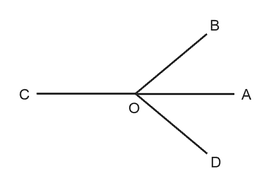 Solve with AI
Written solution
Solution:
Concept: An angle is formed by two rays (its arms) starting from the same point (its vertex). In the name of an angle the vertex letter is always written in the middle, e.g. ∠AOB has vertex O. An acute angle is less than 90°, a right angle is 90°, an obtuse angle is between 90° and 180°, a straight angle is 180° and a reflex angle is between 180° and 360°. A reflex angle = 360° − the angle on the other side. Adjacent angles have a common vertex and a common arm, and lie on opposite sides of that arm.
Step 1 — Read the figure.
Rays OA, OB, OC and OD start from O. ∠AOB and ∠AOD are small (less than 90°), while ∠BOC and ∠COD are larger than 90° but less than 180°.
Step 2 — Part (i).
Adjacent angles share the vertex and one arm and lie on opposite sides of it. Three such pairs are ∠AOB and ∠BOC (common arm OB), ∠BOC and ∠COD (common arm OC), and ∠COD and ∠DOA (common arm OD).
Step 3 — Part (ii).
The angles ∠AOB and ∠AOD are each less than 90°, so they are acute.
Step 4 — Part (iii).
The angles ∠BOC and ∠COD are each between 90° and 180°, so they are obtuse.
Step 5 — Part (iv).
The angle on the outside of an acute or obtuse angle is more than 180°. So reflex ∠AOB and reflex ∠COD are two reflex angles.
Note: Other correct answers are possible, e.g. reflex ∠BOC in part (iv).
Therefore, (i) ∠AOB and ∠BOC, ∠BOC and ∠COD, ∠COD and ∠DOA; (ii) ∠AOB and ∠AOD; (iii) ∠BOC and ∠COD; (iv) reflex ∠AOB and reflex ∠COD.
- 303 marks
Question 30
In the given figure :
PQR is a straight line. If :
(i) ∠SQR = 75°; find ∠PQS.
(ii) ∠PQS = 110°; find ∠RQS.
 Solve with AI
Written solution
Solution:
Concept: Angles on one side of a straight line, at one point of it, add up to 180° (a straight angle).
Given: PQR is a straight line.
Step 1 — Part (i).
The angles ∠PQS and ∠SQR lie on the straight line PQR at Q, so they add up to 180°.
Step 2 — Part (ii).
In the same way ∠PQS and ∠RQS add up to 180°.
Watch out: Subtract from 180°, not from 90°: the two angles make a straight angle.
Therefore, (i) ∠PQS = 105°; (ii) ∠RQS = 70°.
- 313 marks
Question 31
In the given figure, AOC is a straight line. If angle AOB = 50°, angle AOE = 90° and angle COD = 25°, find the measure of :
(i) angle BOC (ii) angle EOD
(iii) obtuse angle BOD (iv) reflex angle BOD
(v) reflex angle COE.
 Solve with AI
Written solution
Solution:
Concept: Angles on one side of a straight line, at one point of it, add up to 180° (a straight angle). The angles around a point add up to 360° (one complete turn). An acute angle is less than 90°, a right angle is 90°, an obtuse angle is between 90° and 180°, a straight angle is 180° and a reflex angle is between 180° and 360°. A reflex angle = 360° − the angle on the other side.
Given: AOC is a straight line, ∠AOB = 50°, ∠AOE = 90° and ∠COD = 25°.
Step 1 — Part (i).
The angles ∠AOB and ∠BOC lie on the straight line AOC, so they add up to 180°.
Step 2 — Find ∠EOC.
The angles ∠AOE and ∠EOC also lie on the straight line AOC.
Step 3 — Part (ii).
OD lies inside ∠EOC, so ∠EOD is what is left of ∠EOC after ∠COD.
Step 4 — Part (iii).
The obtuse ∠BOD is made of ∠BOC and ∠COD together.
Step 5 — Part (iv).
Reflex ∠BOD is the rest of the full turn of 360° around O.
Step 6 — Part (v).
The angle ∠COE is 90° (Step 2), so reflex ∠COE is the rest of 360°.
Watch out: For a reflex angle subtract the ordinary angle from 360°, not from 180°.
Therefore, (i) ∠BOC = 130°; (ii) ∠EOD = 65°; (iii) obtuse ∠BOD = 155°; (iv) reflex ∠BOD = 205°; (v) reflex ∠COE = 270°.
- 323 marks
Question 32
In the given figure, if :
(i) a = 130°, find b.
(ii) b = 200°, find a.
(iii) a = right angle, find b.
 Solve with AI
Written solution
Solution:
Concept: The angles around a point add up to 360° (one complete turn).
Step 1 — Part (i).
Angles a and b together go once round the point, so they add up to 360°.
Step 2 — Part (ii).
In the same way, a is the rest of 360° after b.
Step 3 — Part (iii).
First we change of a right angle into degrees, since one right angle is 90°.
Then b is the rest of 360°.
Watch out: Here a and b make a full turn (360°), not a straight line (180°).
Therefore, (i) b = 230°; (ii) a = 160°; (iii) b = 210°.
- 333 marks
Question 33
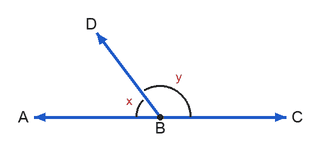
In the figure given alongside, ABC is a straight line.
(i) If x = 53°, find y.
(ii) If y = right angles, find x.
 Solve with AI
Written solution
Solution:
Concept: Angles on one side of a straight line, at one point of it, add up to 180° (a straight angle).
Given: ABC is a straight line.
Step 1 — Part (i).
Angles x and y lie on the straight line ABC at B, so they add up to 180°.
Step 2 — Part (ii).
First we change right angles into degrees (one right angle is 90°).
Then x is the rest of 180°.
Therefore, (i) y = 127°; (ii) x = 45°.
- 343 marks
Question 34
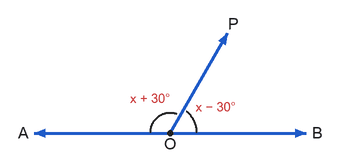
In the figure given alongside, AOB is a straight line. Find the value of x and also answer each of the following :
(i) ∠AOP = ..................
(ii) ∠BOP = ..................
(iii) which angle is obtuse ?
(iv) which angle is acute ?
 Solve with AI
Written solution
Solution:
Concept: Angles on one side of a straight line, at one point of it, add up to 180° (a straight angle). An acute angle is less than 90°, a right angle is 90°, an obtuse angle is between 90° and 180°, a straight angle is 180° and a reflex angle is between 180° and 360°. A reflex angle = 360° − the angle on the other side.
Given: AOB is a straight line.
Step 1 — Form the equation.
The angles ∠AOP and ∠BOP lie on the straight line AOB at O, so their sum is 180°.
Step 2 — Part (i).
We put x = 90° in ∠AOP.
Step 3 — Part (ii).
We put x = 90° in ∠BOP.
Step 4 — Parts (iii) and (iv).
Here ∠AOP = 120° is between 90° and 180°, so it is obtuse. ∠BOP = 60° is less than 90°, so it is acute.
Watch out: The +30° and −30° cancel when the two angles are added, so 2x = 180°.
Therefore, x = 90°; (i) ∠AOP = 120°; (ii) ∠BOP = 60°; (iii) ∠AOP is obtuse; (iv) ∠BOP is acute.
- 353 marks
Question 35
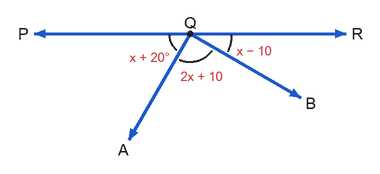
In the figure given alongside, PQR is a straight line. Find x. Then complete the following:
(i) ∠AQB = ..................
(ii) ∠BQP = ..................
(iii) ∠AQR = ..................
 Solve with AI
Written solution
Solution:
Concept: Angles on one side of a straight line, at one point of it, add up to 180° (a straight angle).
Given: PQR is a straight line.
Step 1 — Form the equation.
The three angles ∠PQA = x + 20°, ∠AQB = 2x + 10° and ∠BQR = x − 10° lie on the straight line PQR at Q, so they add up to 180°.
Step 2 — Find each angle.
We put x = 40 in the three expressions.
Step 3 — Part (i).
From Step 2, ∠AQB = 90°.
Step 4 — Part (ii).
The angle ∠BQP is made of ∠BQA and ∠AQP together.
Step 5 — Part (iii).
The angle ∠AQR is made of ∠AQB and ∠BQR together.
Watch out: Add all three angles at Q; leaving one out gives a wrong value of x.
Therefore, x = 40°; (i) ∠AQB = 90°; (ii) ∠BQP = 150°; (iii) ∠AQR = 120°.
- 363 marks
Question 36
In the figure given alongside, lines AB and CD intersect at point O.
(i) Find the value of ∠a.
(ii) Name all the pairs of vertically opposite angles.
(iii) Name all the pairs of adjacent angles.
(iv) Name all the reflex angles formed and write the measure of each.
 Solve with AI
Written solution
Solution:
Concept: Angles on one side of a straight line, at one point of it, add up to 180° (a straight angle). When two straight lines cross, the vertically opposite angles are equal. An acute angle is less than 90°, a right angle is 90°, an obtuse angle is between 90° and 180°, a straight angle is 180° and a reflex angle is between 180° and 360°. A reflex angle = 360° − the angle on the other side.
Given: Lines AB and CD intersect at O and ∠AOC = 68°.
Step 1 — Part (i).
The angles ∠a (= ∠BOC) and ∠AOC = 68° lie on the straight line AB at O, so they add up to 180°.
Step 2 — Part (ii).
Vertically opposite angles face each other across O: ∠AOC and ∠BOD, and ∠AOD and ∠BOC.
Step 3 — Part (iii).
Neighbouring angles share an arm: ∠AOC and ∠BOC, ∠BOC and ∠BOD, ∠BOD and ∠DOA, and ∠DOA and ∠AOC.
Step 4 — Find the four angles.
Vertically opposite angles are equal. ∠BOD is opposite ∠AOC, so ∠BOD = 68°; ∠AOD is opposite ∠BOC, so ∠AOD = 112°.
Step 5 — Part (iv).
Each angle has a reflex angle on its outside, equal to 360° minus the angle.
In the same way reflex ∠AOD = 248° and reflex ∠BOD = 292°.
Watch out: Vertically opposite angles are the ones facing each other, not the ones side by side.
Therefore, (i) ∠a = 112°; (ii) ∠AOC and ∠BOD, ∠AOD and ∠BOC; (iii) ∠AOC and ∠BOC, ∠BOC and ∠BOD, ∠BOD and ∠DOA, ∠DOA and ∠AOC; (iv) reflex ∠BOC = 248°, reflex ∠AOC = 292°, reflex ∠AOD = 248°, reflex ∠BOD = 292°.
- 373 marks
Question 37
In the figure given alongside :
(i) if ∠AOB = 45°, ∠BOC = 30° and ∠AOD = 110°; find angles COD and BOD.
(ii) if ∠BOC = ∠DOC = 34° and ∠AOD = 120°; find angle AOB and angle AOC.
(iii) if ∠AOB = ∠BOC = ∠COD = 38°;
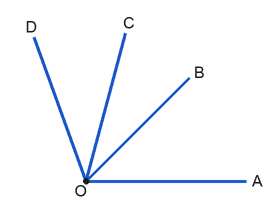 Solve with AI
Written solution
Solution:
Concept: When rays OB and OC lie inside ∠AOD, the angles between neighbouring rays add up to the whole angle: ∠AOD = ∠AOB + ∠BOC + ∠COD. An acute angle is less than 90°, a right angle is 90°, an obtuse angle is between 90° and 180°, a straight angle is 180° and a reflex angle is between 180° and 360°. A reflex angle = 360° − the angle on the other side.
Step 1 — Part (i): find ∠COD.
The angle ∠AOD is made of ∠AOB, ∠BOC and ∠COD, so ∠COD is what is left after the other two.
Step 2 — Part (i): find ∠BOD.
The angle ∠BOD is ∠AOD without ∠AOB.
Step 3 — Part (ii): find ∠AOB.
Now ∠AOD = 120° is made of ∠AOB, ∠BOC = 34° and ∠COD = 34°.
Step 4 — Part (ii): find ∠AOC.
The angle ∠AOC is ∠AOD without ∠COD.
Step 5 — Part (iii): find ∠AOC and ∠AOD.
Each of the three angles is 38°.
Step 6 — Part (iii): find the reflex angles.
A reflex angle is 360° minus the ordinary angle.
Watch out: ∠BOD includes both ∠BOC and ∠COD.
Note: Part (iii) is printed without saying what to find; the working above finds reflex ∠AOC and reflex ∠AOD, the two angles usually asked for here.
Therefore, (i) ∠COD = 35° and ∠BOD = 65°; (ii) ∠AOB = 52° and ∠AOC = 86°; (iii) reflex ∠AOC = 284° and reflex ∠AOD = 246°.
- 383 marks
Question 38
Write the complement angle of :
(i) 45° (ii) x° (iii) (iv)
Solve with AIWritten solution
Solution:
Concept: Two angles are complementary if their sum is 90°; each is the complement of the other, so complement = 90° − the angle.
Step 1 — Part (i).
We subtract the angle from 90°.
Step 2 — Part (ii).
We subtract x° from 90°; the answer stays in terms of x.
Step 3 — Part (iii).
We subtract the whole angle (x − 10)° from 90°, so the bracket is opened with a change of sign.
Step 4 — Part (iv).
We subtract the whole angle (20 + y)° from 90°.
Watch out: Subtract the whole angle in a bracket: 90 − (x − 10) is 100 − x, not 80 − x.
Therefore, (i) 45°; (ii) (90 − x)°; (iii) (100 − x)°; (iv) (70 − y)°.
- 393 marks
Question 39
Write the supplement angle of :
(i) 49° (ii) 111° (iii) (iv)
Solve with AIWritten solution
Solution:
Concept: Two angles are supplementary if their sum is 180°; each is the supplement of the other, so supplement = 180° − the angle.
Step 1 — Part (i).
We subtract the angle from 180°.
Step 2 — Part (ii).
We subtract the angle from 180°.
Step 3 — Part (iii).
We subtract the whole angle (x − 30)° from 180°.
Step 4 — Part (iv).
We subtract the whole angle (20 + y)° from 180°.
Watch out: 180 − (x − 30) is 210 − x: the minus sign in front of the bracket turns −30 into +30.
Therefore, (i) 131°; (ii) 69°; (iii) (210 − x)°; (iv) (160 − y)°.
- 403 marks
Question 40
Find the complement angle of :
(i) of 60° (ii) of 160° (iii) of 70° (iv) of 90°
Solve with AIWritten solution
Solution:
Concept: Two angles are complementary if their sum is 90°; each is the complement of the other, so complement = 90° − the angle.
Step 1 — Part (i).
First we find the angle, then we subtract it from 90°.
Step 2 — Part (ii).
First we find the angle, then we subtract it from 90°.
Step 3 — Part (iii).
First we find the angle, then we subtract it from 90°.
Step 4 — Part (iv).
First we find the angle, then we subtract it from 90°.
Watch out: Find the complement of the angle you worked out, not of the angle in the question (60°, 160°, …).
Therefore, (i) 60°; (ii) 58°; (iii) 62°; (iv) 75°.
- 413 marks
Question 41
Find the supplement angle of :
(i) 50% of 120° (ii) of 150° (iii) 60% of 100° (iv) of 160°
Solve with AIWritten solution
Solution:
Concept: Two angles are supplementary if their sum is 180°; each is the supplement of the other, so supplement = 180° − the angle.
Step 1 — Part (i).
First we find the angle (a per cent is a fraction out of 100), then we subtract it from 180°.
Step 2 — Part (ii).
First we find the angle (a per cent is a fraction out of 100), then we subtract it from 180°.
Step 3 — Part (iii).
First we find the angle (a per cent is a fraction out of 100), then we subtract it from 180°.
Step 4 — Part (iv).
First we find the angle (a per cent is a fraction out of 100), then we subtract it from 180°.
Watch out: 50% of 120° means one half of 120°.
Therefore, (i) 120°; (ii) 130°; (iii) 120°; (iv) 60°.
- 423 marks
Question 42
Find the angle : (i) that is equal to its complement ?
(ii) that is equal to its supplement ?
Solve with AIWritten solution
Solution:
Concept: Two angles are complementary if their sum is 90°; each is the complement of the other, so complement = 90° − the angle. Two angles are supplementary if their sum is 180°; each is the supplement of the other, so supplement = 180° − the angle.
Step 1 — Part (i).
Let the angle be x. It equals its complement, so the two equal angles add up to 90°.
Step 2 — Part (ii).
Let the angle be x. It equals its supplement, so the two equal angles add up to 180°.
Therefore, (i) 45°; (ii) 90°.
- 433 marks
Question 43
Two complementary angles are in the ratio 7 : 8. Find the angles.
Solve with AIWritten solution
Solution:
Concept: Two angles are complementary if their sum is 90°; each is the complement of the other, so complement = 90° − the angle.
Step 1 — Write the angles.
In the ratio 7 : 8 we take the angles as 7k and 8k, where k is a common multiplier.
Step 2 — Use the sum.
Complementary angles add up to 90°.
Step 3 — Find the angles.
We multiply each ratio number by k = 6°.
Step 4 — Check.
The two angles should add up to 90°.
Watch out: The multiplier k is not the answer; multiply it by 7 and 8.
Therefore, the angles are 42° and 48°.
- 443 marks
Question 44
Two supplementary angles are in the ratio 7 : 11. Find the angles.
Solve with AIWritten solution
Solution:
Concept: Two angles are supplementary if their sum is 180°; each is the supplement of the other, so supplement = 180° − the angle.
Step 1 — Write the angles.
In the ratio 7 : 11 we take the angles as 7k and 11k.
Step 2 — Use the sum.
Supplementary angles add up to 180°.
Step 3 — Find the angles.
We multiply each ratio number by k = 10°.
Therefore, the angles are 70° and 110°.
- 453 marks
Question 45
The measures of two complementary angles are and . Find x.
Solve with AIWritten solution
Solution:
Concept: Two angles are complementary if their sum is 90°; each is the complement of the other, so complement = 90° − the angle.
Step 1 — Form the equation.
The two angles are complementary, so their measures add up to 90.
Step 2 — Check.
With x = 31 the angles are 55° and 35°, and they add up to 90°.
Therefore, x = 31.
- 463 marks
Question 46
The measures of two supplementary angles are and . Find x.
Solve with AIWritten solution
Solution:
Concept: Two angles are supplementary if their sum is 180°; each is the supplement of the other, so supplement = 180° − the angle.
Step 1 — Form the equation.
The two angles are supplementary, so their measures add up to 180.
Step 2 — Check.
With x = 32 the angles are 111° and 69°, and they add up to 180°.
Therefore, x = 32.
- 473 marks
Question 47
For an angle x°, find :
(i) the complementary angle
(ii) the supplementary angle.
(iii) the value of x° if its supplementary angle is three times its complementary angle.
Solve with AIWritten solution
Solution:
Concept: Two angles are complementary if their sum is 90°; each is the complement of the other, so complement = 90° − the angle. Two angles are supplementary if their sum is 180°; each is the supplement of the other, so supplement = 180° − the angle.
Step 1 — Part (i).
The complement of x° is what is left of 90°, so it is (90 − x)°.
Step 2 — Part (ii).
The supplement of x° is what is left of 180°, so it is (180 − x)°.
Step 3 — Part (iii).
The supplement is three times the complement, so we write that as an equation and solve it.
Step 4 — Check.
For 45° the complement is 45° and the supplement is 135°, which is three times 45°.
Watch out: Multiply the whole bracket by 3: 3(90 − x) is 270 − 3x.
Therefore, (i) (90 − x)°; (ii) (180 − x)°; (iii) x = 45°.
- 483 marks
Question 48
Two straight lines AB and CD intersect each other at a point O and angle AOC = 50°; find :
(i) angle BOD (ii) ∠AOD (iii) ∠BOC
 Solve with AI
Written solution
Solution:
Concept: When two straight lines cross, the vertically opposite angles are equal. Angles on one side of a straight line, at one point of it, add up to 180° (a straight angle).
Given: Lines AB and CD intersect at O and ∠AOC = 50°.
Step 1 — Part (i).
The angles ∠BOD and ∠AOC face each other across O, so they are vertically opposite and equal: ∠BOD = 50°.
Step 2 — Part (ii).
The angles ∠AOD and ∠AOC lie on the straight line CD at O, so they add up to 180°.
Step 3 — Part (iii).
The angles ∠BOC and ∠AOD are vertically opposite, so ∠BOC equals ∠AOD: ∠BOC = 130°.
Therefore, (i) ∠BOD = 50°; (ii) ∠AOD = 130°; (iii) ∠BOC = 130°.
- 493 marks
Question 49
The adjoining figure shows two straight lines AB and CD intersecting at point P. If ∠BPC = 4x − 5° and ∠APD = 3x + 15°, find :
(i) the value of x. (ii) ∠APD
(iii) ∠BPD (iv) ∠BPC.
 Solve with AI
Written solution
Solution:
Concept: When two straight lines cross, the vertically opposite angles are equal. Angles on one side of a straight line, at one point of it, add up to 180° (a straight angle).
Given: ∠BPC = 4x − 5° and ∠APD = 3x + 15°.
Step 1 — Part (i).
The angles ∠BPC and ∠APD are vertically opposite angles, so they are equal.
Step 2 — Part (ii).
We put x = 20° in ∠APD.
Step 3 — Part (iii).
The angles ∠BPD and ∠APD lie on the straight line AB at P, so they add up to 180°.
Step 4 — Part (iv).
We put x = 20° in ∠BPC; it must equal ∠APD.
Watch out: Vertically opposite angles are equal; they do not add up to 180°.
Therefore, (i) x = 20°; (ii) ∠APD = 75°; (iii) ∠BPD = 105°; (iv) ∠BPC = 75°.
- 503 marks
Question 50
The figure, given alongside, shows two adjacent angles AOB and AOC whose exterior sides are along the same straight line. Find the value of x.
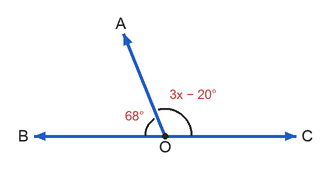 Solve with AI
Written solution
Solution:
Concept: Angles on one side of a straight line, at one point of it, add up to 180° (a straight angle).
Given: ∠AOB = 68° and ∠AOC = 3x − 20°, with OB and OC along one straight line.
Step 1 — Form the equation.
The exterior arms OB and OC lie along one straight line, so ∠AOB and ∠AOC add up to 180°.
Step 2 — Check.
With x = 44°, ∠AOC is 112°, and 68° + 112° makes the straight angle.
Therefore, x = 44°.
- 513 marks
Question 51
Each figure, given below, shows a pair of adjacent angles AOB and BOC. Find whether or not the exterior arms OA and OC are in the same straight line.
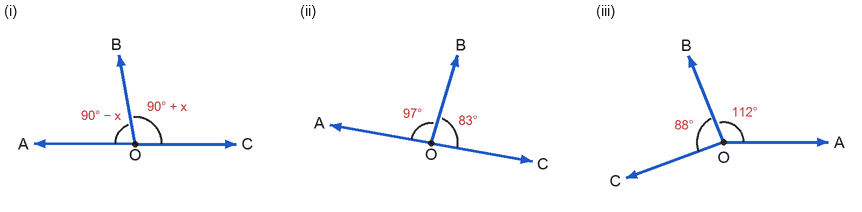 Solve with AI
Written solution
Solution:
Concept: If two adjacent angles add up to exactly 180°, their exterior arms lie in one straight line; otherwise they do not.
Step 1 — Part (i).
We add the two adjacent angles; the x terms cancel.
The sum is 180°, so OA and OC are in the same straight line: yes.
Step 2 — Part (ii).
We add the two adjacent angles.
The sum is 180°, so OA and OC are in the same straight line: yes.
Step 3 — Part (iii).
We add the two adjacent angles.
The sum is 200°, not 180°, so OA and OC are not in the same straight line.
Watch out: Close to 180° is not enough; the sum must be exactly 180°.
Therefore, (i) yes; (ii) yes; (iii) no.
- 523 marks
Question 52
A line segment AP stands at point P of a straight line BC such that ∠APB = 5x − 40° and ∠APC = x + 10°; find the values of x and angle APB.
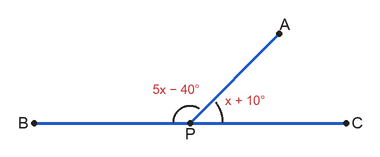 Solve with AI
Written solution
Solution:
Concept: Angles on one side of a straight line, at one point of it, add up to 180° (a straight angle).
Given: ∠APB = 5x − 40° and ∠APC = x + 10°.
Step 1 — Form the equation.
AP stands on the straight line BC at P, so ∠APB and ∠APC add up to 180°.
Step 2 — Find ∠APB.
We put x = 35° in ∠APB.
Therefore, x = 35° and ∠APB = 135°.
- 533 marks
Question 53
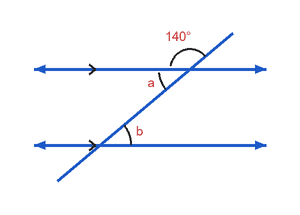
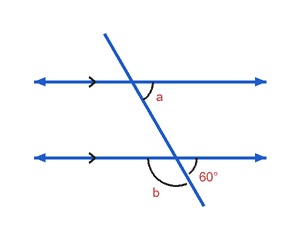
Each figure given below shows a pair of parallel lines cut by a transversal. For each case, find a and b, giving reasons.
(i)
(ii)
(iii)

(iv)
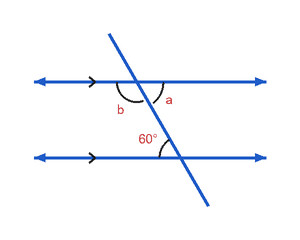
(v)
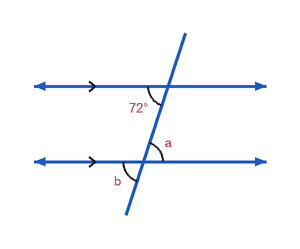
(vi)
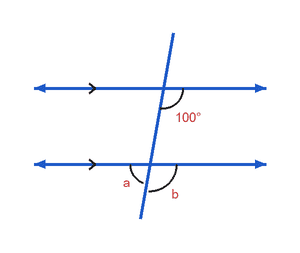
(vii)

(viii)
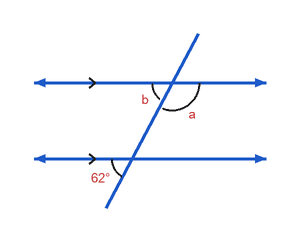
(ix)
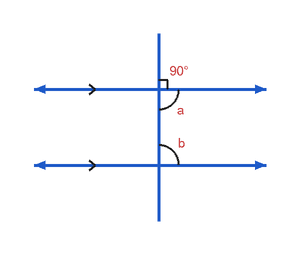
The arrows in the diagrams given above, indicate that the lines are parallel.
Solve with AIWritten solution
Solution:
Concept: When a transversal cuts two parallel lines: corresponding angles are equal, alternate angles are equal, and co-interior angles (between the lines, on the same side of the transversal) add up to 180°. At each crossing, vertically opposite angles are equal and angles on a straight line add up to 180°.
Step 1 — Part (i).
At the upper line, a and 140° lie on that straight line, so they add up to 180°.
Angles b and a are alternate angles between the parallel lines, so b equals a: b = 40°.
Step 2 — Part (ii).
Angle a at the upper line and 60° at the lower line are in the same position at the two crossings (corresponding angles), so a = 60°. At the lower line, b and 60° lie on the straight line.
Step 3 — Part (iii).
Angles a and 110° are vertically opposite at the upper crossing, so a = 110°. The angle above the upper line, to the right of the transversal, is on the straight line with 110°, so it is 70°; b corresponds to it, so b = 70°.
Step 4 — Part (iv).
Angles a and 60° are alternate angles, so a = 60°. At the upper line, b and a lie on the straight line.
Step 5 — Part (v).
Angles a and 72° are alternate angles, so a = 72°; b and a are vertically opposite, so b = 72°.
Step 6 — Part (vi).
Angles b and 100° are corresponding angles, so b = 100°. At the lower line, a and b lie on the straight line.
Step 7 — Part (vii).
Angles b and 130° are vertically opposite, so b = 130°. Angles a and 130° lie between the parallel lines on the same side of the transversal (co-interior), so they add up to 180°.
Step 8 — Part (viii).
Angles b and 62° are corresponding angles, so b = 62°. At the upper line, a and b lie on the straight line.
Step 9 — Part (ix).
Angles a and 90° lie on the upper line, so a is 90° too. Angle b corresponds to the 90° angle, so b = 90°.
Watch out: Check the position of each angle (above or below the line, left or right of the transversal) before naming the pair.
Therefore, (i) a = 40°, b = 40°; (ii) a = 60°, b = 120°; (iii) a = 110°, b = 70°; (iv) a = 60°, b = 120°; (v) a = 72°, b = 72°; (vi) a = 80°, b = 100°; (vii) a = 50°, b = 130°; (viii) a = 118°, b = 62°; (ix) a = 90°, b = 90°.
- 543 marks
Question 54
If ∠1 = 120°, find the measures of :
∠2, ∠3, ∠4, ∠5, ∠6, ∠7 and ∠8.
Give reasons.
 Solve with AI
Written solution
Solution:
Concept: When a transversal cuts two parallel lines: corresponding angles are equal, alternate angles are equal, and co-interior angles (between the lines, on the same side of the transversal) add up to 180°. At each crossing, vertically opposite angles are equal and angles on a straight line add up to 180°.
Given: ∠1 = 120°.
Step 1 — Angles at the upper crossing.
The angle ∠2 is on the straight line with ∠1; ∠3 is vertically opposite ∠1 and ∠4 is vertically opposite ∠2.
So ∠3 = 120° (equal to ∠1) and ∠4 = 60° (equal to ∠2).
Step 2 — Angles at the lower crossing.
The lines are parallel, so each angle at the lower crossing equals the corresponding angle at the upper crossing: ∠5 = ∠1, ∠6 = ∠2, ∠7 = ∠3 and ∠8 = ∠4.
So ∠5 = 120°, ∠6 = 60°, ∠7 = 120° and ∠8 = 60°.
Watch out: Match each angle with the one in the same position at the other crossing.
Therefore, ∠2 = 60°, ∠3 = 120°, ∠4 = 60°, ∠5 = 120°, ∠6 = 60°, ∠7 = 120° and ∠8 = 60°.
- 553 marks
Question 55
In the figure given alongside, find the measure of the angles denoted by x, y, z, p, q and r.
 Solve with AI
Written solution
Solution:
Concept: When a transversal cuts two parallel lines: corresponding angles are equal, alternate angles are equal, and co-interior angles (between the lines, on the same side of the transversal) add up to 180°. At each crossing, vertically opposite angles are equal and angles on a straight line add up to 180°.
Step 1 — Angles at the lower crossing.
Angle q is vertically opposite the 100° angle, so q = 100°. Angle p is on a straight line with the 100° angle, and x is vertically opposite p.
So x = 80° (equal to p).
Step 2 — Angles at the upper crossing.
The two lines marked with arrows are parallel, so each angle at the upper crossing equals the corresponding angle at the lower crossing: z corresponds to 100°, y to p and r to q.
So z = 100°, y = 80° and r = 100°.
Therefore, x = 80°, y = 80°, z = 100°, p = 80°, q = 100° and r = 100°.
- 563 marks
Question 56
Using the figure given alongside, fill in the blanks :
∠x = ................; ∠z = ................;
∠p = ................; ∠q = ................;
∠r = ................; ∠s = ................;
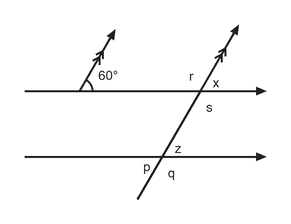 Solve with AI
Written solution
Solution:
Concept: When a transversal cuts two parallel lines: corresponding angles are equal, alternate angles are equal, and co-interior angles (between the lines, on the same side of the transversal) add up to 180°. At each crossing, vertically opposite angles are equal and angles on a straight line add up to 180°.
Step 1 — Find x.
The 60° ray and the transversal are parallel (arrow marks), and the upper line cuts both. So x and 60° are corresponding angles: x = 60°.
Step 2 — Find r and s.
Angles r and x lie on the upper straight line, and s is vertically opposite r.
So s = 120° (equal to r).
Step 3 — Find z, p and q.
The two horizontal lines are parallel, so z corresponds to x: z = 60°. Angle p is vertically opposite z, so p = 60°. Angles q and z lie on the lower straight line.
Watch out: There are two pairs of parallel lines here; say which pair each step uses.
Therefore, x = 60°, z = 60°, p = 60°, q = 120°, r = 120° and s = 120°.
- 573 marks
Question 57
In the figure given alongside, find the angles shown by x, y, z and w. Give reasons.
 Solve with AI
Written solution
Solution:
Concept: When a transversal cuts two parallel lines: corresponding angles are equal, alternate angles are equal, and co-interior angles (between the lines, on the same side of the transversal) add up to 180°. At each crossing, vertically opposite angles are equal and angles on a straight line add up to 180°.
Step 1 — Find x and w.
Angles x and 115° are vertically opposite at the upper line, so x = 115°. Angle w corresponds to x at the lower line, so w = 115°.
Step 2 — Find y and z.
Angles y and 70° are vertically opposite at the upper line, so y = 70°. Angle z corresponds to y at the lower line, so z = 70°.
Therefore, x = 115°, y = 70°, z = 70° and w = 115°.
- 583 marks
Question 58
Find a, b, c and d in the figure given below :
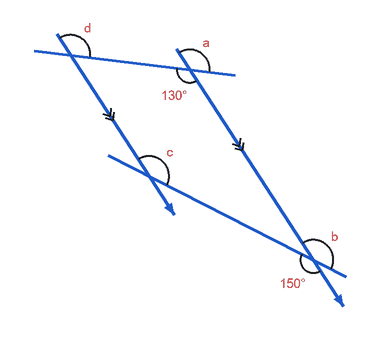 Solve with AI
Written solution
Solution:
Concept: When a transversal cuts two parallel lines: corresponding angles are equal, alternate angles are equal, and co-interior angles (between the lines, on the same side of the transversal) add up to 180°. At each crossing, vertically opposite angles are equal and angles on a straight line add up to 180°.
Step 1 — Find a and d.
Angles a and 130° are vertically opposite, so a = 130°. The two lines with double arrows are parallel and the upper line cuts both, so d corresponds to a: d = 130°.
Step 2 — Find b and c.
Angles b and 150° are vertically opposite, so b = 150°. The lower line cuts both parallel lines, so c corresponds to b: c = 150°.
Watch out: Here the parallel lines are the two marked with double arrows; the other two lines are transversals.
Therefore, a = 130°, b = 150°, c = 150° and d = 130°.
- 593 marks
Question 59
Find x, y and z in the figure given below :
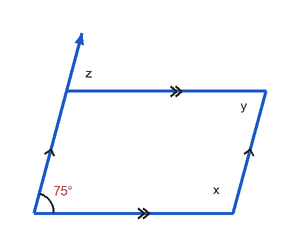 Solve with AI
Written solution
Solution:
Concept: When a transversal cuts two parallel lines: corresponding angles are equal, alternate angles are equal, and co-interior angles (between the lines, on the same side of the transversal) add up to 180°. At each crossing, vertically opposite angles are equal and angles on a straight line add up to 180°.
Step 1 — Find x.
The left and right sides are parallel (single arrows) and the bottom side cuts both, so 75° and x are co-interior angles.
Step 2 — Find y.
The top and bottom sides are parallel (double arrows) and the right side cuts both, so x and y are co-interior.
Step 3 — Find z.
The top and bottom sides are parallel and the extended left side cuts both, so z corresponds to the 75° angle: z = 75°.
Therefore, x = 105°, y = 75° and z = 75°.
- 601 mark
Question 60
Which of the following has neither length nor width nor thickness ?
Solve with AIAnswer
(A) Line
(B) Surface
(C) Plane
- Correct
(D) Point
Answer: (D) Point
Concept: A point (a dot) only marks a position: it has no length, no width and no thickness. A line goes on without end in both directions and has no end point. A ray starts at one end point and goes on without end in one direction. A line segment has two end points, so it has a definite length.
Step 1 — Recall the sizes.
A line has length; a surface or plane has length and width; a point has no size at all.
Why the other options are wrong:
- (A) Line: A line has length (but no width).
- (B) Surface: A surface has length and width.
- (C) Plane: A plane is a flat surface, so it has length and width.
Therefore, a point has neither length nor width nor thickness, option (D).
- 611 mark
Question 61
In which of the following figures, AB is perpendicular bisector of line segment PQ ?
Solve with AIAnswer
(A)
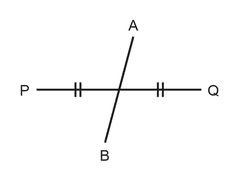
- Correct
(B)
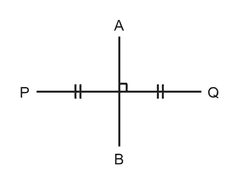
(C)

(D) none of these
Answer: (B) the figure where AB meets PQ at 90° and the two parts of PQ are equal
Concept: The perpendicular bisector of a segment is perpendicular to it and passes through its mid-point.
Step 1 — Check both conditions.
AB is the perpendicular bisector of PQ only if AB meets PQ at 90° and the two parts of PQ are equal (equal tick marks).
Step 2 — Look at the figures.
In figure (B) AB is at 90° to PQ and both parts of PQ carry equal marks.
Watch out: A right angle alone is not enough; the parts of PQ must be marked equal.
Why the other options are wrong:
- (A): In this figure PQ is cut into equal parts, but AB is not at 90° to it.
- (C): In this figure AB is at 90° to PQ, but the parts of PQ are not marked equal.
- (D) none of these: Figure (B) does show a perpendicular bisector, so “none of these” is wrong.
Therefore, the figure in option (B) shows AB as the perpendicular bisector of PQ.
- 621 mark
Question 62
Which of the following statements is incorrect?
Solve with AIAnswer
(A) Ray has one fixed point.
(B) Ray can be extended in only one direction.
- Correct
(C) Ray has a definite length.
(D) All of these.
Answer: (C) Ray has a definite length.
Concept: A point (a dot) only marks a position: it has no length, no width and no thickness. A line goes on without end in both directions and has no end point. A ray starts at one end point and goes on without end in one direction. A line segment has two end points, so it has a definite length.
Step 1 — Test each statement.
A ray has one fixed end point and goes on without end in one direction, so it cannot have a definite length. Only statement (C) is incorrect.
Why the other options are wrong:
- (A) Ray has one fixed point: This statement is correct: a ray has one fixed (end) point.
- (B) Ray can be extended in only one direction: This statement is correct: a ray goes on in only one direction.
- (D) All of these: Statements (A) and (B) are correct, so “all of these” cannot be the incorrect one.
Therefore, the incorrect statement is (C), “Ray has a definite length”.
- 631 mark
Question 63
The number of line(s) passing through two fixed points is :
Solve with AIAnswer
- Correct
(A) 1
(B) 2
(C) 0
(D) 3
Answer: (A) 1
Concept: Points that lie on one straight line are collinear. Exactly one straight line passes through two given points, while endlessly many lines pass through one point.
Step 1 — Use the fact.
A ruler placed through two fixed points can lie in only one position, so exactly one line passes through them.
Why the other options are wrong:
- (B) 2: A second line through the same two points would lie exactly on the first one.
- (C) 0: There is always one line through two points, so 0 is wrong.
- (D) 3: Three different lines cannot pass through the same two points.
Therefore, exactly one line passes through two fixed points, option (A).
- 641 mark
Question 64
The complement of is :
Solve with AIAnswer
(A)
- Correct
(B)
(C)
(D)
Answer: (B)
Concept: Two angles are complementary if their sum is 90°; each is the complement of the other, so complement = 90° − the angle.
Step 1 — Subtract from 90°.
The complement is 90° minus the whole angle (x − y)°.
Watch out: The minus sign in front of the bracket changes −y into +y.
Why the other options are wrong:
- (A) : This keeps −y, as if the bracket were not opened correctly.
- (C) : This is 90° plus the angle, which is not the complement.
- (D) : This is the angle minus 90°, which is negative for an angle smaller than 90°.
Therefore, the complement of (x − y)° is (90 − x + y)°, option (B).
- 651 mark
Question 65
The supplement of of 60° is :
Solve with AIAnswer
(A) 52°
- Correct
(B) 132°
(C) 40°
(D) 80°
Answer: (B) 132°
Concept: Two angles are supplementary if their sum is 180°; each is the supplement of the other, so supplement = 180° − the angle.
Step 1 — Find the angle.
We first work out four-fifths of 60°.
Step 2 — Find the supplement.
The supplement is 180° minus this angle.
Watch out: Take the supplement of 48°, not of 60°.
Why the other options are wrong:
- (A) 52°: Adding 52° to 48° gives 100°, not 180°, so 52° is not the supplement of 48°.
- (C) 40°: Adding 40° to 48° gives 88°, not 180°, so 40° is not the supplement of 48°.
- (D) 80°: Adding 80° to 48° gives 128°, not 180°; 80° is of 60°, the fraction turned upside down.
Therefore, the supplement is 132°, option (B).
- 661 mark
Question 66
Reflex angle measures :
Solve with AIAnswer
(A) more than 90° and less than 180°
(B) more than 180° and less than 270°
- Correct
(C) more than 180° and less than 360°
(D) more than 90° and less than 360°
Answer: (C) more than 180° and less than 360°
Concept: An acute angle is less than 90°, a right angle is 90°, an obtuse angle is between 90° and 180°, a straight angle is 180° and a reflex angle is between 180° and 360°. A reflex angle = 360° − the angle on the other side.
Step 1 — Recall the definition.
A reflex angle is greater than a straight angle (180°) and less than a complete angle (360°).
Why the other options are wrong:
- (A) more than 90° and less than 180°: Angles between 90° and 180° are obtuse, not reflex.
- (B) more than 180° and less than 270°: This leaves out reflex angles between 270° and 360°, such as 300°.
- (D) more than 90° and less than 360°: This also includes obtuse angles (between 90° and 180°) and the straight angle.
Therefore, a reflex angle measures more than 180° and less than 360°, option (C).
- 671 mark
Question 67
When two parallel lines are cut by a transversal then which one of following is not true ?
Solve with AIAnswer
(A) Interior alternate angles are equal.
- Correct
(B) Exterior alternate angles are complementary.
(C) Co-interior angles are supplementary.
(D) Corresponding angles are equal.
Answer: (B) Exterior alternate angles are complementary.
Concept: When a transversal cuts two parallel lines: corresponding angles are equal, alternate angles are equal, and co-interior angles (between the lines, on the same side of the transversal) add up to 180°. At each crossing, vertically opposite angles are equal and angles on a straight line add up to 180°.
Step 1 — Test each statement.
For parallel lines cut by a transversal, interior alternate angles are equal, corresponding angles are equal and co-interior angles are supplementary. Exterior alternate angles are equal, so they are not complementary (they would add up to 90° only if each were 45°).
Watch out: The words “not true” ask for the false statement.
Note: Choosing “co-interior angles are supplementary” as the false statement is a slip: by this chapter's own rule, that statement is true for parallel lines.
Why the other options are wrong:
- (A) Interior alternate angles are equal: This is true: interior alternate angles are equal.
- (C) Co-interior angles are supplementary: This is true: co-interior angles add up to 180°, so they are supplementary.
- (D) Corresponding angles are equal: This is true: corresponding angles are equal.
Therefore, the statement that is not true is (B), “Exterior alternate angles are complementary”.
- 681 mark
Question 68
In the given figure, lines AB and CD are parallel to each other and ∠a : ∠b = 7 : 11, then ∠b is equal to :
 Solve with AI
Answer
(A) 70°
- Correct
(B) 110°
(C) 100°
(D) none of these
Answer: (B) 110°
Concept: When a transversal cuts two parallel lines: corresponding angles are equal, alternate angles are equal, and co-interior angles (between the lines, on the same side of the transversal) add up to 180°. At each crossing, vertically opposite angles are equal and angles on a straight line add up to 180°.
Step 1 — Relate a and b.
The angle a at CD equals the angle at AB on the right of the transversal above AB (corresponding angles). That angle and ∠b lie on the straight line AB, so a + b = 180°.
Step 2 — Use the ratio.
We write a = 7k and b = 11k.
Step 3 — Find ∠b.
We multiply 11 by k.
Watch out: 70° is ∠a, not ∠b.
Why the other options are wrong:
- (A) 70°: 70° is ∠a (7 × 10°), not ∠b.
- (C) 100°: 100° does not fit the ratio: 180° − 100° = 80°, and 80 : 100 is not 7 : 11.
- (D) none of these: Option (B) is correct, so “none of these” is wrong.
Therefore, ∠b = 110°, option (B).
- 691 mark
Question 69
Two parallel lines are cut by a transversal, then which of the following can not be ture ?
Solve with AIAnswer
(A) Corresponding angles are equal.
- Correct
(B) Co-interior angles are complementary.
(C) Co-interior angles are supplementary.
(D) Alternate angles are equal.
Answer: (B) Co-interior angles are complementary.
Concept: When a transversal cuts two parallel lines: corresponding angles are equal, alternate angles are equal, and co-interior angles (between the lines, on the same side of the transversal) add up to 180°. At each crossing, vertically opposite angles are equal and angles on a straight line add up to 180°.
Step 1 — Test each statement.
For parallel lines, corresponding angles are equal, alternate angles are equal and co-interior angles add up to 180°. Since co-interior angles always add up to 180°, they can never add up to 90°, so (B) can not be true.
Watch out: The words “can not be true” ask for the statement that is always false.
Note: Choosing “alternate angles are equal” is a slip: alternate angles of parallel lines are always equal, by this chapter's own rule.
Why the other options are wrong:
- (A) Corresponding angles are equal: This is always true for parallel lines.
- (C) Co-interior angles are supplementary: This is always true: co-interior angles add up to 180°.
- (D) Alternate angles are equal: This is always true for parallel lines.
Therefore, the statement that can not be true is (B), “Co-interior angles are complementary”.
- 701 mark
Question 70
Statement 1 : Two lines in a plane either intersect at a point or they are parallel to each other.
Statement 2 : Exactly two lines in the same plane which do not intersect at any point even when further extended up to infinity are called parallel lines.
Which of the following options is correct?
Solve with AIAnswer
- Correct
(A) Both the statements are true.
(B) Both the statements are false.
(C) Statement 1 is true, and statement 2 is false.
(D) Statement 1 is false, and statement 2 is true.
Answer: (A) Both the statements are true.
Concept: Two straight lines in the same plane that never meet, however far they are extended, are parallel. Lines that meet (or would meet when extended) are intersecting lines. Two lines that meet at a right angle (90°) are perpendicular.
Step 1 — Judge Statement 1.
Two different lines in one plane either meet at exactly one point or never meet (parallel). So Statement 1 is true.
Step 2 — Judge Statement 2.
Lines in the same plane that never meet, however far they are extended, are called parallel lines. Statement 2 is this definition, so it is true.
Note: Two lines that coincide (lie one on the other) are really one line, so Statement 1 speaks of two different lines.
Why the other options are wrong:
- (B) Both the statements are false: Both statements are true, so (B) is wrong.
- (C): Statement 2 is the definition of parallel lines, so it is true.
- (D): Statement 1 is true for two different lines in a plane.
Therefore, both statements are true, option (A).
- 711 mark
Question 71
Statement 1 : If an angle is such that its supplement is 5 times its complement then the angle is .
Statement 2 : When two adjacent angles form a linear pair then they are supplementary.
Which of the following options is correct?
Solve with AIAnswer
- Correct
(A) Both the statements are true.
(B) Both the statements are false.
(C) Statement 1 is true, and statement 2 is false.
(D) Statement 1 is false, and statement 2 is true.
Answer: (A) Both the statements are true.
Concept: Two angles are complementary if their sum is 90°; each is the complement of the other, so complement = 90° − the angle. Two angles are supplementary if their sum is 180°; each is the supplement of the other, so supplement = 180° − the angle.
Step 1 — Judge Statement 1.
Let the angle be x. Its supplement is 5 times its complement.
So the angle is and Statement 1 is true.
Step 2 — Judge Statement 2.
A linear pair lies on a straight line, so the two angles add up to 180°: they are supplementary. Statement 2 is true.
Watch out: Multiply the whole complement (90 − x) by 5.
Why the other options are wrong:
- (B) Both the statements are false: Both statements are true, so (B) is wrong.
- (C): Statement 2 is true, so (C) is wrong.
- (D): Statement 1 is true, so (D) is wrong.
Therefore, both statements are true, option (A).
- 721 mark
Question 72
Choose your answer based on the codes given below :
(1) A is true, R is false. (2) A is false, R is true. (3) Both A and R are true. (4) Both A and R are false.
Assertion (A) : There are some figures in geometry which have both curvilinear and linear boundary.
Reason (R) : Curvilinear means having curved line , linear means straight line.
Solve with AIAnswer
(A) (1) A is true, R is false.
(B) (2) A is false, R is true.
- Correct
(C) (3) Both A and R are true.
(D) (4) Both A and R are false.
Answer: (C) (3) Both A and R are true.
Concept: A closed figure bounded only by curves has a curvilinear boundary; one bounded only by line segments has a linear boundary.
Step 1 — Judge the Assertion.
A semicircle is bounded by a curved arc and a straight diameter, so some figures have both a curvilinear and a linear boundary. A is true.
Step 2 — Judge the Reason.
Curvilinear means made of curved lines and linear means made of straight lines. R is true.
Why the other options are wrong:
- (A): R is also true, so (A) is wrong.
- (B): A is true (a semicircle is an example), so (B) is wrong.
- (D): Both A and R are true, so (D) is wrong.
Therefore, both A and R are true, option (C).
- 731 mark
Question 73
Choose your answer based on the codes given below :
(1) A is true, R is false. (2) A is false, R is true. (3) Both A and R are true. (4) Both A and R are false.
Assertion (A) : The angles around a point are : a right angle, , , remaining two angles form a linear pair. Then the value of x is 40°.
Reason (R) : The sum of all angles around a point is 360°.
Solve with AIAnswer
(A) (1) A is true, R is false.
- Correct
(B) (2) A is false, R is true.
(C) (3) Both A and R are true.
(D) (4) Both A and R are false.
Answer: (B) (2) A is false, R is true.
Concept: The angles around a point add up to 360° (one complete turn).
Step 1 — Judge the Reason.
One complete turn around a point is 360°, so the sum of all angles around a point is 360°. R is true.
Step 2 — Find x.
The angles around the point are a right angle (90°), (x − 10)°, (2x + 40)° and two angles forming a linear pair (together 180°). Their sum is 360°.
Step 3 — Judge the Assertion.
The value of x is 20°, not 40°, so A is false.
Watch out: The linear pair adds 180° to the total, not 90°.
Note: Calling the Assertion true is a slip: with x = 40° the angles would add up to 420°, not 360°.
Why the other options are wrong:
- (A): A is false and R is true, not the other way round.
- (C): A is false, since x = 20°.
- (D): R is true: the angles around a point add up to 360°.
Therefore, A is false and R is true, option (B).
What Class 6 Maths Ch 14 covers
The sections of the chapter, in the order the book takes them. Every question above comes from one of these.
- 01Basic Concept
- 02Open and Closed Figures
- 03Perpendicular to a Line Segment
- 04Concept of an Angle
- 05Measuring an Angle
- 06Types of Angles
- 07Adjacent and Vertically Opposite Angles
More ways to study this chapter
The same chapter asked three other ways. Practise it, revise it, and see what the board has set on Ch 14 before.
Class 6 Maths Ch 14 questions students ask
How many questions are there in Class 6 Maths Ch 14?
73 questions. Every one is solved step by step on this page.
Are these Class 6 Maths solutions free?
Yes. Every question and its full working is free to read, with no account needed.
Can I download the Class 6 Maths Ch 14 solutions as a PDF?
There is no PDF to download. Every solution is on this page instead, which means it is searchable, always the current syllabus, and readable on a phone. Use your browser's print option if you want it on paper.