
Opening your dashboard
Class 6 Maths Chapter 14 Fundamental Concepts (Geometry): Practice Questions
43 questions on Chapter 14, each worked through on its own page with the AI tutor. Class 6 Maths, ICSE 2026-27.
43 questions
1–5 marks · Mixed difficulty
- 11 mark
Question 1
Bloom's level: Remember
Which of the following has exactly one end point?
- 21 mark
Question 2
Bloom's level: Remember
One degree () is equal to :
- 31 mark
Question 3
Bloom's level: Understand
An angle equal to three right angles is :
- 41 mark
Question 4
Bloom's level: Apply
The supplement of the complement of is :
- 51 mark
Question 5
Bloom's level: Apply
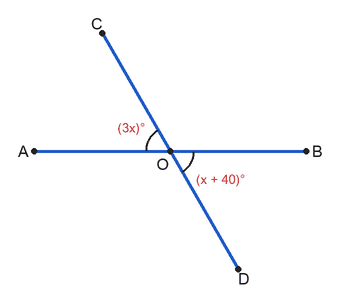
Two straight lines AB and CD intersect at O. If ∠AOC and ∠BOD , then ∠AOC is :
- 61 mark
Question 6
Bloom's level: Understand
Which of the following is an example of parallel lines?
- 71 mark
Question 7
Bloom's level: Apply
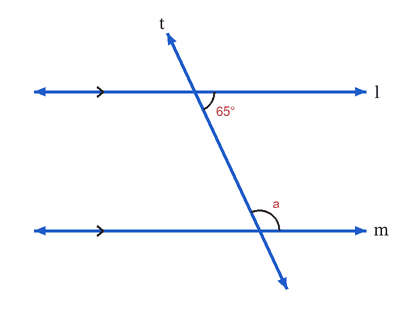
In the given figure, and is a transversal. The value of is :
- 81 mark
Question 8
Bloom's level: Understand
Line MN is the perpendicular bisector of the line segment AB and cuts it at P. Which of the following is not necessarily true?
- 91 mark
Question 9
Bloom's level: Understand
Which of the following is a closed figure with a curvilinear boundary?
- 101 mark
Question 10
Bloom's level: Understand
Assertion (A) : If two straight lines intersect and one of the four angles formed is , then all four angles are .
Reason (R) : Vertically opposite angles are equal, and adjacent angles formed on a straight line add up to .
- 111 mark
Question 11
Bloom's level: Evaluate
Assertion (A) : Two acute angles can never be supplementary.
Reason (R) : Any two acute angles are always complementary.
- 121 mark
Question 12
Bloom's level: Evaluate
Assertion (A) : A transversal cuts two lines, and a pair of co-interior angles formed measure and . So the two lines are parallel.
Reason (R) : When two parallel lines are cut by a transversal, the co-interior angles are supplementary.
- 132 marks
Question 13
Bloom's level: Remember
What is an angle? For the angle XYZ, name its vertex and its arms.
- 142 marks
Question 14
Bloom's level: Apply
Two angles measure and . Find their sum. Is the sum an acute angle or an obtuse angle?
- 152 marks
Question 15
Bloom's level: Understand
Distinguish between a line, a ray and a line segment with regard to (i) the number of end points and (ii) their length.
- 162 marks
Question 16
Bloom's level: Apply
An angle is more than its supplement. Find the angle and its supplement.
- 172 marks
Question 17
Bloom's level: Analyse
Two straight lines AB and CD intersect at O.
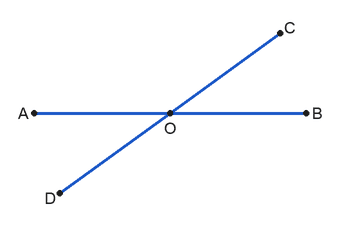
If ∠AOC is four times ∠BOC, find all four angles formed at O.
- 182 marks
Question 18
Bloom's level: Apply
Find each angle and name its type (acute, right, obtuse, straight, reflex or complete) :
(i) of a straight angle
(ii) of a right angle
(iii) of a complete angle
(iv) the angle which, together with , makes a complete angle
- 192 marks
Question 19
Bloom's level: Evaluate
Rohan says, "Line passes through the mid-point of the line segment AB, so must be the perpendicular bisector of AB." Is Rohan right? Justify your answer.
- 202 marks
Question 20
Bloom's level: Apply
Two parallel lines are cut by a transversal. A pair of co-interior angles formed measure and . Find and the two angles.
- 212 marks
Question 21
Bloom's level: Understand
What is geometry? Name the geometrical idea (point, line segment, ray or plane) best shown by each of the following :
(i) the tip of a sharp compass needle
(ii) the edge of a ruler
(iii) the beam of light from a torch
(iv) the top of a table
- 222 marks
Question 22
Bloom's level: Remember
Fill in the blanks :
(i) The sum of all the angles around a point is ............
(ii) A straight angle is equal to ............ right angles.
(iii) Two angles whose sum is are called ............ angles.
(iv) When two straight lines intersect, the vertically opposite angles are ............
- 234 marks
Question 23
Bloom's level: Analyse
A transversal cuts two lines and . In each case, decide whether and can be parallel. Give a reason.
(i) A pair of corresponding angles measure and .
(ii) A pair of co-interior angles measure and .
(iii) A pair of interior alternate angles measure and .
(iv) A pair of exterior allied angles measure and .
- 244 marks
Question 24
Bloom's level: Apply
In the given figure, straight lines AB and CD intersect at O, ∠AOC and ray OE is perpendicular to AB.
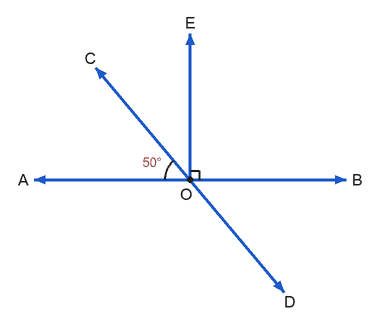
Find, giving reasons :
(i) ∠BOD
(ii) ∠BOC
(iii) ∠COE, and state how ∠COE and ∠AOC are related
(iv) ∠DOE and reflex ∠DOE
- 255 marks
Question 25
Bloom's level: Apply
Case study: A straight road crosses two parallel railway tracks and at P and Q, as shown. At P, the road makes an angle of with track . A lamp post PK stands at P, perpendicular to track .

(a) Find . Name the pair of angles you used.
(b) Find and . Show that and name this pair of angles.
(c) Find the angle between the lamp post PK and the road. How is this angle related to the angle?
- 265 marks
Question 26
Bloom's level: Analyse
Case study: The minute hand of a clock is like a ray rotating about the centre of the clock. It makes one complete rotation () in 60 minutes. The hour hand makes one complete rotation in 12 hours.
(a) Through what angle does the minute hand turn in 1 minute? In 15 minutes? Name the type of the second angle.
(b) Through what angle does the minute hand turn from 12 : 00 to 12 : 40? Name its type. For how many minutes, at the least, must the minute hand turn to make a reflex angle? Explain.
(c) From 3 : 00 to 3 : 30, through what angles do the minute hand and the hour hand turn? Name the type of each.
- 273 marks
Question 27
Bloom's level: Create
(a) Frame two angles, written as expressions in , which are complementary when .
(b) Frame two angles, written as expressions in , which are supplementary when .
In each case, form the equation and solve it to check that .
- 284 marks
Question 28
Bloom's level: Create
Draw your own example of each of the following and explain why it fits :
(a) an open figure made of line segments
(b) a closed figure with a linear boundary made of exactly 5 line segments
(c) a closed figure whose boundary is not made of line segments only (a curvilinear boundary). Shade its interior.
- 294 marks
Question 29
Bloom's level: Analyse
Study the given figure, in which A, B and C lie on a line and P is a point outside it.

(a) Name three collinear points, and three points that are not collinear.
(b) How many line segments are there in the figure? Name them.
(c) How many angles less than have their vertex at P? Name them.
(d) How many closed figures with three sides (triangles) can you find? Name them.
- 303 marks
Question 30
Bloom's level: Analyse
(a) Four points A, B, C and D are marked on a plane so that no three of them are collinear. How many different lines can be drawn, each passing through two of these points?
(b) How many lines can be drawn if A, B and C are collinear but D is not on that line?
(c) How many lines can be drawn through 5 points, no three of which are collinear? Explain the pattern.
- 312 marks
Question 31
Two angles are complementary and one angle is more than three times the other. Find the angles.
- 324 marks
Question 32
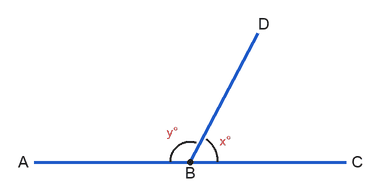
In the given figure, ABC is a straight line. Find :
(i) , if
(ii) , if
- 333 marks
Question 33
Fill in the blanks :
(i) An angle of is called ............
(ii) An angle of is called ............
(iii) An angle greater than but less than is called ............
- 341 mark
Question 34
An angle measuring is called :
- 351 mark
Question 35
The supplement of an angle of is :
- 361 mark
Question 36
A transversal cuts two parallel lines. Two interior angles on the same side of the transversal are such that one of them is . The other is :
- 372 marks
Question 37
(a) Through how many degrees does the minute hand of a clock turn in 15 minutes ?
(b) Through how many degrees does the hour hand of a clock turn in 1 hour ?
- 382 marks
Question 38
(a) Write the number of end points of a line segment, of a ray and of a line.
(b) Which of these three has a definite length ? Give a reason.
- 392 marks
Question 39
is a line segment of length 8 cm. The line is perpendicular to and meets it at its mid-point .
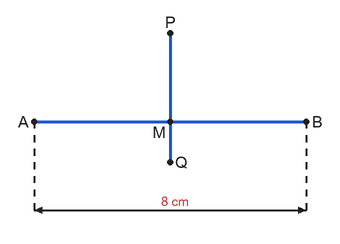
(a) Write the measure of and the length of .
(b) What is the line called ?
- 402 marks
Question 40
While measuring with a protractor, the arm lies along the mark and the arm passes through the mark on the same scale.

(a) Write the measure of and name its type.
(b) Find the measure of the reflex angle at formed by the same two arms.
- 413 marks
Question 41
Two angles are complementary. One of them is more than the other.
(a) If the smaller angle is , write the other angle and form an equation.
(b) Find the two angles.
(c) Find the supplement of the larger angle.
- 424 marks
Question 42
In the figure, and are straight lines that meet at . and .
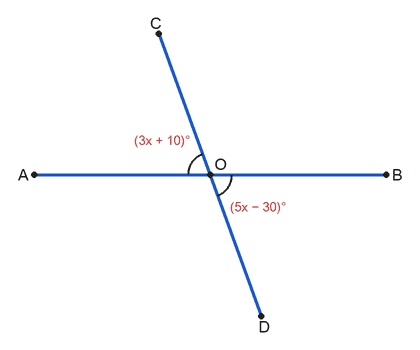
(a) Name the pair of angles and , and use it to find .
(b) Find and .
(c) Find . What is the relation between and ?
- 433 marks
Question 43
In the figure, and the transversal cuts at and at . .
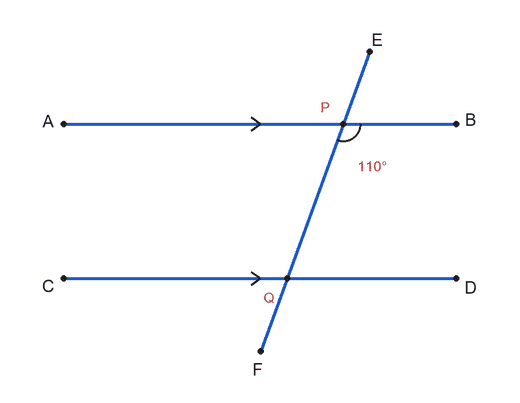
(a) Find and name the pair of angles and .
(b) Find and name the pair of angles and .
(c) Find .