Solution:
Concept: When a transversal cuts two parallel lines: corresponding angles are equal, alternate angles are equal, and co-interior angles (between the lines, on the same side of the transversal) add up to 180°. At each crossing, vertically opposite angles are equal and angles on a straight line add up to 180°.
Step 1 — Part (i).
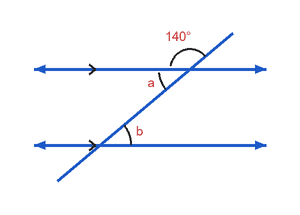
At the upper line, a and 140° lie on that straight line, so they add up to 180°.
a=180∘−140∘=40∘
Angles b and a are alternate angles between the parallel lines, so b equals a: b = 40°.
Step 2 — Part (ii).
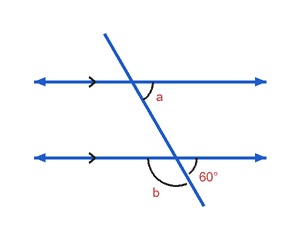
Angle a at the upper line and 60° at the lower line are in the same position at the two crossings (corresponding angles), so a = 60°. At the lower line, b and 60° lie on the straight line.
b=180∘−60∘=120∘
Step 3 — Part (iii).
Angles a and 110° are vertically opposite at the upper crossing, so a = 110°. The angle above the upper line, to the right of the transversal, is on the straight line with 110°, so it is 70°; b corresponds to it, so b = 70°.
180∘−110∘=70∘
Step 4 — Part (iv).
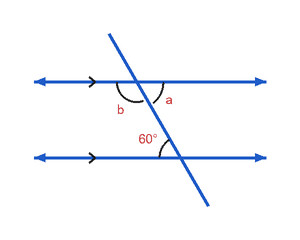
Angles a and 60° are alternate angles, so a = 60°. At the upper line, b and a lie on the straight line.
b=180∘−60∘=120∘
Step 5 — Part (v).
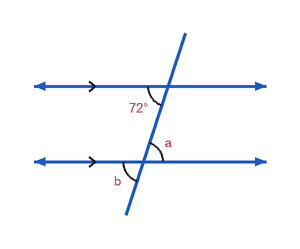
Angles a and 72° are alternate angles, so a = 72°; b and a are vertically opposite, so b = 72°.
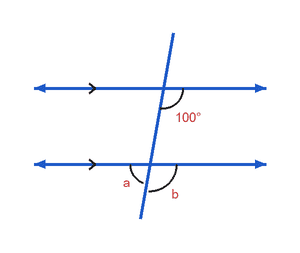
Step 6 — Part (vi).
Angles b and 100° are corresponding angles, so b = 100°. At the lower line, a and b lie on the straight line.
a=180∘−100∘=80∘
Step 7 — Part (vii).
Angles b and 130° are vertically opposite, so b = 130°. Angles a and 130° lie between the parallel lines on the same side of the transversal (co-interior), so they add up to 180°.
a=180∘−130∘=50∘
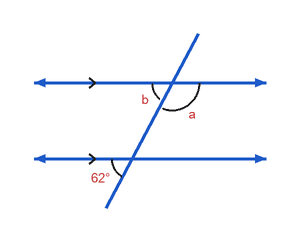
Step 8 — Part (viii).
Angles b and 62° are corresponding angles, so b = 62°. At the upper line, a and b lie on the straight line.
a=180∘−62∘=118∘
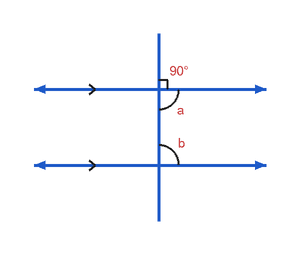
Step 9 — Part (ix).
Angles a and 90° lie on the upper line, so a is 90° too. Angle b corresponds to the 90° angle, so b = 90°.
a=180∘−90∘=90∘
Watch out: Check the position of each angle (above or below the line, left or right of the transversal) before naming the pair.
Therefore, (i) a = 40°, b = 40°; (ii) a = 60°, b = 120°; (iii) a = 110°, b = 70°; (iv) a = 60°, b = 120°; (v) a = 72°, b = 72°; (vi) a = 80°, b = 100°; (vii) a = 50°, b = 130°; (viii) a = 118°, b = 62°; (ix) a = 90°, b = 90°.