
Opening your dashboard
Class 6 Maths Chapter 14 Fundamental Concepts (Geometry): Competency-Based Questions (CBQ)
40 questions on Chapter 14, each worked through on its own page with the AI tutor. Class 6 Maths, ICSE 2026-27.
40 questions
1–5 marks · Mixed difficulty
- 11 mark
Question 1
Competency: Understanding
On a map, three bus stops are marked as the points A, B and C. The transport office wants one straight road to pass through all three stops.
This is possible only if the points A, B and C are
- 21 mark
Question 2
Competency: Application
A round pizza is cut from the centre into 8 equal slices. Aman takes 3 slices that lie next to each other.
The angle at the centre of Aman's share is
- 31 mark
Question 3
Competency: Analysis
The letter Z is painted on a board. Its top stroke and bottom stroke are parallel. The slant stroke makes an angle of with the top stroke.
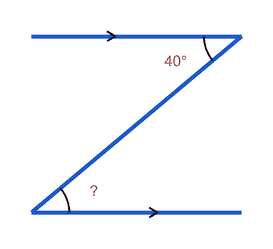
The angle marked ? is also . This is because the two angles are
- 41 mark
Question 4
Competency: Application
The two blades of a pair of scissors are straight. They cross at the screw. When the scissors are opened, the angle between the two blades is .

The angle between the two handles, on the other side of the screw, is
- 51 mark
Question 5
Competency: Evaluation
Assertion (A): Any two adjacent edges of a page of your textbook are perpendicular to each other.
Reason (R): Two lines are perpendicular to each other if they contain an angle of between them.
- 61 mark
Question 6
Competency: Analysis
A carpenter cuts a right-angled corner of a board into two pieces with one straight cut from the corner. The two angles formed at the corner must be complementary.
Which pair of angles can he get?
- 72 marks
Question 7
Competency: Application
A spinner for a board game is divided into three parts from its centre. The red part has an angle of at the centre. The angle of the blue part is twice the angle of the green part.
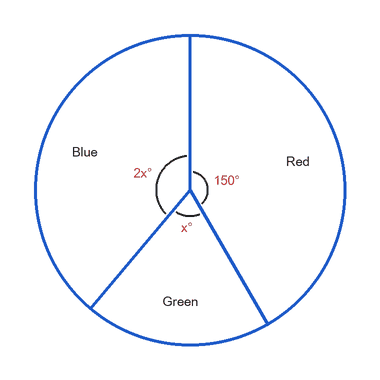
Find the angle of the green part and of the blue part. State the type of each of these two angles.
- 82 marks
Question 8
Competency: Evaluation
Meena says, "The supplement of an acute angle is always an obtuse angle."
Is Meena's statement always true, sometimes true or never true? Justify your answer, and give one example.
- 92 marks
Question 9
Competency: Analysis
A window grill has two parallel bars and a slant bar across them. The slant bar makes an angle of with the upper bar, as shown.
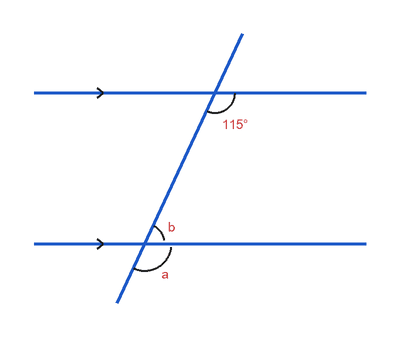
Find the angles and that the slant bar makes with the lower bar. Give a reason for each.
- 102 marks
Question 10
Competency: Application
Two villages A and B are joined by a straight road AB that is 600 m long. A straight canal is the perpendicular bisector of AB. A bridge is built at P, where the canal crosses the road.
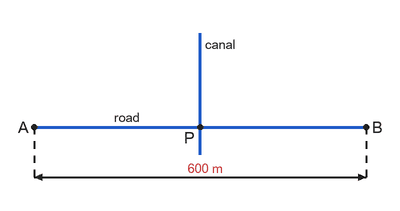
(a) How far is the bridge from village A?
(b) What angle does the canal make with the road? Riya's house is on the road, 200 m from A. How far is it from the bridge?
- 113 marks
Question 11
Competency: Analysis & Evaluation
A road-painting team paints the centre line of a road in two parts that meet at a junction. A side lane also starts from each junction. An engineer measures the two angles at each junction, as shown.
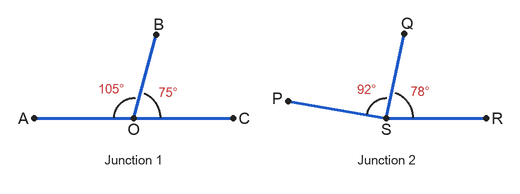
At which junction do the two parts of the centre line form one straight line? Do not judge by looking at the figure. Justify your answer using the angles.
- 123 marks
Question 12
Competency: Creativity
Design a simple road map for a new colony. Your map must have:
- two roads that are parallel to each other,
- a third road that is perpendicular to both of them,
- a fourth road that cuts both parallel roads but is not perpendicular to them.
(a) Draw your map. Name the roads, and mark the parallel roads and the right angles.
(b) Choose and mark one angle between your fourth road and the first parallel road.
(c) Write the four angles that the fourth road makes with the second parallel road. Give reasons.
- 133 marks
Question 13
Competency: Application & Analysis
A garden sprinkler turns at a steady speed. Its arm makes one complete rotation in 40 seconds.
(a) Through what angle does the arm turn in 1 second?
(b) Through what angle does it turn in 15 seconds? What type of angle is this?
(c) How long does the arm take to turn through a straight angle? How long does it take to turn through a reflex angle of ?
- 145 marks
Question 14
Competency: Analysis & Evaluation
Case study — The folding table
The figure shows a folding table seen from the side. The top AB is parallel to the floor CD. The two straight legs AD and BC cross each other at O. Each leg makes an angle of with the top, and .
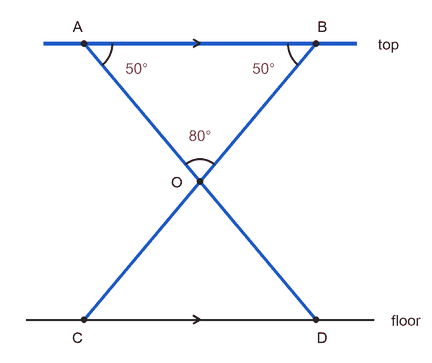
(a) Name the two transversals of the parallel lines AB and CD.
(b) Find the angles that the legs make with the floor, and . Give reasons.
(c) Find , and , with reasons. Tanu says, " and are supplementary, because they are vertically opposite angles." Is Tanu right? Justify.
- 154 marks
Question 15
Competency: Application & Analysis
Case study — The laptop lid
Sameer measures the angle between the lid of his laptop and its keyboard in four positions. The keyboard stays flat on the table.
Position P Q R S Angle between the lid and the keyboard (a) Name the type of angle in each position.
(b) Find the complement of the angle in position P and the supplement of the angle in position R. What do you notice?
(c) Through what angle does the lid turn when it moves from position P to position R? In which two pairs of positions are the two directions of the lid perpendicular to each other?
- 161 mark
Question 16
Competency: Analysis
Three different straight lines , and in a plane all pass through the same point T. A fourth line is drawn parallel to , and is not the same line as .
Which statement is correct?
- 171 mark
Question 17
Competency: Application & Analysis
A student places a protractor on an angle, as shown. One arm of the angle passes through the mark and the other arm passes through the mark on the scale.
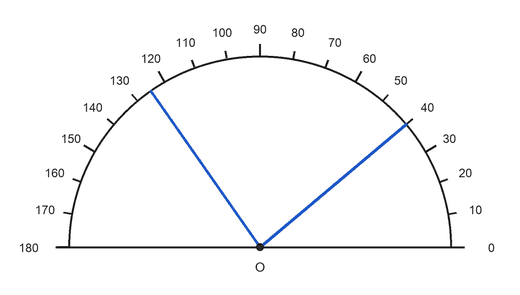
The measure of the angle between the two arms is
- 181 mark
Question 18
Competency: Application
Riya stands facing North. She turns clockwise until she faces South-West.
The angle through which she turns is
- 191 mark
Question 19
Competency: Analysis
For every acute angle, its supplement is greater than its complement by
- 201 mark
Question 20
Competency: Analysis & Evaluation
Assertion (A) : The letter V (drawn with two straight strokes) is a closed figure, because its two strokes meet at a point.
Reason (R) : A figure is closed when it has no free end points, so that its path comes back to the point where it started.
- 211 mark
Question 21
Competency: Application
Two straight roads cross each other. The four angles formed at the crossing, taken in order around the point, are , , and . It is given that .
The measure of is
- 221 mark
Question 22
Competency: Understanding & Evaluation
Assertion (A) : A semicircular protractor cannot measure a reflex angle directly.
Reason (R) : The scale of a semicircular protractor shows only the marks from to .
- 231 mark
Question 23
Competency: Application
A signboard pole PC stands perpendicular to a straight footpath AB, meeting it at the point C. Riya measures the angle that the pole makes with the footpath on the side of A and writes it as .
The value of is
- 241 mark
Question 24
Competency: Understanding
Meena draws an angle PQR with arms cm long. Her friend draws an angle with the same opening between the arms, but makes the arms cm long.
Compared with Meena's angle, the friend's angle is
- 251 mark
Question 25
Competency: Evaluation
Gita draws a straight mark on her paper with a sharp pencil and names it AB. The mark has two ends, and it is a very thin strip of graphite.
Which statement about her drawing is best?
- 262 marks
Question 26
Competency: Understanding & Analysis
Three points P, Q and R lie on a straight line, with Q between P and R.
(a) Are the rays and the same ray?
(b) Are the rays and the same ray?
Give a reason for each answer.
- 272 marks
Question 27
Competency: Application
A farmer has many straight pieces of bamboo. He fixes them end to end to fence a vegetable patch.
(a) What is the smallest number of pieces with which he can make a closed fence?
(b) He makes a closed fence with pieces. Then he removes one piece. Is the fence now open or closed? How many free end points does it have?
- 282 marks
Question 28
Competency: Application
(Hypothetical data.) A robot arm is at from its starting line. It turns, in the same direction, to . Then it turns a further in the same direction.
(a) How much did the arm turn in the first move?
(b) How far is the arm from its starting line after the second move?
- 292 marks
Question 29
Competency: Application & Analysis
(Hypothetical data.) A round flower bed is divided into four parts by four straight edging strips OA, OB, OC and OD. All four strips start from the centre O of the bed, and they are taken in this order around O. Also, , and .
(a) Find and name its type.
(b) There are two angles between the strips OA and OC: one passes over OB and the other passes over OD. Find both, and name the type of each.
- 302 marks
Question 30
Competency: Analysis & Evaluation
Two vertical lamp posts stand on a level straight road. Each post makes a right angle with the road. Treat the posts as straight lines in one plane with the road.
Are the two posts parallel? Use the road as a transversal and give a reason.
- 312 marks
Question 31
Competency: Evaluation
Sana says, "Any two adjacent angles are supplementary."
Is she right? Give an example to support your answer.
- 323 marks
Question 32
Competency: Analysis
A pencil is placed across two ruled lines and of a notebook page. The lines are parallel. The pencil makes alternate interior angles of and , as shown.
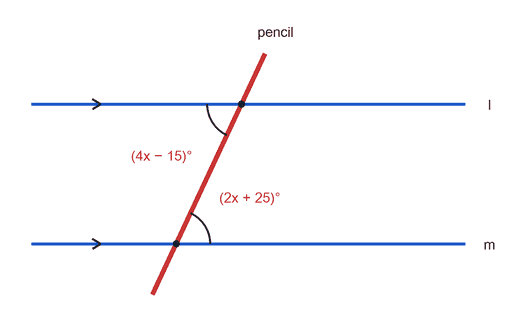
(a) Find the value of .
(b) Find the measure of each of the two alternate angles.
(c) Find the angle that the pencil makes with the line , on the same side of the pencil as the angle , between the two lines (the co-interior angle of ).
- 333 marks
Question 33
Competency: Analysis
In the figure, AOC is a straight line. The ray OD bisects and the ray OE bisects . Also, .
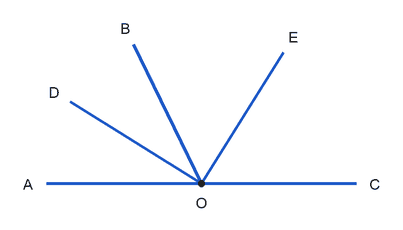
(a) Find .
(b) Find and .
(c) Find . Will change if is changed? Give a reason.
- 343 marks
Question 34
Competency: Analysis
Four points A, B, C and D lie on a straight line in this order.
(a) Name all the line segments whose two end points are among these four points.
(b) Name all the different rays that start at one of these points and pass through another of them. (The rays , and are the same ray, so count it once.)
(c) There are ways to choose a starting point and a second point. Explain why the number of different rays is less than .
- 353 marks
Question 35
Competency: Analysis
A teacher writes the measures of five angles on the board.
Angle P Q R S T Measure (a) Which two angles are complementary?
(b) Which pairs of angles are supplementary?
(c) Which angles belong to both a complementary pair and a supplementary pair? Name the partners of each.
- 363 marks
Question 36
Competency: Creativity
(Hypothetical situation.) A builder wants to mark out a small plot of land with four straight sides. The plot must have exactly two right angles, one angle of and one pair of parallel sides.
(a) Draw a rough sketch of such a plot. Name its corners A, B, C and D.
(b) Write the measure of all four angles. Give a reason for the fourth angle.
(c) Name the two parallel sides. Name a side that cuts both of them.
- 375 marks
Question 37
Competency: Analysis & Application
Case study — The wind vane
(Hypothetical data.) A school weather station records the direction of the wind with a wind vane. The direction is given as the angle through which the vane has turned clockwise from North.
Day Mon Tue Wed Thu Angle from North (a) Name the type of angle for the reading of each day.
(b) Through what angle must the vane turn clockwise to move from the Monday reading to the Wednesday reading? Name the type of this angle. What does it tell you about the two wind directions?
(c) Find the clockwise turn from the Tuesday reading to the Wednesday reading, and from the Wednesday reading to the Thursday reading. Show that these two angles are supplementary, and explain why this must be so.
- 384 marks
Question 38
Competency: Analysis & Evaluation
Case study — Shelf brackets
Two shelves, the upper shelf and the lower shelf, are fixed one above the other and are parallel. Two slanting bars, bar 1 and bar 2, each cross both shelves, as shown. Below the upper shelf and to the left of each bar, bar 1 makes an angle of and bar 2 makes an angle of with the shelf.

(a) At the lower shelf, find the angle that bar 1 makes with the shelf, below the shelf and to the left of the bar. Give a reason.
(b) At the lower shelf, find the angle between bar 2 and the shelf, above the shelf and to the left of bar 2 (between the two shelves). Give a reason.
(c) Anil says, "Both bars slant, so bar 1 and bar 2 are parallel." Use the upper shelf as a transversal of the two bars to decide whether Anil is right.
- 395 marks
Question 39
Competency: Application & Analysis
Case study — Three roads at a roundabout
(Hypothetical situation.) Three straight roads AB, CD and EF cross at the centre O of a roundabout, as shown. The angles on one side of the road AB are , and .
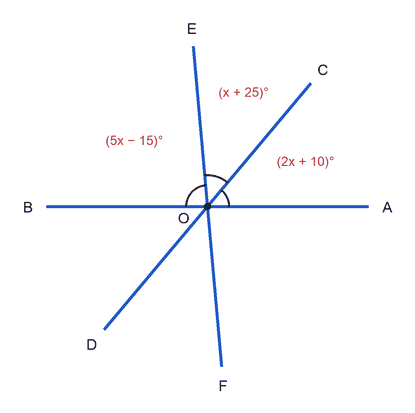
(a) Form an equation in and find the value of .
(b) Find , and .
(c) Find , and , giving a reason for each. Then show that the six angles around O add up to .
- 404 marks
Question 40
Competency: Understanding & Application
Case study — Folding a right angle
Mira has a strip of paper with a straight edge. She marks a point P on the edge. She folds the paper so that the part of the edge on one side of P falls exactly on the part of the edge on the other side. The fold line (crease) passes through P.
(a) Why are the two angles that the crease makes with the edge, on its two sides, equal?
(b) Find the measure of each of these angles. What is the crease in relation to the edge?
(c) Mira now folds again, so that the edge on the right of P falls along the first crease. What angle does the new crease make with the first crease, and what angle does it make with the edge on the left of P? Give reasons.