
Question 373 marksEasy
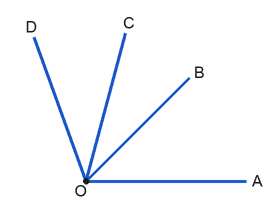
In the figure given alongside :
(i) if ∠AOB = 45°, ∠BOC = 30° and ∠AOD = 110°; find angles COD and BOD.
(ii) if ∠BOC = ∠DOC = 34° and ∠AOD = 120°; find angle AOB and angle AOC.
(iii) if ∠AOB = ∠BOC = ∠COD = 38°;
Confirming your payment
Sign up now and get 250 free tokens.
Fundamental Concepts (Geometry) · Question 37 of 73
In the figure given alongside :
(i) if ∠AOB = 45°, ∠BOC = 30° and ∠AOD = 110°; find angles COD and BOD.
(ii) if ∠BOC = ∠DOC = 34° and ∠AOD = 120°; find angle AOB and angle AOC.
(iii) if ∠AOB = ∠BOC = ∠COD = 38°;
Solution:
Concept: When rays OB and OC lie inside ∠AOD, the angles between neighbouring rays add up to the whole angle: ∠AOD = ∠AOB + ∠BOC + ∠COD. An acute angle is less than 90°, a right angle is 90°, an obtuse angle is between 90° and 180°, a straight angle is 180° and a reflex angle is between 180° and 360°. A reflex angle = 360° − the angle on the other side.
Step 1 — Part (i): find ∠COD.
The angle ∠AOD is made of ∠AOB, ∠BOC and ∠COD, so ∠COD is what is left after the other two.
Step 2 — Part (i): find ∠BOD.
The angle ∠BOD is ∠AOD without ∠AOB.
Step 3 — Part (ii): find ∠AOB.
Now ∠AOD = 120° is made of ∠AOB, ∠BOC = 34° and ∠COD = 34°.
Step 4 — Part (ii): find ∠AOC.
The angle ∠AOC is ∠AOD without ∠COD.
Step 5 — Part (iii): find ∠AOC and ∠AOD.
Each of the three angles is 38°.
Step 6 — Part (iii): find the reflex angles.
A reflex angle is 360° minus the ordinary angle.
Watch out: ∠BOD includes both ∠BOC and ∠COD.
Note: Part (iii) is printed without saying what to find; the working above finds reflex ∠AOC and reflex ∠AOD, the two angles usually asked for here.
Therefore, (i) ∠COD = 35° and ∠BOD = 65°; (ii) ∠AOB = 52° and ∠AOC = 86°; (iii) reflex ∠AOC = 284° and reflex ∠AOD = 246°.