
Question 293 marksEasy
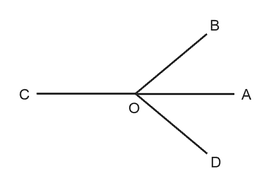
In the figure given alongside, name :
(i) three pairs of adjacent angles.
(ii) two acute angles.
(iii) two obtuse angles.
(iv) two reflex angles.
Confirming your payment
Sign up now and get 250 free tokens.
Fundamental Concepts (Geometry) · Question 29 of 73
In the figure given alongside, name :
(i) three pairs of adjacent angles.
(ii) two acute angles.
(iii) two obtuse angles.
(iv) two reflex angles.
Solution:
Concept: An angle is formed by two rays (its arms) starting from the same point (its vertex). In the name of an angle the vertex letter is always written in the middle, e.g. ∠AOB has vertex O. An acute angle is less than 90°, a right angle is 90°, an obtuse angle is between 90° and 180°, a straight angle is 180° and a reflex angle is between 180° and 360°. A reflex angle = 360° − the angle on the other side. Adjacent angles have a common vertex and a common arm, and lie on opposite sides of that arm.
Step 1 — Read the figure.
Rays OA, OB, OC and OD start from O. ∠AOB and ∠AOD are small (less than 90°), while ∠BOC and ∠COD are larger than 90° but less than 180°.
Step 2 — Part (i).
Adjacent angles share the vertex and one arm and lie on opposite sides of it. Three such pairs are ∠AOB and ∠BOC (common arm OB), ∠BOC and ∠COD (common arm OC), and ∠COD and ∠DOA (common arm OD).
Step 3 — Part (ii).
The angles ∠AOB and ∠AOD are each less than 90°, so they are acute.
Step 4 — Part (iii).
The angles ∠BOC and ∠COD are each between 90° and 180°, so they are obtuse.
Step 5 — Part (iv).
The angle on the outside of an acute or obtuse angle is more than 180°. So reflex ∠AOB and reflex ∠COD are two reflex angles.
Note: Other correct answers are possible, e.g. reflex ∠BOC in part (iv).
Therefore, (i) ∠AOB and ∠BOC, ∠BOC and ∠COD, ∠COD and ∠DOA; (ii) ∠AOB and ∠AOD; (iii) ∠BOC and ∠COD; (iv) reflex ∠AOB and reflex ∠COD.