
Opening your dashboard
Class 12 Physics Chapter 29: Nuclear Energy - Fission and Fusion Solutions
80 textbook questions with step-by-step answers, free to read, for ISC 2026-27.
Get talked through Ch 29, not just shown the answer
Reading a finished solution is not the same as being able to do it. The AI tutor takes one question at a time and works it with you, in your own words, until you can.
- Ask it out loud, in your own words
- It gives you the next step, not the answer
- Stuck on part (ii)? Start there
80 questions with solutions
1–5 marks · Mixed difficulty
The first 73 solutions are on this page. This chapter is a long one, so the rest open on their own page to keep this one quick to load.
- 11 mark
Question 1
The process by which a heavy nucleus splits into light nuclei is known as
Solve with AIAnswer
- Correct
(A) fission
(B) α-decay
(C) fusion
(D) chain reaction
Answer: (A) fission
Concept: Nuclear fission is the splitting of a heavy nucleus, such as uranium-235, into two lighter nuclei of comparable size, with the release of energy and a few neutrons.
Step 1 — Match the process to its name. The stem describes a heavy nucleus splitting into lighter nuclei. This is exactly the definition of nuclear fission.
Step 2 — Check the other options. Each of the other processes is different:
- (B) In α-decay the nucleus gives out only a small helium-4 nucleus, and the daughter nucleus is almost as heavy as the parent; the nucleus does not split into two comparable parts.
- (C) Fusion is the joining of light nuclei to form a heavier one, the opposite process.
- (D) A chain reaction is a self-sustaining series of fissions in which neutrons from one fission cause further fissions; it is not the name of the splitting itself.
Therefore, the process is nuclear fission, option (A).
- 21 mark
Question 2
The explosion of the atomic bomb takes place due to
Solve with AIAnswer
(A) nuclear fusion
- Correct
(B) nuclear fission
(C) scattering
(D) thermionic emission
Answer: (B) nuclear fission
Concept: An atomic bomb is a fission bomb: an uncontrolled chain reaction of fission in uranium-235 or plutonium-239 releases a huge amount of energy in less than a microsecond.
Step 1 — Identify the energy source. In an atomic bomb, pieces of fissile material are brought together to form a mass larger than the critical mass. The number of fissions then multiplies from one generation of neutrons to the next, and the energy of all these fissions is released at once.
Step 2 — Check the other options. None of the others can release this energy:
- (A) Fusion is the energy source of the hydrogen (thermonuclear) bomb; the atomic bomb is a fission bomb.
- (C) Scattering only changes the direction of particles; it releases no nuclear energy.
- (D) Thermionic emission is the emission of electrons from a hot metal surface; it involves no nuclear energy.
Therefore, the explosion of an atomic bomb is due to nuclear fission, option (B).
- 31 mark
Question 3
The example of nuclear fusion is
Solve with AIAnswer
(A) formation of Ba and Kr from
- Correct
(B) formation of He from H
(C) formation of from
(D) formation of water from hydrogen and oxygen
Answer: (B) formation of He from H
Concept: Nuclear fusion is the joining of two or more light nuclei to form a heavier nucleus, with the release of energy.
Step 1 — Test option (B). In the Sun, hydrogen nuclei (protons) combine, through a series of steps, to form a helium nucleus. Light nuclei join to make a heavier one, so this is fusion.
Step 2 — Check the other options. None of the others joins nuclei:
- (A) The formation of barium and krypton from uranium-235 is the splitting of a heavy nucleus, which is fission.
- (C) No two nuclei combine here: the mass number stays 235 and only the atomic number would change, so it is not fusion.
- (D) Water is formed by a chemical reaction between atoms; the nuclei of hydrogen and oxygen are not changed.
Therefore, the formation of helium from hydrogen is an example of nuclear fusion, option (B).
- 41 mark
Question 4
Energy generation in stars is mainly due to
Solve with AIAnswer
(A) chemical reaction
(B) fission of heavy nuclei
- Correct
(C) fusion of light nuclei
(D) fusion of heavy nuclei
Answer: (C) fusion of light nuclei
Concept: Stars such as the Sun shine by thermonuclear fusion in their cores, where hydrogen nuclei are fused into helium at temperatures of about K.
Step 1 — Identify the source. In the core of a star, four hydrogen nuclei are joined, through a chain of reactions, into one helium-4 nucleus, releasing about 26.7 MeV. This fusion of light nuclei is the main source of the energy of stars.
Step 2 — Check the other options. None of the others can supply the energy of a star:
- (A) Chemical reactions release only a few electronvolts per atom; a Sun powered by chemical burning would last only a few thousand years, not billions.
- (B) Heavy nuclei are very rare in stars, so their fission cannot be the main source.
- (D) The binding energy per nucleon falls beyond , so fusing nuclei into products heavier than iron absorbs energy instead of releasing it.
Therefore, energy generation in stars is mainly due to fusion of light nuclei, option (C).
- 51 mark
Question 5
Fusion reaction takes place at high temperature because
Solve with AIAnswer
(A) atoms are ionised at high temperature
(B) molecules break up at high temperature
(C) nuclei break up at high temperature
- Correct
(D) kinetic energy is high enough to overcome repulsion
Answer: (D) kinetic energy is high enough to overcome repulsion
Concept: Nuclei are positively charged and repel each other. To fuse, they must come within about m of each other, where the attractive nuclear force acts, so they must have enough kinetic energy to overcome the electrostatic (Coulomb) repulsion.
Step 1 — Link temperature to kinetic energy. The average kinetic energy of particles increases with temperature. Only at temperatures of the order of K and above do enough nuclei move fast enough to get close despite the repulsion.
Step 2 — Conclude. So a very high temperature is needed for fusion to take place.
Step 3 — Check the other options. The other reasons do not explain fusion:
- (A) Atoms are indeed fully ionised at these temperatures (the matter becomes a plasma), but ionisation alone does not bring nuclei together; the nuclei still have to overcome their mutual repulsion, which needs high kinetic energy.
- (B) Molecules break up at a few thousand kelvin; this is a chemical change and does not make nuclei fuse.
- (C) The nuclei do not break up; fusion needs whole nuclei to join together.
Therefore, fusion needs a high temperature because only then is the kinetic energy of the nuclei high enough to overcome their repulsion, option (D).
- 61 mark
Question 6
In a working nuclear reactor, cadmium rods (control rods) are used to
Solve with AIAnswer
(A) speed up neutrons
(B) slow down neutrons
- Correct
(C) absorb some neutrons
(D) absorb all neutrons
Answer: (C) absorb some neutrons
Concept: In a working reactor the chain reaction must be steady, with multiplication factor : on average exactly one neutron from each fission goes on to cause another fission.
Step 1 — State the role of cadmium rods. Cadmium absorbs neutrons strongly. Each fission gives out 2 to 3 neutrons, and the cadmium rods absorb some of the extra neutrons so that stays equal to 1.
Step 2 — Check the other options. The other options do not describe control rods:
- (A) Nothing in a reactor is used to speed up neutrons; fast neutrons are in fact slowed down.
- (B) Slowing down neutrons is the job of the moderator (heavy water, graphite), not of cadmium rods.
- (D) If the rods absorbed all the neutrons, the chain reaction would stop at once; in a working reactor they absorb only some of them.
Therefore, in a working reactor the cadmium rods absorb some neutrons, option (C).
- 71 mark
Question 7
Which of the following is used as a moderator in nuclear reactors?
Solve with AIAnswer
(A) Uranium
- Correct
(B) Heavy water
(C) Cadmium
(D) Plutonium
Answer: (B) Heavy water
Concept: A moderator slows down fast neutrons. It must have light nuclei and must absorb very few neutrons.
Step 1 — Pick the moderator. Heavy water contains light deuterium nuclei that slow neutrons in a few collisions and hardly absorb them, so it is a moderator (graphite and ordinary water are also used).
Step 2 — Check the other options. The other materials have different roles:
- (A) Uranium is the nuclear fuel; its nuclei are far too heavy to slow neutrons.
- (C) Cadmium absorbs neutrons strongly, so it is used for control rods; a moderator must absorb as few neutrons as possible.
- (D) Plutonium-239 is a fissile material used as fuel, not to slow neutrons.
Therefore, heavy water is used as a moderator, option (B).
- 81 mark
Question 8
Nuclear fission was discovered by
Solve with AIAnswer
- Correct
(A) Otto Hahn and F. Strassman
(B) Fermi
(C) Bethe
(D) Rutherford
Answer: (A) Otto Hahn and F. Strassman
Concept: Nuclear fission was discovered in 1938, when uranium bombarded with neutrons was found to produce barium, a much lighter element.
Step 1 — Recall the discovery. In 1938 Otto Hahn and Fritz Strassmann found barium among the products of uranium bombarded with neutrons. Lise Meitner and Otto Frisch explained that the uranium nucleus had split into two, and called the process fission.
Step 2 — Check the other options. The other scientists are known for other work:
- (B) Fermi bombarded uranium with neutrons in 1934 but did not recognise fission; he built the first nuclear reactor in 1942.
- (C) Bethe explained in 1938–39 how stars produce energy by nuclear fusion.
- (D) Rutherford discovered the atomic nucleus (1911) and the first artificial nuclear transmutation (1919).
Therefore, nuclear fission was discovered by Otto Hahn and F. Strassmann, option (A).
- 91 mark
Question 9
Nuclear fission experiments show that the neutrons split the uranium nuclei into two fragments of about the same size. This process is accompanied by the emission of several
Solve with AIAnswer
(A) protons and positrons
(B) α-particles
- Correct
(C) neutrons
(D) protons and α-particles
Answer: (C) neutrons
Concept: Heavy nuclei have many more neutrons than protons. The fission fragments are lighter nuclei, which are stable with a smaller proportion of neutrons, so the extra neutrons are set free.
Step 1 — State what is emitted. Each fission of uranium-235 gives out 2 to 3 neutrons (about 2.4 on average), for example
Step 2 — Note why this matters. These neutrons can cause further fissions, which makes a chain reaction possible.
Step 3 — Check the other options. The other particles are not the regular products of fission:
- (A) The fragments are rich in neutrons, so they later decay by giving out electrons (β⁻ particles), not positrons; protons are not given out in fission.
- (B) An α-particle is given out in only about 1 fission in 500 (ternary fission), so α-particles do not accompany fission in general.
- (D) Protons are not given out in fission, and α-particles only very rarely.
Note: in most fissions the two fragments are of unequal size, for example with mass numbers near 95 and 140.
Therefore, fission is accompanied by the emission of several neutrons, option (C).
- 101 mark
Question 10
In the reaction , if the binding energies of , and are , and (in MeV) respectively, then the energy (in MeV) released in this reaction is
Solve with AIAnswer
(A)
- Correct
(B)
(C)
(D)
Answer: (B)
Concept: The energy released in a nuclear reaction equals the total binding energy of the products minus the total binding energy of the reactants. A free neutron has no binding energy.
Step 1 — Write the binding energy on each side. The reactants are and , so their total binding energy is . The products are the helium-4 nucleus (binding energy ) and a free neutron (binding energy 0).
Step 2 — Subtract. We take products minus reactants:
Step 3 — Check the other options. The other expressions come from wrong signs:
- (A) This adds the binding energy of deuterium instead of subtracting it.
- (C) This adds all three binding energies; the reactants' binding energy must be subtracted.
- (D) This is the negative of the true answer, the energy that would have to be supplied for the reverse reaction.
Therefore, the energy released is , option (B).
- 111 mark
Question 11
When two deuterium nuclei fuse together to form a tritium nuclei, we get a
Solve with AIAnswer
(A) neutron
(B) deuteron
(C) α-particle
- Correct
(D) proton
Answer: (D) proton
Concept: In every nuclear reaction the total mass number and the total charge number are the same on both sides.
Step 1 — Write the reaction with the unknown particle. Let the unknown particle be :
Step 2 — Balance the mass numbers. The mass numbers must add up to the same total:
Step 3 — Balance the charge numbers. The charge numbers must also agree:
A particle with and is a proton.
Step 4 — Check the other options. None of the others balances the equation:
- (A) A neutron has , so the charge would not balance (); the neutron comes from the other deuterium–deuterium reaction, which gives helium-3.
- (B) A deuteron has , so the mass numbers would not balance ().
- (C) An α-particle has and , so neither total would balance.
Therefore, the other particle produced is a proton, option (D).
- 121 mark
Question 12
The operation of a nuclear reactor is said to be critical, if the multiplication factor () has a value
Solve with AIAnswer
- Correct
(A) 1
(B) 1.5
(C) 2.1
(D) 2.5
Answer: (A) 1
Concept: The multiplication factor is
Step 1 — Describe the critical state. A reactor is critical when the number of neutrons, and so the rate of fission, stays constant from one generation to the next. This happens when .
Step 2 — Check the other options. All the other values are greater than 1:
- (B) With the number of fissions grows by half in every generation; the reactor is supercritical.
- (C) With the number of fissions more than doubles every generation, which is a runaway (supercritical) reaction.
- (D) With the reaction grows even faster, as in an uncontrolled chain reaction.
Therefore, the reactor is critical when , option (A).
- 131 mark
Question 13
Which of the following cannot cause fission in a heavy nucleus?
Solve with AIAnswer
(A) α-particle
(B) Proton
(C) Deuteron
- Correct
(D) Laser rays
Answer: (D) Laser rays
Concept: To make a heavy nucleus split, a particle must be absorbed by it and give it several MeV of excitation energy. A charged particle can do this if it has enough kinetic energy (several MeV) to overcome the repulsion of the nucleus.
Step 1 — Find the energy of laser photons. Laser light consists of photons of visible or near-visible light, each carrying only a few electronvolts, about a million times too little to cause fission.
Step 2 — Conclude. So laser rays cannot cause fission in a heavy nucleus.
Step 3 — Check the other options. Each of the other particles can cause fission when it is fast enough:
- (A) α-particles of high energy (tens of MeV) can enter a heavy nucleus and cause fission.
- (B) Fast protons from an accelerator can also enter a heavy nucleus and cause fission.
- (C) Fast deuterons can likewise cause fission of heavy nuclei.
Watch out: Gamma-ray photons of energy above about 6 MeV can cause fission (photofission); laser photons are far too weak.
Note: since 2000, very intense pulsed lasers have caused fission indirectly: the laser drives fast electrons in a metal target, these give out high-energy γ-rays, and the γ-rays split the nuclei. The laser light itself cannot split a nucleus.
Therefore, laser rays cannot cause fission in a heavy nucleus, option (D).
- 141 mark
Question 14
When is bombarded with one neutron, the fission occurs and the products are three neutrons, and
Solve with AIAnswer
(A)
- Correct
(B)
(C)
(D)
Answer: (B)
Concept: In a nuclear reaction the total mass number and the total charge number are conserved.
Step 1 — Write the reaction with the unknown nucleus. Let the unknown nucleus be :
Step 2 — Balance the mass numbers. The mass numbers on the two sides must be equal:
Step 3 — Balance the charge numbers. The charge numbers must also be equal:
The element with is barium, so the nucleus is .
Step 4 — Check the other options. Each of the others breaks a conservation law:
- (A) This balances neither total: with the mass numbers on the right would add up to 239 instead of 236, and the charge numbers to 89 instead of 92.
- (C) The mass number fits, but the charges would add to , not 92.
- (D) The mass number fits, but the charges would add to , not 92.
Therefore, the other product is , option (B).
- 151 mark
Question 15
Hydrogen bomb is based on which of the following phenomenon?
Solve with AIAnswer
(A) Nuclear fission
- Correct
(B) Nuclear fusion
(C) Radioactive decay
(D) None of these
Answer: (B) Nuclear fusion
Concept: A hydrogen (thermonuclear) bomb is based on the fusion of isotopes of hydrogen (deuterium and tritium) into helium at a temperature of many millions of kelvin.
Step 1 — Identify the process the bomb is based on. The very high temperature needed is produced by exploding a fission bomb inside the hydrogen bomb. At this temperature the hydrogen isotopes fuse and release a huge energy. This fusion stage is what makes it a hydrogen bomb.
Step 2 — Check the other options. The other options are not the basis of the bomb:
- (A) A fission bomb is used as the trigger that heats the fuel, but the process that defines a hydrogen bomb is the fusion of hydrogen isotopes.
- (C) Radioactive decay releases energy far too slowly to cause an explosion.
- (D) This is wrong, because option (B) is correct.
Note: in many designs the fast neutrons from the fusion stage also split a casing of uranium-238, and this fission can add a large share of the total energy; the bomb is still named after its fusion stage.
Therefore, the hydrogen bomb is based on nuclear fusion, option (B).
- 161 mark
Question 16
Nuclear fusion is common to the pair
Solve with AIAnswer
(A) Thermonuclear reactor, uranium-based nuclear reactor
(B) Energy production in the Sun, uranium-based nuclear reactor
- Correct
(C) Energy production in the Sun, hydrogen bomb
(D) Disintegration of heavy nuclei, hydrogen bomb
Answer: (C) Energy production in the Sun, hydrogen bomb
Concept: Fusion joins light nuclei into heavier ones; fission splits heavy nuclei. A pair is correct only if both members use fusion.
Step 1 — Test pair (C). The Sun produces energy by fusing hydrogen into helium, and the hydrogen bomb is named after, and based on, its fusion stage, in which hydrogen isotopes fuse. Both use fusion.
Step 2 — Check the other pairs. Each other pair contains a fission process:
- (A) A thermonuclear reactor would use fusion, but a uranium-based reactor works by fission of uranium.
- (B) The Sun uses fusion, but a uranium-based reactor uses fission.
- (D) The disintegration of heavy nuclei is fission, although the hydrogen bomb uses fusion.
Therefore, nuclear fusion is common to energy production in the Sun and the hydrogen bomb, option (C).
- 171 mark
Question 17
Heavy water is used as a moderator in a nuclear reactor. The function of the moderator is
Solve with AIAnswer
(A) to control the energy released in the reactor
(B) to absorb neutrons and stop chain reaction
(C) to cool the reactor faster
- Correct
(D) to slow down the neutrons to thermal energies
Answer: (D) to slow down the neutrons to thermal energies
Concept: Uranium-235 undergoes fission much more readily with slow (thermal) neutrons, of energy about 0.025 eV, than with the fast neutrons (about 2 MeV) released in fission.
Step 1 — State the function of the moderator. The deuterium nuclei of heavy water collide elastically with the fast neutrons and slow them down to thermal energies, so that they can cause further fission.
Step 2 — Check the other options. The other jobs belong to other parts of the reactor:
- (A) The energy released is controlled by the control rods, which change the number of neutrons available.
- (B) Absorbing neutrons is what control rods do; a moderator must absorb as few neutrons as possible.
- (C) Cooling is the job of the coolant. In pressurised heavy water reactors heavy water is also used as the coolant, but in a separate circuit; its job as a moderator is to slow the neutrons.
Therefore, the function of the moderator is to slow down the neutrons to thermal energies, option (D).
- 181 mark
Question 18
How much energy is released during the fission of one nucleus of ?
Solve with AIWritten solution
Solution:
Concept: The energy released in fission comes from the mass defect: the products are lighter than the uranium-235 nucleus plus the neutron, and the lost mass appears as energy . One atomic mass unit (1 u) is equivalent to 931.5 MeV.
Step 1 — Estimate the mass lost. In a typical fission of uranium-235 the products are lighter than the reactants by about 0.215 u, so we take u.
Step 2 — Convert the mass defect to energy. We multiply the mass defect by 931.5 MeV for each atomic mass unit:
Step 3 — Express the energy in joules. We use 1 MeV J:
Most of this energy (about 165–170 MeV) appears as the kinetic energy of the two fragments.
Therefore, about 200 MeV ( J) of energy is released in the fission of one uranium-235 nucleus.
- 191 mark
Question 19
Distinguish between prompt neutrons and delayed neutrons.
Solve with AIWritten solution
Solution:
Concept: The neutrons from fission do not all appear at the same moment; most come out at once, and a small fraction come out later from the decay of some fission products.
Step 1 — Describe prompt neutrons. Prompt neutrons are given out by the fission fragments within about s of the fission. They make up more than 99 % of all fission neutrons.
Step 2 — Describe delayed neutrons. Delayed neutrons are given out by certain fission products after they have undergone β-decay, from a fraction of a second to a few minutes after the fission. For uranium-235 they are only about 0.65 % of all the neutrons, but they make the chain reaction slow enough to be controlled.
Therefore, prompt neutrons are emitted by the fission fragments within about s of fission, while delayed neutrons are emitted later (up to a few minutes) by the decay of some fission products.
- 201 mark
Question 20
What is critical size?
Solve with AIWritten solution
Solution:
Concept: In a piece of fissile material some neutrons escape through the surface (leakage) and some are captured without fission. Neutron production depends on the volume, while leakage depends on the surface area.
Step 1 — See why size matters. When the piece is made larger, its volume grows faster than its surface area. So the neutrons produced inside increase faster than the neutrons lost through the surface, and a smaller fraction of them escapes.
Step 2 — State the definition. Critical size is the minimum size of a piece of fissile material for which the number of neutrons produced by fission in each generation just balances the number lost by leakage and by non-fission capture. The chain reaction can then just sustain itself, with multiplication factor .
Therefore, critical size is the minimum size of the fissile material for which the neutrons produced in fission just balance those lost by leakage and non-fission capture, so that a chain reaction is just sustained.
- 211 mark
Question 21
What is critical mass?
Solve with AIWritten solution
Solution:
Concept: For a given fissile material, shape and density, the size of the piece fixes its mass. A chain reaction sustains itself only when the piece is at least of the critical size.
Step 1 — Link the critical size to a mass. Since the mass of a piece is its density times its volume, a piece of the critical size has a definite mass. This mass is called the critical mass.
Step 2 — State the definition and what it depends on. Critical mass is the minimum mass of fissile material in which a chain reaction can sustain itself; with less than this mass too many neutrons escape. It depends on the material, its purity and density, its shape and any neutron reflector around it. For a bare sphere of pure uranium-235 it is about 52 kg.
Therefore, critical mass is the minimum mass of fissile material (of the critical size) needed to sustain a chain reaction.
- 221 mark
Question 22
What is a nuclear reactor?
Solve with AIWritten solution
Solution:
Concept: A fission chain reaction is controlled when the multiplication factor is kept at , so that on average exactly one neutron from each fission causes another fission.
Step 1 — State the principle. A reactor works on a controlled, self-sustaining fission chain reaction. Control rods absorb the extra neutrons so that stays equal to 1 and the rate of fission stays constant.
Step 2 — State the definition and uses. A nuclear reactor is therefore a device in which a self-sustaining fission chain reaction is carried out under control, so that nuclear energy is released at a steady rate. The energy is used to generate electricity, and the neutrons are used to make radioisotopes and for research.
Therefore, a nuclear reactor is a device which works on the principle of controlled, self-sustaining fission chain reaction, releasing nuclear energy at a steady rate.
- 231 mark
Question 23
What are the essential parts of a nuclear reactor?
Solve with AIWritten solution
Solution:
Concept: Each part of a reactor does one job: supplying fissions, slowing neutrons, controlling their number, carrying away heat or stopping radiation.
Step 1 — List the parts that run the chain reaction. These parts produce the fissions and keep their rate steady:
- nuclear fuel (uranium-235, plutonium-239), in which fission takes place;
- moderator (heavy water, graphite, ordinary water), which slows the neutrons;
- control rods (cadmium, boron), which absorb neutrons and control the rate of fission.
Step 2 — List the parts that remove heat and give protection. These parts carry the energy away and keep neutrons and radiation in:
- coolant (water, heavy water, liquid sodium), which carries the heat away;
- neutron reflector, which sends escaping neutrons back into the core;
- shielding (thick concrete), which protects people from radiation.
Therefore, the essential parts are the nuclear fuel, moderator, control rods, coolant (cooling system), neutron reflector and safety shield.
- 241 mark
Question 24
What is the difference between radioactive decay and nuclear fission?
Solve with AIWritten solution
Solution:
Concept: Radioactive decay is a spontaneous change in an unstable nucleus. Nuclear fission, as used in reactors, is started by an outside neutron.
Step 1 — Describe radioactive decay. Radioactive decay happens by itself, and its rate practically cannot be changed by temperature, pressure or chemical combination. Each decay releases only a small energy (at most a few MeV) by emitting an α-particle, a β-particle or a γ-ray.
Step 2 — Describe nuclear fission. Fission in a reactor or bomb is induced: a neutron is absorbed and the heavy nucleus splits into two comparable parts. Its rate can be controlled through the number of neutrons, and each fission releases a large energy (about 200 MeV).
Note: some heavy nuclei also undergo fission by themselves (spontaneous fission). Uranium-238 does so only very rarely, while californium-252 does so in about 3 % of its decays; the fission used for energy is the induced kind.
Therefore, radioactive decay is spontaneous, practically cannot be controlled and releases little energy, while nuclear fission (induced by neutrons) can be controlled and releases a large amount of energy.
- 251 mark
Question 25
What is the source of stellar energy?
Solve with AIWritten solution
Solution:
Concept: Stellar energy is the energy radiated by the Sun and other stars. It comes from nuclear reactions in the star's core.
Step 1 — Describe the conditions in a star's core. The core of a star is extremely hot and dense (about K in the Sun). At this temperature hydrogen nuclei move fast enough to overcome their electric repulsion and fuse.
Step 2 — State the source. Through a chain of reactions, four hydrogen nuclei are joined into one helium-4 nucleus. About 0.7 % of the mass is lost, and this mass defect is released as about 26.7 MeV of energy, which the star radiates.
Therefore, the source of stellar energy is nuclear fusion, mainly of hydrogen into helium.
- 261 mark
Question 26
Explain one similarity and one dissimilarity between nuclear fission and fusion.
Solve with AIWritten solution
Solution:
Concept: Both processes release energy because their products have a greater binding energy per nucleon than the reactants.
Step 1 — Give a similarity. Both nuclear fission and nuclear fusion release a large amount of energy, which comes from the mass defect ().
Step 2 — Give a dissimilarity. In fission a heavy nucleus splits into two lighter nuclei, whereas in fusion two light nuclei join to form a heavier nucleus.
Therefore, both release a large amount of energy (similarity), but in fission a heavy nucleus splits into two lighter nuclei while in fusion two lighter nuclei unite to form a heavier one (dissimilarity).
- 271 mark
Question 27
Name the reaction which takes place when a slow neutron beam strikes nuclei. Write the nuclear reaction involved.
Solve with AIWritten solution
Solution:
Concept: In nuclear fission a heavy nucleus such as uranium-235 absorbs a slow neutron and splits into two lighter nuclei of comparable size, giving out 2 to 3 neutrons and about 200 MeV of energy.
Step 1 — Name the reaction. A slow neutron absorbed by uranium-235 causes nuclear fission.
Step 2 — Write a typical reaction and check it. One common way the nucleus splits is
The mass numbers balance () and so do the charge numbers ().
Therefore, nuclear fission takes place: (about 200 MeV).
- 281 mark
Question 28
Why is it necessary to slow down the neutrons produced through the fission of nuclei to sustain chain reaction? What type of nuclei are needed for slowing down neutrons?
Solve with AIWritten solution
Solution:
Concept: The chance that a neutron causes fission of uranium-235 is hundreds of times larger for a slow (thermal) neutron than for a fast one.
Step 1 — Explain why the neutrons must be slowed. The neutrons released in fission are fast (about 2 MeV). Fast neutrons mostly pass through uranium-235 without causing fission, or are captured by uranium-238 without fission. So they must be slowed down to thermal velocities to keep the chain reaction going.
Step 2 — Name the nuclei needed. A neutron loses most energy in a collision with a light nucleus, so the moderator must contain light nuclei that absorb very few neutrons, such as deuterium (in heavy water), carbon (in graphite), hydrogen (in ordinary water) or beryllium.
Note: the moderators named in the book are heavy water and graphite; heavy water contains deuterium, a hydrogen isotope, but graphite contains carbon, so the requirement is light nuclei that absorb few neutrons rather than protons or hydrogen as such.
Therefore, the neutrons must be slowed because fast neutrons rarely cause fission of uranium-235; light nuclei that absorb few neutrons (such as deuterium in heavy water, or carbon in graphite) are used to slow them.
- 291 mark
Question 29
What are thermal neutrons?
Solve with AIWritten solution
Solution:
Concept: Thermal neutrons are neutrons that have been slowed down until they are in thermal equilibrium with the material around them, so their speeds follow the same spread as the molecules of that material.
Step 1 — Give their typical speed. At room temperature (about 20 °C) the most probable speed of thermal neutrons is about .
Step 2 — Find the energy at this speed. We use the kinetic-energy formula, taking the neutron mass as 1.675 × 10⁻²⁷ kg:
Step 3 — Convert the energy to electronvolts. One electronvolt is J, so we divide by this value:
This is equal to at about 20 °C, as expected for neutrons in thermal equilibrium.
Therefore, thermal neutrons are slow neutrons in thermal equilibrium with their surroundings, with energy about 0.0253 eV and speed about at room temperature.
- 301 mark
Question 30
What is nuclear energy?
Solve with AIWritten solution
Solution:
Concept: In a nuclear reaction the total mass of the products is less than that of the reactants; the lost mass is converted into energy by .
Step 1 — Find where the energy comes from. In fission and fusion the products are more tightly bound (greater binding energy per nucleon) than the reactants. The difference in binding energy shows up as a loss of mass, the mass defect.
Step 2 — State the definition. Nuclear energy is the energy released in nuclear reactions such as fission and fusion. It equals the mass defect times , about 200 MeV for each fission of uranium-235.
Therefore, the energy released during a nuclear reaction (such as fission or fusion) is called nuclear energy.
- 311 mark
Question 31
Which is fissile and which is fertile, or ?
Solve with AIWritten solution
Solution:
Concept: A fissile nucleus can be split by slow (thermal) neutrons. A fertile nucleus is not fissile itself but can be changed into a fissile nucleus by absorbing a neutron.
Step 1 — Classify uranium-235. Uranium-235 undergoes fission with slow neutrons, so it is fissile.
Step 2 — Classify uranium-238. Uranium-238 does not undergo fission with slow neutrons, but it absorbs a neutron and, after two β-decays, becomes plutonium-239, which is fissile:
So uranium-238 is fertile.
Therefore, is fissile, whereas is fertile (it can be made fissionable).
- 321 mark
Question 32
Write any one equation representing nuclear fusion reaction.
Solve with AIWritten solution
Solution:
Concept: In nuclear fusion light nuclei join to form a heavier nucleus, and the mass defect is released as energy .
Step 1 — Write a fusion equation. Two deuterium nuclei can fuse to form a helium nucleus:
Here is the energy released, about 23.8 MeV. Both sides have a total mass number of 4 and a total charge number of 2, so the equation is balanced.
Step 2 — Note the reaction used in practice. This route is rare (the energy is then carried off by a γ-ray); two deuterons usually give helium-3 and a neutron, or tritium and a proton. Fusion reactors such as ITER plan to use the deuterium–tritium reaction:
Therefore, one fusion reaction is , where is the energy released.
- 331 mark
Question 33
Name the phenomenon by which energy is produced in a star.
Solve with AIWritten solution
Solution:
Concept: A star's core is hot and dense enough for light nuclei to overcome their repulsion and fuse.
Step 1 — Describe what happens in the core. In stars, hydrogen nuclei fuse into helium. In the Sun this happens mainly by the proton–proton chain; in stars more than about 1.3 times as massive as the Sun the carbon–nitrogen–oxygen (CNO) cycle is the main route.
Step 2 — Name the process. In both routes light nuclei join to form a heavier nucleus, and the mass lost is released as energy. This process is nuclear fusion.
Therefore, energy is produced in a star by nuclear fusion.
- 341 mark
Question 34
What is a fissile material?
Solve with AIWritten solution
Solution:
Concept: Fissile nuclei split readily when they absorb even a slow neutron.
Step 1 — State the definition. A fissile material is one that can be easily fissioned, even by slow (thermal) neutrons, so that it can sustain a chain reaction.
Step 2 — Give examples. Uranium-235, uranium-233 and plutonium-239 are fissile. Uranium-238 is not fissile: slow neutrons do not split it, although it can be changed into fissile plutonium-239, so it is called fertile.
Therefore, a material which can be easily fissioned (even by slow neutrons) is called a fissile material, for example uranium-235.
- 351 mark
Question 35
Four nuclei of an element fuse together to form a heavier nucleus. If the process is accompanied by the release of energy, which of the two, the parent or the daughter nucleus, would have a higher binding energy per nucleon?
Solve with AIWritten solution
Solution:
Concept: Energy is released in a nuclear reaction only when the total binding energy of the products is greater than that of the reactants.
Step 1 — Compare the total binding energies. The daughter nucleus contains the same nucleons as the four parent nuclei together. Since energy is released, the daughter's total binding energy is greater than the total binding energy of the four parents.
Step 2 — Compare per nucleon. The number of nucleons is the same on both sides, so the daughter also has the greater binding energy per nucleon.
Therefore, the daughter nucleus has the higher binding energy per nucleon.
- 362 marks
Question 36
What is nuclear fission? Write down the nuclear reaction equation.
Solve with AIWritten solution
Solution:
Concept: In nuclear fission a heavy nucleus such as uranium-235 absorbs a slow neutron and splits into two lighter nuclei of comparable size, giving out 2 to 3 neutrons and about 200 MeV of energy.
Step 1 — Define nuclear fission. Nuclear fission is the process in which a heavy nucleus splits up into two lighter nuclei of comparable mass, with the release of a large amount of energy and a few neutrons.
Step 2 — Write the equation. When uranium-235 is bombarded with slow neutrons, it can split into barium and krypton:
The mass numbers balance () and the charge numbers balance ().
Step 3 — Explain where comes from. The total mass of the products is less than the mass of the neutron and the uranium-235 nucleus. This mass defect appears as the energy , about 200 MeV.
Therefore, nuclear fission is the splitting of a heavy nucleus into two lighter nuclei with the release of a large amount of energy, for example .
- 372 marks
Question 37
What is uncontrolled chain reaction?
Solve with AIWritten solution
Solution:
Concept: The multiplication factor of a chain reaction is
Step 1 — Describe a chain reaction. Each fission of uranium-235 releases 2 to 3 neutrons. If these neutrons cause further fissions, the reaction keeps itself going: this is a chain reaction.
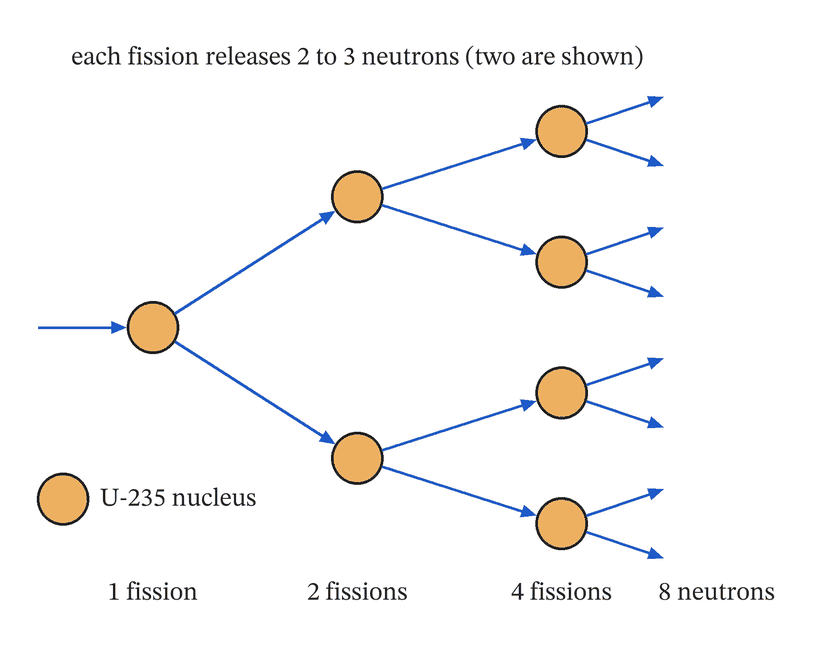
Step 2 — Describe the uncontrolled case. If more than one neutron from each fission causes another fission (), the number of fissions multiplies in every generation, as shown below. Since one generation takes a tiny fraction of a microsecond, an enormous energy is released almost at once, causing an explosion.
Step 3 — Give the example. This is what happens in an atomic (fission) bomb.
Therefore, an uncontrolled chain reaction is a fission chain reaction in which the number of fissions grows rapidly from generation to generation (), so that a huge energy is released in a very short time, as in an atom bomb.
- 382 marks
Question 38
What is multiplication factor?
Solve with AIWritten solution
Solution:
Concept: The multiplication factor of a chain reaction is
Step 1 — State the definition. The multiplication factor is the ratio of the number of neutrons in any one generation of the chain reaction to the number of neutrons in the preceding generation.
Step 2 — Explain its values. If the chain reaction is steady (critical); if it grows (supercritical); if it dies out (subcritical).
Therefore, the multiplication factor is .
- 392 marks
Question 39
What is critical size? What is the significance?
Solve with AIWritten solution
Solution:
Concept: Neutrons are produced throughout the volume of a piece of fissile material, but they escape through its surface. As the size increases, the volume grows faster than the surface area, so a smaller fraction of the neutrons escapes.
Step 1 — Define critical size. Critical size is the minimum size of the fissile material for which the number of neutrons produced in fission just balances the number lost by leakage through the surface and by non-fission capture, so that .
Step 2 — State its significance. If the size of the fissionable material is less than the critical size, too many neutrons escape and there is no chain reaction. A chain reaction can be sustained only when the size is equal to or greater than the critical size; this sets the minimum size of a reactor core, and in a bomb the material is kept in pieces smaller than the critical size until it is to explode.
Therefore, critical size is the minimum size of fissile material that can sustain a chain reaction; below it there is no chain reaction, at or above it a chain reaction can take place.
- 402 marks
Question 40
Explain the construction and working of an atom bomb.
Solve with AIWritten solution
Solution:
Concept: An atom bomb is based on an uncontrolled fission chain reaction () in a mass of fissile material (uranium-235 or plutonium-239) larger than the critical mass.
Step 1 — Describe the construction. The bomb contains two (or more) pieces of uranium-235, each smaller than the critical size, kept apart so that no chain reaction can start. A charge of ordinary (conventional) explosive is placed behind one piece, as in the simple gun-type design shown:
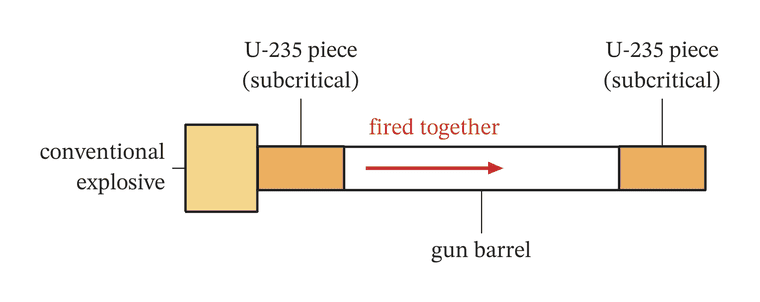
Step 2 — Explain how it is set off. When the conventional explosive is fired, it drives one piece along the barrel into the other at high speed. Together they form a single mass larger than the critical mass.
Step 3 — Explain the explosion. A stray neutron (or a neutron source) starts fission in the combined mass. Since the mass is supercritical, and the number of fissions multiplies in every generation. An enormous energy is released in about a microsecond, producing a huge explosion with intense heat and radiation. (In the other common design, the implosion type, a sphere of plutonium-239 is squeezed by surrounding explosives until it becomes supercritical.)
Therefore, an atom bomb holds subcritical pieces of fissile material that an ordinary explosive suddenly brings together into a supercritical mass, so that an uncontrolled fission chain reaction releases a huge energy almost instantly.
- 412 marks
Question 41
What is a nuclear reactor? What is its principle of working?
Solve with AIWritten solution
Solution:
Concept: The multiplication factor of a chain reaction is
Step 1 — Define a nuclear reactor. A nuclear reactor is a device in which nuclear energy is released at a steady, controlled rate by a fission chain reaction.
Step 2 — State its principle. It works on the principle of a controlled, self-sustaining fission chain reaction. The control rods absorb the extra neutrons so that, on average, exactly one neutron from each fission causes another fission (), and the rate of fission stays constant.
Therefore, a nuclear reactor is a device for producing nuclear energy at a steady rate, and it works on the principle of controlled self-sustaining fission chain reaction ().
- 422 marks
Question 42
What is meant by enriched uranium?
Solve with AIWritten solution
Solution:
Concept: Natural uranium is about 99.3 % uranium-238 and only about 0.7 % uranium-235, and only the uranium-235 undergoes fission with slow neutrons.
Step 1 — State the meaning. Uranium in which the percentage of uranium-235 has been increased above its natural value of about 0.7 % is called enriched uranium.
Step 2 — Give its use. Light-water reactors, such as the VVERs at Kudankulam, use uranium enriched to about 3–5 % uranium-235, because ordinary water absorbs too many neutrons for natural uranium to work.
Therefore, enriched uranium is uranium in which the percentage of uranium-235 is greater than in natural uranium, which contains only about 0.7 % of uranium-235.
- 432 marks
Question 43
What is a moderator? What are its characteristics?
Solve with AIWritten solution
Solution:
Concept: Fast fission neutrons (about 2 MeV) must be slowed to thermal energies (about 0.025 eV) before they can cause fission of uranium-235 efficiently.
Step 1 — Define a moderator. A moderator is a material used in a reactor to slow down fast neutrons to thermal energies by elastic collisions.
Step 2 — List its characteristics. A good moderator should:
- contain light nuclei (mass close to the neutron's), so that a neutron loses much energy in each collision;
- have a very small cross-section for absorbing neutrons;
- be stable, so that it does not react chemically or break down under radiation.
Step 3 — Give examples. Heavy water, graphite, ordinary water and beryllium are used as moderators.
Therefore, a moderator is a substance that slows fast neutrons to thermal energies; it should have light nuclei, absorb very few neutrons and be stable (for example heavy water and graphite).
- 442 marks
Question 44
Distinguish between a heterogeneous reactor and a homogeneous reactor.
Solve with AIWritten solution
Solution:
Concept: Reactors are classified by how the fuel and the moderator are arranged in the core.
Step 1 — Describe a heterogeneous reactor. In a heterogeneous reactor the fuel and the moderator are kept separate: the fuel is in the form of rods or bundles arranged in a regular pattern (lattice) inside the moderator. Almost all power reactors, including India's pressurised heavy water reactors, are of this type.
Step 2 — Describe a homogeneous reactor. In a homogeneous reactor the fuel and the moderator are mixed uniformly, for example a uranium salt dissolved in water, so the core is one uniform mixture.
Therefore, in a heterogeneous reactor the fuel is placed as separate rods in the moderator, while in a homogeneous reactor the fuel and moderator are mixed uniformly.
- 452 marks
Question 45
What are power reactors?
Solve with AIWritten solution
Solution:
Concept: A reactor turns nuclear energy into heat; a power reactor goes on to turn this heat into electricity.
Step 1 — State the definition. Nuclear reactors which are used for the production of electric power are called power reactors.
Step 2 — Explain how they work. The thermal energy produced during the sustained chain reaction is carried away by the coolant and used to make steam. The steam turns a turbine that drives an electric generator, so the heat is converted into electric energy.
Therefore, power reactors are nuclear reactors used for producing electric power, in which the heat from the sustained chain reaction is converted into electric energy.
- 462 marks
Question 46
What is meant by critical mass?
Solve with AIWritten solution
Solution:
Concept: For a given fissile material and shape, a chain reaction is just sustained when the piece has the critical size.
Step 1 — State the meaning. The mass of fissionable material corresponding to the critical size is called the critical mass.
Step 2 — State its significance. When the mass is less than the critical mass, too many neutrons escape and there is no chain reaction. When it is greater than the critical mass, the chain reaction can grow.
Therefore, critical mass is the mass of fissionable material corresponding to the critical size; with less than this mass there is no chain reaction.
- 472 marks
Question 47
What are control rods? Give an example.
Solve with AIWritten solution
Solution:
Concept: The rate of fission in a reactor depends on the number of neutrons available, so it can be controlled by absorbing neutrons.
Step 1 — Define control rods. Control rods are rods of a strongly neutron-absorbing material that are moved into or out of the reactor core to control the rate of fission. Pushing them in absorbs more neutrons and slows the reaction; pulling them out speeds it up.
Step 2 — Give an example. Cadmium or boron rods are used as control rods.
Therefore, control rods are neutron-absorbing rods used to control the chain reaction in a reactor; for example, cadmium or boron rods.
- 482 marks
Question 48
Draw a labelled diagram of a nuclear power reactor.
Solve with AIWritten solution
Solution:
Concept: A nuclear power reactor produces heat by a controlled fission chain reaction and converts it into electricity through steam, a turbine and a generator.
Step 1 — Draw the reactor core. The core holds the fuel rods (uranium) in the moderator, with control rods that can be moved in and out. It is enclosed in a steel vessel and a thick concrete shield.
Step 2 — Draw the heat-transfer circuit. The coolant is pumped through the core, carries the heat to the steam generator (heat exchanger), and returns.
Step 3 — Draw the electricity-generating circuit. In the steam generator, water is turned into steam, which drives a turbine coupled to an electric generator. The steam is condensed in the condenser and pumped back. The labelled diagram is:
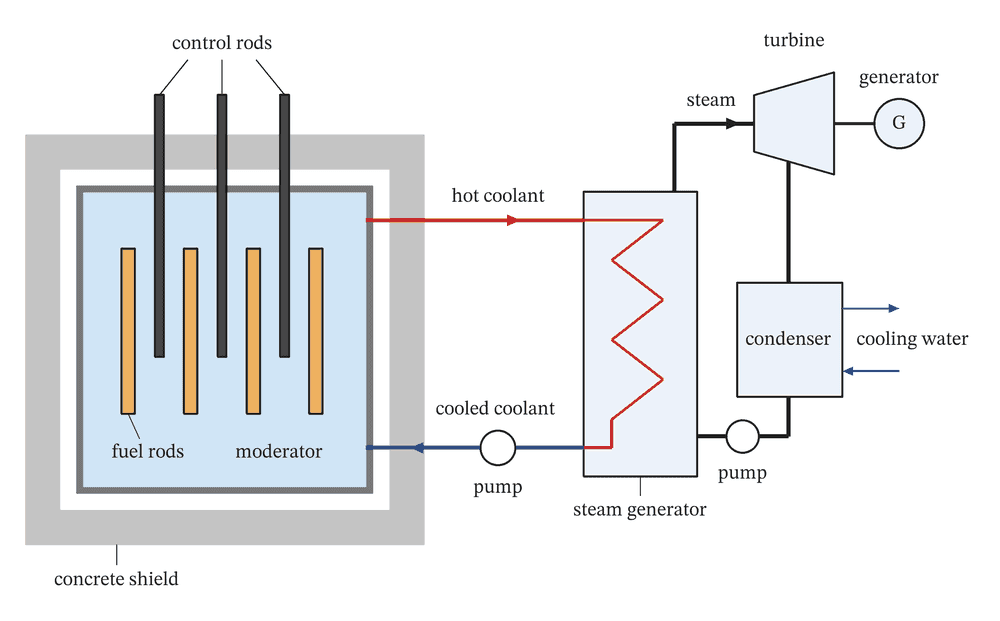
Therefore, the labelled diagram shows the fuel rods, moderator, control rods, coolant, concrete shield, steam generator, turbine, generator, condenser and pumps of a nuclear power reactor.
- 492 marks
Question 49
Mention three uses of a reactor.
Solve with AIWritten solution
Solution:
Concept: A reactor gives out a large amount of heat and a very large number of neutrons; both are useful.
Step 1 — Use the heat. Reactors are used to generate electric power (and to power ships and submarines).
Step 2 — Use the neutrons to make isotopes. Reactors produce radioisotopes, such as cobalt-60 and iodine-131, used in medicine, agriculture and industry.
Step 3 — Use the neutrons for research and fuel. Reactors are used for research with neutron beams, and breeder reactors convert uranium-238 (or thorium-232) into new fissile fuel such as plutonium-239 (or uranium-233).
Therefore, three uses of a reactor are: generating electric power, producing radioisotopes, and research (including breeding new fissile fuel).
- 502 marks
Question 50
What is a breeder reactor?
Solve with AIWritten solution
Solution:
Concept: A fertile nucleus, such as uranium-238 or thorium-232, becomes a fissile nucleus after it absorbs a neutron and undergoes two β-decays.
Step 1 — State the definition. A breeder reactor is a reactor that produces more fissile material than it consumes. Some of the neutrons from fission are absorbed by fertile material placed around the core, turning it into new fuel.
Step 2 — Show the breeding reaction. In a fast breeder reactor, uranium-238 is converted into plutonium-239:
Step 3 — Give India's example. India's Fast Breeder Test Reactor and the 500 MWe Prototype Fast Breeder Reactor at Kalpakkam belong to the second stage of India's three-stage nuclear programme, which aims to use thorium in the third stage.
Therefore, a breeder reactor is a nuclear reactor which produces more fissile fuel (such as plutonium-239 from uranium-238) than it consumes.
- 512 marks
Question 51
What are transuranic elements? Give examples.
Solve with AIWritten solution
Solution:
Concept: Uranium has atomic number , the highest of the elements found in useful amounts in nature.
Step 1 — State the definition. Transuranic elements are elements with atomic number greater than 92. They are made artificially, mostly in reactors and accelerators (only traces of neptunium and plutonium occur in uranium ores), and all of them are radioactive.
Step 2 — Give examples. Neptunium (), plutonium (), americium () and curium () are transuranic elements.
Therefore, transuranic elements are the elements beyond uranium (), for example neptunium and plutonium.
- 522 marks
Question 52
What is nuclear fusion?
Solve with AIWritten solution
Solution:
Concept: Light nuclei have a low binding energy per nucleon, so joining them usually forms a more tightly bound nucleus and releases energy.
Step 1 — State the definition. Nuclear fusion is the process in which two or more light nuclei combine to form a heavier nucleus, with the release of a large amount of energy.
Step 2 — Give an example. Deuterium and tritium fuse to form helium:
Therefore, nuclear fusion is the combining of light nuclei to form a heavier nucleus with the release of energy.
- 532 marks
Question 53
What are thermonuclear reactions? Why are they called so?
Solve with AIWritten solution
Solution:
Concept: For two nuclei to fuse, they must come close enough for the nuclear force to act, which needs enough kinetic energy to overcome their electrostatic repulsion.
Step 1 — Define thermonuclear reactions. Fusion reactions that take place at extremely high temperatures, of the order of K or more, are called thermonuclear reactions.
Step 2 — Explain the name. At such temperatures the nuclei get the large kinetic energy they need simply from the heat (thermal motion) of the material. Because the nuclear reactions are caused by thermal energy, they are called thermonuclear reactions.
Therefore, thermonuclear reactions are fusion reactions occurring at very high temperatures; they are so called because the energy needed to overcome the repulsion between nuclei is supplied as heat.
- 542 marks
Question 54
“For nuclear fusion to take place, very high temperatures are necessary”. Why?
Solve with AIWritten solution
Solution:
Concept: Nuclei are positively charged, so they repel each other (Coulomb repulsion). The attractive nuclear force acts only when they are within about m of each other.
Step 1 — State what fusion needs. For two nuclei to fuse, they must approach each other very closely, so they must have enough kinetic energy to overcome the Coulomb repulsion.
Step 2 — Link this to temperature. The kinetic energy of particles increases with temperature. Only at very high temperatures (about K and above) do enough nuclei have sufficient energy. At these temperatures the atoms are completely ionised, so the matter is a plasma of bare nuclei and free electrons.
Therefore, very high temperatures are needed so that the nuclei have enough kinetic energy to overcome the Coulomb repulsion between them and come close enough to fuse.
- 552 marks
Question 55
What is thermonuclear energy?
Solve with AIWritten solution
Solution:
Concept: Thermonuclear reactions are fusion reactions made possible by an extremely high temperature.
Step 1 — State the meaning. Thermonuclear energy is the energy released in thermonuclear (fusion) reactions. These reactions take place only in matter heated to many millions of kelvin, where the matter is in the plasma state (bare nuclei and free electrons).
Step 2 — Explain why heat is needed and where the energy comes from. The very high temperature gives the nuclei enough kinetic energy to overcome their electric repulsion and come close enough to fuse. The heat of the plasma only makes the reactions possible; the energy released comes from the mass lost when light nuclei fuse into a more tightly bound nucleus.
Step 3 — Give examples. Thermonuclear energy is the source of the energy of the Sun and the other stars, where hydrogen fuses into helium. It is also the energy of the hydrogen bomb.
Note: The book calls thermonuclear energy the energy of a substance in the plasma state. More precisely, it is the energy that the fusion reactions in the plasma release.
Therefore, thermonuclear energy is the energy released by fusion reactions that take place at very high temperatures in a plasma, as in the Sun and the stars.
- 562 marks
Question 56
What is stellar energy?
Solve with AIWritten solution
Solution:
Concept: Stars have extremely hot, dense cores in which light nuclei can fuse.
Step 1 — State the meaning. Stellar energy is the energy radiated by the Sun and the other stars.
Step 2 — Give its source. It is produced by thermonuclear fusion in the stars' cores, mainly the fusion of hydrogen into helium.
Therefore, stellar energy is the energy radiated by the Sun and stars, produced by nuclear fusion (mainly of hydrogen into helium) in their cores.
- 572 marks
Question 57
Explain the production of energy in Sun and stars.
Solve with AIWritten solution
Solution:
Concept: The core of the Sun is at about K and is very dense, so hydrogen nuclei (protons) can overcome their repulsion and fuse into helium.
Step 1 — Write the proton–proton chain. In the Sun and smaller stars the main process is the proton–proton chain:
Step 2 — Add up the chain. The first two reactions happen twice for each helium nucleus formed. Adding the reactions gives the net result:
Here the 26.7 MeV includes the energy from the two positrons annihilating with electrons.
Step 3 — Mention the carbon–nitrogen cycle. In stars more than about 1.3 times as massive as the Sun, whose cores are hotter, hydrogen is fused into helium mainly by the carbon–nitrogen–oxygen (CNO) cycle, in which carbon acts as a catalyst; the net result and energy are the same.
Step 4 — Describe the scale. The Sun converts about kg of hydrogen into helium every second, losing about kg of mass per second as radiated energy.
Therefore, the Sun and stars produce energy by thermonuclear fusion of hydrogen into helium (by the proton–proton chain and the CNO cycle) in their hot cores, each helium nucleus formed releasing about 26.7 MeV.
- 582 marks
Question 58
Write a note on nuclear holocaust.
Solve with AIWritten solution
Solution:
Concept: A nuclear holocaust means destruction on a vast scale caused by the use of nuclear weapons in a war.
Step 1 — Describe the immediate effects. A nuclear explosion releases a huge energy in an instant. Its blast flattens buildings, its heat starts fires and burns people kilometres away, and its intense radiation kills or injures those exposed. The two atomic bombs used on Hiroshima and Nagasaki in August 1945 killed well over a hundred thousand people.
Step 2 — Describe the after-effects. Radioactive fallout spreads over large areas and causes radiation sickness, cancers and genetic damage for many years. Studies suggest that a large nuclear war would throw so much smoke and soot into the atmosphere that sunlight would be blocked, temperatures would fall and crops would fail ("nuclear winter"), threatening people far from the war.
Step 3 — State the present danger. About 12,000 nuclear warheads exist in the world (2025 estimate), many far more powerful than the 1945 bombs. This is why treaties to limit and reduce nuclear weapons, and to stop their spread, are so important.
Therefore, a nuclear holocaust is the large-scale destruction of life and the environment that a nuclear war would cause through blast, heat, radiation, fallout and climate effects; preventing it requires nuclear disarmament.
- 592 marks
Question 59
Explain the construction of hydrogen bomb.
Solve with AIWritten solution
Solution:
Concept: A hydrogen (thermonuclear) bomb is based on the principle of nuclear fusion of isotopes of hydrogen, which needs a temperature of many millions of kelvin.
Step 1 — Describe the parts. A hydrogen bomb contains a fission (atom) bomb, which acts as the trigger, and the fusion fuel, usually solid lithium-6 deuteride, inside a heavy casing:
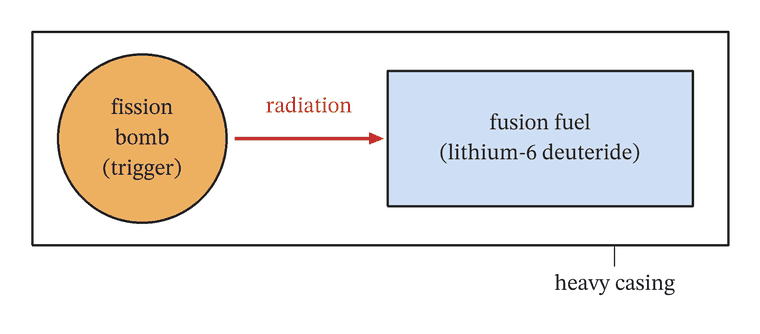
Step 2 — Explain the trigger. When the fission bomb explodes, its radiation produces a temperature of tens of millions of kelvin and a very high pressure in the fusion fuel.
Step 3 — Explain the fusion stage. Neutrons from the fission convert lithium-6 into tritium:
The deuterium and tritium then fuse:
Step 4 — Compare its power. Since there is no critical mass for fusion fuel, a hydrogen bomb can be made far more powerful than a fission bomb.
Note: in many designs the fast neutrons from the fusion stage also split the heavy casing of uranium-238, and this fission can add a large share of the total energy; the bomb is still named after its fusion stage.
Therefore, a hydrogen bomb consists of a fission bomb (trigger) and fusion fuel (deuterium with lithium, which provides tritium) in a heavy casing; the fission explosion produces the very high temperature at which the hydrogen isotopes fuse and release enormous energy.
- 603 marks
Question 60
Draw the graph showing the variation of binding energy per nucleon with mass number and explain the cause of fission and fusion.
Solve with AIWritten solution
Solution:
Concept: The binding energy per nucleon, , measures how tightly a nucleus is bound. A nuclear reaction releases energy when its products have a greater total binding energy than the reactants.
Step 1 — Draw the graph. We plot the binding energy per nucleon (in MeV) against the mass number , using measured nuclear masses:
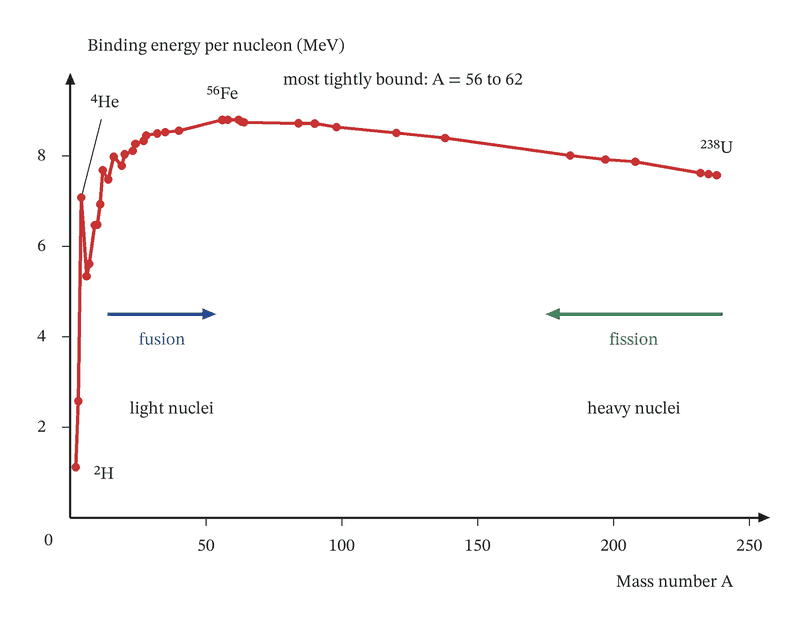
Step 2 — Describe the curve. The binding energy per nucleon:
- is small for light nuclei (about 1.1 MeV for deuterium) and rises steeply with , with a sharp peak at helium-4 (about 7.1 MeV);
- reaches a broad maximum of about 8.8 MeV near to (iron and nickel), the most stable nuclei;
- falls slowly for heavier nuclei, to about 7.6 MeV for uranium-238.
Step 3 — Explain the cause of fission. A heavy nucleus such as uranium-235 (about 7.6 MeV per nucleon) splits into two middle-weight nuclei that lie near the peak (about 8.5 MeV per nucleon). The nucleons become more tightly bound, so the total binding energy increases by roughly MeV. This rough estimate agrees with the measured energy of about 200 MeV per fission, and this energy is released.
Step 4 — Explain the cause of fusion. Two very light nuclei, which lie on the steep rising part of the curve, join to form a heavier nucleus that usually has a much greater binding energy per nucleon (for example deuterium at 1.1 MeV and helium-4 at 7.1 MeV per nucleon). Again the total binding energy increases, and the increase is released as energy.
Therefore, both fission of heavy nuclei and fusion of light nuclei move the nucleons towards the peak of the binding-energy curve (near ), so the products are more tightly bound and the gain in binding energy is released.
- 613 marks
Question 61
What is uncontrolled chain reaction? Explain the working of a fission bomb.
Solve with AIWritten solution
Solution:
Concept: The multiplication factor of a chain reaction is
Step 1 — Explain the uncontrolled chain reaction. Each fission of uranium-235 gives out 2 to 3 neutrons. If more than one of them, on average, causes a further fission (), the number of fissions grows rapidly from one generation to the next (1, 2 and 4 fissions, then 8 neutrons, in the figure). This is an uncontrolled chain reaction:
Step 2 — Estimate how fast it grows. A generation of neutrons lasts only about s, so in less than a microsecond there can be about 80 generations. With , eighty generations give fissions, so an enormous energy is released almost at once.
Step 3 — Describe the construction of a fission bomb. A uranium fission (atom) bomb of the gun type contains uranium-235 in pieces, each smaller than the critical size, so that no chain reaction can start. A conventional explosive is placed so that it can drive the pieces together:
Step 4 — Explain its working. When the conventional explosive is fired, it drives the subcritical pieces together very quickly into one mass larger than the critical mass. A stray neutron (or a neutron source) starts fission, and since an uncontrolled chain reaction follows. The energy of the fissions is released in about a microsecond, producing a very high temperature and pressure, a huge blast, and intense heat and radiation.
Note: A plutonium-239 bomb, like the one dropped on Nagasaki, cannot use this gun design, because stray neutrons from spontaneous fission (of plutonium-240 in the fuel) would start the chain reaction before the pieces had fully met. Instead, explosives placed all round a subcritical sphere of plutonium squeeze it inwards (implosion) until it becomes supercritical.
Therefore, an uncontrolled chain reaction is one in which the number of fissions multiplies every generation (); a fission bomb works by suddenly making a supercritical mass of fissile material, by firing subcritical pieces of uranium-235 together (gun type) or by squeezing a subcritical plutonium core (implosion), so that such a chain reaction releases enormous energy in an instant.
- 623 marks
Question 62
Draw a labelled diagram of a nuclear reactor, stating the function of each part.
Solve with AIWritten solution
Solution:
Concept: A nuclear reactor carries out a controlled, self-sustaining fission chain reaction () and turns the energy released into heat (and, in a power reactor, into electricity).
Step 1 — Draw the labelled diagram. The diagram of a nuclear power reactor is:
Step 2 — State the function of each part of the reactor itself. The parts inside the shield are:
- Fuel rods (uranium-235, natural or enriched uranium): fission takes place in them and releases energy and neutrons.
- Moderator (heavy water, graphite or ordinary water): slows down the fast fission neutrons to thermal energies so that they can cause further fission.
- Control rods (cadmium or boron): absorb neutrons; moved in or out to start, control or stop the chain reaction and keep .
- Coolant (water, heavy water, liquid sodium or a gas): carries the heat produced in the core to the steam generator.
- Concrete shield (with the steel vessel): stops the dangerous radiation from escaping.
Step 3 — State the function of the parts that produce electricity. The parts outside the shield are:
- Steam generator (heat exchanger): uses the heat of the coolant to turn water into steam.
- Turbine and generator: the steam turns the turbine, which drives the generator to produce electricity.
- Condenser and pumps: the condenser turns the used steam back into water, and the pumps keep the coolant and the water circulating.
Therefore, the reactor consists of fuel rods (fission), moderator (slows neutrons), control rods (absorb neutrons), coolant (removes heat) and shield (stops radiation), connected through a steam generator to a turbine and generator that produce electricity.
- 633 marks
Question 63
(a) Write a balanced equation showing nuclear fission of uranium nucleus.
(b) Heavy water is a suitable moderator in a nuclear reactor. Explain briefly.
Solve with AIWritten solution
Solution:
Concept: In a nuclear reaction both the mass number and the charge number are conserved. A moderator slows fast neutrons by elastic collisions and must absorb very few of them.
Step 1 — Write the fission equation (a). When uranium-235 absorbs a slow neutron, it can split in many ways. One of them is shown below:
Here MeV is the energy released.
Step 2 — Check that it is balanced (a). The mass numbers add up to the same total on both sides:
The charge numbers also agree:
Step 3 — Explain why heavy water is suitable (b). Heavy water () contains deuterium nuclei, which are light (only about twice the mass of a neutron), so a fast neutron loses a large part of its energy in each elastic collision and is slowed to thermal energy in a few tens of collisions. Deuterium has a very small cross-section for capturing neutrons, so very few neutrons are lost. Because so few neutrons are absorbed, natural uranium can be used as the fuel, as in India's pressurised heavy water reactors.
Therefore, (a) ; (b) heavy water is a good moderator because its light deuterium nuclei slow neutrons quickly while absorbing very few of them.
- 643 marks
Question 64
In a nuclear reactor, what is the function of the following?
(a) The moderator
(b) The control rods
(c) Coolants
Solve with AIWritten solution
Solution:
Concept: A reactor keeps a fission chain reaction going steadily () and removes the heat it produces. Each of these three parts serves one of these aims.
Step 1 — Give the function of the moderator (a). The moderator (heavy water, graphite or ordinary water) slows down the fast neutrons produced in fission to thermal energies (about 0.025 eV) by elastic collisions, so that they can cause further fission of uranium-235.
Step 2 — Give the function of the control rods (b). The control rods (cadmium or boron) absorb neutrons. By moving them into or out of the core, the number of neutrons, and so the rate of fission, is controlled: the reactor can be started, kept steady at , or shut down.
Step 3 — Give the function of the coolant (c). The coolant (ordinary water, heavy water, liquid sodium or a gas such as carbon dioxide) flows through the core and carries away the heat produced by fission. This keeps the core from overheating, and the heat is used to produce steam for generating electricity.
Therefore, (a) the moderator slows down fast neutrons, (b) the control rods absorb neutrons to control the rate of fission, and (c) the coolant removes the heat from the core and carries it to where it is used.
- 655 marks
Question 65
(a) What is nuclear fission?
(b) Explain controlled chain reaction.
(c) Explain the working of a nuclear power reactor.
Solve with AIWritten solution
Solution:
Concept: A heavy nucleus that splits releases energy and neutrons; these neutrons can cause further fissions, and a reactor keeps this chain reaction steady while using the heat to produce electricity.
Step 1 — Define nuclear fission (a). Nuclear fission is the splitting of a heavy nucleus into two lighter nuclei of comparable size, with the release of a large amount of energy (about 200 MeV) and 2 to 3 neutrons. For example, uranium-235 can split as follows:
Step 2 — Explain a chain reaction (b). The neutrons released in one fission can cause fission in other uranium-235 nuclei, which release more neutrons, and so on. The multiplication factor is the number of neutrons in one generation divided by the number in the generation before.
Step 3 — Explain how the chain reaction is controlled (b). In a controlled chain reaction, of the 2 to 3 neutrons released in each fission, some escape and the control rods absorb the extra ones, so that on average exactly one neutron causes the next fission (). The rate of fission, and so the power, then stays constant:
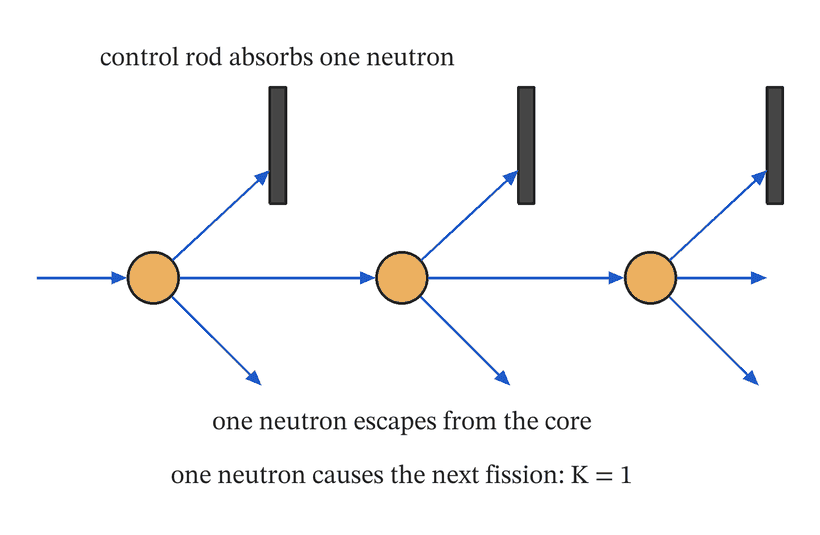
This is possible because a small fraction of the neutrons (the delayed neutrons) appear seconds after fission, which gives time to move the control rods.
Step 4 — Describe the core of a power reactor (c). The core holds fuel rods of uranium in a moderator, which slows the neutrons, and control rods that keep . It is surrounded by a steel vessel and a thick concrete shield:
Step 5 — Explain how the heat becomes electricity (c). The energy of fission appears as heat in the fuel rods. A coolant is pumped through the core and carries this heat to the steam generator (heat exchanger), where it turns water into steam. The steam drives a turbine, which turns an electric generator. The used steam is condensed back to water in the condenser and pumped back to the steam generator, and the cooled coolant returns to the core.
Therefore, (a) fission is the splitting of a heavy nucleus into two lighter nuclei with release of energy and neutrons; (b) in a controlled chain reaction the extra neutrons are absorbed so that and the fission rate is steady; (c) in a power reactor the heat of this controlled fission is carried by the coolant to make steam, which drives a turbine and generator to produce electricity.
- 665 marks
Question 66
(a) What is nuclear fusion?
(b) Explain the production of stellar energy.
(c) What are the advantages of fusion over fission?
Solve with AIWritten solution
Solution:
Concept: Light nuclei have a small binding energy per nucleon, so joining them into a heavier nucleus usually increases the total binding energy and releases energy; very high temperatures are needed so that the nuclei can overcome their repulsion.
Step 1 — Define nuclear fusion (a). Nuclear fusion is the process in which two or more light nuclei combine to form a heavier nucleus, with the release of a large amount of energy. One example is the fusion of deuterium and tritium:
Step 2 — State the source of stellar energy (b). The Sun and stars produce their energy by thermonuclear fusion of hydrogen into helium in their cores, where the temperature is about K (in the Sun) and the density is very high.
Step 3 — Write the proton–proton chain (b). In the Sun the main process is the proton–proton chain:
Step 4 — Give the net result (b). The first two reactions occur twice for every helium nucleus formed, so the net result is
In stars more than about 1.3 times as massive as the Sun, whose cores are hotter, hydrogen is fused into helium mainly by the carbon–nitrogen–oxygen (CNO) cycle, with the same net result. The Sun turns about kg of hydrogen into helium every second.
Step 5 — Compare the energy per unit mass (c). Fusion gives more energy per unit mass of fuel. The deuterium–tritium reaction releases 17.6 MeV for 5 nucleons, about 3.5 MeV per nucleon, while the fission of uranium-235 releases about 200 MeV for 236 nucleons, about 0.85 MeV per nucleon, roughly four times less.
Step 6 — Give the other advantages (c). Fusion has further advantages:
- Fuel supply: deuterium is plentiful in sea water, and tritium can be made from lithium, whereas uranium-235 is scarce.
- Waste: fusion produces much less long-lived radioactive waste; its main product, helium, is not radioactive, although tritium and the neutron-activated walls of the reactor do need safe handling.
- Safety: there is no chain reaction that can run away; if anything goes wrong, the hot plasma cools and the reaction simply stops.
- No weapons material: fusion fuel cannot be used to make plutonium for bombs.
Watch out: Controlled fusion power has not yet been achieved on a commercial scale. Large experiments such as ITER, a tokamak (a doughnut-shaped magnetic container for the plasma) being built in France with India as a partner, are working towards it.
Therefore, (a) fusion is the joining of light nuclei into a heavier nucleus with the release of energy; (b) stars produce energy by fusing hydrogen into helium (proton–proton chain and CNO cycle), with about 26.7 MeV released for every helium nucleus; (c) fusion gives more energy per unit mass of fuel, uses plentiful fuel, leaves much less long-lived radioactive waste and cannot run away like a chain reaction.
- 675 marks
Question 67
(a) Distinguish between fission and fusion.
(b) What is (i) critical size and (ii) multiplication factor?
(c) What are the conditions required to maintain the chain reaction?
Solve with AIWritten solution
Solution:
Concept: Fission splits heavy nuclei and fusion joins light ones; a fission chain reaction keeps going only if, on average, at least one neutron from each fission causes another fission.
Step 1 — Distinguish fission from fusion (a). The two processes differ in these ways:
- Nuclei involved: in fission a heavy nucleus (such as uranium-235) splits into two lighter nuclei; in fusion light nuclei (such as deuterium and tritium) join to form a heavier nucleus.
- Conditions: fission is started by a slow neutron at ordinary temperatures; fusion needs a temperature of about K or more.
- Energy: about 200 MeV per fission (about 0.85 MeV per nucleon); about 17.6 MeV per deuterium–tritium fusion (about 3.5 MeV per nucleon), so fusion gives more energy per unit mass.
- Products: fission gives radioactive fragments and long-lived waste; fusion gives mainly helium, which is not radioactive.
- Use and control: fission is used in nuclear reactors and the atom bomb and can be controlled; fusion powers the Sun and the hydrogen bomb, and controlled fusion for power is still being developed.
Step 2 — Define critical size (b)(i). Critical size is the minimum size of a piece of fissile material for which the number of neutrons produced by fission just balances the number lost by leakage and non-fission capture, so that a chain reaction is just sustained.
Step 3 — Define the multiplication factor (b)(ii). The multiplication factor is
For a steady chain reaction ; if the reaction grows, and if it dies out.
Step 4 — State the conditions for a chain reaction (c). A chain reaction can be maintained only if:
- the amount of fissile material is at least the critical size (critical mass), so that not too many neutrons leak out;
- the multiplication factor is at least 1, and exactly 1 for a steady reaction (adjusted with control rods);
- in a thermal reactor, a moderator slows the fast neutrons to thermal energies, and the fuel has enough uranium-235 (natural uranium with heavy water, or enriched uranium with ordinary water);
- neutron losses are kept small: impurities that absorb neutrons are removed and a reflector sends escaping neutrons back.
Therefore, (a) fission splits a heavy nucleus while fusion joins light nuclei (needing very high temperature and giving more energy per unit mass); (b) critical size is the minimum size of fissile material that sustains a chain reaction, and the multiplication factor is the ratio of neutrons in one generation to those in the previous one; (c) the chain reaction is maintained when the fissile material is at least of critical size and , with slow neutrons and small neutron losses.
- 683 marks
Question 68
The efficiency of a reactor is 30% in which fissions are occurring each second and the energy per fission is 220 MeV. What is the useful power generated by the reactor?
Solve with AIWritten solution
Solution:
Concept: The power released in a reactor is (number of fissions per second) × (energy per fission). The useful power is the efficiency times this power. One MeV is J.
Step 1 — Convert the energy per fission to joules. We multiply 220 MeV by J per MeV:
Step 2 — Find the total power released. There are fissions each second, so the energy released each second is:
Step 3 — Apply the efficiency. Only 30% of this power is useful:
Therefore, the useful power generated is 1056 W.
- 693 marks
Question 69
Bombay requires 3000 MWh of electric energy per day. It is to be supplied by a reactor which converts nuclear energy into electric energy with an efficiency of 20%. If reactor uses nuclear fuel of U, calculate the mass of U needed for one day's operation.
Solve with AIWritten solution
Solution:
Concept: One mole of uranium-235 has a mass of 235 g and contains Avogadro's number, , of atoms. So a mass (in grams) of uranium-235 contains nuclei, and each fission releases about 200 MeV.
Step 1 — State the assumption. The stem does not give the energy per fission, so we take the usual value of 200 MeV ( J) per fission.
Step 2 — Convert the electric energy to joules. One MWh is , so:
Step 3 — Find the nuclear energy needed. Only 20% of the nuclear energy becomes electric energy, so we divide by 0.20:
Step 4 — Find the number of fissions. We divide by the energy of one fission:
Step 5 — Convert the number of nuclei to a mass. We divide by Avogadro's number to get moles, then multiply by 235 g per mole:
This is 0.658 kg. To two significant figures it is 0.66 kg.
Note: the 3000 MWh a day in the question is an old textbook figure. A city of Mumbai's (Bombay's) size now needs far more: its peak demand is several thousand megawatts (mid-2020s), or tens of thousands of MWh a day. The method stays the same.
Therefore, about 0.66 kg (0.658 kg) of uranium-235 is needed for one day's operation, as printed (0.660 kg).
- 703 marks
Question 70
What is the power output of a reactor if it takes 30 days to use up 2 kg of fuel and if each fission gives 185 MeV of usable energy?
Solve with AIWritten solution
Solution:
Concept: One mole of uranium-235 has a mass of 235 g and contains Avogadro's number, , of atoms. So a mass (in grams) of uranium-235 contains nuclei. Here each fission gives 185 MeV of usable energy.
Step 1 — Find the number of nuclei in 2 kg. We use 2 kg = 2000 g:
Step 2 — Find the usable energy. Each fission gives 185 MeV, or J, so we multiply:
Step 3 — Find the time in seconds. Thirty days contain:
Step 4 — Divide the energy by the time. The power output is:
Therefore, the power output is about 58.5 MW.
- 713 marks
Question 71
Find the mass of helium nucleus formed in the following fusion reaction, if the energy released is J.
Mass of deuterium nucleus kg, mass of tritium nucleus kg, mass of neutron kg.
Solve with AIWritten solution
Solution:
Concept: The energy released in the reaction comes from the loss of mass: , where is the total mass of the reactants minus the total mass of the products.
Step 1 — Find the mass that disappears. We divide the released energy by , with :
Step 2 — Write the mass balance. The reactants' mass equals the products' mass plus , so the helium mass is:
Step 3 — Put in the numbers. First we combine the three given masses:
Then we subtract kg:
Therefore, the mass of the helium nucleus is about kg.
- 723 marks
Question 72
A possible fusion reaction is represented by the equation .
(a) Identify the nuclide .
(b) Calculate the atomic mass of in amu. Given amu, amu, amu.
Solve with AIWritten solution
Solution:
Concept: In a nuclear reaction the mass number and the charge number are conserved. The energy released equals the mass lost times ; 1 amu (u) of mass is equivalent to 931.5 MeV.
Step 1 — Identify X for part (a). We balance the mass numbers first and then the charge numbers:
A nuclide with and is helium-4, .
Step 2 — Write the mass balance. The mass of the reactants equals the mass of the products plus the mass equivalent of the 17.6 MeV released:
Step 3 — Combine the given masses. We add the two hydrogen masses and subtract the neutron:
Step 4 — Find the mass equivalent of the energy. We divide 17.6 MeV by 931.5 MeV per u:
Step 5 — Subtract to find the mass of X. This gives:
Therefore, (a) X is , and (b) its atomic mass is 4.0026 amu.
- 734 marks
Question 73
A fusion reaction taking place in a fusion power reactor is .
(a) Find and
(b) if the mass of deuterium nucleus is 2.015 u, that of is 3.017 u and that of neutron is 1.0094, calculate the energy released by the fusion of 1 kg of deuterium. If 50% of this energy were used to produce 1 MW of electricity continuously, for how many days would the station be able to function? ()
Solve with AIWritten solution
Solution:
Concept: In a nuclear reaction mass number and charge are conserved. The energy released in one reaction is . The number of reactions in 1 kg of deuterium is half the number of deuterium nuclei in it, because each reaction uses two of them. We take 1 u kg.
Step 1 — Identify A for part (a). Let the particle have mass number and charge number (the stem already uses the letter A for the particle). We balance the mass numbers first and then the charge numbers:
A particle of mass number 1 and charge 0 is a neutron, .
Step 2 — Find the mass defect of one reaction. We subtract the mass of the products from that of two deuterium nuclei:
Step 3 — Find the energy of one reaction. We change the mass to kilograms and multiply by :
Step 4 — Count the reactions in 1 kg of deuterium. One deuterium nucleus has a mass of kg, so 1 kg contains:
Each reaction uses two nuclei, so the number of reactions is .
Step 5 — Find the energy from 1 kg. We multiply the number of reactions by the energy of one reaction:
Step 6 — Find how long the station runs. Half of this energy, J, is used at the rate of 1 MW :
We divide by 86400 s per day:
Note: the book's printed answer, J and 520 days, comes from taking the neutron mass as 1.009 u (as in ISC Question 9). Then u, the energy from 1 kg is about J, and half of J lasts s, about 520 days. With the neutron mass printed in the question, 1.0094 u, the values are as worked above.
Therefore, (a) A is a neutron, ; (b) with the masses as printed, 1 kg of deuterium releases about J and the station runs for about 465 days (with a neutron mass of 1.009 u, about J and 520 days, as printed).
- 743 marks
Question 74
A positron and an electron with negligible kinetic energy annihilate to produce two photons. What are the new frequencies? Mass of electron kg.
- 753 marks
Question 75
It is proposed to use the nuclear fusion reaction
in a nuclear reactor of 200 MW rating. If the energy from the above reaction is used with a 25% efficiency in the reactor, how many grams of the deuterium fuel will be needed per day? The masses of and are 2.0141 and 4.0026 respectively.
- 763 marks
Question 76
A nuclear reactor using as fuel is operating at a power level of 2.5 kW. What is the fission rate (i.e., number of fissions per second), assuming that 200 MeV energy is released in the fission of a single nucleus?
- 773 marks
Question 77
Calculate the energy liberated when a nucleus of is produced
(i) by fusing two neutrons and
(ii) by fusing two deuterium nuclei .
Why is the quantity of energy different in the two cases?
[Neutron mass u, proton mass u, deuterium mass u, helium mass u.]
- 783 marks
Question 78
Calculate the energy released in the reaction
The binding energies per nucleon in Li and He are known to be equal to 5.60 and 7.06 MeV respectively.
- 793 marks
Question 79
An electron positron pair is produced by a -ray of 2.22 MeV. How much kinetic energy is imparted to each particle? Rest mass of electron or positron u.
- 803 marks
Question 80
A fusion reaction is given as
What is the -value of this reaction? Is such a fusion energetically favourable? Atomic mass of Be is 8.0053 u and that He is 4.0026 u.
What Class 12 Physics Ch 29 covers
The sections of the chapter, in the order the book takes them. Every question above comes from one of these.
- 01Binding Energy Curve and Nuclear Energy
- 02Nuclear Fission
- 03Chain Reaction and Critical Size
- 04Nuclear Reactor
- 05Nuclear Fusion
- 06Energy of Stars
More ways to study this chapter
The same chapter asked three other ways. Practise it, revise it, and see what the board has set on Ch 29 before.
- Competency-Based Questions (CBQ)Case study questions: a situation, and the part of the chapter that answers it.40questionsOpen
- Previous Year QuestionsQuestions that have actually appeared in board papers, each tagged with its year.11questionsOpen
- Practice QuestionsExtra questions per chapter, for when one attempt at a method is not enough.101questionsOpen
Ch 29 in past ISC papers
The same chapter as the board has actually asked it. These are worded differently from the textbook exercise, which is the point of reading them.
- 11 mark
Board paper question 1
Write any one balanced equation representing nuclear fission.
Solve with AIWritten solution
Solution:
Key idea: In nuclear fission a heavy nucleus, such as uranium-235, absorbs a slow neutron and splits into two lighter nuclei of comparable mass, releasing two or three fast neutrons and a large amount of energy. In a balanced nuclear equation the mass numbers and the charge numbers add up to the same totals on both sides.
Step 1 — Write the equation.
A slow neutron is absorbed by a uranium-235 nucleus, which splits into barium-141 and krypton-92 and sets free three neutrons.
Step 2 — Check the balance.
We check that the equation is balanced. The total mass number (number of nucleons) must be the same on both sides.
The total charge number (number of protons) must also be the same on both sides.
Both totals agree, so the equation is balanced. On average, each fission of uranium-235 releases about of energy.
Therefore, one fission equation is ²³⁵U + n → ¹⁴¹Ba + ⁹²Kr + 3n + energy (about 200 MeV).
- 21 mark
Board paper question 2
In a nuclear reactor, what is the function of a moderator?
Solve with AIWritten solution
Solution:
Key idea: Uranium-235 undergoes fission most readily when it absorbs a slow (thermal) neutron, but the neutrons released in fission are fast, with energies of about .
Step 1 — State the problem the moderator solves.
Fast neutrons are very unlikely to cause a fresh fission of uranium-235. If they were not slowed down, most of them would escape or be captured without fission, and the chain reaction would die out.
Step 2 — State the function.
The moderator (for example heavy water, ordinary water or graphite) slows down the fast neutrons to thermal speeds. The neutrons lose energy by colliding again and again with the light nuclei of the moderator, which absorb very few of them.
Therefore, a moderator slows down the fast neutrons produced in fission to thermal speeds so that they can cause further fission of U-235 and keep the chain reaction going.
- 31 mark
Board paper question 3
In our Nature, where is the nuclear fusion reaction taking place continuously?
Solve with AIWritten solution
Solution:
Key idea: Nuclear fusion needs extremely high temperature and density so that light nuclei can overcome their electrical repulsion and join together.
Step 1 — Identify where these conditions exist naturally.
Such conditions exist naturally in the cores of stars. The core of the Sun is at about and is very dense.
Step 2 — Name the reaction.
In the Sun's core, hydrogen nuclei fuse continuously to form helium, and the energy released is the source of sunlight.
Therefore, nuclear fusion takes place continuously in the Sun and the other stars (in their cores).
- 41 mark
Board paper question 4
Why nuclear fusion reaction is also called thermo-nuclear reaction ?
Solve with AIWritten solution
Solution:
Key idea: The nuclei that fuse are both positively charged, so they repel each other strongly. They must come within about of each other before the attractive nuclear force can act.
Step 1 — Find what is needed to overcome the repulsion.
To come this close, the nuclei must move towards each other with very large kinetic energy. In a gas the kinetic energy of the particles depends on temperature, so the gas must be at an extremely high temperature, of the order of or more.
Step 2 — Explain the name.
Because the fusion reaction can start and continue only at such very high temperatures (that is, it is driven by heat), it is called a thermonuclear reaction.
Therefore, fusion is called a thermonuclear reaction because it needs an extremely high temperature (about 10⁷ K or more) to give the nuclei enough energy to overcome their electrical repulsion.
- 51 mark
Board paper question 5
Name a material which is used in making control rods in a nuclear reactor.
Solve with AIWritten solution
Solution:
Key idea: Control rods control the rate of the chain reaction by absorbing neutrons, so they are made of a material that absorbs neutrons very strongly.
Step 1 — Name the material.
Cadmium absorbs slow neutrons very strongly, so it is used to make control rods. Boron (for example as boron carbide) is also widely used.
Step 2 — Link the material to the job of a control rod.
Pushing the rods deeper into the core absorbs more neutrons and slows the chain reaction; pulling them out lets it speed up, and pushing them fully in shuts the reactor down.
Therefore, control rods are made of cadmium (or boron).
- 63 marks
Board paper question 6
Write one balanced equation each to show:
(i) Nuclear fission
(ii) Nuclear fusion
(iii) Emission of (i.e. a negative beta particle)
Solve with AIWritten solution
Solution:
Key idea: In every nuclear reaction the total mass number (number of nucleons) and the total charge number are the same on both sides of the equation. Fission splits a heavy nucleus, fusion joins light nuclei, and in decay a neutron inside a nucleus changes into a proton and an electron.
Part (i) — nuclear fission
Step 1 — Write the fission equation.
A slow neutron splits a uranium-235 nucleus into barium-141 and krypton-92, with three neutrons and energy (about on average per fission).
Step 2 — Check the balance.
We check that the equation is balanced. The total mass number (number of nucleons) must be the same on both sides.
The total charge number (number of protons) must also be the same on both sides.
Part (ii) — nuclear fusion
Step 3 — Write the fusion equation.
A deuterium nucleus and a tritium nucleus fuse to form a helium-4 nucleus and a neutron.
Step 4 — Check the balance.
The mass numbers on the two sides are equal.
The charge numbers on the two sides are also equal.
The energy comes from the mass defect, , multiplied by per u.
Part (iii) — emission of a negative beta particle
Step 5 — Write the decay equation.
Carbon-14 is a emitter. A neutron in its nucleus changes into a proton, so the mass number stays the same and the charge number rises by one. An electron (the particle) and an antineutrino are emitted.
Step 6 — Check the balance.
The mass number is 14 on both sides. The charge numbers on the right add up to the charge number on the left.
Therefore, (i) ²³⁵U + n → ¹⁴¹Ba + ⁹²Kr + 3n + energy; (ii) ²H + ³H → ⁴He + n + 17.6 MeV; (iii) ¹⁴C → ¹⁴N + e⁻ + antineutrino.
All 11 board paper questions for this chapter, solved the same way.
Class 12 Physics Ch 29 questions students ask
How many questions are there in Class 12 Physics Ch 29?
80 questions. Every one is solved step by step on this page.
Are these Class 12 Physics solutions free?
Yes. Every question and its full working is free to read, with no account needed.
Can I download the Class 12 Physics Ch 29 solutions as a PDF?
There is no PDF to download. Every solution is on this page instead, which means it is searchable, always the current syllabus, and readable on a phone. Use your browser's print option if you want it on paper.