
Question 655 marksMedium
(a) What is nuclear fission?
(b) Explain controlled chain reaction.
(c) Explain the working of a nuclear power reactor.
Confirming your payment
Sign up now and get 250 free tokens.
Nuclear Energy - Fission and Fusion · Question 65 of 80
(a) What is nuclear fission?
(b) Explain controlled chain reaction.
(c) Explain the working of a nuclear power reactor.
Solution:
Concept: A heavy nucleus that splits releases energy and neutrons; these neutrons can cause further fissions, and a reactor keeps this chain reaction steady while using the heat to produce electricity.
Step 1 — Define nuclear fission (a). Nuclear fission is the splitting of a heavy nucleus into two lighter nuclei of comparable size, with the release of a large amount of energy (about 200 MeV) and 2 to 3 neutrons. For example, uranium-235 can split as follows:
Step 2 — Explain a chain reaction (b). The neutrons released in one fission can cause fission in other uranium-235 nuclei, which release more neutrons, and so on. The multiplication factor is the number of neutrons in one generation divided by the number in the generation before.
Step 3 — Explain how the chain reaction is controlled (b). In a controlled chain reaction, of the 2 to 3 neutrons released in each fission, some escape and the control rods absorb the extra ones, so that on average exactly one neutron causes the next fission (). The rate of fission, and so the power, then stays constant:
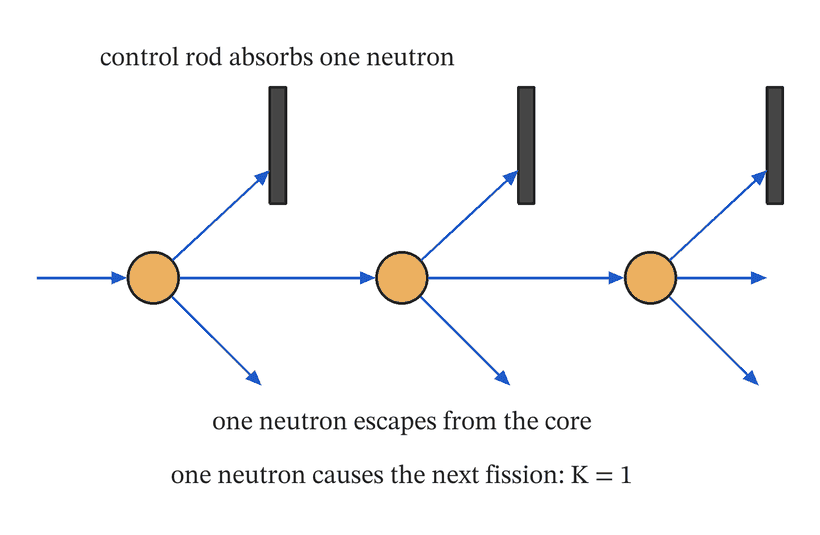
This is possible because a small fraction of the neutrons (the delayed neutrons) appear seconds after fission, which gives time to move the control rods.
Step 4 — Describe the core of a power reactor (c). The core holds fuel rods of uranium in a moderator, which slows the neutrons, and control rods that keep . It is surrounded by a steel vessel and a thick concrete shield:
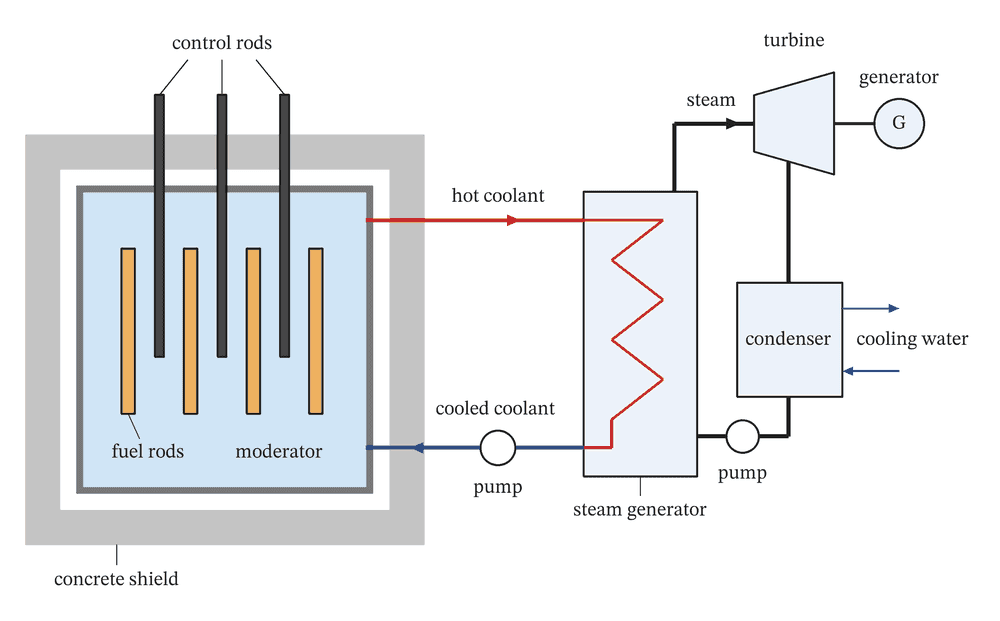
Step 5 — Explain how the heat becomes electricity (c). The energy of fission appears as heat in the fuel rods. A coolant is pumped through the core and carries this heat to the steam generator (heat exchanger), where it turns water into steam. The steam drives a turbine, which turns an electric generator. The used steam is condensed back to water in the condenser and pumped back to the steam generator, and the cooled coolant returns to the core.
Therefore, (a) fission is the splitting of a heavy nucleus into two lighter nuclei with release of energy and neutrons; (b) in a controlled chain reaction the extra neutrons are absorbed so that and the fission rate is steady; (c) in a power reactor the heat of this controlled fission is carried by the coolant to make steam, which drives a turbine and generator to produce electricity.