
Question 623 marksMedium
Draw a labelled diagram of a nuclear reactor, stating the function of each part.
Confirming your payment
Sign up now and get 250 free tokens.
Nuclear Energy - Fission and Fusion · Question 62 of 80
Draw a labelled diagram of a nuclear reactor, stating the function of each part.
Solution:
Concept: A nuclear reactor carries out a controlled, self-sustaining fission chain reaction () and turns the energy released into heat (and, in a power reactor, into electricity).
Step 1 — Draw the labelled diagram. The diagram of a nuclear power reactor is:
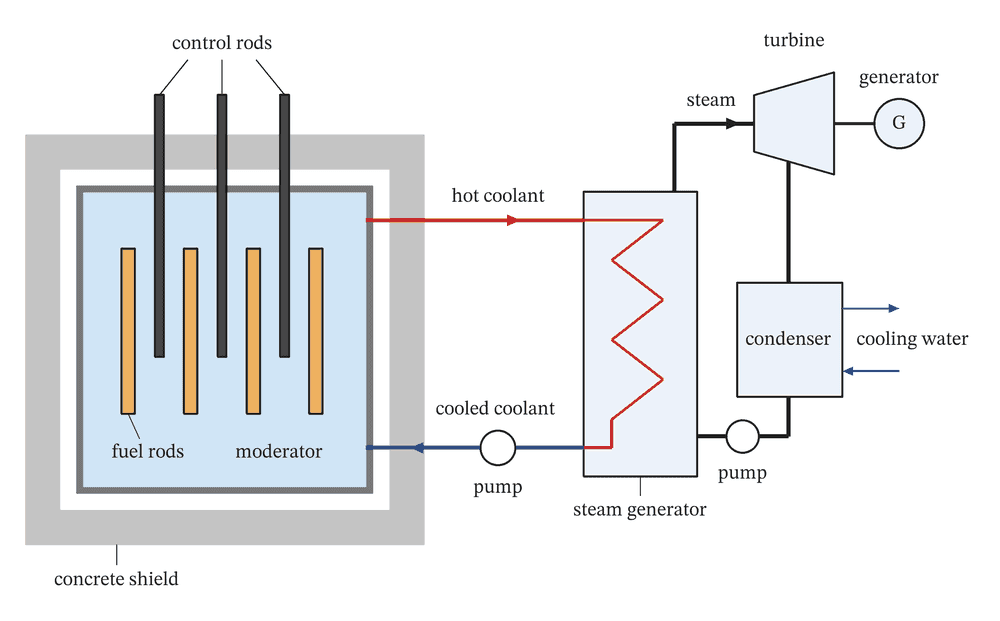
Step 2 — State the function of each part of the reactor itself. The parts inside the shield are:
Step 3 — State the function of the parts that produce electricity. The parts outside the shield are:
Therefore, the reactor consists of fuel rods (fission), moderator (slows neutrons), control rods (absorb neutrons), coolant (removes heat) and shield (stops radiation), connected through a steam generator to a turbine and generator that produce electricity.