
Question 613 marksMedium
What is uncontrolled chain reaction? Explain the working of a fission bomb.
Confirming your payment
Sign up now and get 250 free tokens.
Nuclear Energy - Fission and Fusion · Question 61 of 80
What is uncontrolled chain reaction? Explain the working of a fission bomb.
Solution:
Concept: The multiplication factor of a chain reaction is
Step 1 — Explain the uncontrolled chain reaction. Each fission of uranium-235 gives out 2 to 3 neutrons. If more than one of them, on average, causes a further fission (), the number of fissions grows rapidly from one generation to the next (1, 2 and 4 fissions, then 8 neutrons, in the figure). This is an uncontrolled chain reaction:
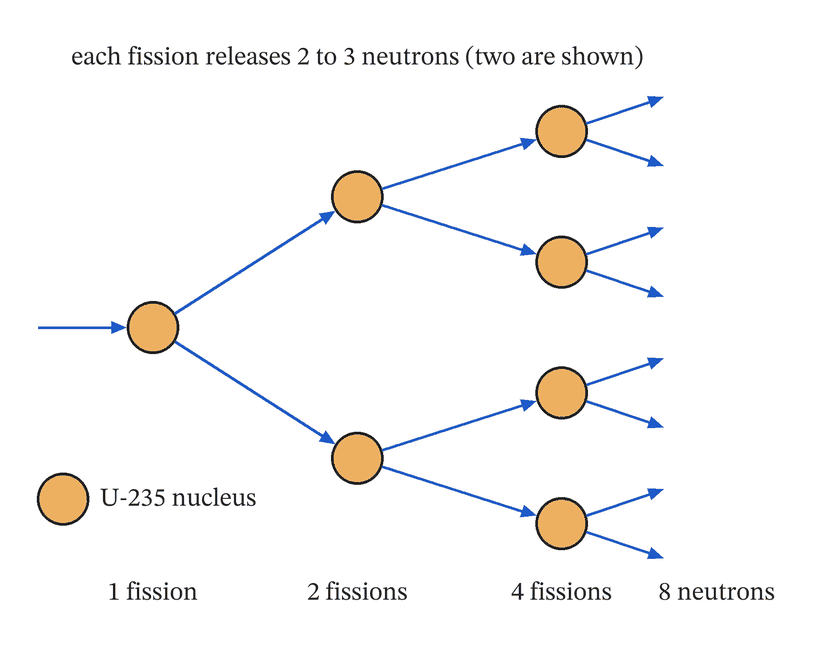
Step 2 — Estimate how fast it grows. A generation of neutrons lasts only about s, so in less than a microsecond there can be about 80 generations. With , eighty generations give fissions, so an enormous energy is released almost at once.
Step 3 — Describe the construction of a fission bomb. A uranium fission (atom) bomb of the gun type contains uranium-235 in pieces, each smaller than the critical size, so that no chain reaction can start. A conventional explosive is placed so that it can drive the pieces together:
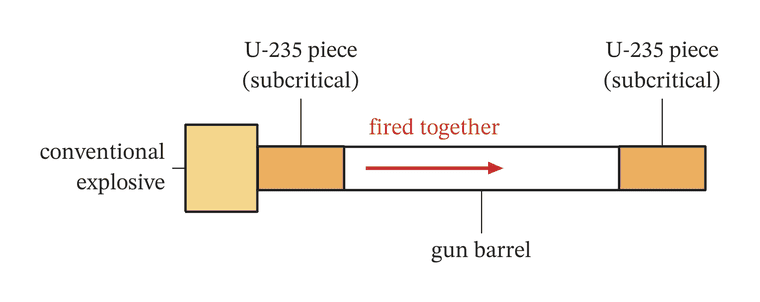
Step 4 — Explain its working. When the conventional explosive is fired, it drives the subcritical pieces together very quickly into one mass larger than the critical mass. A stray neutron (or a neutron source) starts fission, and since an uncontrolled chain reaction follows. The energy of the fissions is released in about a microsecond, producing a very high temperature and pressure, a huge blast, and intense heat and radiation.
Note: A plutonium-239 bomb, like the one dropped on Nagasaki, cannot use this gun design, because stray neutrons from spontaneous fission (of plutonium-240 in the fuel) would start the chain reaction before the pieces had fully met. Instead, explosives placed all round a subcritical sphere of plutonium squeeze it inwards (implosion) until it becomes supercritical.
Therefore, an uncontrolled chain reaction is one in which the number of fissions multiplies every generation (); a fission bomb works by suddenly making a supercritical mass of fissile material, by firing subcritical pieces of uranium-235 together (gun type) or by squeezing a subcritical plutonium core (implosion), so that such a chain reaction releases enormous energy in an instant.