
Question 592 marksMedium
Explain the construction of hydrogen bomb.
Confirming your payment
Sign up now and get 250 free tokens.
Nuclear Energy - Fission and Fusion · Question 59 of 80
Explain the construction of hydrogen bomb.
Solution:
Concept: A hydrogen (thermonuclear) bomb is based on the principle of nuclear fusion of isotopes of hydrogen, which needs a temperature of many millions of kelvin.
Step 1 — Describe the parts. A hydrogen bomb contains a fission (atom) bomb, which acts as the trigger, and the fusion fuel, usually solid lithium-6 deuteride, inside a heavy casing:
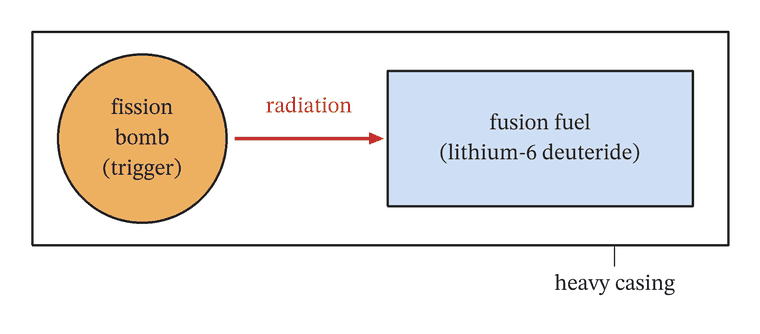
Step 2 — Explain the trigger. When the fission bomb explodes, its radiation produces a temperature of tens of millions of kelvin and a very high pressure in the fusion fuel.
Step 3 — Explain the fusion stage. Neutrons from the fission convert lithium-6 into tritium:
The deuterium and tritium then fuse:
Step 4 — Compare its power. Since there is no critical mass for fusion fuel, a hydrogen bomb can be made far more powerful than a fission bomb.
Note: in many designs the fast neutrons from the fusion stage also split the heavy casing of uranium-238, and this fission can add a large share of the total energy; the bomb is still named after its fusion stage.
Therefore, a hydrogen bomb consists of a fission bomb (trigger) and fusion fuel (deuterium with lithium, which provides tritium) in a heavy casing; the fission explosion produces the very high temperature at which the hydrogen isotopes fuse and release enormous energy.