
Opening your dashboard
Class 12 Physics Chapter 29 Nuclear Energy - Fission and Fusion: Practice Questions
101 questions on Chapter 29, each worked through on its own page with the AI tutor. Class 12 Physics, ICSE 2026-27.
101 questions
1–4 marks · Mixed difficulty
- 11 mark
Question 1
In a nuclear reaction, nuclei X and Y change into nuclei P and R, and a few free neutrons may also be given out. The binding energies of the four nuclei are , , and , and their mass numbers are , , and . The energy released in the reaction is
- 24 marks
Question 2
The graph shows the binding energy per nucleon of light nuclei, found from their measured masses.
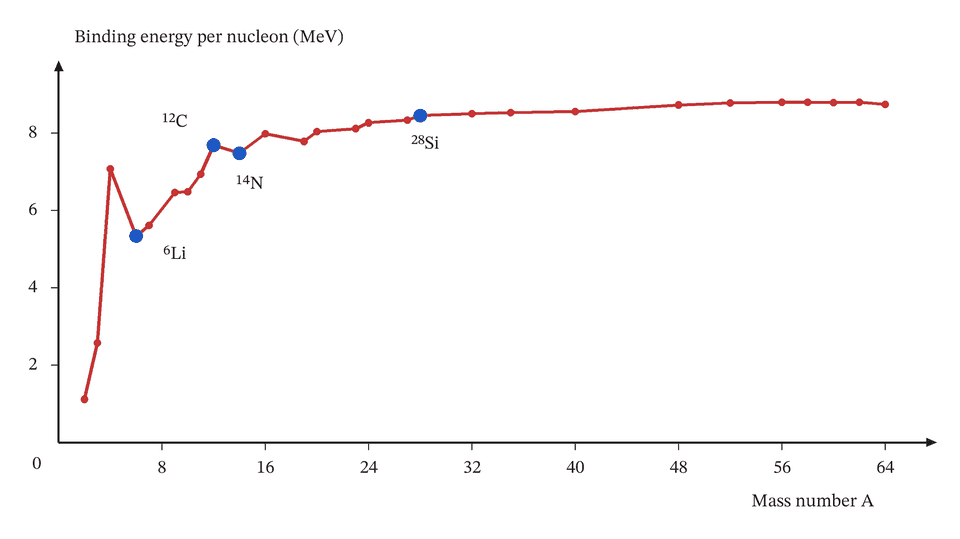
The binding energies per nucleon of the four marked nuclei are:
Nucleus Binding energy per nucleon (MeV) 5.3323 7.6801 7.4756 8.4477 Take .
(a) Find the energy released or needed in each change:
(i) two nuclei joining to form one nucleus;
(ii) one nucleus splitting into two nuclei.
(b) By how much does the total mass change in (i)?
(c) Use the graph to explain why joining two light nuclei usually releases energy, while splitting a light nucleus such as needs energy.
- 31 mark
Question 3
Nickel-62 has the largest binding energy per nucleon of all nuclei, . Suppose two nuclei could be joined to form one nucleus, whose binding energy per nucleon is . Which statement about this change is correct?
- 41 mark
Question 4
In a nuclear reaction that releases energy, the total number of nucleons does not change. Compared with the reactants, the products have
- 54 marks
Question 5
Californium-252 is used as a small, portable source of neutrons, for example to start up nuclear reactors. About of its nuclei decay by spontaneous fission, that is, they split on their own without absorbing any particle; the rest decay by giving out α-particles. Its half-life is years. One common way in which it splits is
The binding energies per nucleon are for , for and for .
(a) Find the energy released in this fission.
(b) A source holds of californium-252. Each spontaneous fission gives out neutrons on average. Find the number of spontaneous fissions per second and the number of neutrons given out per second. Take , the molar mass as and .
- 61 mark
Question 6
A slow neutron is absorbed by a nucleus, and fission follows. The nucleus that actually splits is
- 71 mark
Question 7
The fission of by slow neutrons gives many different pairs of fragments. In one common kind of event, two neutrons are given out along with the two fragments. The pair of fragments formed most often in such events has mass numbers close to
- 83 marks
Question 8
A nucleus at rest splits into a fragment, a fragment and two neutrons. The two fragments share a total kinetic energy of about . Neglect the momentum carried by the neutrons, take the mass of each fragment as its mass number in u, and .
(a) Show that the lighter fragment carries the larger share of the kinetic energy, and find the kinetic energy of each fragment.
(b) Find the speed of each fragment.
- 93 marks
Question 9
One way in which splits gives the fragments and and two neutrons. The stable nuclei with the same mass numbers are and .
(a) Find the neutron-to-proton ratio of , of and of .
(b) Each fragment reaches its stable isobar by a series of β⁻ decays. How many β⁻ decays are needed for each fragment? Write the chain of nuclei for .
(c) Use your answers to explain why fission fragments are radioactive, and why a few neutrons are set free in fission.
- 101 mark
Question 10
The table shows roughly how the energy released in the fission of one nucleus is shared.
Form of energy Energy (MeV) Kinetic energy of the two fission fragments 169.1 Kinetic energy of the prompt neutrons 4.8 Prompt γ-rays 7.0 β-particles from the radioactive fragments 6.5 γ-rays from the radioactive fragments 6.3 Antineutrinos from the radioactive fragments 8.8 In a power reactor, which part of this energy is NOT turned into heat in the reactor?
- 113 marks
Question 11
Neutrons set free in the fission of start with a kinetic energy of about , but is far more likely to capture a neutron and split when the neutron is thermal, with a kinetic energy of about . Take and .
(a) Find the speed of a neutron and of a neutron.
(b) How long does each take to cross a distance of ?
- 121 mark
Question 12
Uranium-235 almost always needs to absorb a neutron before it splits, but fermium-258 splits on its own (spontaneous fission) with a half-life of only , and it usually splits into two nearly equal fragments. Take the split as
with atomic masses and , and . The energy released is about
- 131 mark
Question 13
Which one of these statements about nuclear fission is correct?
- 143 marks
Question 14
Just after a nucleus splits, picture the two fragments, and , as two uniformly charged spheres that just touch, as shown. Each has radius , with . Take .
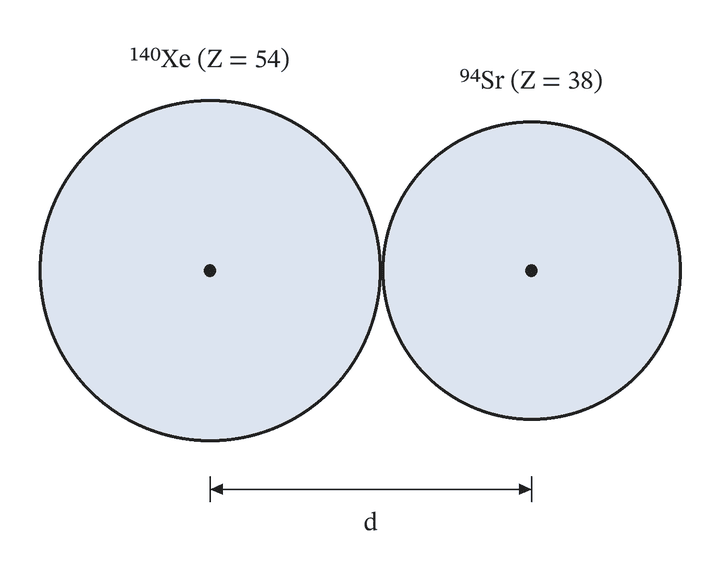
(a) Find the distance between the centres of the two fragments.
(b) Find the electric potential energy of the pair at this moment.
(c) The measured total kinetic energy of such a pair of fragments is about . If all of it comes from their electric potential energy, how far apart must their centres be at the moment they separate? What does this suggest about the shape of the nucleus just before it splits?
- 153 marks
Question 15
In the fission of by slow neutrons, an average of neutrons is given out per fission. Of these neutrons, are prompt (given out at the moment of fission) and are delayed.
(a) In fissions, how many prompt neutrons and how many delayed neutrons are given out?
(b) One source of delayed neutrons is the fission product bromine-87 (, half-life ). It decays by β⁻ emission, and in about of its decays the daughter nucleus is formed with so much excitation energy that it at once throws out a neutron. Write the two steps of this process as nuclear equations, and explain why the neutron is "delayed".
- 163 marks
Question 16
(Hypothetical data.) A burst of neutrons is released inside a block of fissile material whose multiplication factor is . Treat the neutrons generation by generation: the neutrons of each generation produce times as many neutrons in the next generation.
(a) How many neutrons are there in the second and third generations?
(b) What is the total number of neutrons in all the generations together, starting with the burst of 1000?
(c) Find the total again for . What happens to this total as comes closer and closer to 1?
- 173 marks
Question 17
(Hypothetical model.) In an uncontrolled chain reaction in a lump of pure , suppose that the chain starts with a single fission, that every fission leads to exactly two new fissions in the next generation, and that each generation takes .
(a) How many fissions take place in the th generation, and how many in the first generations together?
(b) How many nuclei are there in ? Take and the molar mass as .
(c) How many generations would it take, and how long, for the total number of fissions to reach the number of nuclei in ?
- 183 marks
Question 18
(Hypothetical data.) A reactor is running steadily when its multiplication factor is raised slightly, to , and then held there. The power of the reactor is proportional to the number of neutrons in each generation.
(a) If all the neutrons were prompt, the time from one generation to the next would be about . By what factor would the power rise in ?
(b) Because some neutrons are delayed, the average time from one generation to the next is in fact about . By what factor does the power rise in now?
(c) Use your answers to explain why delayed neutrons make it possible to control a reactor with control rods.
- 193 marks
Question 19
(Hypothetical data.) In a certain block of uranium, each fission gives out neutrons on average. Of these neutrons, escape through the surface. Of the neutrons that stay inside, are absorbed without causing fission, and the rest cause new fissions.
(a) Find the multiplication factor .
(b) State whether the chain reaction grows, stays steady or dies out.
(c) If only the escaping fraction can be changed (by changing the size of the block), what fraction must escape for the chain reaction to be exactly critical?
- 203 marks
Question 20
A bare sphere of pure becomes critical when its mass is about . The density of uranium-235 metal is .
(a) Find the radius of this critical sphere.
(b) The same is instead cast as a cube. Find the length of each edge.
(c) Compare the surface areas of the sphere and the cube. Explain whether the cube is critical, subcritical or supercritical.
- 211 mark
Question 21
A lump of fissile material is slightly smaller than its critical mass, so a chain reaction in it dies out. Which change could make the same lump critical?
- 221 mark
Question 22
A bare sphere of becomes critical at a mass of about . When the sphere is surrounded by a thick shell of beryllium, it becomes critical with a much smaller mass. The main reason is that the beryllium shell
- 232 marks
Question 23
(Simple model.) In a sphere of fissile material, the number of neutrons produced each second is proportional to its volume, and the number that escape through its surface each second is proportional to its surface area.
(a) Show that, in this model, the ratio of neutrons escaping to neutrons produced is inversely proportional to the radius of the sphere.
(b) The radius of the sphere is doubled, at the same density. By what factor does each of these change: the number of neutrons produced, the number escaping, and their ratio? Hence explain why there is a minimum (critical) size for a chain reaction.
- 242 marks
Question 24
(Hypothetical data.) A neutron detector in a reactor shows that three successive generations contain , and neutrons.
(a) Find the multiplication factor .
(b) State whether the reactor is subcritical, critical or supercritical, and what is happening to its power.
(c) To what value must the operators bring to hold the power steady, and how can they do it?
- 252 marks
Question 25
A student says: "When the multiplication factor of a reactor is exactly 1, the chain reaction has stopped growing, so the reactor is no longer producing any energy." Explain what is wrong with this statement, and state what happens to the power of a reactor when , and .
- 261 mark
Question 26
The moderator of a thermal nuclear reactor should be made of
- 274 marks
Question 27
A fast neutron of mass moving with velocity makes an elastic head-on collision with a nucleus of mass at rest in a moderator. After such a collision the neutron's velocity is .
(a) Show that the fraction of its kinetic energy that the neutron keeps is .
(b) Find this fraction for a collision with ordinary hydrogen (), deuterium () and carbon-12 ().
(c) Fission neutrons start with about and must be slowed to about . If every collision were head-on, how many collisions with carbon-12 nuclei would be needed?
- 281 mark
Question 28
In a power reactor, about neutrons are captured each second by cadmium-113 nuclei in the control rods: . Each capture releases about , nearly all of which ends up as heat in the rods and the material around them. (Hypothetical data.) Taking , the heat produced each second by these captures is about
- 292 marks
Question 29
How readily a nucleus captures a slow neutron is measured by its absorption cross-section. For slow (thermal) neutrons this is about for the ordinary hydrogen nucleus and about for the deuterium nucleus ().
(i) How many times more likely is a hydrogen nucleus than a deuterium nucleus to capture a slow neutron?
(ii) The reactors at Kudankulam use ordinary water as moderator and need uranium enriched to a few per cent of uranium-235, while India's pressurised heavy-water reactors use heavy water as moderator and run on natural uranium (only uranium-235). Use your answer to (i) to explain this.
- 303 marks
Question 30
(Hypothetical data.) A pressurised heavy-water reactor produces heat in its core at , and its generators deliver of electricity. Heavy water, pumped through the core as the coolant, enters at and leaves at . Take its specific heat capacity as at these temperatures.
(a) Find the overall efficiency of the power station.
(b) Find the mass of coolant that must flow through the core each second.
(c) The coolant is kept at a pressure of about , about 100 times atmospheric pressure. Why?
- 313 marks
Question 31
The fuel of India's pressurised heavy-water reactors is natural uranium. When it is taken out of the reactor, each tonne of it has typically given about megawatt-days of heat (its "burn-up"); that is, one tonne gives as much heat as supplied for one day. Each fission releases about . Take , the molar mass of uranium as and .
(a) How much heat does each kilogram of fuel give?
(b) How many nuclei have split in each kilogram?
(c) What percentage of all the uranium atoms in the fuel is this? Natural uranium has only uranium-235 atoms, and spent fuel still contains some uranium-235. What does your answer suggest?
- 321 mark
Question 32
India's Prototype Fast Breeder Reactor (PFBR) at Kalpakkam is fuelled with a mixture of plutonium and uranium oxides, is cooled by liquid sodium and has no moderator. It is designed without a moderator because
- 333 marks
Question 33
Even after a reactor is shut down with all its control rods in, the fission products in the fuel keep decaying and give out heat. Just after shutdown this decay heat is about of the heat output the reactor had while running, and one hour later it is about . A reactor was producing heat at before it was shut down. (Hypothetical data.)
(a) Find the decay heat output one hour after shutdown.
(b) Suppose all cooling fails at that moment and the decay heat goes into boiling water that is already at . Taking the heat output as steady at its one-hour value, how much water would boil away in the next hour? (Specific latent heat of vaporisation of water .)
(c) Explain why a reactor must still be cooled for days after it has been shut down.
- 341 mark
Question 34
The diagram shows a simplified pressurised-water reactor power station, like those at Kudankulam (pumps are not shown). The water that flows through the reactor core becomes slightly radioactive.
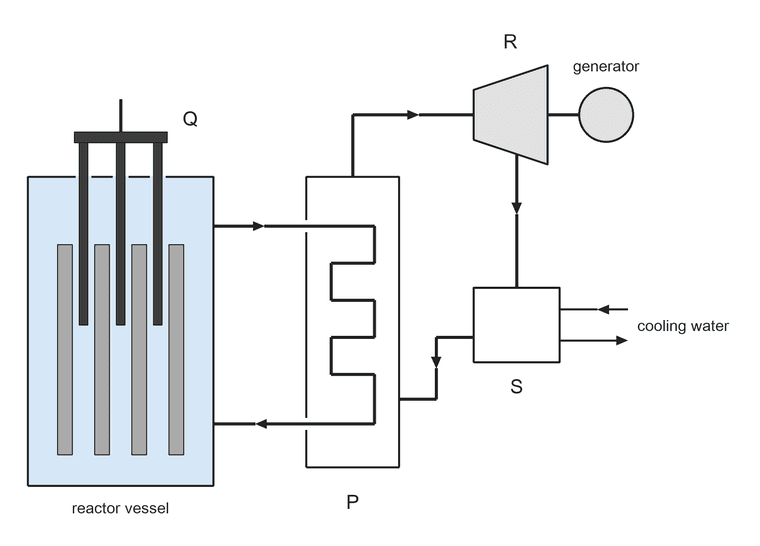
Which labelled part passes heat from this water to a separate supply of water that boils, so that the radioactive water never reaches the turbine?
- 353 marks
Question 35
The Sun's core, where nearly all of its fusion happens, can be treated as a sphere of radius about (roughly a quarter of the Sun's radius) at a temperature of about . The Sun radiates . ITER, the fusion experiment being built in France, is designed to produce of fusion power in a plasma of volume about at about .
(a) Find the average fusion power produced per cubic metre in the Sun's core.
(b) Find the fusion power per cubic metre in ITER's plasma, and how many times larger it is than in the Sun's core.
(c) Use these results to explain why ITER must be about ten times hotter than the Sun's core and must burn deuterium and tritium rather than ordinary hydrogen.
- 364 marks
Question 36
Some fusion research groups are studying the reaction as an alternative to deuterium–tritium fusion. The atomic masses are , and ; .
(a) Find the energy released in each reaction.
(b) Treat two nuclei as touching when their centres are apart, with , and take . Find the electrostatic potential energy of the two nuclei when they touch, for and for , and the ratio of the two.
(c) Give one advantage and one disadvantage of the hydrogen–boron reaction compared with deuterium–tritium fusion.
- 371 mark
Question 37
In the fusion reaction , the energy released, , appears as kinetic energy of the α-particle and the neutron. The deuterium and tritium nuclei have negligible momentum just before they fuse. Taking the masses of the α-particle and the neutron as and , their kinetic energies are about
- 381 mark
Question 38
On 5 December 2022 the National Ignition Facility in the USA fired of laser light into a tiny target holding a capsule of deuterium–tritium fuel, and the fuel released of fusion energy. It was the first time a fusion experiment gave out more energy than the laser energy delivered to its target. Each deuterium–tritium fusion releases . Taking , the number of fusion reactions in that shot was about
- 394 marks
Question 39
In natural water about one hydrogen atom in every is deuterium. Suppose all the deuterium in of seawater could be fused by the overall chain . Treat the seawater as of pure water (). Take the atomic masses , , , , with , and .
(a) Find the energy released by the overall chain.
(b) Find the number of deuterium atoms in the litre of water.
(c) Find the total energy that the deuterium could release.
(d) Petrol gives about per litre when burnt. How many litres of petrol give the same energy?
- 401 mark
Question 40
Which statement about producing electricity from deuterium–tritium fusion is correct?
- 413 marks
Question 41
(Hypothetical data.) In a large tokamak the plasma holds deuterium and tritium nuclei per cubic metre and the same number of electrons, all at about . Treat the nuclei and electrons together as an ideal gas, with pressure , where is the total number of particles per cubic metre and .
(a) Find the pressure of the plasma, in pascals and in atmospheres ().
(b) The magnetic field of that holds the plasma can exert a pressure of up to , with . Find this magnetic pressure and how many times larger it is than the plasma pressure.
(c) The thermal energy stored in each cubic metre of the plasma is . Find it, and explain why the plasma must still be kept from touching the wall of the vessel.
- 423 marks
Question 42
ITER is designed to give out of fusion power while of heating power is fed into its plasma. Each deuterium–tritium fusion releases . Take , the mass of a tritium atom as and .
(a) Find ITER's fusion gain (fusion power ÷ heating power), and explain why a power station needs a gain much larger than 1.
(b) How many fusion reactions take place each second at full power?
(c) ITER will run in pulses of about . What mass of tritium is burnt in one such pulse?
- 431 mark
Question 43
Sunlight reaches the top of the Earth's atmosphere with an intensity of (the solar constant). In the Sun's core, every helium-4 nucleus made from four protons releases about , and two neutrinos are given out with it. Neutrinos pass through the Sun almost unhindered. Ignoring the small share of the energy that the neutrinos themselves carry, and taking , the number of solar neutrinos passing each second through facing the Sun at the Earth is about
- 443 marks
Question 44
In stars more than about 1.3 times as massive as the Sun, hydrogen is turned into helium mainly by the CNO cycle. Its last step is . The atomic masses are , , and ; .
(a) Identify .
(b) Find the energy released in this step.
(c) The first step of the cycle is . Explain why carbon-12 is said to act as a catalyst in the cycle.
- 453 marks
Question 45
The first step of the proton–proton chain in the Sun is (two protons form a deuteron, a positron and a neutrino). Take the atomic masses and , the electron (or positron) mass and . Neglect the neutrino's mass and the tiny binding energies of the electrons in atoms.
(a) Show that, with atomic masses, the energy released is .
(b) Find this energy.
(c) The positron soon meets an electron and both are annihilated. How much extra energy does this give, and what is the total energy released by the step?
- 461 mark
Question 46
Which statement about the source of the Sun's energy today is correct?
- 473 marks
Question 47
In the nineteenth century, before nuclear energy was known, some scientists suggested that the Sun shines because it slowly shrinks, turning gravitational potential energy into heat. A rough estimate of the energy this could supply is . Take , the Sun's mass , its radius , its power and .
(a) Estimate the energy available from shrinking.
(b) For how many years could this keep the Sun shining at its present rate?
(c) Rocks from meteorites show that the solar system is about years old. What does this tell us about the source of the Sun's energy?
- 481 mark
Question 48
Treat two nuclei as touching when their centres are apart, with . The electrostatic potential energy at touching is about for two protons. For a proton and a carbon-12 nucleus (charge ), as in the first step of the CNO cycle, the potential energy at touching is larger by a factor of about
- 493 marks
Question 49
When hydrogen is turned into helium, about of the hydrogen's mass is converted into energy. Suppose that during its whole hydrogen-burning life the Sun turns about of its mass (the hydrogen in and near its core) into helium. Take the Sun's mass as , its power as , and .
(a) How much energy will this release?
(b) For how many years can the Sun shine at its present rate on this hydrogen?
(c) The Sun is about years old. Roughly what fraction of its hydrogen-burning life has passed?
- 503 marks
Question 50
When the hydrogen in a star's core runs out, the star swells into a red giant and its helium core becomes hot enough (about ) for the triple-alpha process: three helium-4 nuclei fuse to form carbon-12, . Take , and .
(a) Find the energy released each time a carbon-12 nucleus is formed.
(b) What percentage of the mass of the helium is converted into energy?
(c) Turning hydrogen into helium converts about of the mass into energy. Use this to explain why a star spends a much shorter time burning helium than it spent burning hydrogen.
- 511 mark
Question 51
What is the role of moderator in a nuclear reactor?
- 522 marks
Question 52
Why is heavy water used as moderator?
- 532 marks
Question 53
What is the role of a control rod in a reactor?
- 541 mark
Question 54
Why are control rods made of cadmium?
- 552 marks
Question 55
Safety of nuclear reactor is an important issue that has attracted much attention recently. Guess some of the safety problems that a nuclear engineer must cope within reactor design.
- 561 mark
Question 56
What are thermal reactors?
- 572 marks
Question 57
Why do lighter elements prefer to fuse?
- 583 marks
Question 58
During the fission of using slow neutrons, the average value of the kinetic energy of the fission fragments was found to be 167 MeV. The average number of neutrons emitted per fission of is 2.5 and the average kinetic energy of these neutrons is 2 MeV. If the kinetic energy of the prompt γ-rays is 7 MeV and the energy carried by β-rays and other radiations is 21 MeV, find the total energy released during the reaction.
- 593 marks
Question 59
When 1 kg of uranium is fissioned, J of energy is released. How much power (in MW) can 1 kg of uranium give for one day, assuming that 1 kg of uranium is fissioned in one day?
- 603 marks
Question 60
Find the fission rate of for producing one watt of electric power, if fission of one atom of releases J.
- 613 marks
Question 61
A railway engine develops an average power of 1200 kW during a 10 hour run from one station to another. If the engine is driven by an atomic power plant of 20% efficiency, how much would be consumed on the run? Each atom on fission releases 180 MeV of energy.
- 623 marks
Question 62
A nuclear reactor produces 200 MW of electric power. The thermal efficiency is 30%. Assuming 200 MeV of energy per fission, calculate the amount of natural uranium fuel (in kg) consumed per day. Natural uranium contains 0.7% of .
- 633 marks
Question 63
The masses of and atoms are 1.00813 amu and 4.00386 amu, respectively. How much hydrogen must be converted to helium if solar constant is and the Earth is m from the Sun?
- 643 marks
Question 64
A fusion reactor having an efficiency of 30% is used to provide a power output of 100 MW in a day using deuterium according to the nuclear reaction:
Find the mass of deuterium consumed. Given that the mass of deuterium is 2.01478 u and mass of helium is 4.00388 u.
- 653 marks
Question 65
A star initially has deuterons. It produces energy via the processes:
If the average power radiated by the star is W, how long will the deuteron supply last? Take amu, amu, amu and amu.
- 663 marks
Question 66
How much is consumed in a day in an atomic powerhouse operating at 400 MW, provided the whole of the mass of is converted into energy?
- 673 marks
Question 67
In the hypothetical fission reaction:
What are the values of and ? Calculate the total energy released per nuclear fission (in MeV) when the masses (in amu) of neutron = 1.009, X nucleus = 235.891, Y nucleus = 140.673 and Z nucleus = 91.791.
- 683 marks
Question 68
If 200 MeV energy is released in the fission of a sample nucleus of , how many fissions must occur per second to produce a power of 1 kW?
- 691 mark
Question 69
What is the role of moderator in a nuclear reactor?
- 701 mark
Question 70
What is the function of heavy water in a nuclear reactor?
- 711 mark
Question 71
What is the principle of operation of a nuclear reactor?
- 721 mark
Question 72
What is the role of control rods in nuclear reactor?
- 732 marks
Question 73
Complete the following nuclear reactions.
(i)
(ii)
(iii)
(iv)
- 742 marks
Question 74
The following equation represents a fusion reaction
where is the energy released. Mass of atom u, mass of atom u, mass atom u and mass of neutron u. Calculate the value of .
- 752 marks
Question 75
Draw a labelled sketch to illustrate pair production.
- 762 marks
Question 76
(i) In the following nuclear reaction, calculate the energy released in MeV.
Given that mass of u, mass of u, mass of u.
(ii) What is the name of the reaction?
- 772 marks
Question 77
What is nuclear fusion? Give one representative equation.
- 781 mark
Question 78
In our nature, where is the nuclear fusion reaction taking place continuously?
- 791 mark
Question 79
Why nuclear fusion reaction is also called thermonuclear reaction?
- 801 mark
Question 80
Name a material which is used in making control rods in a nuclear reactor.
- 812 marks
Question 81
Fission of U-235 nucleus releases 200 MeV of energy. Calculate the fission rate (i.e., no. of fissions per second) in order to produce a power of 320 MW.
- 821 mark
Question 82
Fission of nuclei is possible because the binding energy per nucleon in them
- 831 mark
Question 83
What was the fissionable material used in bomb dropped at Nagasaki (Japan) in the year 1945?
- 841 mark
Question 84
In any fission process, the ratio is
- 851 mark
Question 85
When undergoes fission, 0.1% of its original mass is changed into energy. How much energy is released if 1 kg of undergoes fission?
- 861 mark
Question 86
Pick out the unmatched pair from the following.
(A) Moderator – Heavy water
(B) Nuclear fuel –
(C) Pressurised water reactor – Water as the heat exchange system
(D) Safety rods – Carbon
(E) Reactor is critical – Multiplication factor is velocity
- 871 mark
Question 87
The Sun's energy is due to
- 881 mark
Question 88
Energy released in the fission of a single nucleus is 200 MeV. The fission rate of a fuelled reactor operating at a power level of 5 W is
- 891 mark
Question 89
Light energy emitted by stars is due to
- 901 mark
Question 90
The energy liberated on complete fission of 1 kg of is (assume 200 MeV energy is liberated on fission of 1 nucleus)
- 911 mark
Question 91
In atomic bomb, the energy is released due to
- 921 mark
Question 92
If hydrogen nucleus is completely converted into energy, the energy produced will be around
- 931 mark
Question 93
The principle of controlled chain reaction is used in
- 941 mark
Question 94
The function of moderators in nuclear reactor is to
- 951 mark
Question 95
Fusion reaction takes place at high temperature because
- 961 mark
Question 96
In the nuclear fusion reaction , given that the repulsive potential energy between the two nuclei is J, the temperature at which the gases must be heated to initiate the reaction is nearly [Boltzmann's constant J/K]
- 971 mark
Question 97
Four atoms of hydrogen combine to form a atom with a release of energy of
- 981 mark
Question 98
The energy released by the fission of one uranium atom is 200 MeV. The number of fission per second required to produce 64 W power is
- 991 mark
Question 99
In a reactor 2 kg of fuel is fully used up in 30 days. The energy released per fission is 200 MeV. Given that the Avogadro number per kilo mole and J. The power output of the reactor is close to
- 1001 mark
Question 100
When a uranium isotope is bombarded with a neutron, it generates , three neutrons and
- 1011 mark
Question 101
Cadmium rods are used in a nuclear reactor as