
Opening your dashboard
Class 12 Physics Chapter 24: Matter Waves Solutions
51 textbook questions with step-by-step answers, free to read, for ISC 2026-27.
Get talked through Ch 24, not just shown the answer
Reading a finished solution is not the same as being able to do it. The AI tutor takes one question at a time and works it with you, in your own words, until you can.
- Ask it out loud, in your own words
- It gives you the next step, not the answer
- Stuck on part (ii)? Start there
51 questions with solutions
1–5 marks · Mixed difficulty
The first 32 solutions are on this page. This chapter is a long one, so the rest open on their own page to keep this one quick to load.
- 11 mark
Question 1
The de Broglie wavelength associated with the particle of mass moving with velocity is
Solve with AIAnswer
- Correct
(A)
(B)
(C)
(D)
Answer: (A) , the Planck constant divided by the momentum
Concept: The de Broglie relation gives the wavelength of the wave linked with any moving particle of momentum (mass , speed ), where is the Planck constant:
Step 1 — Write the momentum. A particle of mass and velocity has momentum .
Step 2 — Substitute into de Broglie's relation. We put into the relation:
Step 3 — Check the other options. Only (A) has the dimensions of a length:
- (B) This is the reciprocal of the wavelength; it has unit m⁻¹.
- (C) This is not a length (its unit is kg J s² m⁻¹), and it wrongly grows with mass.
- (D) This has the mass on top and below, so its unit is kg ÷ (J s × m s⁻¹), not a length.
Therefore, the answer is (A).
- 21 mark
Question 2
G.P. Thomson experimentally confirmed the existence of matter waves by the phenomenon of
Solve with AIAnswer
- Correct
(A) diffraction
(B) refraction
(C) polarisation
(D) scattering
Answer: (A) diffraction of electrons
Concept: A wave shows its wave nature most clearly through diffraction, the spreading round obstacles that gives a pattern of bright and dark rings.
Step 1 — Recall the experiment. In 1927 G.P. Thomson sent fast electrons through a very thin metal foil and obtained a pattern of concentric rings on a photographic plate.
Step 2 — Interpret it. The rings are like the rings X-rays give with a powdered crystal, so the electrons were diffracted by the crystals of the foil, and the ring sizes matched .
Step 3 — Check the other options. The other effects were not what the experiment showed:
- (B) This was not observed; refraction alone does not prove wave nature, since a stream of particles can also bend at a boundary.
- (C) This applies to transverse waves such as light and was not the effect seen with the electrons.
- (D) Particles scatter too, so scattering alone cannot show that electrons behave as waves.
Therefore, the answer is (A).
- 31 mark
Question 3
What will be the ratio of de Broglie wavelengths of proton and -particle of same energy
Solve with AIAnswer
- Correct
(A) 2 : 1
(B) 1 : 2
(C) 4 : 1
(D) 1 : 4
Answer: (A) 2 : 1, the proton's wavelength is twice the α-particle's
Concept: A particle of mass and kinetic energy has momentum , because . Its de Broglie wavelength is therefore:
Step 1 — Write the ratio. The energy is the same for both, so the wavelength varies as :
Step 2 — Use the mass ratio. An α-particle is about four times as heavy as a proton:
Step 3 — Check the other options. Each wrong option comes from a slip:
- (B) This is the ratio turned upside down, α-particle to proton.
- (C) This uses the mass ratio 4 without taking its square root.
- (D) This both inverts the ratio and leaves out the square root.
Therefore, the answer is (A).
- 41 mark
Question 4
de Broglie hypothesis treated electron as
Solve with AIAnswer
(A) particle
(B) waves
- Correct
(C) both (A) and (B)
(D) none of these
Answer: (C) both a particle and a wave
Concept: The de Broglie hypothesis (1924) states that matter, like radiation, has a dual nature: a moving particle has a wave linked with it, of wavelength .
Step 1 — Read the relation. The momentum on the right is a particle property; the wavelength on the left is a wave property. The relation joins the two.
Step 2 — Apply it to the electron. The electron keeps its mass, charge and momentum as a particle and also behaves as a wave of wavelength .
Step 3 — Check the other options. Each of these leaves out part of the hypothesis:
- (A) This is the classical view before de Broglie; it leaves out the wave linked with the electron.
- (B) This drops the particle properties (mass, charge, momentum) that the electron keeps.
- (D) The hypothesis does give the electron both natures, so "none" is wrong.
Therefore, the answer is (C).
- 51 mark
Question 5
Which phenomenon best supports the theory that matter has a wave nature?
Solve with AIAnswer
(A) electron momentum
- Correct
(B) electron diffraction
(C) photon momentum
(D) photon diffraction
Answer: (B) electron diffraction
Concept: Diffraction is a property of waves; if particles of matter diffract, matter must have a wave nature.
Step 1 — Pick the effect that involves matter behaving as a wave. Electrons are particles of matter. The Davisson–Germer and G.P. Thomson experiments showed that electrons are diffracted by crystals, with a wavelength equal to .
Step 2 — Check the other options. None of the others shows a wave property of matter:
- (A) Momentum is a particle property; having momentum does not show wave behaviour.
- (C) Photon momentum shows the particle nature of radiation, the opposite of what is asked.
- (D) Photon diffraction shows the wave nature of radiation (light), not of matter.
Therefore, the answer is (B).
- 61 mark
Question 6
If an electron and a photon propagate in the form of waves having the same wavelength, it implies that they have the same
Solve with AIAnswer
(A) energy
- Correct
(B) momentum
(C) velocity
(D) angular momentum
Answer: (B) momentum
Concept: The de Broglie relation gives the wavelength of the wave linked with any moving particle of momentum (mass , speed ), where is the Planck constant:
Step 1 — Rearrange the relation. The momentum is , and is the same for every particle, so equal wavelengths mean equal momenta.
Step 2 — Check the other options. The other quantities differ:
- (A) For the same momentum the photon's energy is much larger than the electron's kinetic energy .
- (C) The photon moves at ; the electron always moves slower than light.
- (D) Angular momentum depends on the path about a chosen point, which the wavelength does not fix.
Therefore, the answer is (B).
- 71 mark
Question 7
According to the de Broglie, the de Broglie wavelength for electron in the orbit of (radius m) hydrogen atom is m. The principal quantum number for this electron is
Solve with AIAnswer
(A) 1
(B) 2
- Correct
(C) 3
(D) 4
Answer: (C) 3
Concept: In de Broglie's picture an electron can stay in a Bohr orbit only if a whole number of its wavelengths fits round the orbit:
Step 1 — Rearrange for . We divide both sides by :
Step 2 — Substitute the data. We put and :
Step 3 — Choose the whole number. The quantum number must be a whole number; the nearest is 3.
Step 4 — Check the other options. The other whole numbers are much farther from 3.33:
- (A) One wavelength round this orbit would need .
- (B) Two wavelengths would need .
- (D) Four wavelengths would need .
Note: the printed data do not fit a real hydrogen orbit exactly (the ratio is 3.33, not a whole number; m is the radius of the first orbit), so the answer is the nearest whole number, 3.
Therefore, the answer is (C).
- 81 mark
Question 8
The de Broglie wavelength of neutron at 27°C is . What will be its wavelength at 927°C?
Solve with AIAnswer
- Correct
(A)
(B)
(C)
(D)
Answer: (A) , half the original wavelength
Concept: A thermal neutron has average kinetic energy , so its de Broglie wavelength is , which varies as with in kelvin.
Step 1 — Convert both temperatures to kelvin. We add 273 to each Celsius temperature:
Step 2 — Write the ratio of wavelengths. Since , the ratio of the wavelengths is the square root of the inverse ratio of the temperatures:
Step 3 — Check the other options. Each wrong option comes from a slip:
- (B) A factor of 3 would need the absolute temperature to become 9 times larger (300 K to 2700 K), but 1200 K is only 4 times 300 K.
- (C) This uses instead of (temperature becomes 4 times).
- (D) A factor of 9 would need the absolute temperature to become 81 times larger, but it becomes only 4 times larger.
Therefore, the answer is (A).
- 91 mark
Question 9
An electron and a proton have the same de Broglie wavelength. Then the kinetic energy of the electron is
Solve with AIAnswer
(A) zero
(B) infinity
(C) equal to kinetic energy of proton
- Correct
(D) greater than the kinetic energy of the proton
Answer: (D) greater than the kinetic energy of the proton
Concept: A particle of mass and kinetic energy has momentum , because . Its de Broglie wavelength is therefore:
Step 1 — Rearrange for the kinetic energy. Squaring and rearranging gives .
Step 2 — Compare for the same wavelength. With the same, ; the electron is about 1836 times lighter, so its kinetic energy is about 1836 times larger.
Step 3 — Check the other options. None of the others fits:
- (A) A particle at rest would have infinite wavelength, so a finite wavelength needs nonzero kinetic energy.
- (B) Infinite energy would make the wavelength zero, not equal to a finite value.
- (C) Equal energies would give the electron a wavelength about 43 times the proton's, not equal to it.
Therefore, the answer is (D).
- 101 mark
Question 10
The de Broglie wavelength
Solve with AIAnswer
(A) is proportional to mass
(B) is proportional to impulse
- Correct
(C) inversely proportional to impulse
(D) does not depend on impulse
Answer: (C) inversely proportional to impulse
Concept: The de Broglie relation gives the wavelength of the wave linked with any moving particle of momentum (mass , speed ), where is the Planck constant:
Step 1 — Link impulse with momentum. The impulse needed to set a particle moving from rest equals the momentum it gains, .
Step 2 — Write in terms of impulse. We put into the relation:
So .
Step 3 — Check the other options. Each of these contradicts :
- (A) For a given speed falls as the mass grows, so it is not proportional to mass.
- (B) A larger impulse gives a shorter wavelength, not a longer one.
- (D) The wavelength changes whenever the impulse (momentum) changes.
Therefore, the answer is (C).
- 111 mark
Question 11
What is the momentum of a photon of wavelength ?
Solve with AIWritten solution
Solution:
Concept: A photon of frequency and wavelength carries energy , where is the Planck constant. A photon has no rest mass; it always moves at the speed of light , and its momentum is its energy divided by .
Step 1 — Write the photon's energy in terms of its wavelength. For light the frequency is , so the energy becomes:
Step 2 — Divide the energy by the speed of light. We divide the energy by to get the momentum:
This is the same relation, , that de Broglie later applied to particles of matter.
Therefore, the momentum of the photon is .
- 121 mark
Question 12
Write down the relation between the energy and the momentum of a photon.
Solve with AIWritten solution
Solution:
Concept: A photon has zero rest mass and always moves at the speed of light . Its energy has a mass equivalent , given by Einstein's mass–energy relation ; this is only the mass equivalent of the energy, not a rest mass.
Step 1 — Write the mass equivalent of the photon. We divide the photon's energy by :
Step 2 — Multiply the mass equivalent by the speed. Momentum is (mass) × (speed), and the photon moves at speed :
Step 3 — Write the energy in terms of the momentum. We multiply both sides by :
Note: The same result follows from the relativistic energy–momentum relation when the rest mass is zero, as it is for a photon.
Therefore, the energy and momentum of a photon are related by (that is, ).
- 131 mark
Question 13
What is the momentum of a photon of frequency ?
Solve with AIWritten solution
Solution:
Concept: A photon of frequency has energy , where is the Planck constant. A photon moves at the speed of light , and its momentum is its energy divided by .
Step 1 — Write the photon's energy. By Planck's quantum relation, a photon of frequency has energy:
Step 2 — Divide the energy by the speed of light. The momentum of a photon is , so we put in place of :
Since , this is the same as .
Therefore, the momentum of the photon is .
- 141 mark
Question 14
The de Broglie wavelength of a particle of kinetic energy is . What would be its wavelength if the kinetic energy were ?
Solve with AIWritten solution
Solution:
Concept: A particle of mass and kinetic energy has momentum , because . Its de Broglie wavelength is therefore:
Step 1 — Find how depends on . For the same particle and are fixed, so .
Step 2 — Apply the change. The kinetic energy becomes one quarter, so:
Therefore, the wavelength becomes (it is doubled).
- 151 mark
Question 15
What information is derived from electron diffraction experiments?
Solve with AIWritten solution
Solution:
Concept: Diffraction is a wave effect, so a beam of electrons that diffracts must behave as a wave.
Step 1 — State the result of the experiments. Electron beams scattered by crystals (Davisson and Germer) or sent through thin foils (G.P. Thomson) give diffraction maxima, just as X-rays do.
Step 2 — State what this tells us. The wavelength found from the diffraction pattern agrees with .
Therefore, electron diffraction experiments show that electrons (particles of matter) have a wave nature, with the wavelength given by de Broglie's relation.
- 161 mark
Question 16
What is meant by the phrase ‘dual nature of radiation’?
Solve with AIWritten solution
Solution:
Concept: Some experiments with radiation, such as interference and diffraction, are explained by treating it as a wave. Others, such as the photoelectric effect, cannot be explained by the wave theory and are explained by treating radiation as particles (photons).
Step 1 — List the wave effects. Interference, diffraction and polarisation show that radiation behaves as a wave.
Step 2 — List the particle effects. The photoelectric effect and the Compton effect show that radiation behaves as a stream of particles (photons), each of energy and momentum .
Therefore, dual nature of radiation means that radiation behaves as a wave in some experiments and as a stream of particles (photons) in others.
- 171 mark
Question 17
Are matter waves electromagnetic? Write de Broglie equation.
Solve with AIWritten solution
Solution:
Concept: Electromagnetic waves come from accelerated charges, while a matter wave goes with any moving particle, charged or neutral.
Step 1 — Answer the first part. Matter waves are not electromagnetic; even uncharged neutrons have matter waves, and their wavelength does not depend on charge.
Step 2 — Write de Broglie's equation. The wavelength of a particle of mass moving with velocity is:
Here is the de Broglie wavelength and the Planck constant.
Therefore, no, matter waves are not electromagnetic, and de Broglie's equation is .
- 181 mark
Question 18
An electron, -particle and a proton have the same kinetic energy . Which of these particles has the shortest de Broglie wavelength?
Solve with AIWritten solution
Solution:
Concept: A particle of mass and kinetic energy has momentum , because . Its de Broglie wavelength is therefore:
Step 1 — Find how depends on mass. For the same , , so the heaviest particle has the shortest wavelength.
Step 2 — Compare the masses. The α-particle (about 4 proton masses) is heavier than the proton, which is much heavier than the electron.
Therefore, the α-particle has the shortest de Broglie wavelength.
- 191 mark
Question 19
An -particle and a proton are accelerated through the same potential difference. Calculate the ratio of linear momenta acquired by the two.
Solve with AIWritten solution
Solution:
Concept: A charge of mass accelerated from rest through gains kinetic energy , so its momentum is:
Step 1 — Write the ratio. The same cancels:
Step 2 — Substitute the masses and charges. An α-particle has and , while the proton has charge :
Therefore, the ratio of linear momenta .
- 201 mark
Question 20
Mention the significance of Davisson-Germer experiment. An -particle and a proton are accelerated from rest through the same potential difference . Find the ratio of de Broglie wavelengths associated with them.
Solve with AIWritten solution
Solution:
Concept: A charge of mass accelerated from rest through a potential difference gains kinetic energy , so its momentum is and its de Broglie wavelength is:
Step 1 — State the significance. The Davisson–Germer experiment showed that electrons are diffracted by a nickel crystal, with a wavelength that agrees with . It was the first experimental proof of the wave nature of electrons (matter waves).
Step 2 — Write the ratio of wavelengths. The same cancels:
Step 3 — Substitute the masses and charges. We use and :
Therefore, the experiment confirmed the wave nature of electrons, and .
- 211 mark
Question 21
An electron and a photon have same de Broglie wavelength (say Å). Which one possesses more kinetic energy?
Or
Compare the energy of an electron of de Broglie wavelength 1 Å with that of an X-ray photon of the same wavelength.
Solve with AIWritten solution
Solution:
Concept: The same wavelength means the same momentum . The electron's kinetic energy is ; the photon's energy is .
Step 1 — Write the electron's kinetic energy. We put into :
Step 2 — Write the photon's energy. The photon's energy is :
Step 3 — Take the ratio. We divide the electron's kinetic energy by the photon's energy:
Step 4 — Substitute the values for a wavelength of 1 Å. We use and :
So the photon's energy is about 83 times the electron's kinetic energy.
Therefore, the photon has more energy: , so an X-ray photon of 1 Å has about 83 times the energy of an electron of the same wavelength.
- 221 mark
Question 22
An electron and a proton each have de Broglie wavelength of 1.00 nm. Write the ratio of their linear momenta.
Solve with AIWritten solution
Solution:
Concept: The de Broglie relation gives the wavelength of the wave linked with any moving particle of momentum (mass , speed ), where is the Planck constant:
Step 1 — Rearrange for the momentum. The momentum is , which depends only on , not on the mass.
Step 2 — Compare. Both particles have , so their momenta are equal.
Therefore, .
- 232 marks
Question 23
What are de Broglie waves? Name the particles with which they are seen.
Solve with AIWritten solution
Solution:
Concept: In 1924 de Broglie proposed that matter, like radiation, has a dual nature.
Step 1 — Define the waves. The waves associated with moving material particles are called matter waves or de Broglie waves. Their wavelength is .
Step 2 — Name the particles. They have been observed with electrons, protons, neutrons, α-particles and whole atoms and molecules. For large bodies the wavelength is too small to detect.
Therefore, de Broglie waves are the waves linked with moving material particles, and they are seen with small particles such as electrons, protons, neutrons and atoms.
- 242 marks
Question 24
How did de Broglie arrive at the existence of matter waves?
Solve with AIWritten solution
Solution:
Concept: By the 1920s radiation was known to behave both as a wave and as a stream of photons.
Step 1 — Use the symmetry of nature. Nature has two forms, radiation and matter. Interference and diffraction showed radiation to be a wave, while the photoelectric effect showed it to be particles. de Broglie argued that if radiation can take both forms, matter should also have both.
Step 2 — Use the integer rules. Interference and diffraction are governed by whole numbers (bright fringes at whole numbers of wavelengths). In Bohr's model the allowed orbits of an electron are also chosen by whole numbers. This suggested that electrons behave as waves.
Step 3 — Extend the photon relation. A photon has momentum . de Broglie proposed that the same relation, , holds for any particle.
Therefore, de Broglie reasoned from the symmetry between matter and radiation and from the whole-number rules of Bohr's orbits, and proposed that every moving particle has a wave of wavelength .
- 252 marks
Question 25
What is the de Broglie wavelength of a particle of mass moving with a velocity ?
Solve with AIWritten solution
Solution:
Concept: The de Broglie relation gives the wavelength of the wave linked with any moving particle of momentum (mass , speed ), where is the Planck constant:
Step 1 — Write the momentum. The particle's momentum is .
Step 2 — Substitute. Putting into the relation gives the wavelength.
Therefore, the de Broglie wavelength is .
- 262 marks
Question 26
What is the relation connecting the de Broglie wavelength and the momentum of a particle?
Solve with AIWritten solution
Solution:
Concept: In 1924 de Broglie extended the photon relation to every moving particle.
Step 1 — Write the relation. For a particle of momentum , the wavelength is given by the following relation, with the Planck constant:
Step 2 — Read it. The wavelength is inversely proportional to the momentum: the greater the momentum, the shorter the wavelength.
Therefore, .
- 272 marks
Question 27
Obtain the relation connecting the de Broglie wavelength and kinetic energy of a particle.
Solve with AIWritten solution
Solution:
Concept: The de Broglie relation gives the wavelength of the wave linked with any moving particle of momentum (mass , speed ), where is the Planck constant:
Step 1 — Write the kinetic energy in terms of momentum. A particle of mass and speed has . We multiply both sides by :
Step 2 — Find the momentum. We take the square root of both sides:
Step 3 — Substitute into de Broglie's relation. We put this into :
Therefore, , where is the kinetic energy of the particle.
- 282 marks
Question 28
“We cannot observe matter waves in our day-to-day life”. Why?
Solve with AIWritten solution
Solution:
Concept: The de Broglie relation gives the wavelength of the wave linked with any moving particle of momentum (mass , speed ), where is the Planck constant:
Step 1 — Look at everyday masses. Everyday bodies have large masses, so is large compared with .
Step 2 — Work out an example. A ball of mass at has:
Step 3 — Compare. Wave effects show only when the wave meets openings or obstacles about as small as its wavelength. Nothing is anywhere near in size.
Therefore, we cannot observe matter waves in daily life because the de Broglie wavelength of everyday bodies is very, very small.
- 292 marks
Question 29
Are the de Broglie waves electromagnetic in nature?
Solve with AIWritten solution
Solution:
Concept: Electromagnetic waves are oscillating electric and magnetic fields produced by accelerated charges.
Step 1 — Look at what decides a de Broglie wave. The wavelength depends only on the particle's mass and speed, not on its charge.
Step 2 — Use a neutral particle. Neutrons, which have no charge, also show de Broglie waves, so these waves cannot be electromagnetic.
Therefore, no, de Broglie waves are not electromagnetic in nature.
- 302 marks
Question 30
The two lines and shown in the graph plot the de Broglie wavelength () as a function of ( is the accelerating potential) for two particles having the same charge, which of the two represents the particle of heavier mass?
 Solve with AI
Written solution
Solution:
Concept: A charge of mass accelerated from rest through a potential difference gains kinetic energy , so its momentum is and its de Broglie wavelength is:
Step 1 — Write against . We separate the factor that changes with :
So the graph of against is a straight line through the origin.
Step 2 — Find the slope. The slope of each line is:
The charge is the same for both particles, so the slope is proportional to : the heavier particle has the smaller slope.
Step 3 — Read the graph. We draw a vertical line at one value of , which means the same accelerating potential for both particles (the dashed line in the figure below). Line gives the smaller wavelength on that line, so it has the smaller slope.
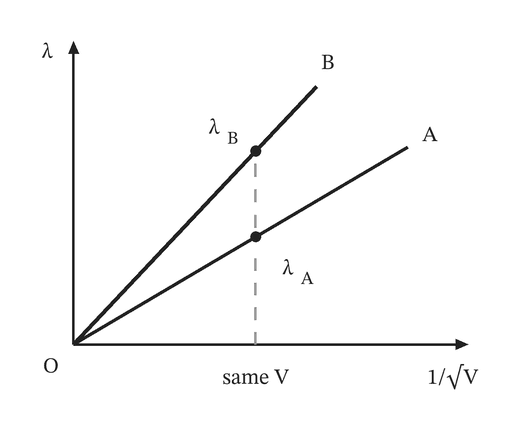
Therefore, line , which has the smaller slope, represents the particle of heavier mass.
- 312 marks
Question 31
Calculate the de Broglie wavelength associated with an electron of energy 200 eV. What will be the change in this wavelength if the accelerating potential is increased to four times its earlier value?
Solve with AIWritten solution
Solution:
Concept: A particle of mass and kinetic energy has momentum , because . Its de Broglie wavelength is therefore:
Step 1 — Convert the energy to joules. We multiply by :
Step 2 — Substitute into the formula. We use and :
Step 3 — Find the effect of four times the potential. The kinetic energy is , so . Four times the potential gives:
The wavelength is halved, a decrease of about .
Note: The last digit depends on the rounded constants. With kg the result is m, and with the precise values of , and it is m.
Therefore, (0.864 Å), and with four times the potential it becomes .
- 322 marks
Question 32
Why are de Broglie waves associated with a moving football not visible? The wavelength, of a photon and the de Broglie wavelength of an electron have the same value. Show that the energy of the photon is times the kinetic energy of the electron, where , and have their usual meanings.
Solve with AIWritten solution
Solution:
Concept: A particle of momentum has de Broglie wavelength ; a photon of wavelength has energy .
Step 1 — Explain the football. A football has a large mass, so is extremely small (about ), far too small to produce any observable wave effect.
Step 2 — Write the electron's kinetic energy. With , the electron's momentum is , so:
Step 3 — Write the photon's energy. The photon of the same wavelength has:
Step 4 — Divide the two energies. We divide by :
Therefore, the football's wavelength is too small to be seen, and the photon's energy is times the kinetic energy of the electron.
- 332 marks
Question 33
Calculate the ratio of the accelerating potential required to accelerate (i) a proton and (ii) an -particle to have the same de Broglie wavelength associated with them [given, mass of proton kg, mass of -particle kg].
- 342 marks
Question 34
(i) What are matter waves?
(ii) Show how de Broglie wavelength of a moving particle varies with their linear momentum .
- 352 marks
Question 35
Name a phenomenon or an experiment which proves
(i) particle nature of electromagnetic radiation and
(ii) wave nature of particles.
- 362 marks
Question 36
de Broglie wavelength of electrons of kinetic energy is . What will be its value if kinetic energy of electrons is made ?
- 372 marks
Question 37
State de Broglie hypothesis.
- 383 marks
Question 38
Derive an expression for the de Broglie wavelength of a particle of mass moving with a velocity .
- 393 marks
Question 39
An electron is under a potential difference volt. Derive an expression for its de Broglie wavelength in terms of its kinetic energy.
- 403 marks
Question 40
Describe an experiment to verify the existence of de Broglie waves.
- 413 marks
Question 41
(i) What is de Broglie hypothesis?
(ii) What conclusion can be drawn from Davisson and Germer's experiment?
- 425 marks
Question 42
(a) Explain what is meant by wave particle duality.
(b) Derive an expression for de Broglie wavelength.
(c) An electron is accelerated under a potential difference of volt. Obtain an expression for the de Broglie wavelength of electron.
- 435 marks
Question 43
(a) How did de Broglie arrive at the existence of matter waves?
(b) Describe Davisson and Germer's experiment to verify matter waves.
- 443 marks
Question 44
Calculate the de Broglie wavelength of a particle of mass 2 kg moving with a velocity 5 m/s ( J s).
- 453 marks
Question 45
Calculate the de Broglie wavelength of an electron moving with a velocity of 1/100th of the velocity of light ( kg).
- 463 marks
Question 46
Calculate the wavelength of an electron accelerated under a p.d. of V ( C, kg).
- 473 marks
Question 47
Calculate the K.E. of a neutron in electron volt if it has a de Broglie wavelength of 0.04 Å ( kg).
- 483 marks
Question 48
Through what voltage must an electron be accelerated such that it has a de Broglie wavelength of 0.386 Å ( kg, C)?
- 493 marks
Question 49
The K.E. of an electron is 50 eV. Calculate its de Broglie wavelength.
- 503 marks
Question 50
Find the de Broglie wavelength of electron moving with a speed of .
- 513 marks
Question 51
Electrons initially at rest, are passed through a potential difference of 2 kV. Calculate their (i) de Broglie wavelength and (ii) final velocity.
What Class 12 Physics Ch 24 covers
The sections of the chapter, in the order the book takes them. Every question above comes from one of these.
- 01Wave-Particle Duality
- 02de Broglie Hypothesis and Wavelength
- 03de Broglie Wavelength of an Accelerated Electron
- 04Electron Diffraction
More ways to study this chapter
The same chapter asked three other ways. Practise it, revise it, and see what the board has set on Ch 24 before.
- Competency-Based Questions (CBQ)Case study questions: a situation, and the part of the chapter that answers it.41questionsOpen
- Previous Year QuestionsQuestions that have actually appeared in board papers, each tagged with its year.10questionsOpen
- Practice QuestionsExtra questions per chapter, for when one attempt at a method is not enough.99questionsOpen
Ch 24 in past ISC papers
The same chapter as the board has actually asked it. These are worded differently from the textbook exercise, which is the point of reading them.
- 12 marks
Board paper question 1
(i) State how de-Broglie wavelength () of moving particles varies with their linear momentum (p).
(ii) State any one phenomenon in which moving particles exhibit wave nature.
Solve with AIWritten solution
Solution:
Key idea: According to de Broglie, a particle of momentum has a wave associated with it, of wavelength , where is Planck's constant.
Step 1 — Part (i): read the relation.
Planck's constant is fixed, so is inversely proportional to .
For example, doubling the momentum halves the de Broglie wavelength.
Step 2 — Part (ii): name a phenomenon.
Moving electrons show diffraction: a beam of electrons scattered by a crystal (the Davisson–Germer experiment) or passed through a thin film gives a diffraction pattern, just as waves do.
Therefore, (i) the de Broglie wavelength is inversely proportional to the linear momentum (λ = h/p); (ii) electron diffraction (as in the Davisson–Germer experiment) shows the wave nature of moving particles.
- 22 marks
Board paper question 2
(i) What is de Broglie hypothesis?
(ii) What conclusion can be drawn from Davisson and Germer's experiment?
Solve with AIWritten solution
Solution:
Key idea: De Broglie proposed that matter, like light, has a dual nature. Davisson and Germer tested this by looking for diffraction of electrons.
Step 1 — Part (i): state de Broglie hypothesis.
Light shows both wave and particle properties. De Broglie suggested that nature is symmetric, so every moving material particle (an electron, a proton, a ball) also has a wave associated with it, called a matter wave or de Broglie wave.
Step 2 — Part (i): give the wavelength.
The wavelength of the matter wave of a particle of mass moving with speed is Planck's constant divided by the particle's momentum .
Step 3 — Part (ii): recall what Davisson and Germer did.
They fired a beam of electrons, accelerated through a known voltage, at a nickel crystal and measured how many electrons were scattered at different angles. At they found a strong peak at an angle of about , a diffraction maximum like the one X-rays give from a crystal.
Step 4 — Part (ii): state the conclusion.
Diffraction is a property of waves, so moving electrons behave as waves. The wavelength found from the diffraction (about ) agreed with the de Broglie wavelength of electrons (about ). The experiment confirmed de Broglie's hypothesis.
Therefore, (i) de Broglie hypothesis: every moving material particle has a wave associated with it, of wavelength λ = h/p (that is, h/mv); (ii) the Davisson–Germer experiment showed that electrons are diffracted, so moving particles have a wave nature, with a wavelength that agrees with λ = h/p.
- 32 marks
Board paper question 3
(i) Find the de Broglie wavelength of electrons moving with a speed of .
(ii) Describe in brief what is observed when moving electrons are allowed to fall on a thin graphite film and the emergent beam falls on a fluorescent screen.
Solve with AIWritten solution
Solution:
Key idea: The de Broglie wavelength of a particle of mass moving with speed is . Waves of such short wavelength are diffracted by the regular rows of atoms in a crystal.
Step 1 — Part (i): find the momentum of an electron.
We use the paper's constants and .
Step 2 — Part (i): find the de Broglie wavelength.
We divide Planck's constant by the momentum.
This is about , similar to the spacing of atoms in a crystal.
Step 3 — Part (ii): describe what is seen.
A thin graphite film is made of a very large number of tiny crystals pointing in all directions. The electron waves are diffracted by the planes of atoms in these crystals, and the emergent beam forms a set of concentric bright and dark rings round a central bright spot on the fluorescent screen, like the ring pattern X-rays give from a powdered crystal.
Step 4 — Part (ii): interpret the pattern.
A diffraction pattern can be produced only by waves, so the rings show that moving electrons behave as waves (electron diffraction), as de Broglie predicted.
Therefore, (i) the de Broglie wavelength of the electrons is about 1.04 × 10⁻¹⁰ m; (ii) a diffraction pattern of concentric bright and dark rings appears on the screen, showing the wave nature of moving electrons.
- 42 marks
Board paper question 4
(i) State de Broglie hypothesis.
(ii) With reference to photoelectric effect, define threshold wavelength.
Solve with AIWritten solution
Solution:
Key idea: De Broglie extended the wave–particle duality of light to matter. The threshold wavelength is the photoelectric limit expressed as a wavelength instead of a frequency.
Step 1 — Part (i): state de Broglie hypothesis.
Light shows both wave and particle properties. De Broglie suggested that nature is symmetric, so every moving material particle (an electron, a proton, a ball) also has a wave associated with it, called a matter wave or de Broglie wave.
Step 2 — Part (i): give the wavelength.
The wavelength of the matter wave of a particle of mass moving with speed is Planck's constant divided by the particle's momentum .
Step 3 — Part (ii): define threshold wavelength.
The threshold wavelength of a metal is the maximum wavelength of the incident radiation that can just eject photoelectrons from its surface. Radiation of longer wavelength emits no photoelectrons. It is related to the work function of the metal (the least energy needed to free an electron from it) as shown below, where is the speed of light.
Therefore, (i) de Broglie hypothesis: every moving material particle has an associated wave of wavelength λ = h/p (that is, h/mv); (ii) threshold wavelength is the longest wavelength of incident radiation that can just cause photoelectric emission from a metal (λ₀ = hc/φ₀).
- 52 marks
Board paper question 5
(i) State de Broglie hypothesis
(ii) What conclusion can be drawn from Davisson and Germer's experiment
Solve with AIWritten solution
Solution:
Key idea: De Broglie proposed that matter, like light, has a dual nature. Davisson and Germer tested this by looking for diffraction of electrons.
Step 1 — Part (i): state de Broglie hypothesis.
Light shows both wave and particle properties. De Broglie suggested that nature is symmetric, so every moving material particle (an electron, a proton, a ball) also has a wave associated with it, called a matter wave or de Broglie wave.
Step 2 — Part (i): give the wavelength.
The wavelength of the matter wave of a particle of mass moving with speed is Planck's constant divided by the particle's momentum .
Step 3 — Part (ii): recall what Davisson and Germer did.
They fired a beam of electrons, accelerated through a known voltage, at a nickel crystal and measured how many electrons were scattered at different angles. At they found a strong peak at an angle of about , a diffraction maximum like the one X-rays give from a crystal.
Step 4 — Part (ii): state the conclusion.
Diffraction is a property of waves, so moving electrons behave as waves. The wavelength found from the diffraction (about ) agreed with the de Broglie wavelength of electrons (about ). The experiment confirmed de Broglie's hypothesis.
Therefore, (i) de Broglie hypothesis: every moving material particle has a wave associated with it, of wavelength λ = h/p (that is, h/mv); (ii) the Davisson–Germer experiment showed that electrons are diffracted, so moving particles have a wave nature, with a wavelength that agrees with λ = h/p.
- 61 mark
Board paper question 6
Matter waves are:
Solve with AIAnswer
- Correct
(A) Waves associated with moving particles.
(B) Waves associated with stationary particles.
(C) Waves associated with any charged particles.
(D) Waves associated with electrons only.
Answer: (A) Waves associated with moving particles.
Key idea: De Broglie's matter wave of a particle has wavelength (Planck's constant divided by the momentum), where is the mass and the speed of the particle.
Step 1 — Use the formula.
The wavelength depends on the momentum . For a moving particle the momentum is finite, so a matter wave of definite wavelength is associated with it.
Step 2 — Check the other cases.
For a particle at rest, , so has no finite value: no matter wave is associated with a stationary particle. The formula contains no charge, so it applies to every moving material particle, charged or not.
Why the others are wrong:
- (B) A stationary particle has zero momentum, so no matter wave of finite wavelength is associated with it.
- (C) The de Broglie relation contains no charge; neutral particles such as neutrons also have matter waves (neutron diffraction is used to study crystals).
- (D) Electrons are only one example; protons, neutrons, atoms and even large bodies have matter waves (too short to detect for large bodies).
Therefore, matter waves are waves associated with moving particles, option (A).
All 10 board paper questions for this chapter, solved the same way.
Class 12 Physics Ch 24 questions students ask
How many questions are there in Class 12 Physics Ch 24?
51 questions. Every one is solved step by step on this page.
Are these Class 12 Physics solutions free?
Yes. Every question and its full working is free to read, with no account needed.
Can I download the Class 12 Physics Ch 24 solutions as a PDF?
There is no PDF to download. Every solution is on this page instead, which means it is searchable, always the current syllabus, and readable on a phone. Use your browser's print option if you want it on paper.