
Opening your dashboard
Class 12 Physics Chapter 24 Matter Waves: Practice Questions
99 questions on Chapter 24, each worked through on its own page with the AI tutor. Class 12 Physics, ICSE 2026-27.
99 questions
1–4 marks · Mixed difficulty
- 11 mark
Question 1
Light from a very faint lamp passes through a double slit and falls on a photographic plate. The light is so faint that the photons pass through the apparatus one at a time. After a short exposure the plate shows a few dots scattered at random. After a very long exposure the dots form bright and dark bands, as shown.

What do these observations show about light?
- 23 marks
Question 2
In an electron double-slit experiment, electrons leave the source at an average rate of per second. Each electron travels to the detector screen at a speed of about , as shown. (Hypothetical data.) Over many minutes, the single flashes on the screen build up interference fringes.

(i) Find the average time between one electron leaving the source and the next.
(ii) Find the average distance between two electrons that follow each other.
(iii) Find the time one electron spends between the source and the screen, and hence the average number of electrons in the apparatus at any instant.
(iv) What do these results tell us about how the fringes are formed?
- 31 mark
Question 3
In a double-slit experiment with very faint light, photons reach a photographic plate one at a time. With both slits open, a long exposure gives bright and dark fringes made of dots. Slit B is now covered, as shown, and the exposure is repeated for the same length of time.
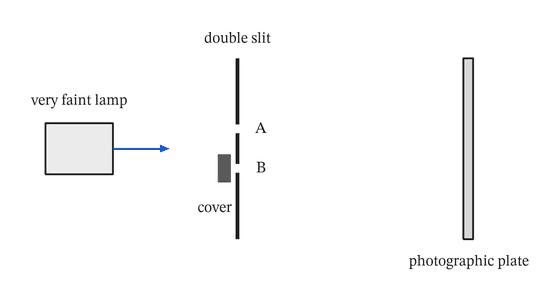
The pattern of dots on the plate is now
- 43 marks
Question 4
In a laser-cooling experiment, a sodium atom of mass moves at straight into a laser beam of wavelength , as shown. Each photon it absorbs gives it the photon's momentum, opposite to its motion. The atom later sends the absorbed energy out again as photons in random directions, so on average these do not change its momentum. (Hypothetical data.) Take .
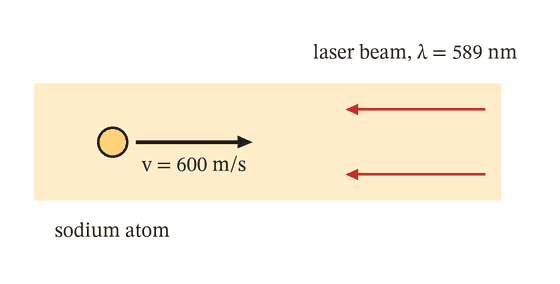
(i) Find the momentum of one photon of the laser light.
(ii) Find the decrease in the atom's speed each time it absorbs one photon.
(iii) Find how many photons the atom must absorb to be brought nearly to rest.
(iv) If the atom absorbs photons per second, how long does this take?
- 51 mark
Question 5
A beam of particles passes through a narrow slit of width , and the spreading of the beam beyond the slit is studied. Which single change would make the wave nature of the particles easier to notice?
- 63 marks
Question 6
A cricket ball of mass is bowled at . Take .
(i) Find the de Broglie wavelength of the ball.
(ii) At what speed would the ball have to move for its de Broglie wavelength to be ?
(iii) At that speed, how long would the ball take to travel the length of the pitch? Compare this with the age of the universe, about , and say what this shows about matter waves of everyday objects.
- 71 mark
Question 7
A student lists four observations about light. Which one cannot be explained by the wave theory of light, but is explained by treating light as a stream of photons?
- 83 marks
Question 8
A grain of dust is just big enough to be seen with a good microscope. Treat it as a sphere of diameter made of material of density . It drifts through still air at only . (Hypothetical data.) Take .
(i) Find the mass of the grain.
(ii) Find its de Broglie wavelength.
(iii) How many times larger is the grain than its own de Broglie wavelength? Compare the wavelength with the size of an atom, about , and say whether the grain could show wave behaviour.
- 91 mark
Question 9
Which pair of observations, both made with the same beam of electrons, shows that electrons have a dual (wave and particle) nature?
- 103 marks
Question 10
An electron gun produces electrons whose de Broglie wavelength is (). When a beam passes a gap of width , it spreads through an angle of roughly (in radians), as shown. (Hypothetical data.)
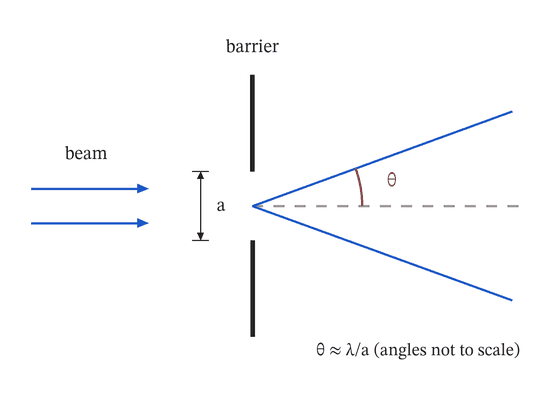
(i) In a cathode-ray tube the beam passes through a hole wide and travels to the screen. Estimate the spreading angle and the extra width of the spot it causes on the screen.
(ii) The same electrons pass through a thin crystal where the gaps between rows of atoms are about . Estimate the spreading angle in degrees.
(iii) Use your answers to explain why the same electrons behave like particles in one apparatus and like waves in the other.
- 111 mark
Question 11
Imagine a world in which Planck's constant were instead of . A ball of mass rolls at towards a doorway wide. Which statement would then be correct?
- 123 marks
Question 12
The same violet light of wavelength is used in two experiments. (Hypothetical data.) Take , and .
(i) It falls on two narrow slits apart, and fringes are seen on a screen away. The fringe width is . Find .
(ii) It falls on a clean potassium surface of work function . Electrons are freed only if the energy of one photon, , is at least the work function , and the fastest freed electrons then have kinetic energy . Find whether electrons are freed and, if so, find in eV.
(iii) State which nature of light each experiment shows.
- 134 marks
Question 13
In a molecule-interference experiment, a beam of molecules (football-shaped carbon molecules, each about across and of mass ) moves at . It passes through a grating whose slits are apart, and a detector plane is placed beyond it, as shown. The first-order beam leaves the grating at an angle given by . (Hypothetical data.) Take .

(i) Find the de Broglie wavelength of a molecule.
(ii) How many times larger than its own de Broglie wavelength is a molecule?
(iii) Find , and the distance between the central point O and the first-order point P on the detector plane.
- 141 mark
Question 14
The speed of a slowly moving particle is increased by , while its mass stays the same. Its de Broglie wavelength
- 153 marks
Question 15
In a neutron time-of-flight line, a rotating chopper lets a short burst of neutrons through from a reactor. A detector away records that a group of neutrons arrives after the burst, as shown. (Hypothetical data.) Take and .
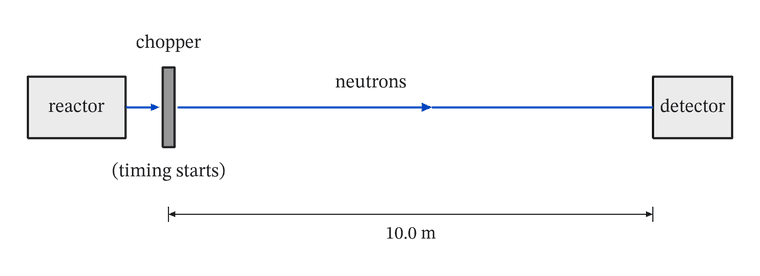
(i) Find the speed of these neutrons.
(ii) Find their de Broglie wavelength.
(iii) An experiment needs neutrons of wavelength . How long after the burst do these neutrons reach the detector?
- 161 mark
Question 16
A beam of helium atoms is used to study the surface of a crystal without damaging it. A helium atom has a mass of , about four times . Take . For the atoms to have a de Broglie wavelength of , their speed must be about
- 173 marks
Question 17
A nitrogen molecule in the air of a room has a mass of and a typical speed of . The air contains about molecules in each cubic metre. (Hypothetical data.) Take .
(i) Find the de Broglie wavelength of a nitrogen molecule.
(ii) Estimate the average distance between neighbouring molecules. (Each molecule has, on average, a cube of space of volume to itself; the side of this cube is the average spacing.)
(iii) By comparing your answers, decide whether the molecules of air need to be treated as waves or can be treated as ordinary particles.
- 183 marks
Question 18
A student measures the de Broglie wavelength of electrons moving at four different speeds and plots against , as shown. (Hypothetical data.) The readings are:
() 2.0 4.0 6.0 8.0 (nm) 0.146 0.291 0.437 0.582 
(i) Explain why the graph is a straight line through the origin, and what its slope stands for.
(ii) Taking the mass of an electron as , use the slope to find a value of Planck's constant.
- 191 mark
Question 19
Which statement about de Broglie waves is correct?
- 202 marks
Question 20
A deuteron has about twice the mass of a proton. In an experiment, a deuteron moves at one-third of the speed of a proton. Find
(i) the ratio of the de Broglie wavelength of the deuteron to that of the proton, and
(ii) the ratio of their kinetic energies.
- 211 mark
Question 21
Take , , , and the mass of a molecule as . Which of these has the longest de Broglie wavelength?
- 223 marks
Question 22
An alpha particle from a radioactive source has a kinetic energy of and a mass of . It moves slowly enough compared with light for to be used. Take and .
(i) Find the momentum of the alpha particle.
(ii) Find its de Broglie wavelength.
(iii) The radius of a gold nucleus is about . Compare the two lengths and say what this suggests about using such alpha particles to study the inside of a nucleus.
- 233 marks
Question 23
An electron moves at . At such a speed its momentum is , where and is its rest mass (older books call the relativistic mass). Take , and the rest mass .
(i) Find the value of for the moving electron.
(ii) Find its de Broglie wavelength.
(iii) Find the wavelength a student would get by wrongly using the rest mass, and say by what factor this is too large.
- 242 marks
Question 24
A student writes: “Only charged particles such as electrons and protons can have matter waves, because a matter wave is produced by the electric field of the moving charge.” Give two reasons from this chapter why the student is wrong.
- 251 mark
Question 25
The handy formula gives the de Broglie wavelength of an electron accelerated through a potential difference of volts. Which condition must hold for this formula to give the correct wavelength?
- 262 marks
Question 26
(a) Using , find the accelerating voltage at which an electron starting from rest would reach one-tenth of the speed of light ().
(b) Find the de Broglie wavelength of the electron at this voltage.
Take , and ; for an electron accelerated from rest through volts you may use .
- 271 mark
Question 27
An electron is accelerated from rest through a potential difference of . (Hypothetical data.) Take , and ; for an electron accelerated from rest through volts you may use . The magnitude of the electron's momentum is
- 283 marks
Question 28
Two parallel metal plates are apart, with a uniform electric field of between them, as shown. An electron starts from rest at the negative plate (cathode) and passes out through a small hole in the positive plate (anode). (Hypothetical data.)

Take , and ; for an electron accelerated from rest through volts you may use .
(a) Find the potential difference between the plates and the electron's de Broglie wavelength as it reaches the hole.
(b) Find its de Broglie wavelength when it is halfway across the gap.
- 291 mark
Question 29
An electron starts from rest and is accelerated through a potential difference of . It then enters a region where a retarding potential difference of slows it down. (Hypothetical data.) Take , and ; for an electron accelerated from rest through volts you may use . The de Broglie wavelength of the electron after it leaves the retarding region is
- 303 marks
Question 30
Electrons leave a hot filament with a kinetic energy of about and are then accelerated through . (Hypothetical data.) Take , and ; for an electron accelerated from rest through volts you may use .
(a) Find their de Broglie wavelength, allowing for the .
(b) By what percentage does the formula with , which ignores the , overestimate the wavelength?
(c) By what percentage would the same change the result for electrons accelerated through ?
- 311 mark
Question 31
The accelerating voltage of an electron beam is raised by , from a value of a few hundred volts. (Hypothetical data.) The de Broglie wavelength of the electrons
- 324 marks
Question 32
A student finds the de Broglie wavelength of electrons accelerated from rest through different voltages by electron diffraction, with these results. (Hypothetical data.)
(volts) 50 100 200 400 (Å) 1.73 1.22 0.866 0.612 (a) Show that , and use it to say what graph of these results should be a straight line through the origin.
(b) Plot that graph and find its slope.
(c) The theory gives , with in Å and in volts. Use the slope to find , compare it with the textbook value 12.27, and predict for electrons accelerated through .
- 333 marks
Question 33
A transmission electron microscope accelerates electrons from rest through . At this voltage the electrons reach about 0.70 times the speed of light, and when relativity is allowed for, their de Broglie wavelength is .
(a) Find the wavelength given by the formula .
(b) By what percentage does this formula overestimate the true wavelength?
(c) Electron microscopes fitted with aberration correctors can resolve details of about , roughly 20 times the electrons' wavelength. State the main reason the resolution is not much closer to the wavelength.
- 341 mark
Question 34
For an electron accelerated from rest through volts, . Written with in nanometres, this formula becomes
- 353 marks
Question 35
A beam of electrons, accelerated from rest through , carries a current of and is completely absorbed by a metal target. (Hypothetical data.) Take , and ; for an electron accelerated from rest through volts you may use .
(a) Find the de Broglie wavelength of the electrons.
(b) Use the wavelength to find the momentum of each electron.
(c) Find the force that the beam exerts on the target.
- 362 marks
Question 36
Two electron guns, X and Y, each accelerate electrons from rest through . In gun X the anode is from the cathode; in gun Y it is away, so the field in Y is weaker. (Hypothetical data.) A student says that the electrons from gun Y have the longer de Broglie wavelength because a weaker field pushed them. Take , and ; for an electron accelerated from rest through volts you may use . Find the wavelength for each gun and say whether the student is right.
- 371 mark
Question 37
When a narrow beam of fast electrons passes through a very thin metal foil, the pattern on a screen beyond it is a set of sharp concentric rings around a central spot, not a few separate spots. The rings are formed because
- 383 marks
Question 38
In an experiment of the Davisson–Germer type, a narrow beam of electrons falls normally on the surface of a crystal, and a detector measures how many electrons are scattered at different angles , measured from the direction straight back along the incident beam. In each polar graph below, the vertical line through O is that backward direction, the horizontal line is the crystal surface, and the distance from O to the curve gives the number of electrons scattered in that direction. The graphs are for accelerating voltages of , and ; in the graph the spur points at . (Hypothetical data.)
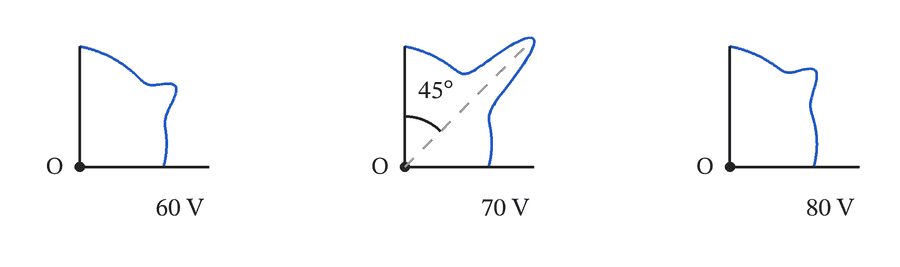
Take , and ; for an electron accelerated from rest through volts you may use . For rows of surface atoms a distance apart, the first diffraction maximum is at .
(a) At which voltage is the diffracted beam strongest?
(b) Find the de Broglie wavelength of the electrons at that voltage.
(c) Find the spacing of the rows of surface atoms.
- 391 mark
Question 39
In the 1927 experiment of Davisson and Germer, electrons accelerated through and falling normally on a nickel crystal gave a strong diffracted beam at from the direction straight back along the incident beam. Treat the surface rows of atoms as a grating, with the first maximum at , where . If the same crystal is used with electrons accelerated through , the first maximum is expected at about
- 401 mark
Question 40
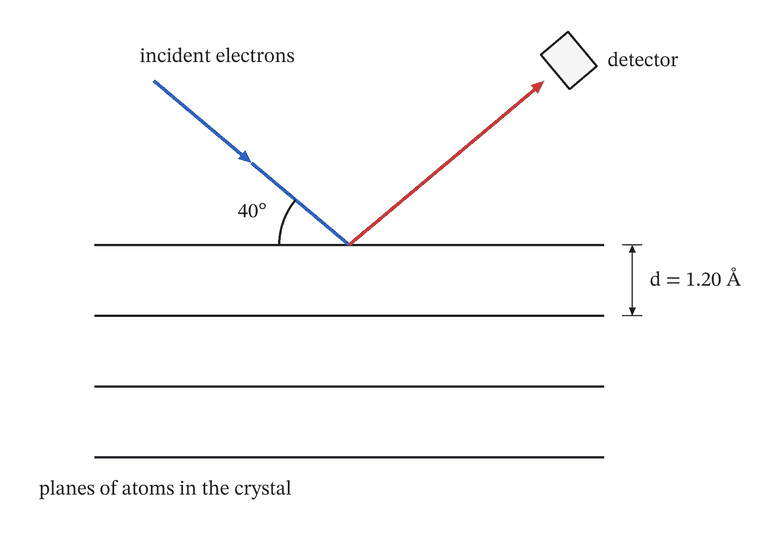
Electrons accelerated from rest through a potential difference fall on planes of atoms apart in a crystal, as shown, and the first-order Bragg reflection is observed at a glancing angle of . (Hypothetical data.)
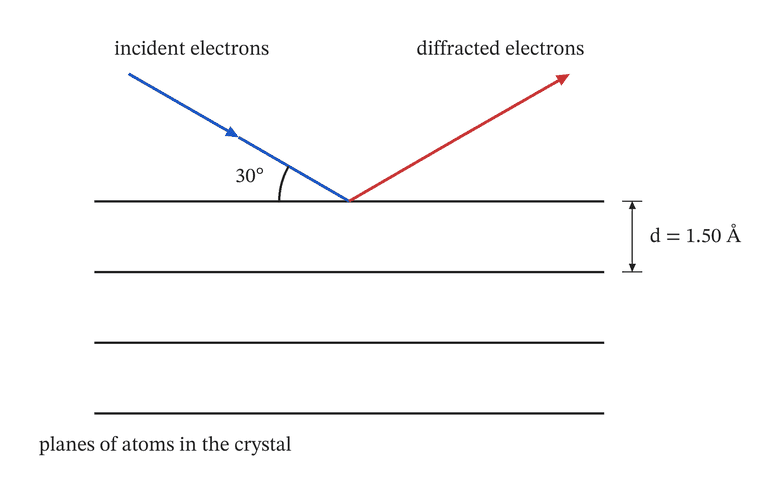
Using Bragg's law and , the accelerating voltage is about
- 414 marks
Question 41
A crystal has planes of atoms apart. Electrons accelerated from rest through volts fall on these planes, and Bragg reflections occur at glancing angles given by . (Hypothetical data.) Take , and ; for an electron accelerated from rest through volts you may use .
(a) Find the least accelerating voltage for which a first-order reflection from these planes is possible.
(b) Find the least voltage for which a second-order reflection is possible.
(c) For electrons accelerated through , find the glancing angles of the first-order and second-order reflections.
- 421 mark
Question 42
In a school electron-diffraction tube, electrons pass through a thin film of graphite and form bright rings on a flat screen a distance beyond it, as shown. With an accelerating voltage of a certain ring has radius . (Hypothetical data.)
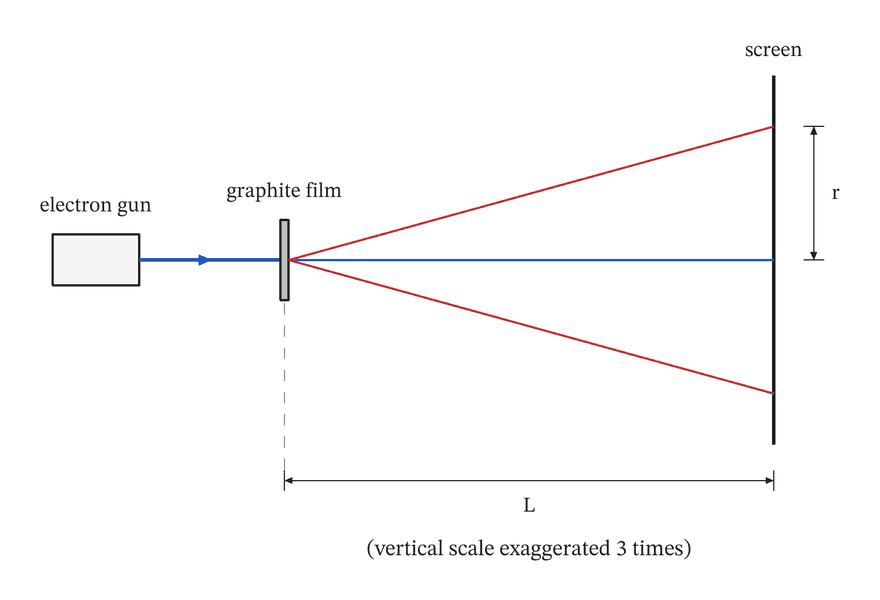
The voltage is raised to . Taking the ring's angle as small, the new radius of the same ring is
- 433 marks
Question 43
In an electron-diffraction tube, electrons accelerated from rest through pass through a thin film of graphite made of many tiny crystals. A flat screen beyond the film shows a bright ring of diameter , as shown. (Hypothetical data.)
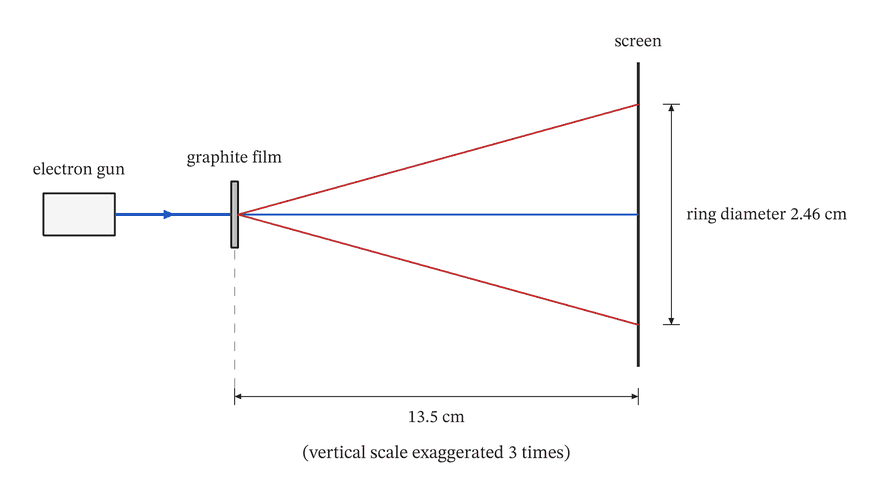
Take , and ; for an electron accelerated from rest through volts you may use . The ring is formed by first-order Bragg reflection, , from one set of planes in the graphite.
(a) Find the de Broglie wavelength of the electrons.
(b) Find the angle through which the electrons forming the ring are turned, and hence the glancing angle .
(c) Find the spacing of the planes that produce this ring.
- 443 marks
Question 44
A crystal is set so that a beam of electrons meets one set of its planes of atoms, apart, at a fixed glancing angle of , and a detector is placed in the direction of the reflected beam, as shown. The accelerating voltage is slowly raised from to , and the detector current rises to a sharp peak several times. (Hypothetical data.)
Take , and ; for an electron accelerated from rest through volts you may use . Bragg reflections occur when , with
(a) Find the accelerating voltages at which the peaks occur in this range.
(b) Show that these voltages are in the ratio , and explain why.
- 451 mark
Question 45
Electrons accelerated through about are diffracted strongly by a crystal, but visible light of wavelength shows no such diffraction by the rows of atoms. The main reason is that
- 464 marks
Question 46
Electrons accelerated from rest through fall normally on a crystal surface whose rows of atoms are apart. For normal incidence, the diffracted beams from the rows leave at angles (measured from the direction straight back along the incident beam) given by , with (Hypothetical data.) Take , and ; for an electron accelerated from rest through volts you may use .
(a) Find the de Broglie wavelength of the electrons.
(b) Find for every order that can occur, and explain why no higher order appears.
(c) Find the least accelerating voltage at which a third-order beam would appear.
- 472 marks
Question 47
In low-energy electron diffraction (LEED), which is used to study the surfaces of crystals, electrons with kinetic energies from about to are diffracted back from a crystal surface. Take , and ; for an electron accelerated from rest through volts you may use .
(a) Find the range of the de Broglie wavelengths of these electrons, and compare it with the spacing of atoms in a crystal (about 2–4 Å).
(b) Explain why these electrons give information mainly about the top few layers of atoms rather than the whole crystal.
- 481 mark
Question 48
In an electron-diffraction tube with a graphite film, the two brightest rings come from planes of atoms with spacings (inner ring) and (outer ring). Taking the ring angles as small, the ratio of the radius of the outer ring to that of the inner ring is about
- 492 marks
Question 49
Is the de Broglie wavelength of a photon of an e.m. radiation equal to the wavelength of the radiation?
- 502 marks
Question 50
Why cannot we experience the existence of matter waves in our day-to-day life?
- 511 mark
Question 51
Mention an application of matter waves.
- 522 marks
Question 52
An electron and a proton are possessing same amount of kinetic energy; which of the two has greater de Broglie wavelength? Justify your answer.
- 531 mark
Question 53
What is the dimensional formula of ?
- 541 mark
Question 54
Are matter waves electromagnetic?
- 552 marks
Question 55
What is the difference between light waves and matter waves?
- 562 marks
Question 56
A proton and an electron have same de Broglie wavelength. Which possesses more K.E.?
- 572 marks
Question 57
A photon and electron have got same de Broglie wavelength. Which has greater total energy?
- 583 marks
Question 58
Calculate the momentum of electrons if their wavelength is 2 Å. Given, J s and kg.
- 593 marks
Question 59
Calculate the de Broglie wavelength of electron and proton, if their speed is m s. Given, mass of proton kg, mass of electron kg and J s.
- 601 mark
Question 60
What information is derived from electron diffraction experiments?
- 612 marks
Question 61
An electron is accelerated from rest through a potential difference volts and it acquires a final velocity metre/sec. Obtain an expression for of electron in terms of and .
- 621 mark
Question 62
State how the wavelength and momentum are related to each other in describing wave particle duality of matter.
- 631 mark
Question 63
The historic experiment on the diffraction of electrons confirmed a new nature of electron. What is this new nature? Who has proposed it?
- 641 mark
Question 64
Write down the relation between the wavelength and momentum of a photon. What do the symbols stand for?
- 651 mark
Question 65
What inference was drawn from Davisson and Germer's experiment regarding the nature of electrons?
- 662 marks
Question 66
What is the momentum of a photon of ultraviolet light of wavelength nm.
- 672 marks
Question 67
Calculate the momentum of a photon of green light of wavelength nm in S.I. unit. Given, J s.
- 682 marks
Question 68
An electron is accelerated under a potential difference of 150 volts. What is its de Broglie wavelength?
- 692 marks
Question 69
An electron and a proton possess the same kinetic energy, which of the two has greater de Broglie wavelength? Write down the formula used.
- 701 mark
Question 70
The wavelength of matter wave is independent of
- 711 mark
Question 71
The kinetic energy of an electron with de Broglie wavelength of 0.3 nm is
- 721 mark
Question 72
Davisson and Germer experiment proved
- 731 mark
Question 73
If kinetic energy of a free electron doubles, its de Broglie wavelength changes by the factor
- 741 mark
Question 74
A particle which has zero rest mass and non-zero energy and momentum, must travel with a speed
- 751 mark
Question 75
A particle of mass 1 mg has the same wavelength as an electron moving with a velocity of . The velocity of the particles is
- 761 mark
Question 76
In Davisson Germer experiment, maximum intensity is observed at
- 771 mark
Question 77
The de Broglie wavelength associated with an electron having kinetic energy is given by the expression
- 781 mark
Question 78
For a moving ball of cricket, the correct statement about the de Broglie wavelength is
(A) it is not applicable for such big particle
(B)
(C)
(D)
- 791 mark
Question 79
An -particle moves in a circular path of radius 0.83 cm in the presence of a magnetic field . The de Broglie wavelength associated with the particle will be
- 801 mark
Question 80
The de Broglie wavelength of a neutron in thermal equilibrium with heavy water at temp (kelvin) and mass is
- 811 mark
Question 81
A proton accelerated through a potential has de Broglie wavelength . Then the de Broglie wavelength of an -particle, when accelerated through the same potential is
- 821 mark
Question 82
The speed of an electron having a wavelength of m is
- 831 mark
Question 83
Particle nature and wave nature of electromagnetic waves and electrons can be shown by
- 841 mark
Question 84
The de Broglie wavelength associated with an electron accelerated by a potential of 64 V is
- 851 mark
Question 85
If alpha particle, proton and electron move with the same momentum, then their respective de Broglie wavelengths , , are related as
- 861 mark
Question 86
An electron is accelerated through a potential difference of 10000 V. Its de Broglie wavelength is (nearly) ( kg)
- 871 mark
Question 87
A particle is moving 5 times as fast as an electron. The ratio of the de Broglie wavelength of the particle to that of the electron is . The mass of the particle is close to
- 881 mark
Question 88
An electron is accelerated from rest through a potential difference of volt. If the de Broglie wavelength of the electrons is nm, the potential difference is
- 891 mark
Question 89
The de Broglie wavelength of a proton and -particle are equal. The ratio of their velocities is
- 901 mark
Question 90
An electron of mass and a proton of mass are moving with the same speed. The ratio of their de Broglie wavelength will be
- 911 mark
Question 91
The wave nature of electron was experimentally verified by
- 921 mark
Question 92
An electromagnetic wave of wavelength is incident on a photosensitive surface of negligible work function. If photoelectron of mass '' emitted from the surface has de Broglie wavelength , then
- 931 mark
Question 93
The de Broglie wavelength associated with an electron and a proton were calculated by accelerating them through the same potential of 100 V. What should nearly be the ratio of their wavelengths ( u, u)?
- 941 mark
Question 94
A particle is travelling 4 times as fast as an electron. Assuming the ratio of de Broglie wavelength of a particle to that of electron is 2 : 1 the mass of the particle is
- 951 mark
Question 95
A particle of mass at rest disintegrates into two particles of mass and respectively having non-zero velocities. The ratio of de Broglie wavelength of particle of mass to that of mass will be
- 961 mark
Question 96
An electron having de Broglie wavelength is incident on a target in X-ray tube. Cut-off wavelength of emitted X-ray is
- 971 mark
Question 97
An electron of mass and a proton of mass are accelerated through the same potential difference. The ratio of the de Broglie wavelength associated with the electron to that with proton is
- 981 mark
Question 98
A moving proton and electron have the same de Broglie wavelength. If and denote the K.E. and momentum respectively, then choose the correct option.
- 991 mark
Question 99
The de Broglie wavelength of a particle having kinetic energy is . How much extra energy must be given to this particle so that the de Broglie wavelength reduces to 25% of the initial value?