
In an experiment of the Davisson–Germer type, a narrow beam of electrons falls normally on the surface of a crystal, and a detector measures how many electrons are scattered at different angles , measured from the direction straight back along the incident beam. In each polar graph below, the vertical line through O is that backward direction, the horizontal line is the crystal surface, and the distance from O to the curve gives the number of electrons scattered in that direction. The graphs are for accelerating voltages of , and ; in the graph the spur points at . (Hypothetical data.)
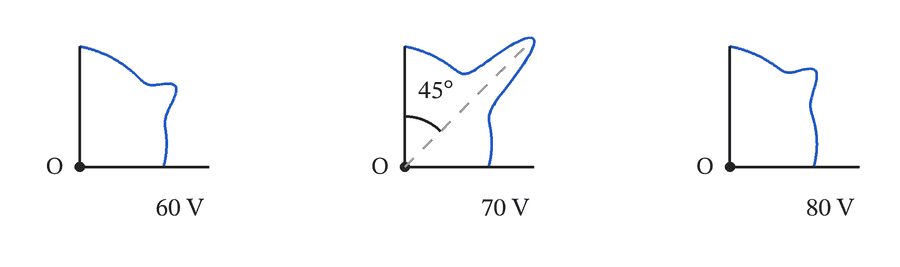
Take , and ; for an electron accelerated from rest through volts you may use . For rows of surface atoms a distance apart, the first diffraction maximum is at .
(a) At which voltage is the diffracted beam strongest?
(b) Find the de Broglie wavelength of the electrons at that voltage.
(c) Find the spacing of the rows of surface atoms.