
Question 433 marksMedium
In an electron-diffraction tube, electrons accelerated from rest through pass through a thin film of graphite made of many tiny crystals. A flat screen beyond the film shows a bright ring of diameter , as shown. (Hypothetical data.)
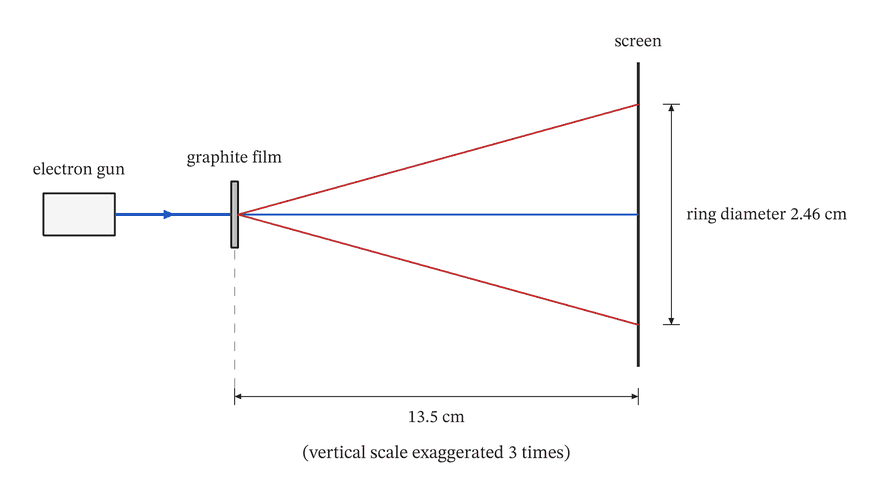
Take , and ; for an electron accelerated from rest through volts you may use . The ring is formed by first-order Bragg reflection, , from one set of planes in the graphite.
(a) Find the de Broglie wavelength of the electrons.
(b) Find the angle through which the electrons forming the ring are turned, and hence the glancing angle .
(c) Find the spacing of the planes that produce this ring.