
Question 435 marksHard
(a) How did de Broglie arrive at the existence of matter waves?
(b) Describe Davisson and Germer's experiment to verify matter waves.
Confirming your payment
Sign up now and get 250 free tokens.
Matter Waves · Question 43 of 51
(a) How did de Broglie arrive at the existence of matter waves?
(b) Describe Davisson and Germer's experiment to verify matter waves.
Solution:
Concept: In 1924 de Broglie proposed that matter has a wave nature with ; Davisson and Germer confirmed it in 1927 by diffracting electrons with a crystal.
Part (a) — de Broglie's reasoning.
Step 1 — Use the symmetry of nature. Nature exists in two forms, radiation and matter. Experiments had shown radiation to be both a wave (interference, diffraction) and a stream of particles (photoelectric effect). de Broglie argued that matter should also have both natures.
Step 2 — Use the whole-number rules. Interference and diffraction are governed by whole numbers of wavelengths, and Bohr's allowed electron orbits are also fixed by whole numbers. This suggested that electrons should be treated as waves.
Step 3 — Extend the photon relation. A photon has momentum ; de Broglie proposed the same relation for a material particle of momentum :
Part (b) — the Davisson–Germer experiment.
Step 4 — Describe the apparatus. An electron gun (a heated tungsten filament and an anode with a hole) produces a narrow beam of electrons accelerated through a known potential difference . The beam falls normally on the polished face of a nickel crystal. A detector (a Faraday-cup collector joined to a galvanometer) can be moved on a circular scale round the crystal to measure the number of electrons scattered at any angle to the incident beam. The whole set-up is in an evacuated chamber.
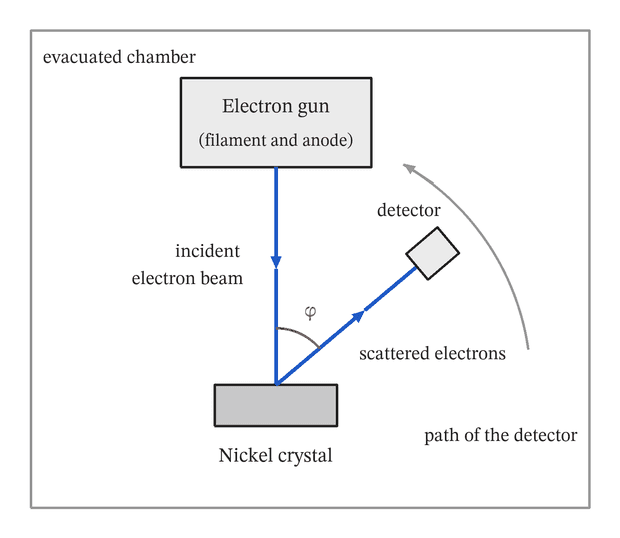
Step 5 — Describe the procedure. For a fixed accelerating potential, the detector is moved from one angle to the next and the intensity of the scattered beam is noted. The intensity is plotted against as a polar graph. This is repeated for several potentials (40 V, 44 V, 48 V, 54 V, 60 V, …).
Step 6 — State the observation. A distinct bump (peak) appears in the scattered intensity. It is largest at and .
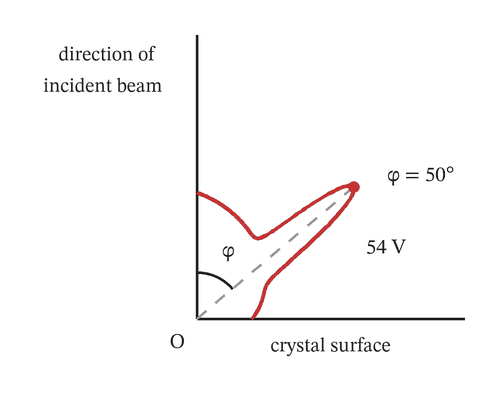
Step 7 — Interpret it as diffraction. Such a sharp maximum can come only from waves reflected by the regular rows of atoms adding in phase (Bragg reflection). For the glancing angle with the Bragg planes of nickel is:
Step 8 — Find the wavelength from Bragg's law. The spacing of these planes is , and for the first order :
Step 9 — Compare with de Broglie's relation. For electrons accelerated through 54 V, the handy formula gives:
The two values agree closely.
Therefore, (a) de Broglie reasoned from the symmetry of nature and the whole-number rules of Bohr's orbits that a particle has a wave of wavelength , and (b) Davisson and Germer found electrons diffracted by a nickel crystal with Å at 54 V, in agreement with the de Broglie value of about 1.67 Å.