
Question 302 marksMedium
The two lines and shown in the graph plot the de Broglie wavelength () as a function of ( is the accelerating potential) for two particles having the same charge, which of the two represents the particle of heavier mass?

Confirming your payment
Sign up now and get 250 free tokens.
Matter Waves · Question 30 of 51
The two lines and shown in the graph plot the de Broglie wavelength () as a function of ( is the accelerating potential) for two particles having the same charge, which of the two represents the particle of heavier mass?
Solution:
Concept: A charge of mass accelerated from rest through a potential difference gains kinetic energy , so its momentum is and its de Broglie wavelength is:
Step 1 — Write against . We separate the factor that changes with :
So the graph of against is a straight line through the origin.
Step 2 — Find the slope. The slope of each line is:
The charge is the same for both particles, so the slope is proportional to : the heavier particle has the smaller slope.
Step 3 — Read the graph. We draw a vertical line at one value of , which means the same accelerating potential for both particles (the dashed line in the figure below). Line gives the smaller wavelength on that line, so it has the smaller slope.
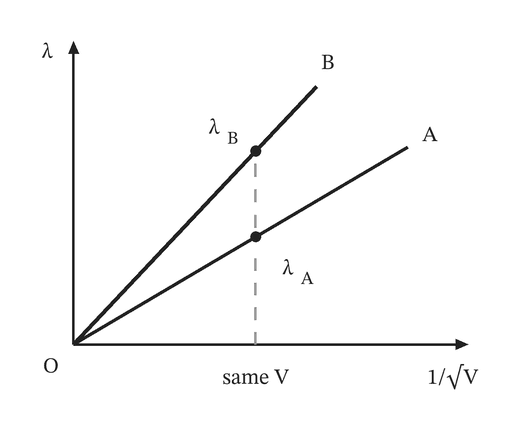
Therefore, line , which has the smaller slope, represents the particle of heavier mass.