
Question 403 marksMedium
Describe an experiment to verify the existence of de Broglie waves.
Confirming your payment
Sign up now and get 250 free tokens.
Matter Waves · Question 40 of 51
Describe an experiment to verify the existence of de Broglie waves.
Solution:
Concept: If electrons are waves, a crystal (whose atom spacing is about the same as their wavelength) should diffract them, just as it diffracts X-rays. Davisson and Germer (1927) tested this.
Step 1 — Describe the apparatus. An electron gun (a heated tungsten filament and an anode with a hole) produces a narrow beam of electrons accelerated through a known potential difference . The beam falls normally on the polished face of a nickel crystal. A detector (a Faraday-cup collector joined to a galvanometer) can be moved on a circular scale round the crystal to measure the number of electrons scattered at any angle to the incident beam. The whole set-up is in an evacuated chamber.
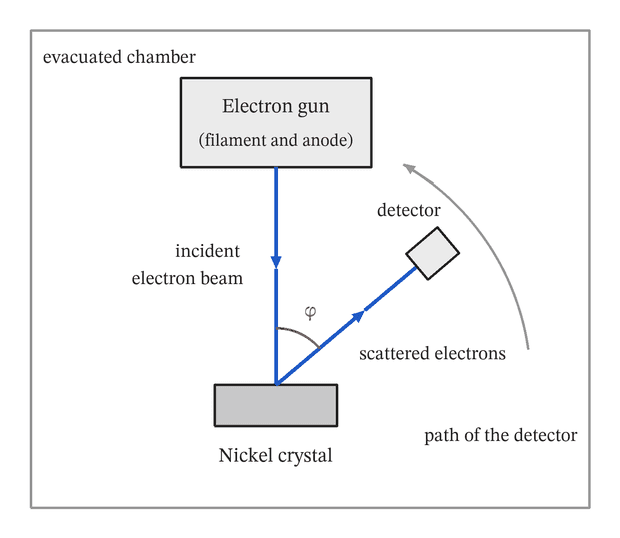
Step 2 — Describe the procedure. For a fixed accelerating potential, the detector is moved from one angle to the next and the intensity of the scattered beam is noted. The intensity is plotted against as a polar graph. This is repeated for several potentials (40 V, 44 V, 48 V, 54 V, 60 V, …).
Step 3 — State the observation. A distinct bump (peak) appears in the scattered intensity. It is largest at and .
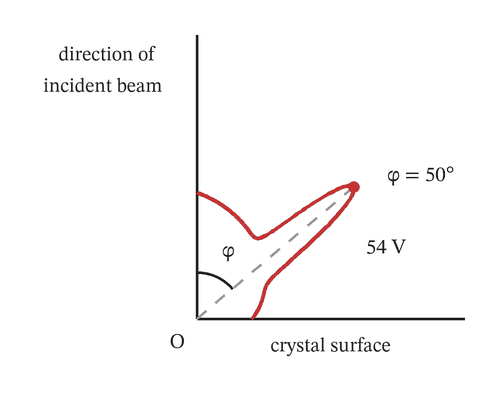
Step 4 — Interpret it as diffraction. Such a sharp maximum can come only from waves reflected by the regular rows of atoms adding in phase (Bragg reflection). For the glancing angle with the Bragg planes of nickel is:
Step 5 — Find the wavelength from Bragg's law. The spacing of these planes is , and for the first order :
Step 6 — Compare with de Broglie's relation. For electrons accelerated through 54 V, the handy formula gives:
The two values agree closely.
Therefore, the Davisson–Germer experiment shows that electrons are diffracted by a crystal, with a wavelength (about 1.65 Å) equal to the de Broglie value (about 1.67 Å), which verifies the existence of de Broglie waves.