
Opening your dashboard
Class 12 Physics Chapter 1: Electric Charges and Fields Solutions
80 textbook questions with step-by-step answers, free to read, for ISC 2026-27.
Get talked through Ch 1, not just shown the answer
Reading a finished solution is not the same as being able to do it. The AI tutor takes one question at a time and works it with you, in your own words, until you can.
- Ask it out loud, in your own words
- It gives you the next step, not the answer
- Stuck on part (ii)? Start there
80 questions with solutions
1–5 marks · Mixed difficulty
The first 34 solutions are on this page. This chapter is a long one, so the rest open on their own page to keep this one quick to load.
- 11 mark
Question 1
One metal sphere P is given positive charge whereas another similar sphere Q having the same mass as P is given an equal amount of negative charge. Then,
Solve with AIAnswer
(A) mass of P increases
(B) mass of Q decreases
- Correct
(C) mass of Q increases
(D) mass of both P and Q increases
Answer: (C) mass of Q increases
Key idea: A body becomes negatively charged by gaining electrons and positively charged by losing electrons. Electrons have mass ( each), so charging changes the mass very slightly.
Step 1 — Decide what happens to P.
P is given a positive charge, so electrons are removed from it. P loses the mass of those electrons, and its mass decreases very slightly.
Step 2 — Decide what happens to Q.
Q is given an equal negative charge, so the same number of extra electrons is added to it. Q gains the mass of those electrons, and its mass increases very slightly.
Why the others are wrong:
- (A) P loses electrons when it becomes positive, so its mass decreases rather than increases.
- (B) Q gains electrons when it becomes negative, so its mass cannot decrease.
- (D) Only Q gains electrons; P loses electrons, so the two masses change in opposite directions.
Therefore, the mass of Q increases, and the answer is (C).
- 21 mark
Question 2
When electrons are removed from a neutral metal plate through some process, then the charge on it becomes
Solve with AIAnswer
- Correct
(A)
(B)
(C)
(D)
Answer: (A)
Key idea: Charge is quantised: a body that loses electrons gains a charge , where .
Step 1 — Find the size of the charge removed.
We multiply the number of electrons by the charge of one electron.
Step 2 — Find the sign of the plate's charge.
The plate was neutral and lost negative charge, so it is left with an equal positive charge.
Why the others are wrong:
- (B) The removed electrons carry ; the plate is left with the opposite sign, .
- (C) The number counts electrons; it must be multiplied by to give a charge in coulombs.
- (D) The charge is smaller than even one electronic charge (), so it cannot be the charge of electrons.
Therefore, the charge on the plate becomes , and the answer is (A).
- 31 mark
Question 3
Which of the following properties does an electric charge not possess?
Solve with AIAnswer
(A) Total charge conservation
(B) Quantisation of charge
(C) Two types of charge
- Correct
(D) Circular line of force
Answer: (D) Circular line of force
Key idea: The basic properties of electric charge are additivity, quantisation, conservation and the existence of two kinds of charge. Electrostatic lines of force start on positive charges and end on negative charges.
Step 1 — Check the property in option (D).
An electrostatic line of force begins on a positive charge and ends on a negative charge (or goes to infinity). It never closes on itself, so a static charge does not produce circular (closed) lines of force.
Step 2 — Check the other options.
Conservation of total charge, quantisation () and the existence of two types of charge are all genuine properties of charge.
Why the others are wrong:
- (A) Total charge is conserved in every process, so this is a property charge does possess.
- (B) Charge is quantised, with a whole number, so this is a property charge does possess.
- (C) Charge comes in two kinds, positive and negative, so this is a property charge does possess.
Therefore, a static electric charge does not have circular lines of force, and the answer is (D).
- 41 mark
Question 4
The force of repulsion between two electrons at a certain distance is . The force between two protons separated by the same distance is ()
Solve with AIAnswer
(A)
- Correct
(B)
(C)
(D)
(E)
Answer: (B)
Key idea: By Coulomb's law . The electric force depends on the charges, the distance and the medium; it does not depend on the masses.
Step 1 — Write the force between the two electrons.
Each electron has charge , so the product of the charges is .
Step 2 — Write the force between the two protons.
Each proton has charge , of the same size as the electron's charge, and the distance and medium are the same.
So the two forces are equal, .
The mass ratio does not enter the electric force.
Why the others are wrong:
- (A) A force of would need the product of the charges to double, but the proton and electron charges have the same size.
- (C) The factor 1836 is a mass ratio, and mass does not appear in Coulomb's law.
- (D) Dividing by 1836 also wrongly brings the mass ratio into the electric force.
- (E) A force of would need the distance to double, but the distance is the same.
Therefore, the force between the two protons is , and the answer is (B).
- 51 mark
Question 5
If charge on a body is , then how many electrons are present in the body?
Solve with AIAnswer
(A)
- Correct
(B)
(C)
(D)
Answer: (B)
Key idea: A charge of on a body means it carries electrons more than it needs to be neutral, with .
Step 1 — Convert the charge to coulombs.
One nanocoulomb is , so the body carries a charge of .
Step 2 — Divide by the charge of one electron.
Both charges are negative, so the number of excess electrons is the ratio of their sizes.
Note: the question means the excess electrons; the body also contains a huge number of electrons that are balanced by its protons.
Why the others are wrong:
- (A) The value mixes up the electronic charge with a number of electrons; even 1 C needs only electrons, so 1 nC needs far fewer.
- (C) The value is times too large; it is the number of electrons in a charge of .
- (D) The value is times too large; it is the number of electrons in a charge of .
Therefore, the body carries excess electrons, and the answer is (B).
- 61 mark
Question 6
Two charged spheres separated by a distance exerts a force on each other. If they are immersed in a liquid of dielectric constant then the force (if all conditions are same) is
Solve with AIAnswer
- Correct
(A)
(B)
(C)
(D)
Answer: (A)
Key idea: In a medium of dielectric constant , the force between two charges is times smaller than in air (vacuum) for the same charges and distance: .
Step 1 — Write the force in the liquid.
The charges and the distance stay the same, so only the medium changes the force.
Step 2 — Substitute the dielectric constant.
We put .
Why the others are wrong:
- (B) The force stays only in a medium with (vacuum, or nearly air), not in this liquid.
- (C) A force of multiplies by , but a dielectric reduces the force.
- (D) A force of would need the force to grow by , which no rule gives; a dielectric reduces the force.
Therefore, the force in the liquid is , and the answer is (A).
- 71 mark
Question 7
An electric dipole of dipole moment is placed in a uniform external electric field . Then the
Solve with AIAnswer
(A) torque experienced by the dipole is
(B) torque is zero, if is perpendicular to
- Correct
(C) torque is maximum, if is perpendicular to
(D) potential energy is maximum, if is parallel to
(E) potential energy is maximum, if is perpendicular to
Answer: (C) torque is maximum, if is perpendicular to
Key idea: A dipole in a uniform field feels a torque , of magnitude , and has potential energy , where is the angle between and .
Step 1 — Find when the torque is greatest.
The factor is largest, equal to 1, at , so the torque is greatest when is perpendicular to .
Step 2 — Find when the potential energy is greatest.
The potential energy is largest when , that is at , where equals .
Why the others are wrong:
- (A) The torque is ; the product points the opposite way.
- (B) At the factor is 1, so the torque is greatest there, not zero.
- (D) When is parallel to , and the potential energy is least (), not greatest.
- (E) When is perpendicular to , and the potential energy is zero; its greatest value occurs at .
Therefore, the torque is maximum when is perpendicular to , and the answer is (C).
- 81 mark
Question 8
An electric dipole placed in a non-uniform electric field experiences
Solve with AIAnswer
- Correct
(A) both torque and force
(B) only a force but no torque
(C) only a torque but no force
(D) no torque and no net force
Answer: (A) both torque and force
Key idea: A dipole feels a net force only if the field is different at its two charges, and a torque if the two forces do not act along the same line.
Step 1 — Check for a net force.
In a non-uniform field the field at differs from the field at . The forces and therefore do not cancel, so there is a net force.
Step 2 — Check for a torque.
In general the two forces also act along different lines, so they produce a turning effect as well. The dipole therefore experiences both a force and a torque.
Why the others are wrong:
- (B) A force with no torque occurs only in the special case when lies along the local field direction; in general a torque acts too.
- (C) A torque with no net force is what happens in a uniform field, where the forces on the two charges are equal and opposite.
- (D) Neither a torque nor a net force occurs only in a uniform field with parallel or antiparallel to ; in a non-uniform field the forces do not cancel.
Therefore, a dipole in a non-uniform field experiences both a torque and a force, and the answer is (A).
- 91 mark
Question 9
Two small spherical shells A and B are given positive charges of 9 C and 4 C, respectively and placed such that their centres are separated by 10 m. If P is a point in between them, where the electric field intensity is zero, then the distance of the point P from the centre of A is
Solve with AIAnswer
(A) 5 m
- Correct
(B) 6 m
(C) 7 m
(D) 8 m
(E) 4 m
Answer: (B) 6 m
Key idea: Between two like charges their fields point in opposite directions, so the resultant is zero at the point where the two magnitudes are equal. The zero point lies nearer the smaller charge.
Step 1 — Write the condition for zero field.
We let P be at distance from A, so it is at distance from B. The fields of the two charges at P must have equal magnitudes; the common factor cancels.
Step 2 — Take square roots.
Both sides are positive and P lies between the charges, so we take the positive square root of each side.
Step 3 — Cross-multiply and solve.
We multiply both sides by .
Step 4 — Check the answer.
At P the two field magnitudes are and , both equal to , so they cancel.
Why the others are wrong:
- (A) The midpoint, 5 m, is the zero point only for equal charges; here A is the larger charge, so P is farther from A.
- (C) At 7 m from A the field of A is and that of B is , so they do not cancel.
- (D) At 8 m from A the field of A is and that of B is , so they do not cancel.
- (E) The value 4 m is the distance of P from B, not from A.
Therefore, P is 6 m from the centre of A, and the answer is (B).
- 101 mark
Question 10
An electric dipole is placed at an angle of with an electric field intensity . It experiences a torque equal to 4 N m. The charge on the dipole, if the dipole length is 2 cm is
Solve with AIAnswer
(A) 8 mC
- Correct
(B) 2 mC
(C) 5 mC
(D)
Answer: (B) 2 mC
Key idea: The torque on a dipole in a uniform field is , and the dipole moment is the charge times the dipole length, .
Step 1 — Write the given data.
The torque is , the field is , the angle is , so , and the dipole length is 2 cm, written in metres below.
Step 2 — Rearrange for the charge.
We write the dipole moment as in the torque formula , and divide by the other factors.
Step 3 — Substitute and calculate.
We put in the values.
This is .
Why the others are wrong:
- (A) A charge of 8 mC is four times too large; it would give a torque of 16 N m in this field.
- (C) A charge of 5 mC would give a torque of 10 N m, not 4 N m.
- (D) A charge of is far too small; it would give a torque of only 0.014 N m.
Therefore, the charge on the dipole is 2 mC, and the answer is (B).
- 111 mark
Question 11
Pick out the statement which is incorrect.
Solve with AIAnswer
(A) A negative test charge experiences a force opposite to the direction of the electric field.
(B) The tangent drawn to a line of force represents the direction of electric field.
(C) Field lines never intersect.
- Correct
(D) The electric field lines form closed loop.
Answer: (D) The electric field lines form closed loop.
Key idea: Electrostatic field lines start on positive charges and end on negative charges (or at infinity). Their tangent gives the field direction, and two of them never cross.
Step 1 — Test statement (D).
An electrostatic field line always runs from a positive charge to a negative charge, so it has a start and an end and cannot close on itself. Statement (D) is therefore incorrect.
Step 2 — Test the other statements.
The force on a charge is , the tangent to a line of force gives the field direction by definition, and two lines can never cross. These three statements are correct.
Why the others are wrong:
- (A) This statement is correct: for a negative , points opposite to .
- (B) This statement is correct: a line of force is drawn so that its tangent at each point gives the field direction there.
- (C) This statement is correct: if two lines crossed, the field would have two directions at one point, which is impossible.
Therefore, the incorrect statement is that electric field lines form closed loops, and the answer is (D).
- 121 mark
Question 12
The net electric force on a charge of at the midpoint on the line joining two charges of magnitude and separated by a distance of 6 mm is
Solve with AIAnswer
(A) 6000 N
(B) 500 N
(C) 60 N
- Correct
(D) 12000 N
Answer: (D) 12000 N
Key idea: By the principle of superposition, the net force on the charge is the vector sum of the forces from the two charges. Each force follows Coulomb's law, .
Step 1 — Find the distance from each charge.
The charges are 6 mm apart and the test charge sits at the midpoint, so it is 3 mm from each.
Step 2 — Find the force from one charge.
We take the charge first.
The charge has the same size and the same distance, so its force also has size .
Step 3 — Find the directions of the two forces.
The charge repels the charge, pushing it towards the charge. The charge attracts it, pulling it towards itself. Both forces point the same way, towards the charge, so they add.
Step 4 — Add the two forces.
The two forces act in the same direction, so the net force is their sum.
Note: the book prints zero as both this option and its answer, which subtracts the two forces; the forces act in the same direction and add, so the option is shown here with the true value, 12000 N.
Why the others are wrong:
- (A) The value 6000 N is the force from only one of the two charges.
- (B) The value 500 N does not come from these charges and this distance; each force alone is already 6000 N.
- (C) The value 60 N is a hundred times smaller than one force alone, as if the charges were 6 cm apart instead of 6 mm.
Therefore, the net force on the charge is 12000 N, directed towards the charge, and the answer is (D).
- 131 mark
Question 13
The angle between the dipole moment and electric field at any point on the equatorial plane is
Solve with AIAnswer
- Correct
(A)
(B)
(C)
(D)
Answer: (A)
Key idea: At any point on the equatorial plane of a dipole the field is parallel to the axis and points from the end towards the end: .
Step 1 — Find the direction of the field.
On the equatorial plane the two charges are equally far away, so the components of their fields across the axis cancel and the components along the axis add. The resultant points from the end to the end.
Step 2 — Compare with the dipole moment.
The dipole moment points from to , which is exactly the opposite direction. The angle between and is therefore .
Why the others are wrong:
- (B) An angle of is found on the axial line outside the charges, where points along .
- (C) An angle of occurs only at some general points off both the axis and the equatorial plane, never on the equatorial plane.
- (D) An angle of is the angle between and the equatorial plane itself, not between and .
Therefore, the angle between the dipole moment and the field on the equatorial plane is , and the answer is (A).
- 141 mark
Question 14
Who suggested the possibility of two types of charges?
Solve with AIWritten solution
Solution:
Key idea: Early experiments showed that some charged bodies attract each other while others repel. This can be explained only if there are two different kinds of charge.
Step 1 — Recall the observation.
Charged glass rods repelled each other, charged resin (amber) rods repelled each other, but a charged glass rod attracted a charged resin rod.
Step 2 — Name the scientist and his conclusion.
The French scientist Charles Du Fay (1733) concluded from this that there are two kinds of electricity, which he called vitreous and resinous. Today these are called positive and negative charge, the names given later by Benjamin Franklin.
Therefore, Du Fay suggested the possibility of two types of charges.
- 151 mark
Question 15
During electrification by friction, is there any transfer of mass?
Solve with AIWritten solution
Solution:
Key idea: In charging by friction, only electrons move from one body to the other, and every electron has a mass of about .
Step 1 — Say what moves during rubbing.
When two bodies are rubbed together, electrons pass from the body that holds them less tightly to the other body.
Step 2 — Say what this does to the masses.
The body that gains electrons gains their mass, and the body that loses electrons loses the same mass. The change is extremely small, because each electron is so light.
Therefore, yes, there is a transfer of mass: the negatively charged body gains a tiny mass and the positively charged body loses the same mass.
- 161 mark
Question 16
A glass rod when rubbed with silk cloth acquires a charge . What is the charge on the silk cloth?
Solve with AIWritten solution
Solution:
Key idea: Charge is conserved. Rubbing does not create charge; it only transfers electrons, so the two bodies get equal and opposite charges.
Step 1 — Apply conservation of charge.
The rod and the cloth were neutral before rubbing, so their total charge must still be zero afterwards.
Step 2 — Find the charge on the silk.
The rod has , so the silk has the same amount with the opposite sign.
Therefore, the charge on the silk cloth is .
- 171 mark
Question 17
Can a body have a charge of ? Justify your answer by comment.
Solve with AIWritten solution
Solution:
Key idea: Charge is quantised: the charge on any body is , where is a whole number and , because bodies gain or lose only whole electrons.
Step 1 — Find the value of for this charge.
We divide the given charge by the electronic charge.
Step 2 — Judge the result.
The value of is not a whole number, so this charge is half of the smallest charge a free body can carry. No body can carry it.
Note: quarks carry charges of and , but they are never found free, so the charge of any free body is still a whole multiple of .
Therefore, no, a body cannot have a charge of , because it is not a whole multiple of .
- 181 mark
Question 18
Name the experiment that established the quantum nature of charge.
Solve with AIWritten solution
Solution:
Key idea: Quantisation of charge means every charge is a whole multiple of a smallest charge . An experiment that measures many separate charges and finds them all multiples of one value establishes this.
Step 1 — Say what the experiment measured.
Millikan balanced tiny charged oil drops between two charged plates and measured the charge on each drop.
Step 2 — Say what it showed.
Every charge he measured was a whole multiple of , which showed that charge comes in units of .
Therefore, Millikan's oil drop experiment established the quantum nature of charge.
- 191 mark
Question 19
How many electrons are needed to produce one coulomb?
Solve with AIWritten solution
Solution:
Key idea: By quantisation of charge, a charge is made of electronic charges, with .
Step 1 — Write the relation for the number of electrons.
We want the number of electrons whose total charge is one coulomb, so we divide one coulomb by the charge of one electron.
Step 2 — Calculate the number.
We divide 1 by 1.6 and adjust the power of ten.
Therefore, electrons are needed to make a charge of one coulomb.
- 201 mark
Question 20
Why absolute permittivity is called so?
Solve with AIWritten solution
Solution:
Key idea: Permittivity describes how a medium affects the electric force between charges placed in it. Relative permittivity compares one medium with free space, while absolute permittivity is the medium's own value.
Step 1 — Say what absolute permittivity is.
The absolute permittivity of a medium is the actual value of the permittivity of that medium, measured in . It appears in Coulomb's law for that medium, .
Step 2 — Contrast it with relative permittivity.
The relative permittivity is a ratio that compares the medium with free space, so it has no unit. The absolute value is not a comparison with any other medium.
Therefore, it is called absolute permittivity because it is the medium's own permittivity, belonging to that medium alone and not measured relative to another medium.
- 211 mark
Question 21
Can we apply Coulomb's law to any type of charge distribution?
Solve with AIWritten solution
Solution:
Key idea: Coulomb's law gives the force between two stationary point charges, where the distance between them is clearly defined.
Step 1 — State where the law applies directly.
The law applies to charges at rest whose sizes are small compared with their separation (point charges). It also applies to spherically symmetric charge distributions, which act as if their charge were at the centre.
Step 2 — Say how other distributions are handled.
For an extended distribution of any other shape the distance is not one value. We divide the distribution into small elements, apply Coulomb's law to each element as a point charge, and add the forces as vectors (principle of superposition).
Therefore, no, Coulomb's law applies directly only to stationary point charges (or spherically symmetric charges); other distributions are handled by dividing them into point elements and using superposition.
- 221 mark
Question 22
Give the S.I. unit of electrical permittivity of free space.
Solve with AIWritten solution
Solution:
Key idea: The unit of follows from Coulomb's law, .
Step 1 — Rearrange Coulomb's law for .
We make the subject; the number has no unit.
Step 2 — Put in the units.
Charge is in coulombs, force in newtons and distance in metres.
This unit is the same as the farad per metre, .
Therefore, the S.I. unit of the permittivity of free space is (equivalently ).
- 231 mark
Question 23
Define unit of electric charge.
Solve with AIWritten solution
Solution:
Key idea: The S.I. unit of charge is the coulomb (C). Coulomb's law with gives a way to picture its size.
Step 1 — State the definition from Coulomb's law.
We take two equal charges of 1 C each, a distance apart in vacuum, and put them into Coulomb's law.
So one coulomb is the charge which, placed in vacuum 1 m from an equal and similar charge, repels it with a force of .
Step 2 — State the current S.I. definition.
In the current S.I. (since 2019) the coulomb is defined through the ampere: one coulomb is the charge carried past a point in one second by a steady current of one ampere (), with the electronic charge fixed exactly at . The force of is a consequence of this definition (more precisely ).
Therefore, one coulomb is the charge carried in one second by a current of one ampere; equivalently, it is the charge that repels an equal charge 1 m away in vacuum with a force of about .
- 241 mark
Question 24
If the distance between two equal point charges is doubled and their individual charges are also doubled, what will happen to the force between them?
Solve with AIWritten solution
Solution:
Key idea: By Coulomb's law the force is proportional to the product of the charges and inversely proportional to the square of the distance: .
Step 1 — Write the original force.
Each charge is and the distance is .
Step 2 — Write the new force.
Each charge becomes and the distance becomes .
Step 3 — Compare the two forces.
The factor 4 from the charges cancels the factor 4 from the distance.
Therefore, the force between the charges remains the same.
- 251 mark
Question 25
What is the importance of Coulomb's law in vector form?
Solve with AIWritten solution
Solution:
Key idea: In vector form, Coulomb's law gives the force on due to as , where is the unit vector from to .
Step 1 — State the first point the vector form shows.
Interchanging the two charges reverses the unit vector, so . The two charges exert equal and opposite forces on each other, in agreement with Newton's third law.
Step 2 — State the second point.
Each force acts along the unit vector , that is along the line joining the two charges. Electrostatic forces are therefore central forces.
Step 3 — State the third point.
The sign of gives the direction automatically: a positive product gives repulsion and a negative product gives attraction, with no separate rule needed.
Therefore, the vector form shows that the forces between two charges are equal and opposite (Newton's third law), act along the line joining them (central forces), and that their sign fixes attraction or repulsion.
- 261 mark
Question 26
Is electric intensity a scalar or a vector quantity? Give its S.I. unit.
Solve with AIWritten solution
Solution:
Key idea: Electric intensity is the force per unit positive charge, . Force is a vector, so the field is a vector too.
Step 1 — Decide whether it is a vector.
The field at a point has both a size and a direction (the direction of the force on a positive test charge), so it is a vector quantity.
Step 2 — Find its S.I. unit.
Force is in newtons and charge in coulombs, so the unit is newton per coulomb. It can also be written as volt per metre.
Therefore, electric intensity is a vector quantity, and its S.I. unit is (or ).
- 271 mark
Question 27
What orientation of an electric dipole in a uniform electric field corresponds to its stable equilibrium?
Solve with AIWritten solution
Solution:
Key idea: A dipole in a uniform field has torque and potential energy . Stable equilibrium is where the torque is zero and the potential energy is least.
Step 1 — Find where the torque is zero.
The torque is zero when , that is at or .
Step 2 — Pick the stable position.
At the potential energy is , its least value. If the dipole is turned slightly, the torque turns it back towards the field, so this equilibrium is stable. At the potential energy is greatest and a small turn makes the dipole swing further away, so that position is unstable.
Therefore, the dipole is in stable equilibrium when its dipole moment is parallel to ().
- 281 mark
Question 28
Can a charge of 1 coulomb be given to a metallic sphere of radius 1 cm?
Solve with AIWritten solution
Solution:
Key idea: The charge on a sphere produces a field at its surface of . Air breaks down (becomes conducting and sparks) when the field is more than about .
Step 1 — Write the data.
The charge is and the radius is 1 cm.
Step 2 — Calculate the field at the surface.
We put the values into the formula.
Step 3 — Compare with the breakdown field of air.
This field is about times the breakdown field of air. Long before the charge reached 1 C the air around the sphere would ionise, and the charge would leak away by sparking.
Therefore, no, a charge of 1 C cannot be given to a metal sphere of radius 1 cm in air, because the field at its surface would far exceed the breakdown field of air.
- 291 mark
Question 29
What is a conservative field? Give an example.
Solve with AIWritten solution
Solution:
Key idea: A force field is conservative when the work it does on a body depends only on the start and end points, not on the path taken.
Step 1 — State the definition.
A conservative field is one in which the work done in moving a charge (or body) between two points is independent of the path. As a result, the work done round any closed path is zero, so the line integral of the field round any closed loop is zero.
Step 2 — Give an example.
The electrostatic field is conservative: the work done in moving a test charge between two points depends only on the potentials of the two points. The gravitational field is another example.
Therefore, a conservative field is one in which the work done round any closed path is zero (work is independent of the path); the electrostatic field is an example.
- 302 marks
Question 30
What is meant by electrification by friction?
Solve with AIWritten solution
Solution:
Key idea: Electrification by friction is the charging of two bodies by rubbing them together. Rubbing transfers electrons; it does not create charge.
Step 1 — Say what happens during rubbing.
When two suitable bodies are rubbed together, electrons pass from the body that holds them less tightly to the other body.
Step 2 — Say how the bodies become charged.
The body that gains electrons becomes negatively charged. The body that loses electrons becomes positively charged by the same amount, so the total charge stays zero.
Step 3 — Give an example.
A glass rod rubbed with silk loses electrons to the silk, so the rod becomes positive and the silk becomes negative.
Therefore, electrification by friction is the charging of two bodies, with equal and opposite charges, by rubbing them so that electrons pass from one to the other.
- 312 marks
Question 31
From where do you get the energy for separating the charges? Name the basic properties of electric charge.
Solve with AIWritten solution
Solution:
Key idea: Separating charges needs energy, because opposite charges attract. The charges themselves are already present in the atoms; rubbing only separates them.
Step 1 — Find the source of the energy.
During rubbing, work is done against friction by the person or machine doing the rubbing. Part of this mechanical work is used to pull electrons away from one body and leave them on the other, separating negative and positive charges.
Step 2 — Name the basic properties of charge.
There are three basic properties.
(i) Charge is additive: the total charge of a system is the algebraic sum of the individual charges.
(ii) Charge is quantised: every charge is a whole multiple of , .
(iii) Charge is conserved: the total charge of an isolated system stays constant; charge can be neither created nor destroyed, only transferred.
Therefore, the energy comes from the work done in rubbing against friction, and the basic properties of charge are additivity, quantisation and conservation.
- 322 marks
Question 32
Explain what is meant by the quantisation of charge.
Solve with AIWritten solution
Solution:
Key idea: Quantisation of charge means that the charge on any free body is always a whole-number multiple of a basic unit , the magnitude of the charge on an electron.
Step 1 — State the rule.
The charge on any body can only take the values
where and .
Step 2 — Give the reason.
A body is charged only by gaining or losing whole electrons, so its charge always changes in steps of .
Step 3 — Explain why charge seems continuous.
The value of is so small that ordinary charges contain enormous numbers of it (1 C is electronic charges). At the everyday (macroscopic) level the steps are too small to notice, and charge appears continuous.
Note: quarks have charges of and , but they are never found free, so the charge of any free body is still a whole multiple of .
Therefore, quantisation of charge means that the charge on any free body is always an integral multiple of : .
- 332 marks
Question 33
What are the similarities and differences between gravitational force and electric force?
Solve with AIWritten solution
Solution:
Key idea: Newton's law of gravitation, , and Coulomb's law, , have the same mathematical form, but they describe different properties of matter.
Step 1 — List the similarities.
The two laws have the same form, so the forces share three features.
(i) Both obey the inverse square law, .
(ii) Both are central forces: they act along the line joining the two bodies.
(iii) Both are conservative forces, and both can act through a vacuum.
Step 2 — List the differences.
The forces act on different properties (mass and charge), so they differ in three ways.
(i) Gravitational force is always attractive; electric force can be attractive or repulsive.
(ii) The constant does not depend on the medium; the electric constant depends on the medium between the charges.
(iii) Electric force is far stronger. For an electron and a proton the ratio of the two forces is
using , , and .
Therefore, both forces are inverse-square, central and conservative, but gravity is always attractive and independent of the medium, while the electric force can attract or repel, depends on the medium and is far stronger.
- 342 marks
Question 34
State Coulomb's law. Hence define unit charge. Write down Coulomb's law in vector form.
Solve with AIWritten solution
Solution:
Key idea: Coulomb's law gives the force between two stationary point charges. The unit of charge can be defined from it by choosing , and vacuum.
Step 1 — State Coulomb's law.
The force of attraction or repulsion between two stationary point charges is directly proportional to the product of the charges and inversely proportional to the square of the distance between them; it acts along the line joining them.
In vacuum the constant has the value .
Step 2 — Define unit charge from the law.
We take two equal charges , in vacuum and a force of , and solve for .
So one coulomb is the charge which repels an equal and similar charge placed 1 m away in vacuum with a force of .
Note: in the current S.I. the coulomb is formally defined as the charge carried in one second by a current of one ampere; the force above is a consequence of that definition.
Step 3 — Write the law in vector form.
The force on due to is
where is the unit vector pointing from to . The force on due to is equal and opposite.
Therefore, ; one coulomb is the charge that repels an equal charge 1 m away in vacuum with ; in vector form .
- 352 marks
Question 35
Define relative permittivity or dielectric constant. Give the dimensional formula of .
- 362 marks
Question 36
Define one coulomb. A conductor has of positive charge. How many electrons are in excess or short?
- 372 marks
Question 37
Does Coulomb's law obey Newton's third law of motion? How many electrons are there in one coulomb of negative charge?
- 382 marks
Question 38
Define electric field and electric intensity. Give its S.I. unit.
- 392 marks
Question 39
What are lines of force? Mention their properties.
- 402 marks
Question 40
A free electron and free proton are placed in an identical uniform electric field. Compare the electric forces on each one of them. Find their accelerations.
- 412 marks
Question 41
“Two lines of force never intersect”. Why?
- 422 marks
Question 42
Draw diagrams to show the lines of force around (i) an isolated positive charge, (ii) two like charges and (iii) two unlike charges.
- 432 marks
Question 43
Write the expression for the electric intensity due to a point charge at a point.
- 442 marks
Question 44
What is an electric dipole? Define dipole moment. What is the direction of the dipole moment?
- 452 marks
Question 45
What is the direction of the electric intensity at a point on the end on position of a dipole? Write its expression.
- 462 marks
Question 46
What is the direction of electric intensity at a point on the broad-side on position of an electric dipole? Write its expression.
- 472 marks
Question 47
Define linear charge density, surface charge density and volume charge density.
- 483 marks
Question 48
An electric dipole is placed in a uniform external electric field . Show that the torque acting on the dipole is given by where is the dipole moment.
- 493 marks
Question 49
(i) Write an expression (derivation not required) for intensity of electric field in (a) axial position (b) broad side on position of an electric dipole, in terms of its length (), dipole moment () and distance ().
(ii) What is the ratio of these two intensities i.e. , for a short electric dipole.
- 503 marks
Question 50
An electric dipole of dipole moment p is placed in a uniform electric field E with its axis inclined to the field. Write an expression for the torque experienced by the dipole in vector form. Show diagrammatically, how the dipole should be kept in the electric field so that the torque acting on it is (i) maximum and (ii) zero.
- 513 marks
Question 51
Write down the equation for Coulomb's law in vector form. Give its importance. State two similarities and two dissimilarities between electrostatic force and gravitational force.
- 525 marks
Question 52
With the help of a labelled diagram, obtain an expression for the electric intensity E at a point P in broad side on position (i.e equatorial line) of an electric dipole.
- 535 marks
Question 53
Obtain an expression for the intensity of electric field in end on position, i.e. axial position of an electric dipole.
- 545 marks
Question 54
(i) What are the basic properties of electric charge? Explain.
(ii) State and explain the principle of super position in electrostatics.
- 555 marks
Question 55
(i) Explain electrostatic induction.
(ii) What is meant by (a) bound charge and (b) free charge?
(iii) How will you charge a given conducting body negatively using the principle of electrostatic induction?
- 563 marks
Question 56
A charged body has 1 μC of negative charge on it. How many excess electrons are there in the body? ( C)
- 573 marks
Question 57
An electric rod is rubbed with fur. It is found to have a charge C. (i) Calculate the number of electrons transferred. (ii) What is the charge on the fur after rubbing?
- 583 marks
Question 58
On a copper sphere having a charge of μC, electrons are placed. What is its net charge now?
- 593 marks
Question 59
Two charges μC each are separated by a distance of 2 m in vacuum. Calculate the force between them.
- 603 marks
Question 60
Two electrons have been removed from each atom. Find the distance between two such atoms, if they repel each other with a force of N, when placed in free space.
- 613 marks
Question 61
Two like charges exert a force of repulsion of 3.5 N on each other. What will be the force if the distance between the charges increased to five times the original value?
- 623 marks
Question 62
Two charges repel each other with a force of N when they are 0.40 m apart. What is the force between them when they are 0.20 m apart?
- 633 marks
Question 63
Helium nucleus has charge and neon nucleus has charge. Calculate the force of repulsion between them if separated by a distance of m. C.
- 643 marks
Question 64
The electrostatic force of repulsion between two equal positively charged ions is N, when they are separated by a distance of 5 Å. How many electrons are missing from each other?
- 653 marks
Question 65
Two point charges and are 3 m apart and their combined charge is 20 μC. If one repels the other with a force of 0.075 N, what are the two charges?
- 663 marks
Question 66
A certain amount of charge is to be divided into two parts and . These charges are placed at a certain distance so that there is maximum repulsion. How is and related?
- 673 marks
Question 67
How far apart two electrons be, if the force each exerts on the other is equal to the weight of the electrons? [ C, kg]
- 683 marks
Question 68
What is the magnitude and direction of the electric field at a point 10 cm from a charge of C.
- 693 marks
Question 69
What is the force on an electron in a field of N C⁻¹?
- 703 marks
Question 70
Two point charges μC and μC are placed 12 cm apart. Find the position of the point where the intensity is zero.
- 713 marks
Question 71
Two fixed point charges and units are separated by a distance . Where should a third point charge be placed for it to be in equilibrium?
- 723 marks
Question 72
An oil drop of mass g is held stationary under an electric field applied between the two horizontal plates. Calculate the electric field if the drop carries 6 excess electrons. ( C)
- 733 marks
Question 73
Assuming that the charge on an atom is distributed uniformly in a sphere of radius m, calculate the electric field at the surface of the gold atom. for gold is 79.
- 743 marks
Question 74
The electric intensity at a point distant 0.1 m from pith ball carrying a certain number of excess electrons is 1.3 kN C⁻¹. Calculate the number of electrons on it. ( C)
- 753 marks
Question 75
ABCD is a square of side . At the corners A and C, a charge each is placed, and at the corners B and D, a charge each is placed. If the resultant electrical force on is zero, how are and related?
- 763 marks
Question 76
Four charges of μC, μC, μC and μC are placed at the four corners of a square of side 20 mm. Calculate the force on a charge μC placed at the point of intersection of the diagonals of the square?
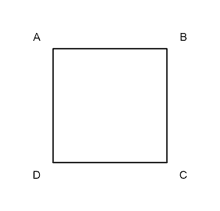
- 773 marks
Question 77
In a hydrogen atom, the electron and proton are separated by a distance m. If the charge on each is C, find the dipole moment of the system.
- 783 marks
Question 78
Calculate the field due to an electric dipole of length 10 cm, having charges of 100 μC at a point 20 cm from each charge.
- 793 marks
Question 79
Two charges each of 0.1 μC, but opposite in sign are 1 mm apart. What is the electric field at a point on the line joining them at a distance 10 cm from the midpoint?
- 803 marks
Question 80
The force experienced by a unit charge when placed at a distance of 10 cm from the middle point of an electric dipole on its axial line is 0.025 N in air, and when it is placed at a distance of 20 cm, the force is reduced to 0.002 N. Find the dipole length.
What Class 12 Physics Ch 1 covers
The sections of the chapter, in the order the book takes them. Every question above comes from one of these.
- 01Electric Charge and Its Properties
- 02Conductors, Insulators and Electrostatic Induction
- 03Coulomb's Law
- 04Principle of Superposition
- 05Electric Field and Electric Intensity
- 06Electric Lines of Force
- 07Electric Dipole
More ways to study this chapter
The same chapter asked three other ways. Practise it, revise it, and see what the board has set on Ch 1 before.
- Competency-Based Questions (CBQ)Case study questions: a situation, and the part of the chapter that answers it.48questionsOpen
- Previous Year QuestionsQuestions that have actually appeared in board papers, each tagged with its year.11questionsOpen
- Practice QuestionsExtra questions per chapter, for when one attempt at a method is not enough.138questionsOpen
Ch 1 in past ISC papers
The same chapter as the board has actually asked it. These are worded differently from the textbook exercise, which is the point of reading them.
- 11 mark
Board paper question 1
What is meant by the term Quantization of charge?
Solve with AIWritten solution
Solution:
Key idea: Electric charge does not come in any amount we like. It always comes in whole-number multiples of a smallest charge, the charge of one electron or proton.
Step 1 — State the meaning.
Quantization of charge means that the charge on any body is always a whole-number multiple of the elementary charge :
Here is a whole number and .
Step 2 — Say why it happens.
A body becomes charged only by gaining or losing whole electrons, and an electron cannot be split. So the charge always changes in steps of ; a charge such as is never found on a free body.
Therefore, quantization of charge means that every charge is , a whole-number multiple of .
- 24 marks
Board paper question 2
Derive an expression for intensity of electric field at a point in broadside position or on an equatorial line of an electric dipole.
Solve with AIWritten solution
Solution:
Key idea: We find the field of each charge at the point separately, then add the two fields as vectors (principle of superposition). On the equatorial line the two fields have equal size, so their parts along the perpendicular bisector cancel and their parts parallel to the dipole axis add.
Step 1 — Set up the dipole and the point.
The dipole has a charge at A and at B, a distance apart, with centre O. Its dipole moment has size and points from to (from A to B). The point P lies on the perpendicular bisector of AB (the broadside or equatorial position), at a distance from O.
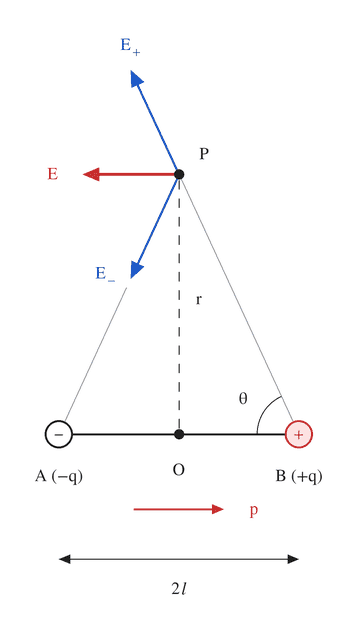
Step 2 — Find the distance of P from each charge.
Triangles AOP and BOP are right-angled at O, so by Pythagoras' theorem P is the same distance from both charges.
Step 3 — Write the field due to each charge.
A point charge gives a field of size at a distance . Both charges have size and are at the same distance, so the two fields at P are equal in size.
The field due to points away from B, along BP produced. The field due to points towards A, along PA.
Step 4 — Resolve the two fields.
Let be the angle that BP (and AP) makes with the axis AB. Each field has a part along the bisector and a part parallel to AB. The parts along the bisector are equal and opposite, so they cancel. The parts parallel to AB both point from B towards A, so they add.
Step 5 — Put in .
From the right-angled triangle BOP, the side next to is and the hypotenuse is .
So the resultant field is:
Step 6 — Write it with the dipole moment.
Since , we get:
The direction of is parallel to the axis, from the end towards the end, that is, opposite to .
Step 7 — Short dipole.
For a short dipole, is very small compared with , so can be dropped beside .
Watch out: The field at an equatorial point is NOT zero even though the potential there is zero; the two fields only cancel along the bisector.
Therefore, at a broadside point , directed opposite to (and for a short dipole).
- 31 mark
Board paper question 3
A charged oil drop weighing is found to remain suspended in a uniform electric field of intensity . Find the charge on the drop.
Solve with AIWritten solution
Solution:
Key idea: The drop stays at rest, so the upward electric force on it balances its weight .
Step 1 — Write the balance condition.
For the drop to remain suspended, the net force on it must be zero. The electric force must therefore be upward and equal in size to the weight.
Step 2 — Solve for the charge.
We divide the weight by the field intensity.
Step 3 — Check it against the elementary charge.
Charge is quantized, so the answer should be a whole number of electron charges.
So the drop carries 5 electronic charges, which is allowed.
Therefore, the charge on the drop is (five electronic charges).
- 43 marks
Board paper question 4
Two point charges and are kept fixed, apart in vacuum. Find intensity of the electric field at midpoint of the line joining and .
Solve with AIWritten solution
Solution:
Key idea: Each charge produces a field at the midpoint M on its own (principle of superposition). Both charges are positive, so each field points away from its own charge; at M the two fields point in opposite directions, and the resultant is their difference.
Step 1 — Find the distance of M from each charge.
The charges are apart, so the midpoint M is half that distance from each.
Step 2 — Field at M due to .
We use . The constant is , and the charge is .
This field points away from , that is, towards .
Step 3 — Field at M due to .
In the same way, we take the charge as :
This field points away from , that is, towards .
Step 4 — Add the two fields as vectors.
The two fields act along the same line in opposite directions, so we subtract the smaller from the larger.
The larger field wins, so the resultant points from towards .
Therefore, the field at the midpoint is , directed along the line from towards .
- 51 mark
Board paper question 5
Maximum torque acting on the electric dipole of moment in a uniform electric field E is . Find E.
Solve with AIWritten solution
Solution:
Key idea: A dipole of moment in a uniform field feels a torque . The torque is largest when the dipole is at right angles to the field, because is ; the largest torque is then .
Step 1 — Write the maximum torque.
At the torque has its largest value.
Step 2 — Solve for .
We divide the maximum torque by the dipole moment.
Therefore, .
- 63 marks
Board paper question 6
Obtain an expression for intensity of electric field at a point in end on position, i.e., axial position of an electric dipole.
Solve with AIWritten solution
Solution:
Key idea: On the axis of the dipole both charges lie on one line with the point, so their fields act along that line. The nearer charge gives the stronger field, and the resultant is the difference of the two fields.
Step 1 — Set up the dipole and the point.
The dipole has a charge at A and at B, a distance apart, with centre O. Its moment points from A to B. The point P is on the axis, beyond B, at a distance from O.
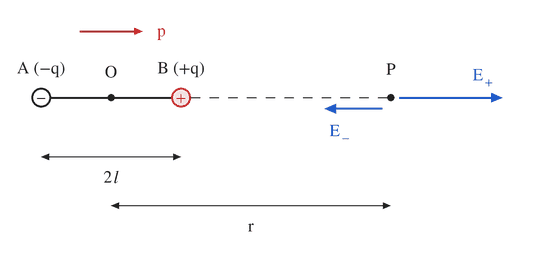
Step 2 — Find the distance of P from each charge.
P is nearer to at B and farther from at A.
Step 3 — Write the field due to each charge.
The field due to points away from B, along AB produced (along ).
The field due to points towards A (opposite to ).
Step 4 — Subtract the two fields.
Since , the field is larger, so the resultant points along and has size .
Step 5 — Simplify the top line.
Expanding the two squares, the and terms cancel and only the cross terms remain.
So:
Step 6 — Write it with the dipole moment.
We regroup the top line so that the dipole moment appears.
So the field becomes:
The direction is along the axis, from towards , that is, along .
Step 7 — Short dipole.
When is very small compared with , can be dropped beside , so .
Therefore, at an axial point , directed along (and for a short dipole).
All 11 board paper questions for this chapter, solved the same way.
Class 12 Physics Ch 1 questions students ask
How many questions are there in Class 12 Physics Ch 1?
80 questions. Every one is solved step by step on this page.
Are these Class 12 Physics solutions free?
Yes. Every question and its full working is free to read, with no account needed.
Can I download the Class 12 Physics Ch 1 solutions as a PDF?
There is no PDF to download. Every solution is on this page instead, which means it is searchable, always the current syllabus, and readable on a phone. Use your browser's print option if you want it on paper.