
Question 525 marksMedium
With the help of a labelled diagram, obtain an expression for the electric intensity E at a point P in broad side on position (i.e equatorial line) of an electric dipole.
Confirming your payment
Sign up now and get 250 free tokens.
Electric Charges and Fields · Question 52 of 80
With the help of a labelled diagram, obtain an expression for the electric intensity E at a point P in broad side on position (i.e equatorial line) of an electric dipole.
Solution:
Concept: By the principle of superposition, the field at a point due to several charges is the vector sum of their separate fields. At a point on the equatorial line of a dipole the two charges are equally far away, so their fields are equal in size.
Step 1 — Describe the set-up.
In the figure, the dipole AB has at A and at B, with and centre O, so its dipole moment points from A to B. The point P lies on the perpendicular bisector of AB, with .
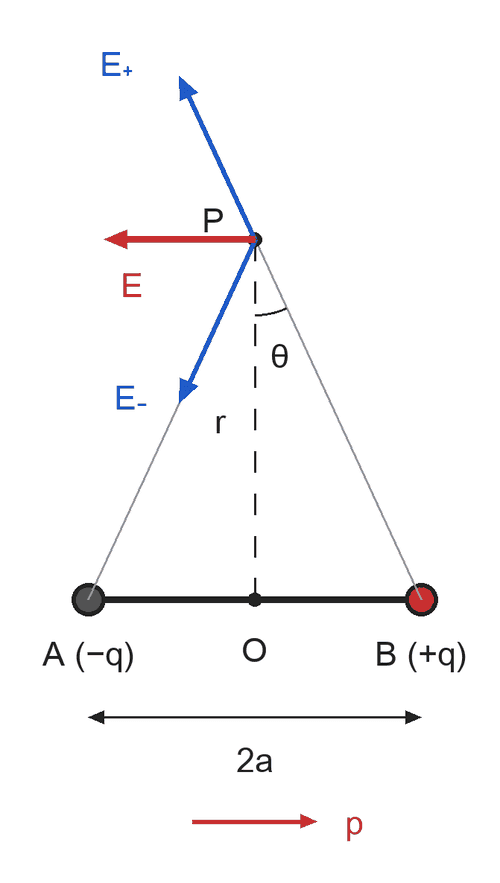
By Pythagoras' theorem in the right-angled triangle OPB, the distance of P from B is as follows; the distance AP is the same.
Step 2 — Find the field of each charge.
Each charge has size and is a distance from P, so the two fields have the same size, which we call .
The field of points away from B, along BP produced. The field of points towards A, along PA.
Step 3 — Resolve the two fields.
Let be the angle that BP (and also AP) makes with OP. Each field has a component along OP and a component parallel to AB. The components along OP are both , one pointing away from O and one towards O, so they cancel. The components parallel to AB are both and both point from B towards A, so they add.
Step 4 — Find .
In the right-angled triangle OPB, the side opposite is and the hypotenuse is BP.
Step 5 — Substitute and simplify.
We put and into and collect the powers of .
Step 6 — State the direction.
The resultant points parallel to the axis, from the end towards the end, which is opposite to . In vector form the field is as follows.
Step 7 — Simplify for a short dipole.
When , is negligible beside .
Therefore, at a point on the equatorial line, , directed parallel to the axis and opposite to the dipole moment .