
Question 763 marksMedium
Four charges of μC, μC, μC and μC are placed at the four corners of a square of side 20 mm. Calculate the force on a charge μC placed at the point of intersection of the diagonals of the square?
Confirming your payment
Sign up now and get 250 free tokens.
Electric Charges and Fields · Question 76 of 80
Four charges of μC, μC, μC and μC are placed at the four corners of a square of side 20 mm. Calculate the force on a charge μC placed at the point of intersection of the diagonals of the square?
Solution:
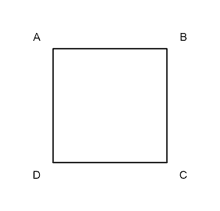
Key idea: The stem does not say which charge sits at which corner, so we take them in the order given: at A, at B, at C and at D. We add the fields of the four charges at the centre O, one diagonal at a time, and then use .
Step 1 — Find the distance of each corner from O.
The diagonal of a square of side 20 mm is mm, and O is its midpoint.
Step 2 — Find the field of a 1 μC charge at O.
All four corners are at the same distance, so it helps to find the field of a 1 μC charge first and scale it. We call this field .
Step 3 — Add the fields along the diagonal AC.
The field of a positive charge points away from it. So at A gives towards C, and at C gives towards A. These are opposite, so we subtract; we call the result .
It points from O towards C.
Step 4 — Add the fields along the diagonal BD.
The field of a negative charge points towards it. So at B gives towards B, and at D gives towards D. Again they are opposite.
It points from O towards B.
Step 5 — Combine the two perpendicular fields.
The diagonals of a square meet at right angles, so the two fields are perpendicular and equal in size.
Because the two parts are equal, the resultant bisects the angle BOC. It points from O towards the midpoint of side BC, which is parallel to AB.
Step 6 — Find the force on the charge.
A positive charge feels a force along the field, of size .
Note: the book's printed answer is N; the correct value for this arrangement is N, because each corner is mm from the centre.
Therefore, the force on the charge is about (636 N), directed from O towards the midpoint of BC, parallel to AB.