
Opening your dashboard
Class 12 Physics Chapter 1 Electric Charges and Fields: Practice Questions
138 questions on Chapter 1, each worked through on its own page with the AI tutor. Class 12 Physics, ICSE 2026-27.
138 questions
1–4 marks · Mixed difficulty
- 11 mark
Question 1
Which one of the following processes can never take place, because it violates the conservation of charge? ( and are neutral particles and is a photon.)
- 23 marks
Question 2
In an experiment to measure the charge on tiny oil drops, a student records the charges on four drops as , , and . (Hypothetical data.)
(i) Find the largest basic unit of charge of which every reading is a whole-number multiple.
(ii) How many such units does each drop carry?
(iii) Name the property of charge that these readings illustrate.
- 32 marks
Question 3
A rubber balloon rubbed on dry hair acquires a charge of . (Hypothetical data.)
(i) How many extra electrons does the balloon carry?
(ii) By what fraction does its charge change if one more electron is added? Use the result to explain why quantisation of charge is not noticed when we charge everyday objects.
(Take .)
- 41 mark
Question 4
Which one of the following statements about electric charge is incorrect?
- 53 marks
Question 5
A copper coin of mass is given a charge of . (Hypothetical data.)
(i) How many electrons were removed from the coin?
(ii) How many electrons does the neutral coin contain?
(iii) What fraction of its electrons was removed?
(Copper: atomic number , molar mass ; ; .)
- 61 mark
Question 6
A positively charged rod is held near an insulated, uncharged metal sphere. The sphere is touched to the earth with a wire. The rod is then taken away first, and only after that is the earth wire removed. The final charge on the sphere is
- 71 mark
Question 7
A negatively charged rod is brought near an insulated metal block, and the block is then connected to the earth. Which statement correctly describes what happens?
- 82 marks
Question 8
Two identical metal spheres A and B on insulating stands are placed touching each other. A negatively charged rod is brought close to sphere A without touching it. While the rod is held there, B is moved a little away from A. The rod is then removed.
(i) State the sign of the charge on each sphere and compare their magnitudes.
(ii) Will the two spheres now attract or repel each other? Give a reason.
- 92 marks
Question 9
An uncharged light metal ball hangs from a silk thread. When a positively charged rod is brought near it, the ball is pulled towards the rod, although its net charge is still zero. Explain why there is a net force of attraction.
- 101 mark
Question 10
A charged rod is held near a sheet of glass. The glass is touched to the earth, the earth connection is removed, and then the rod is taken away. The glass sheet is now
- 111 mark
Question 11
Two point charges placed apart in a liquid of relative permittivity exert a certain force on each other. To get the same force in air, the charges must be placed at a distance of
- 123 marks
Question 12
A point charge is at the origin and a point charge is at the point in the -plane, in air. Using Coulomb's law in vector form, find
(i) the force on due to , in terms of and ;
(ii) the force on due to .
- 133 marks
Question 13
Two small identical spheres, each of mass , are placed some distance apart in vacuum. Equal charges are given to both so that their electric repulsion exactly balances their gravitational attraction.
(i) Find .
(ii) Show that the answer does not depend on the distance between the spheres.
(iii) How many electrons must be removed from each sphere to give this charge?
(, , .)
- 143 marks
Question 14
In an experiment, two small spheres carrying equal charges are held at different separations in air, and the force between them is measured: (Hypothetical data.)
(cm) 2.0 3.0 4.0 6.0 (N) 9.0 4.0 2.25 1.0 (i) Show that the readings obey the inverse square law.
(ii) Find the charge on each sphere.
(.)
- 152 marks
Question 15
In a scattering experiment, an alpha particle (charge , mass ) comes within of a gold nucleus (charge ). (Hypothetical data.) Treating both as point charges, find the force on the alpha particle at this distance and its acceleration.
(, .)
- 163 marks
Question 16
In a crystal of common salt, a sodium ion and a neighbouring chloride ion are apart. Treating them as point charges and ,
(i) find the force between them in vacuum;
(ii) find the force between them at the same separation in water (relative permittivity );
(iii) use your answers to explain why salt dissolves easily in water.
(, .)
- 171 mark
Question 17
Two small identical spheres carrying equal charges repel each other with a force when kept a distance apart. Half of the charge of one sphere is transferred to the other, and the distance is kept the same. The new force between them is
- 181 mark
Question 18
Two metal spheres, each of radius , have their centres apart. They carry unlike charges and . Compared with , the actual force of attraction between them is
- 193 marks
Question 19
Point charges of , and are placed in air at , and respectively. Find the magnitude and direction of the net force on the charge at .
- 201 mark
Question 20
Six equal point charges are placed at the corners of a regular hexagon of side , and a charge is placed at its centre. The charge at one corner, , is now removed. The net force on is
- 213 marks
Question 21
is a square of side . Equal charges are placed at corners , and . Find the magnitude and sign of the charge that must be placed at corner so that the net force on the charge at is zero.
- 221 mark
Question 22
Three equal charges are placed at the corners of an equilateral triangle of side . If , the magnitude of the net force on any one charge is
- 234 marks
Question 23
A rectangle has , , and . Charges of , and are fixed at , and respectively, in air. A charge of is placed at .
(i) Find the force on the charge at due to each of the other charges.
(ii) Find the net force on it in terms of and , its magnitude, and the angle it makes with the -axis.
- 241 mark
Question 24
Two point charges and exert a force on each other. A third charge is now brought near them. The force exerted by on
- 251 mark
Question 25
An electron is released from rest in a uniform electric field of directed towards the east. Its acceleration is (, )
- 263 marks
Question 26
A charge of is spread uniformly in three different ways. Find the charge density in each case.
(a) Along a thin straight rod of length .
(b) Over the flat face of a thin disc of radius (treat all the charge as lying on that one face).
(c) Through the volume of a non-conducting sphere of radius .
(Hypothetical data.)
- 273 marks
Question 27
A charge of is fixed at the origin and a charge of is fixed at , in air. is the point .
(a) Find the electric field at due to each charge, with its direction.
(b) Write the resultant field at in terms of and , and find its magnitude and the angle it makes with the axis.
(c) Find the magnitude of the force on an electron placed at (), and state its direction.
(Hypothetical data.)
- 281 mark
Question 28
The electric field at a point from a point charge in air is , directed towards the charge. The charge is
- 292 marks
Question 29
In a region the electric field is . A charge of is placed there. Find the force on the charge in vector form and its magnitude.
- 303 marks
Question 30
An electron enters a uniform electric field of with a speed of , moving in the direction of the field. (, .)
(a) Explain why the electron slows down, and find its retardation.
(b) How far does it travel before coming to rest for an instant?
(c) How long after entering does it return to its starting point?
(Hypothetical data.)
- 311 mark
Question 31
Electric intensity is defined as , where is a test charge. Why must be very small?
- 321 mark
Question 32
In a field-line diagram the number of lines leaving or ending on a charge is proportional to the size of the charge. All lines that leave charge () end on charge , and more lines coming in from far away also end on . The charge on is
- 332 marks
Question 33
Two point charges and are placed a short distance apart. Sketch the electric lines of force in the region around them, and explain why only half of the lines leaving end on .
- 341 mark
Question 34
An uncharged metal sphere is placed in a uniform electric field. Which statement correctly describes the lines of force near and inside the sphere?
- 352 marks
Question 35
Give two reasons why electric lines of force due to static charges can never form closed loops.
- 362 marks
Question 36
The figure shows some lines of force in a region of an electric field. and are two points in the region.

(a) At which point is the electric intensity greater? Give a reason.
(b) An electron is placed at . In which direction does the force on it act?
- 371 mark
Question 37
The dipole moment of a water molecule is about . If the molecule is modelled as charges and (), the separation between the charges is about
- 383 marks
Question 38
An electric dipole consists of charges and separated by . A point lies on its axis, from its centre.
(a) Find the electric intensity at using the exact expression.
(b) Find it using the short-dipole expression .
(c) By what percentage is the short-dipole value smaller than the exact value?
(Hypothetical data.)
- 391 mark
Question 39
A short electric dipole is placed at the origin with its dipole moment along the direction. The electric fields at and at point, respectively, along
- 403 marks
Question 40
For a short electric dipole, the electric intensity at a point on its axis from its centre is . At what distance from the centre, on its equatorial line, is the intensity also ? How are the directions of the two fields related?
- 411 mark
Question 41
The electric intensity due to a short dipole at a point on its axis from its centre is . The intensity at a point on its equatorial line from its centre is
- 422 marks
Question 42
The net charge on an electric dipole is zero, yet it produces an electric field around it. Explain why. Also explain why, far from the dipole, its field falls off faster with distance than the field of a single point charge.
- 433 marks
Question 43
A hydrogen chloride (HCl) molecule has a dipole moment of ; the chlorine end is negative. Treating it as a short dipole, find
(a) the direction of its dipole moment,
(b) the electric intensity at a point on its axis from its centre,
(c) the electric intensity at a point on its equatorial line from its centre.
- 441 mark
Question 44
An electric dipole of moment is placed in a uniform electric field . The torque on the dipole is
- 453 marks
Question 45
A dipole is made of charges placed apart. It is free to turn in a uniform electric field of .
(a) Find the maximum torque it can experience.
(b) At what angles between and is the torque half of this maximum?
(c) Find the force on each charge and the net force on the dipole.
(Hypothetical data.)
- 461 mark
Question 46
An electric dipole rests in a uniform electric field with pointing opposite to . It is turned through a small angle and released. What happens next?
- 472 marks
Question 47
An electric dipole is held at rest with its axis perpendicular to a uniform electric field and is then released.
(a) Does the dipole as a whole move from its place? Explain.
(b) Describe how it turns, and state the position in which it finally comes to rest if there is a little friction.
- 483 marks
Question 48
Two small spheres carrying charges and are fixed at the ends of a light insulating rod long. The rod can turn about a pivot at its centre in a uniform electric field of .
(a) Find the torque on the rod when it is perpendicular to the field.
(b) What force, applied at the end perpendicular to the rod, will hold the rod in this position?
(c) What force, applied in the same way, holds the rod when it makes with the field?
(Hypothetical data.)
- 492 marks
Question 49
Explain the difference between electrostatic force and gravitational force.
- 502 marks
Question 50
Vehicles carrying inflammable materials usually have metallic ropes touching the ground during motion. Why?
- 512 marks
Question 51
When a polythene piece is rubbed with wool, it acquires negative charge. Is there a transfer of mass from wool to polythene?
- 522 marks
Question 52
A comb run through one's dry hair attracts small bits of paper. Why? What happens if the hair is wet or if it is a rainy day? [Remember a paper does not conduct electricity.]
- 532 marks
Question 53
Ordinary rubber is an insulator. But the special rubber tyres of aircrafts are made slightly conducting. Why is this necessary?
- 542 marks
Question 54
A bird perches on a bare high-power line, and nothing happens to the bird. A man standing on the ground touches the same line and gets a fatal shock. Why?
- 552 marks
Question 55
Give the dimensional formula for .
- 561 mark
Question 56
Which is bigger, the charge on the electron or one coulomb?
- 572 marks
Question 57
A glass rod held in hand can be charged by rubbing with silk. Why cannot a metal rod be charged like this?
- 582 marks
Question 58
Is it possible that a charged particle free to move in an electric field, always moves along the electric lines of force?
- 591 mark
Question 59
What type of symmetry is associated with the field due to (i) a point charge and (ii) a dipole?
- 602 marks
Question 60
“No two lines of force intersect each other.” Why?
- 611 mark
Question 61
What is an ideal dipole?
- 622 marks
Question 62
Two point charges and are placed at distance apart. What are the points at which the resultant field is parallel to the line joining the two charges?
- 633 marks
Question 63
A shower of protons from outer space deposits, equal charge , on the Earth and the Moon. The electrostatic repulsion then exactly counterbalances the gravitational attraction. How large is ?
- 642 marks
Question 64
Can coulomb of charge be given to a conductor? Explain.
- 652 marks
Question 65
State Coulomb's law in vector form.
- 662 marks
Question 66
If the distance between two point charges is doubled and their individual charges are also doubled, what will happen to the force between them?
- 671 mark
Question 67
State S.I. unit of permittivity.
- 681 mark
Question 68
Write down the relation between coulomb and ampere.
- 692 marks
Question 69
State the unit of electric permittivity in terms of the base (fundamental) S.I. units.
- 702 marks
Question 70
Draw (at least three) electric lines of forces due to an electric dipole.
- 711 mark
Question 71
What is the locus of an electron projected perpendicular to a uniform electric field?
- 722 marks
Question 72
What is the locus of a point at which the electric field due to an electric dipole is parallel to the line joining the charges and forming the dipole?
- 732 marks
Question 73
An electron revolves around the nucleus of hydrogen atom in a circular orbit of radius m. Calculate the intensity of electric field at the position of the electron.
- 741 mark
Question 74
What will be the net electric force acting on an electric dipole placed in a uniform electric field?
- 752 marks
Question 75
Draw a diagram to show electric lines of forces due to an electric dipole. Giving reason, indicate on the diagram a point where a small positive charge experiences a force parallel to the line joining the two charges.
- 762 marks
Question 76
A stationary oil drop between two parallel plates has a charge of C and a weight of N. Find the electric field acting on the drop.
- 772 marks
Question 77
A point charge of C experiences a force of N when kept in a uniform electric field of intensity E. Find E.
- 782 marks
Question 78
(i) Write an expression (derivation not required) for intensity of electric field in (a) axial position and (b) broad side on position of an electric dipole in terms of its length (), dipole moment () and distance ().
(ii) What is the ratio of these two intensities for a short electric dipole?
- 791 mark
Question 79
What does signify in electrostatics?
- 801 mark
Question 80
In Coulomb's law, on what factors the value of electrostatic force constant depend?
- 811 mark
Question 81
Does Coulomb's law obey Newton's third law of motion?
- 821 mark
Question 82
Does the motion of a body affect its charge?
- 831 mark
Question 83
A body is charged negatively. Will its mass increase, decrease or remain the same?
- 841 mark
Question 84
Given two point charges and such that . What is the nature of force between them?
- 851 mark
Question 85
Given two point charges and such that . What is the nature of the force between them?
- 861 mark
Question 86
What is the absolute permittivity of a medium whose dielectric constant is one?
- 871 mark
Question 87
Force between two point charges kept at a distance apart in air is . If these charges are kept at the same distance in water, how does the force between them change? of water .
- 881 mark
Question 88
What is the dielectric constant of a metal?
- 891 mark
Question 89
Give the names of two conservative forces in nature.
- 901 mark
Question 90
Does the Coulomb force that one charge exerts on another charge change, if other charges are brought nearby?
- 912 marks
Question 91
What is the importance of Coulomb's law in vector form?
- 922 marks
Question 92
What is the value of charge on an electron in S.I. units? Is a charge less than this value possible?
- 932 marks
Question 93
Two large conducting spheres carrying charges and are brought close to each other. Is the electrostatic force between them exactly given by , where is the distance between their centres?
- 942 marks
Question 94
If the distance between two equal point charges is doubled and their individual charges are also doubled, what would happen to the force between them?
- 952 marks
Question 95
If the distance between two equal point charges is halved and their individual charges are doubled, what would happen to the force between them?
- 962 marks
Question 96
The force of attraction between two point charges placed apart at a distance '' is . What should be the distance between the point charges in the same medium so that the force becomes ? What will happen if force becomes ?
- 971 mark
Question 97
Name any three vector fields.
- 981 mark
Question 98
What are the units of electric field intensity?
- 991 mark
Question 99
How does a free electron at rest move in an electric field?
- 1002 marks
Question 100
"The electric field intensity inside a charged conductor is zero." Why?
- 1011 mark
Question 101
When is an electric dipole in stable equilibrium in an electric field?
- 1021 mark
Question 102
When is an electric dipole in unstable equilibrium in an electric field?
- 1031 mark
Question 103
When is an electric line of force straight?
- 1041 mark
Question 104
The electric field at a point on the equatorial plane at a distance from the centre of a dipole having dipole moment is given by ( separation of the two charges forming the dipole and is the permittivity of free space)
- 1051 mark
Question 105
Consider the force on a charge due to a uniformly charged spherical shell of radius carrying charge distributed uniformly over it. Which one of the following statements is true for , if is placed at a distance from the centre of the shell?
- 1061 mark
Question 106
The acceleration of an electron due to the mutual attraction between the electron and proton when they are apart is (, charge of electron and )
- 1071 mark
Question 107
Two point charges A and B having charges and , respectively are placed at a certain distance apart and force acting between them is . If 25% charge of A is transferred to B, then force between the charges becomes
- 1081 mark
Question 108
Three charges , and are placed at distances , and , respectively from the origin on the X-axis. If the net force experienced by placed at is zero, then the value of is
- 1091 mark
Question 109
The bob of a simple pendulum has mass and a charge of . It is at rest in a uniform horizontal electric field of intensity . At equilibrium, the angle that the pendulum makes with the vertical is (take )
- 1101 mark
Question 110
An electron falls from rest through a vertical distance in a uniform and vertically upward directed electric field . The direction of electric field is now reversed, keeping its magnitude the same. A proton is allowed to fall from rest in it through the same vertical distance . The time of fall of the electron, in comparison to the time of fall of the proton is
- 1111 mark
Question 111
A spherical conductor of radius has a charge of distributed uniformly. What is the magnitude of electric field at a point from the centre of the sphere?
- 1121 mark
Question 112
Polar molecules are the molecules
- 1131 mark
Question 113
Determine the electric dipole moment of a system of three charges, placed on the vertices of an equilateral triangle as shown in the figure.

- 1141 mark
Question 114
An electric dipole is formed by two equal and opposite charges with separation . The charges have the same mass . It is kept in a uniform electric field . If it is slightly rotated from its equilibrium orientation, then its angular frequency is
- 1151 mark
Question 115
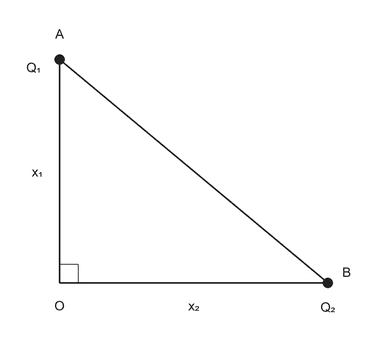
Charges and are at points A and B of a right-angled triangle OAB as shown in the figure. The resultant electric field at the point O is perpendicular to the hypotenuse, then is proportional to
- 1161 mark
Question 116
Two equal point charges each of are separated by a certain distance in metres. If they are located at and then the electrostatic force between them is
- 1171 mark
Question 117
The magnitude of electric force experienced by a charged particle in an electric field depends on
- 1181 mark
Question 118
When electrons are removed from a neutral metal plate through some process, the charge on it becomes
- 1191 mark
Question 119
Two point charges and repel each other with a force of . If a charge of is added to each of them, then the force between them will become
- 1201 mark
Question 120
Two spherical conductors B and C having equal radii and carrying equal charges in them repel each other with a force when kept apart at some distance. A third spherical conductor having same radius as that of B but uncharged is brought in contact with B, then brought in contact with C and finally removed away from both. The new force of repulsion between B and C is
- 1211 mark
Question 121
A charge is divided into two parts of and . If the coulomb repulsion between them when they are separated is to be maximum, then the ratio of should be
- 1221 mark
Question 122
A proton and an electron are placed in a uniform electric field,
- 1231 mark
Question 123
A particle of mass and charge is placed at rest in a uniform electric field and then released. The kinetic energy attained by the particle after moving a distance is
- 1241 mark
Question 124
Two spheres of radii and , respectively, are charged and joined by a wire. The ratio of electric field of the sphere is
- 1251 mark
Question 125
Two point charges and are located at and , respectively. The location of a point on the X-axis at which the net electric field due to these two point charges is zero is
- 1261 mark
Question 126
An electric dipole is placed in a uniform electric field. The net electric force on the dipole is
- 1271 mark
Question 127
An electric dipole is placed at an angle of with an electric field intensity . It experiences a torque equal to . The charge on the dipole, if the dipole length is is
- 1281 mark
Question 128
An electric dipole has a fixed dipole moment which makes an angle with respect to x-axis. When subjected to an electric field , it experiences a torque . When subjected to another electric field , it experiences a torque . The angle is
- 1291 mark
Question 129
An electric dipole of moment is at the origin . The electric field due to this dipole at (note that ) is parallel to
- 1301 mark
Question 130
A hollow metal sphere of radius is uniformly charged. The electric field due to the sphere at a distance from the centre
- 1311 mark
Question 131
A cube of side has point charges located at each of its vertices except at the origin where the charge is . The electric field at the centre of the cube is

- 1321 mark
Question 132
A certain charge is divided into two parts and . How should the charge and be divided so that and placed at a certain distance apart experience maximum electrostatic repulsion?
- 1331 mark
Question 133
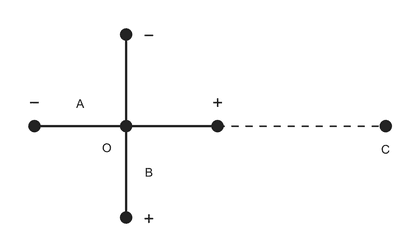
Two ideal electric dipoles A and B having their dipole moments and , respectively, are placed on a plane with their centres at O as shown in the figure. At point C on the axis of dipole A, the resultant electric field is making an angle of with the axis. The ratio of the dipole moments of A and B, is (take )
- 1341 mark
Question 134
The force between two charges separated by a certain distance in air is . If each of the two charges be halved and the distance between them is also halved, the new force would be
- 1351 mark
Question 135
Which one of the following is not a property of electric lines of force?
- 1361 mark
Question 136
An electric dipole consists of two point charges and separated by a distance of . It is kept at an angle of with an electric field of intensity . The torque experienced by the dipole is
- 1371 mark
Question 137
An electric dipole with its charge and , located at the points and lies in an electric field directed along the positive X-axis. The magnitude of torque acting on the dipole is
- 1381 mark
Question 138
64 drops each of radius , with charge combine to form a single drop. Find the ratio of surface charge densities of bigger drop to the smaller drop.