
Question 24 marksAsked 2015Medium
Derive an expression for intensity of electric field at a point in broadside position or on an equatorial line of an electric dipole.
Confirming your payment
Sign up now and get 250 free tokens.
Previous Year Questions · Question 2 of 11
Derive an expression for intensity of electric field at a point in broadside position or on an equatorial line of an electric dipole.
Solution:
Key idea: We find the field of each charge at the point separately, then add the two fields as vectors (principle of superposition). On the equatorial line the two fields have equal size, so their parts along the perpendicular bisector cancel and their parts parallel to the dipole axis add.
Step 1 — Set up the dipole and the point.
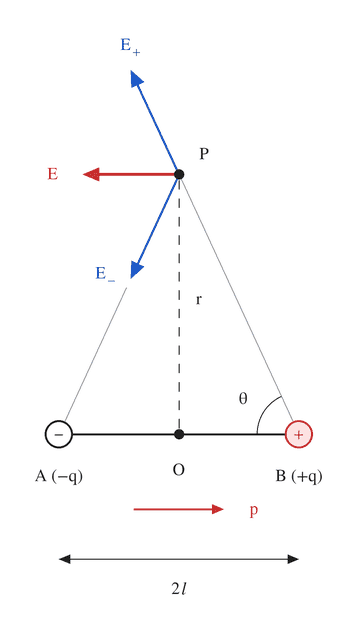
The dipole has a charge at A and at B, a distance apart, with centre O. Its dipole moment has size and points from to (from A to B). The point P lies on the perpendicular bisector of AB (the broadside or equatorial position), at a distance from O.
Step 2 — Find the distance of P from each charge.
Triangles AOP and BOP are right-angled at O, so by Pythagoras' theorem P is the same distance from both charges.
Step 3 — Write the field due to each charge.
A point charge gives a field of size at a distance . Both charges have size and are at the same distance, so the two fields at P are equal in size.
The field due to points away from B, along BP produced. The field due to points towards A, along PA.
Step 4 — Resolve the two fields.
Let be the angle that BP (and AP) makes with the axis AB. Each field has a part along the bisector and a part parallel to AB. The parts along the bisector are equal and opposite, so they cancel. The parts parallel to AB both point from B towards A, so they add.
Step 5 — Put in .
From the right-angled triangle BOP, the side next to is and the hypotenuse is .
So the resultant field is:
Step 6 — Write it with the dipole moment.
Since , we get:
The direction of is parallel to the axis, from the end towards the end, that is, opposite to .
Step 7 — Short dipole.
For a short dipole, is very small compared with , so can be dropped beside .
Watch out: The field at an equatorial point is NOT zero even though the potential there is zero; the two fields only cancel along the bisector.
Therefore, at a broadside point , directed opposite to (and for a short dipole).