
Opening your dashboard
Class 12 Physics Chapter 1 Electric Charges and Fields: Previous Year Questions
11 questions on Chapter 1, each solved step by step. Class 12 Physics, ICSE 2026-27.
11 questions with solutions
1–4 marks · Mixed difficulty
- 11 mark
Question 1
What is meant by the term Quantization of charge?
Solve with AIWritten solution
Solution:
Key idea: Electric charge does not come in any amount we like. It always comes in whole-number multiples of a smallest charge, the charge of one electron or proton.
Step 1 — State the meaning.
Quantization of charge means that the charge on any body is always a whole-number multiple of the elementary charge :
Here is a whole number and .
Step 2 — Say why it happens.
A body becomes charged only by gaining or losing whole electrons, and an electron cannot be split. So the charge always changes in steps of ; a charge such as is never found on a free body.
Therefore, quantization of charge means that every charge is , a whole-number multiple of .
- 24 marks
Question 2
Derive an expression for intensity of electric field at a point in broadside position or on an equatorial line of an electric dipole.
Solve with AIWritten solution
Solution:
Key idea: We find the field of each charge at the point separately, then add the two fields as vectors (principle of superposition). On the equatorial line the two fields have equal size, so their parts along the perpendicular bisector cancel and their parts parallel to the dipole axis add.
Step 1 — Set up the dipole and the point.
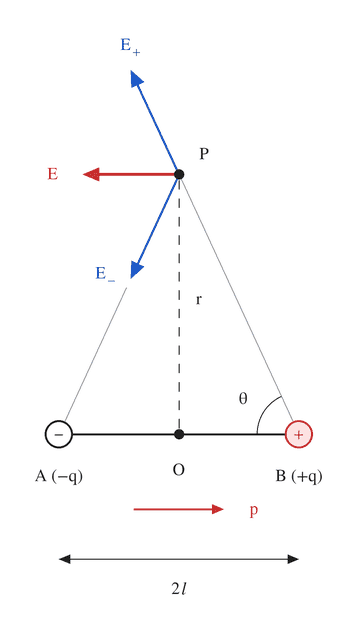
The dipole has a charge at A and at B, a distance apart, with centre O. Its dipole moment has size and points from to (from A to B). The point P lies on the perpendicular bisector of AB (the broadside or equatorial position), at a distance from O.
Step 2 — Find the distance of P from each charge.
Triangles AOP and BOP are right-angled at O, so by Pythagoras' theorem P is the same distance from both charges.
Step 3 — Write the field due to each charge.
A point charge gives a field of size at a distance . Both charges have size and are at the same distance, so the two fields at P are equal in size.
The field due to points away from B, along BP produced. The field due to points towards A, along PA.
Step 4 — Resolve the two fields.
Let be the angle that BP (and AP) makes with the axis AB. Each field has a part along the bisector and a part parallel to AB. The parts along the bisector are equal and opposite, so they cancel. The parts parallel to AB both point from B towards A, so they add.
Step 5 — Put in .
From the right-angled triangle BOP, the side next to is and the hypotenuse is .
So the resultant field is:
Step 6 — Write it with the dipole moment.
Since , we get:
The direction of is parallel to the axis, from the end towards the end, that is, opposite to .
Step 7 — Short dipole.
For a short dipole, is very small compared with , so can be dropped beside .
Watch out: The field at an equatorial point is NOT zero even though the potential there is zero; the two fields only cancel along the bisector.
Therefore, at a broadside point , directed opposite to (and for a short dipole).
- 31 mark
Question 3
A charged oil drop weighing is found to remain suspended in a uniform electric field of intensity . Find the charge on the drop.
Solve with AIWritten solution
Solution:
Key idea: The drop stays at rest, so the upward electric force on it balances its weight .
Step 1 — Write the balance condition.
For the drop to remain suspended, the net force on it must be zero. The electric force must therefore be upward and equal in size to the weight.
Step 2 — Solve for the charge.
We divide the weight by the field intensity.
Step 3 — Check it against the elementary charge.
Charge is quantized, so the answer should be a whole number of electron charges.
So the drop carries 5 electronic charges, which is allowed.
Therefore, the charge on the drop is (five electronic charges).
- 43 marks
Question 4
Two point charges and are kept fixed, apart in vacuum. Find intensity of the electric field at midpoint of the line joining and .
Solve with AIWritten solution
Solution:
Key idea: Each charge produces a field at the midpoint M on its own (principle of superposition). Both charges are positive, so each field points away from its own charge; at M the two fields point in opposite directions, and the resultant is their difference.
Step 1 — Find the distance of M from each charge.
The charges are apart, so the midpoint M is half that distance from each.
Step 2 — Field at M due to .
We use . The constant is , and the charge is .
This field points away from , that is, towards .
Step 3 — Field at M due to .
In the same way, we take the charge as :
This field points away from , that is, towards .
Step 4 — Add the two fields as vectors.
The two fields act along the same line in opposite directions, so we subtract the smaller from the larger.
The larger field wins, so the resultant points from towards .
Therefore, the field at the midpoint is , directed along the line from towards .
- 51 mark
Question 5
Maximum torque acting on the electric dipole of moment in a uniform electric field E is . Find E.
Solve with AIWritten solution
Solution:
Key idea: A dipole of moment in a uniform field feels a torque . The torque is largest when the dipole is at right angles to the field, because is ; the largest torque is then .
Step 1 — Write the maximum torque.
At the torque has its largest value.
Step 2 — Solve for .
We divide the maximum torque by the dipole moment.
Therefore, .
- 63 marks
Question 6
Obtain an expression for intensity of electric field at a point in end on position, i.e., axial position of an electric dipole.
Solve with AIWritten solution
Solution:
Key idea: On the axis of the dipole both charges lie on one line with the point, so their fields act along that line. The nearer charge gives the stronger field, and the resultant is the difference of the two fields.
Step 1 — Set up the dipole and the point.
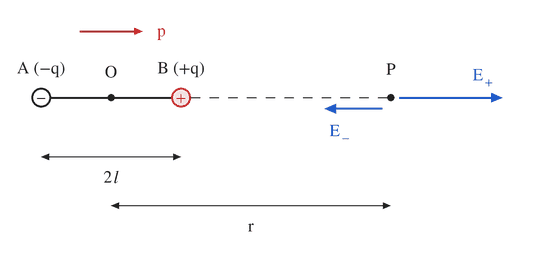
The dipole has a charge at A and at B, a distance apart, with centre O. Its moment points from A to B. The point P is on the axis, beyond B, at a distance from O.
Step 2 — Find the distance of P from each charge.
P is nearer to at B and farther from at A.
Step 3 — Write the field due to each charge.
The field due to points away from B, along AB produced (along ).
The field due to points towards A (opposite to ).
Step 4 — Subtract the two fields.
Since , the field is larger, so the resultant points along and has size .
Step 5 — Simplify the top line.
Expanding the two squares, the and terms cancel and only the cross terms remain.
So:
Step 6 — Write it with the dipole moment.
We regroup the top line so that the dipole moment appears.
So the field becomes:
The direction is along the axis, from towards , that is, along .
Step 7 — Short dipole.
When is very small compared with , can be dropped beside , so .
Therefore, at an axial point , directed along (and for a short dipole).
- 73 marks
Question 7
Show that intensity of electric field E at a point in broadside on position is given by:
Where the terms have their usual meaning.
Solve with AIWritten solution
Solution:
Key idea: At a broadside (equatorial) point the two charges are at equal distances, so their fields are equal in size. Their parts along the perpendicular bisector cancel, and their parts parallel to the dipole axis add.
Step 1 — Set up the dipole and the point.
Here is at A and at B, a distance apart, with centre O, so the dipole moment is (from A to B). P is on the perpendicular bisector of AB at a distance from O.
Step 2 — Find the distances AP and BP.
Triangles AOP and BOP are right-angled at O, so by Pythagoras' theorem:
Step 3 — Write the field due to each charge.
The two charges have equal size and are at equal distances, so the two fields have equal size.
points away from (along BP produced) and points towards (along PA).
Step 4 — Resolve and add.
Let be the angle between BP and the axis AB. The parts along the bisector point in opposite directions and cancel. The parts parallel to AB both point from B towards A and add.
Step 5 — Use the triangle for .
In triangle BOP, the side next to is and the hypotenuse is .
Putting this in:
Step 6 — Bring in the dipole moment.
Since :
This is the required result. Its direction is parallel to the axis, opposite to .
Therefore, at a broadside point, directed opposite to , where is the length of the dipole and the distance of the point from its centre.
- 83 marks
Question 8
Show that intensity of electric field at a point in broadside position of an electric dipole is given by:
where the terms have their usual meaning.
Solve with AIWritten solution
Solution:
Key idea: We add the fields of the two charges as vectors. At a point on the perpendicular bisector the two fields are equal in size; their parts along the bisector cancel and their parts parallel to the dipole axis add.
Step 1 — Describe the arrangement.
The dipole is at A and at B, a distance apart, with centre O. Its moment is , pointing from A to B. P is in the broadside position, on the perpendicular bisector of AB, at a distance from O.
Step 2 — Distance of P from each charge.
By Pythagoras' theorem in the right-angled triangles AOP and BOP:
Step 3 — Field of each charge at P.
We apply to each charge:
points away from B along BP produced; points along PA, towards A.
Step 4 — Components.
Let be the angle each line AP, BP makes with AB. Along the bisector the components and are equal and opposite, so they cancel. Parallel to AB, both components point from B to A and add.
Step 5 — Substitute .
From triangle BOP, is the adjacent side over the hypotenuse.
So:
Step 6 — Use the dipole moment.
With this becomes the required result.
The field is parallel to the dipole axis, directed from the end towards the end (opposite to ).
Watch out: Here is the whole length of the dipole, so is half of it; using the full length in place of gives a wrong answer.
Therefore, at a broadside point, directed opposite to .
- 92 marks
Question 9
(a) What is meant by the statement: "Relative permittivity of water is 81"?
(b) Can a body be given a charge of ? Give a reason for your answer.
Solve with AIWritten solution
Solution:
Key idea: (a) Relative permittivity of a medium tells us how many times the force between two charges becomes weaker when the space between them is filled with that medium. (b) Charge is quantized: any charge must be a whole-number multiple of .
Step 1 — (a) Recall Coulomb's law in a medium.
For two charges and a distance apart, the force in vacuum and in a medium of relative permittivity are:
Dividing one by the other gives the meaning of :
Step 2 — (a) Apply it to water.
"Relative permittivity of water is 81" means that the force between two given charges placed in water is of the force between the same charges at the same distance in vacuum. Equally, the permittivity of water is times that of free space, .
Step 3 — (b) Test the charge against .
We find how many elementary charges would be.
Step 4 — (b) Decide.
A body can gain or lose only whole electrons, so must be a whole number. Here is not a whole number, so this charge is not possible.
Therefore, (a) water reduces the force between two charges to of its value in vacuum (); (b) no, because is , not a whole-number multiple of .
- 102 marks
Question 10
In case of a short electric dipole:
(i) What is the locus of a point having zero potential?
(ii) If electric field intensity at a point in axial position is and at an equidistant point in equatorial position is , what is the ratio ?
Solve with AIWritten solution
Solution:
Key idea: For a short dipole of moment , the potential at a point is , where is the angle between and the line to the point. The field at an axial point is and at an equatorial point is .
Step 1 — (i) Find where the potential is zero.
The potential is zero when , that is, when .
Every point at to the dipole axis through its centre lies on the perpendicular bisector of the dipole. At each such point the distances from and are equal, so their potentials and cancel.
Step 2 — (i) State the locus.
So the locus is the equatorial line, the perpendicular bisector of the dipole axis. In three dimensions it is the whole equatorial plane through the centre of the dipole, at right angles to its axis.
Step 3 — (ii) Write the two fields at the same distance .
At an axial point:
At an equatorial point at the same distance:
Step 4 — (ii) Take the ratio.
Dividing, the factor cancels.
Therefore, (i) the locus of zero potential is the equatorial line (the perpendicular bisector plane of the dipole), and (ii) .
- 113 marks
Question 11
Show that the intensity of electric field at a point in end on position i.e., axial position of an electric dipole is given by:
where the terms have their usual meaning.
Solve with AIWritten solution
Solution:
Key idea: At an axial point both charges are on one line with the point, so their fields act along that line in opposite directions. The nearer charge gives the stronger field, and the resultant is the difference.
Step 1 — Set up the dipole and the point.
Take at A and at B, a distance apart, with centre O. The dipole moment is , pointing from A to B. P lies on the axis beyond B, at a distance from O.
Step 2 — Distances of P from the charges.
P is nearer to B.
Step 3 — Field due to each charge.
The field of at P points away from B (along ):
The field of at P points towards A (opposite to ):
Step 4 — Find the resultant.
Since , the resultant is along with size . We take the common factor out and use a common denominator.
Step 5 — Simplify.
Expanding, , so:
Step 6 — Bring in the dipole moment.
We regroup the top line so that the dipole moment appears.
So the field becomes:
This is the required result. The field points along the axis from to , the same way as .
Watch out: On the axis the field is along , but on the equatorial line it is opposite to ; do not mix the two directions.
Therefore, at an axial point, directed along .