
Opening your dashboard
Class 12 Maths Chapter 15: Application of Integrals: Area Under the Curve Solutions
40 textbook questions with step-by-step answers, free to read, for ISC 2026-27.
Get talked through Ch 15, not just shown the answer
Reading a finished solution is not the same as being able to do it. The AI tutor takes one question at a time and works it with you, in your own words, until you can.
- Ask it out loud, in your own words
- It gives you the next step, not the answer
- Stuck on part (ii)? Start there
40 questions with solutions
3 marks · Mixed difficulty
The first 8 solutions are on this page. This chapter is a long one, so the rest open on their own page to keep this one quick to load.
- 13 marks
Question 1
Using integration, find the area of the region bounded by
(i) the line , the -axis and the lines and .
(ii) , the -axis and the lines and .
Solve with AIWritten solution
Solution:
Key idea: If a curve stays above the -axis for , the area between the curve, the -axis and the lines , is . So in each part we first check that the line is above the -axis on the interval, and then integrate.
Step 1 — Part (i): write in terms of and check its sign.
We divide by 3 so that stands alone.
At , the height is , and at , the height is . The line meets the -axis only at , which is outside , so the line is above the -axis on the whole interval (the shaded region).

Step 2 — Part (i): integrate over .
An antiderivative of is , so we keep the factor outside and put in the limits.
Step 3 — Part (ii): write in terms of and check its sign.
We divide by 2.
At , the height is , and at , the height is . The line meets the -axis only at , which is outside , so the line is above the -axis on the whole interval.
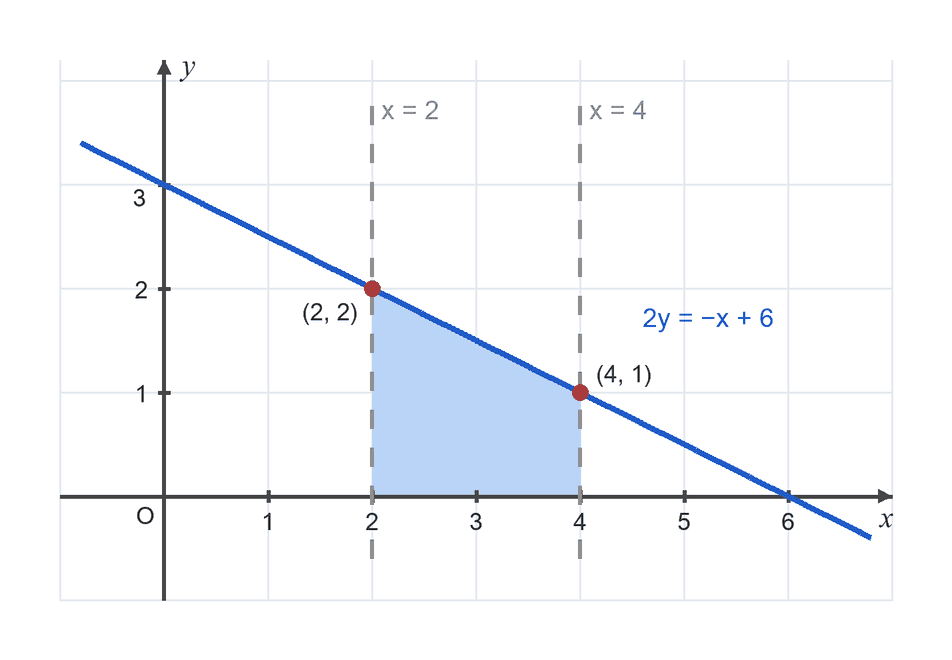
Step 4 — Part (ii): integrate over .
An antiderivative of is , so we keep the factor outside and put in the limits.
Check: Each region is a trapezium. In (i) the parallel sides are and with width , so the area is ; in (ii) the sides are and with width , so the area is .
Therefore, the areas are (i) sq units and (ii) sq units.
- 23 marks
Question 2
(i) Using integration, find the area of the region bounded between the line and the parabola .
(ii) Find the area of the region bounded by the parabola and its latus rectum.
(iii) Find the area enclosed between the co-ordinate axes and the curve in the second quadrant.
Solve with AIWritten solution
Solution:
Key idea: Each parabola here is symmetric about the -axis, so the area of a region cut off by a vertical line is twice the area of its upper half, where . For a parabola , the focus is and the latus rectum is the chord through the focus.
Step 1 — Part (i): find where the line meets the parabola.
We put in the equation of the parabola.
So , and the line meets the parabola at and . The region lies between the vertex and the line , on both sides of the -axis.
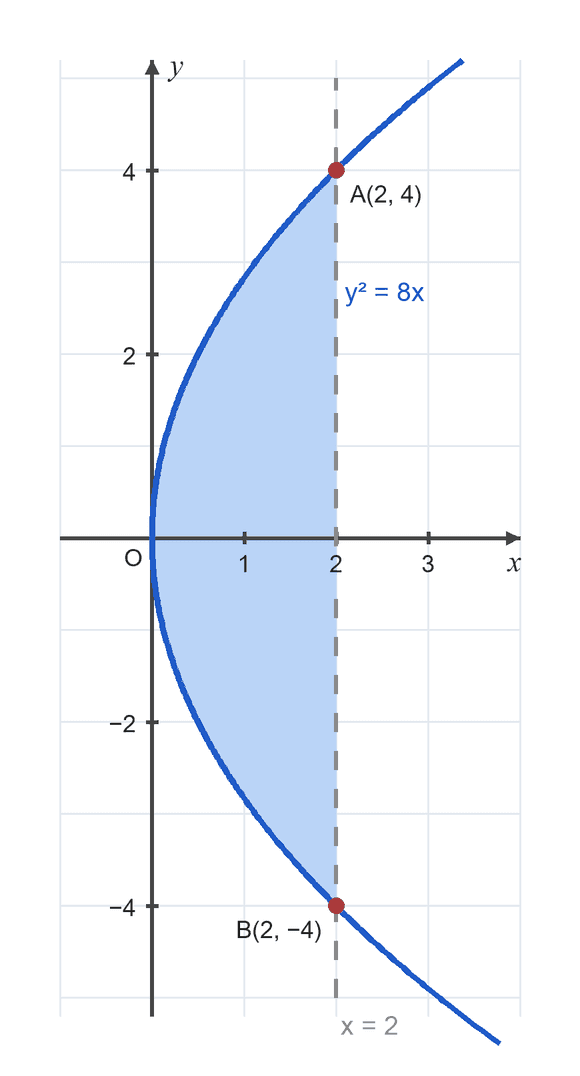
Step 2 — Part (i): integrate the upper half and double it.
For the upper half is (since ), and .
Step 3 — Part (ii): locate the latus rectum.
We compare with the standard form on the right.
So . The focus is , and the latus rectum is the line . When is we get , so its ends are and .
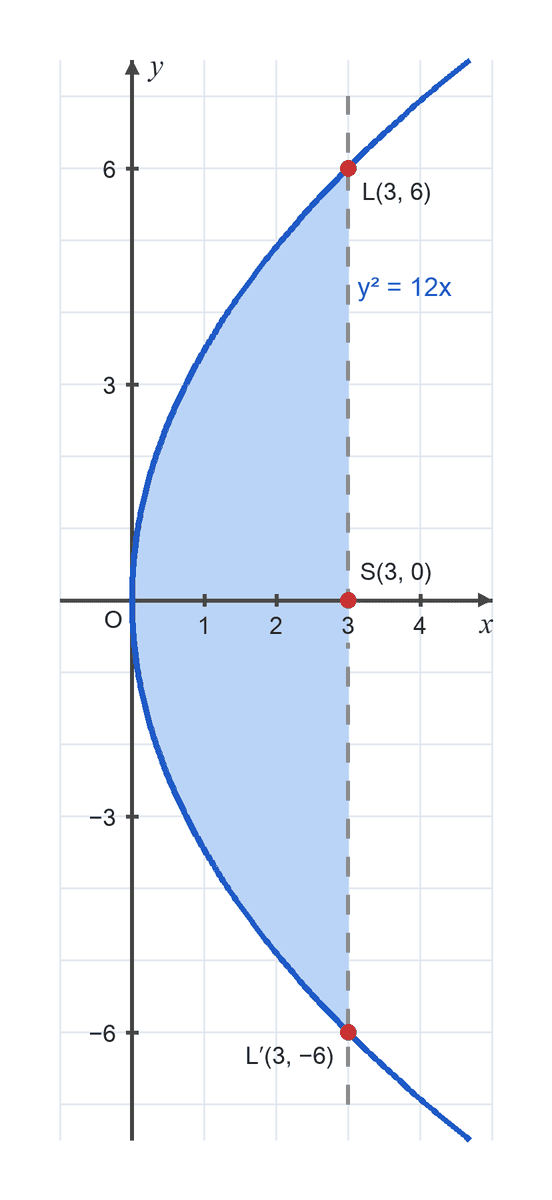
Step 4 — Part (ii): integrate the upper half and double it.
For the upper half is , since .
Step 5 — Part (iii): describe the region in the second quadrant.
We take and . The given curve is a parabola opening to the right with vertex . On the -axis is , so , and the curve meets the positive -axis at . In the second quadrant the region runs from the vertex to the -axis, under the upper branch .
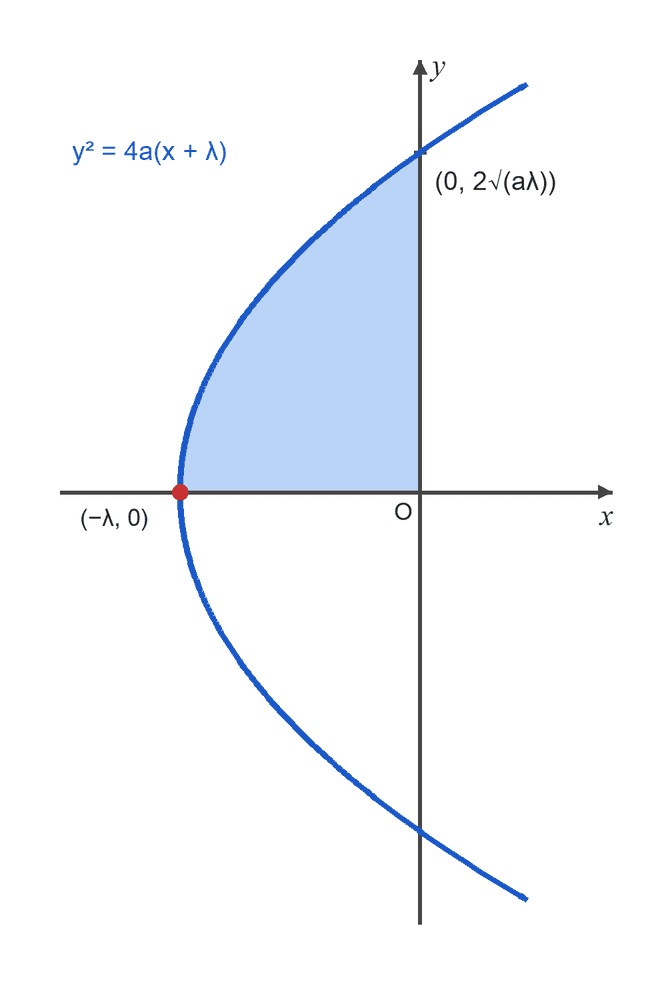
Step 6 — Part (iii): integrate over .
We use .
Note: The book's printed answer has a misprint in the power of . An area must have the units of length², and has them while does not.
Therefore, the areas are (i) sq units, (ii) sq units and (iii) sq units.
- 33 marks
Question 3
Draw the rough sketch of the curve and find the area under the curve, above the -axis and between and .
Solve with AIWritten solution
Solution:
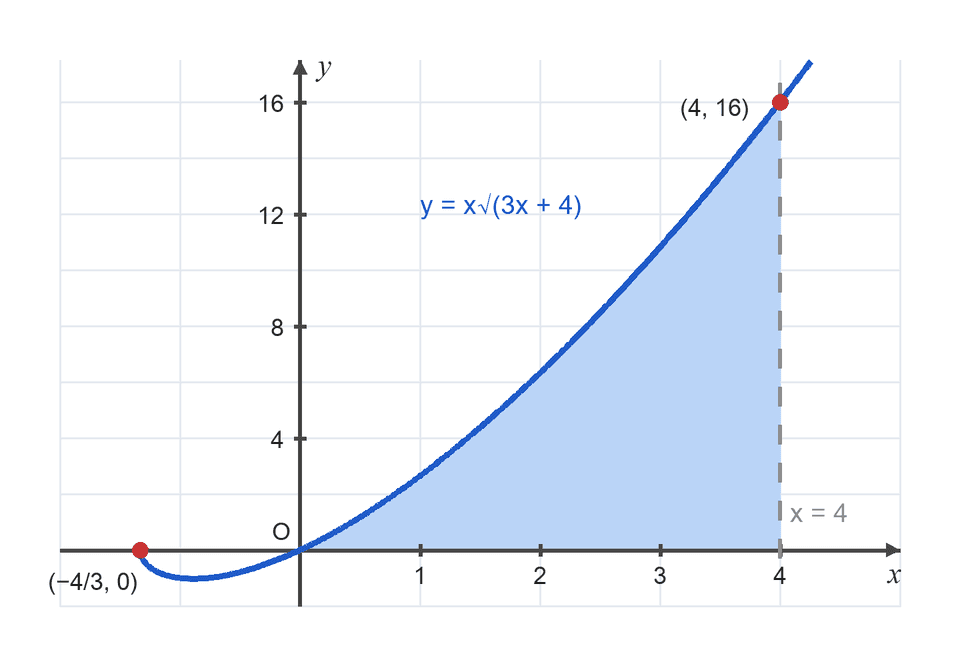
Key idea: The curve as printed is . We find where it is defined and where it lies above the -axis, sketch it, and then integrate over with the substitution .
Step 1 — Find where the curve is defined and its sign.
The square root needs , so . The factor is never negative, so has the same sign as : the curve is below the -axis for and above it for . It meets the -axis at and .
Step 2 — Plot a few points and sketch the curve.
We work out at a few values of in .
The curve rises steadily from to ; the region asked for is shaded.
Step 3 — Set up the integral and substitute.
On the curve is above the -axis, so the area is the plain integral. We put , so that and . When , , and when , ; these are the new limits.
Step 4 — Integrate and put in the limits.
We use and , with , , and .
This is about sq units.
Note: The book's printed answer belongs to the curve (the extra after the root looks like a misprint). For that curve the area is , which works out to , or sq units.
Therefore, for the curve as printed the area is sq units (about sq units).
- 43 marks
Question 4
(i) Sketch the graph of . Evaluate . What does the value of the integral represent on the graph?
(ii) Sketch the graph of . Using integration, find the area of the region bounded by the curve and and .
Solve with AIWritten solution
Solution:
Key idea: To integrate a modulus, split the interval at the point where the expression inside is zero, and write the modulus without bars on each piece. Since , its integral over an interval equals the area between the graph and the -axis.
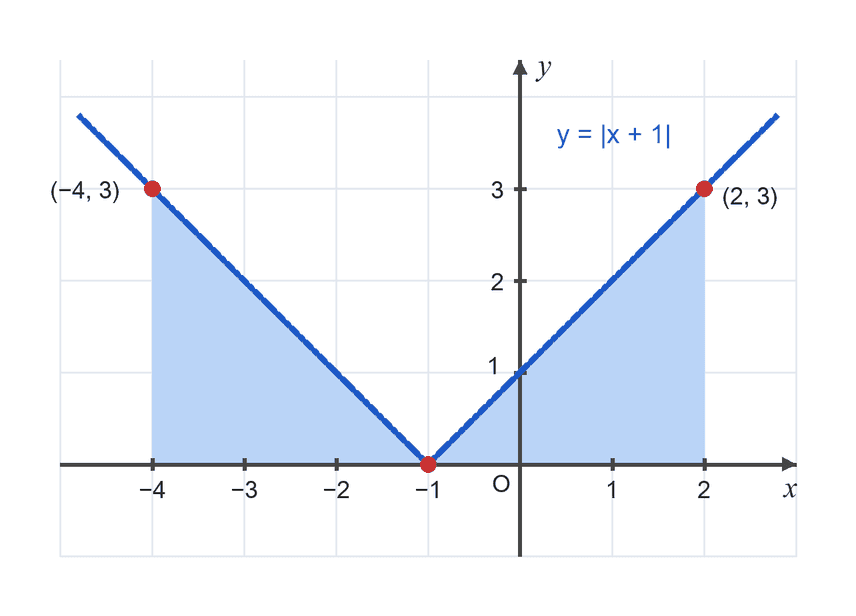
Step 1 — Part (i): write piece by piece and sketch it.
The expression is zero at , negative to the left and positive to the right.
The graph is a V with its corner at , passing through , and .
Step 2 — Part (i): integrate each piece.
We split at and use the correct form on each side.
Step 3 — Part (i): say what the value represents.
The integrand is never negative, so the integral is the area of the region bounded by , the -axis and the lines and . This region is the two shaded triangles, each of area .
Step 4 — Part (ii): write piece by piece and sketch it.
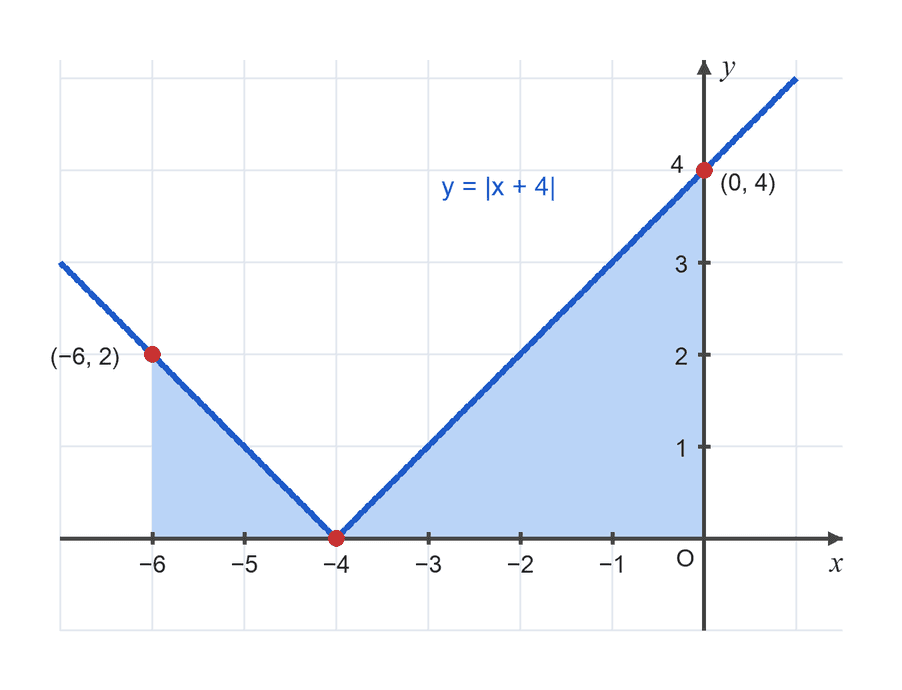
The expression is zero at .
The graph is a V with its corner at , passing through and . The region lies above the -axis between and .
Step 5 — Part (ii): integrate each piece.
We split the interval at .
Check: The two triangles have areas and .
Therefore, (i) the integral equals , which is the area (9 sq units) enclosed by , the -axis and the lines , ; (ii) the area is sq units.
- 53 marks
Question 5
Find the area bounded by the curve and the line .
 Solve with AI
Written solution
Solution:
Key idea: The area between two curves over is , where and are where the curves meet. Here the line is above the parabola between their meeting points.
Step 1 — Find where the line meets the parabola.
We put in the equation of the parabola.
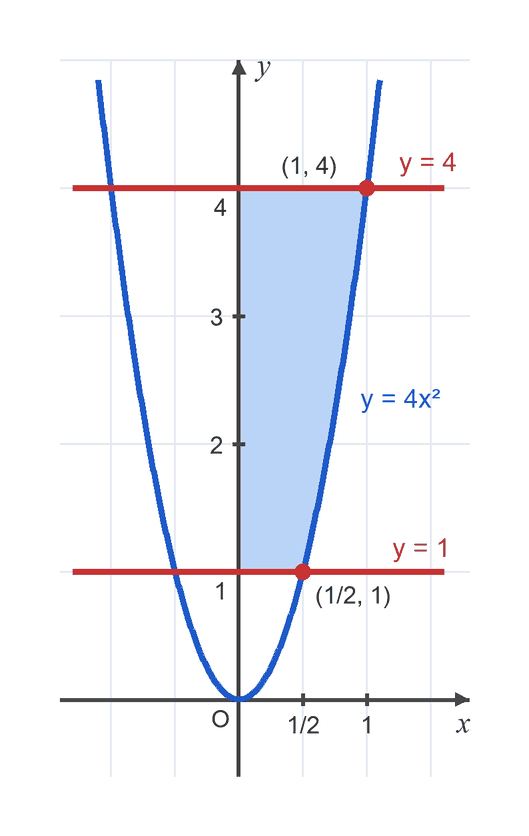
So or , and the meeting points are and , as in the figure.
Step 2 — Decide which curve is on top.
For we have , so the line is the upper boundary and the parabola the lower one. The region is symmetric about the -axis, because is unchanged when is replaced by .
Step 3 — Integrate the difference.
By symmetry we integrate over and double the result.
Check: A parabolic segment has area of its enclosing rectangle, and .
Therefore, the area bounded by and is sq units.
- 63 marks
Question 6
Sketch the region lying in the first quadrant and bounded by , , and . Find the area of the region, using integration.
Solve with AIWritten solution
Solution:
Key idea: When a region is bounded by horizontal lines and , we use horizontal strips: the area is , where is the distance of the curve from the -axis.
Step 1 — Write the curve as in terms of .
In the first quadrant , so from we take the positive root.
Step 2 — Sketch the region.
The curve is a parabola with vertex opening upwards. It meets the line at , and the line at . The region lies between the -axis () and the right branch of the curve, for (shaded).
Step 3 — Integrate with respect to .
Each horizontal strip has length and thickness , and .
Therefore, the area of the region is sq units.
- 73 marks
Question 7
Find the gradients of the curve at the points and and sketch the part of the curve of which both and are positive. Find the area between this part of the curve and the axis.
Solve with AIWritten solution
Solution:
Key idea: The gradient of a curve at a point is the value of there. For the area, we find the interval on which the curve is above the -axis and integrate over it.
Step 1 — Differentiate the curve.
We expand first, so that each term can be differentiated by the power rule.
Step 2 — Find the gradients at and .
We put and in .
So the curve touches the -axis at (gradient ) and crosses it at going downwards (gradient ).
Step 3 — Find the part where both and are positive.
For we have , so exactly when , which means . So the part asked for is .
Step 4 — Find the highest point and sketch.
The gradient is zero at or at . The height at the second point is worked out below.
So the curve rises from to the maximum and falls to ; the region is shaded.
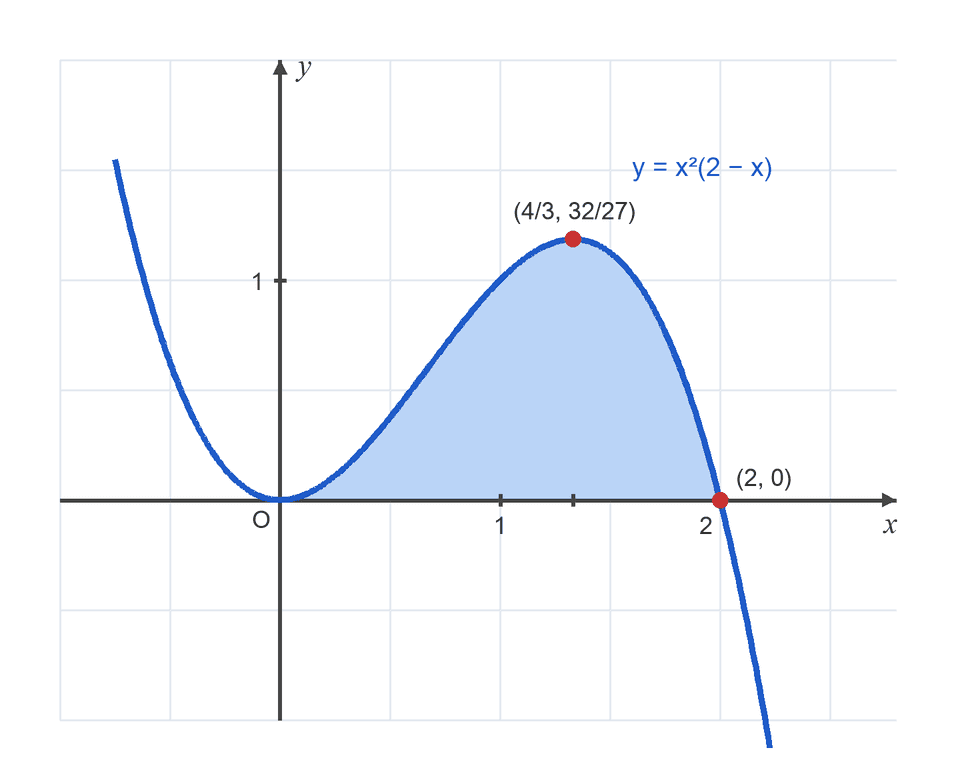
Step 5 — Integrate over .
The curve is above the -axis on , so the area is the plain integral.
Therefore, the gradients are at and at , and the area is sq units.
- 83 marks
Question 8
Find the area included between the curve , the -axis and the lines and .
Solve with AIWritten solution
Solution:
Key idea: If a curve stays above the -axis on , the area between it, the -axis and the lines , is .
Step 1 — Describe the curve and check its sign.
The curve is a parabola opening downwards with vertex . It meets the -axis where , that is at . Since lies inside , the curve is above the -axis there; at its height is .

Step 2 — Use symmetry and integrate.
The function is even, so the integral from to is twice the integral from to .
This is sq units.
Therefore, the required area is sq units.
- 93 marks
Question 9
Find the area bounded by the curve , the line , and the -axis.
- 103 marks
Question 10
Find the area of the region bounded by , , and .
- 113 marks
Question 11
Find the area bounded by the parabola and the ordinates and .
- 123 marks
Question 12
Find the area bounded by the curve and the lines and .
- 133 marks
Question 13
Evaluate the area of the region bounded by the curve , and the -axis, after drawing a rough sketch of the same.
- 143 marks
Question 14
Make a rough sketch of the curve , and calculate its gradient at the point where it meets the axis of . Find the area bounded by the curve and the axis of .
- 153 marks
Question 15
The figure shows a sketch of the curve .
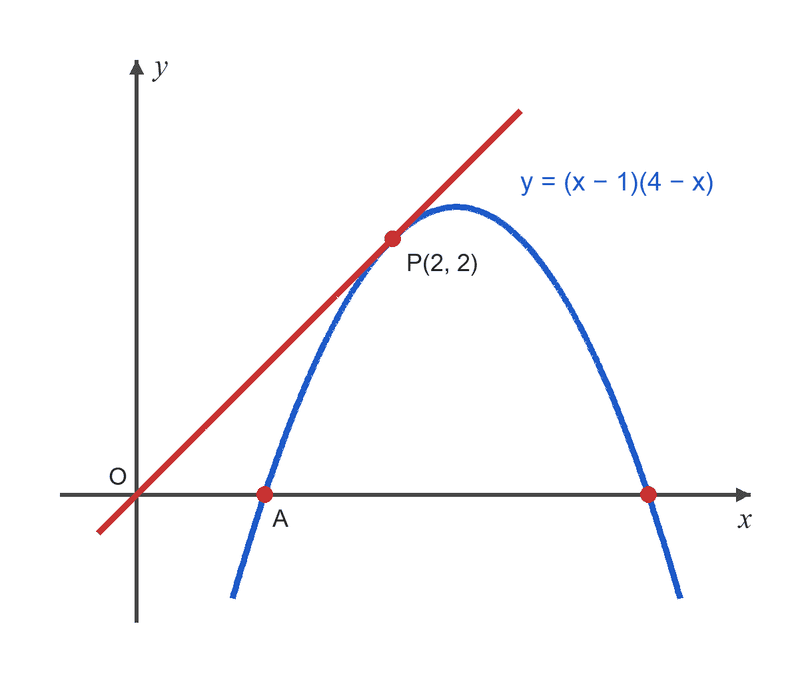
If is the point , verify that the tangent at passes through the origin as shown. Calculate the area enclosed between the tangent, the curve and the axis of .
- 163 marks
Question 16
The curve passes through the points , and its gradient at the point is 2. Find the numerical value of the area included between the curve and the axis of .
- 173 marks
Question 17
The line meets the curve at the point (the origin) and , and is perpendicular to the -axis. Prove that the area between the curve and is one-half the area enclosed by the lines , and the curve.
- 183 marks
Question 18
Calculate the areas of the two parts into which the area enclosed by the -axis and the curve is divided by the line .
- 193 marks
Question 19
Draw the rough sketch of , and find the area enclosed by the curve and the line .
- 203 marks
Question 20
Find the area bounded by the curve and the line and .
- 213 marks
Question 21
Make a rough sketch of the following curves. Also, find the area enclosed between the curves and the axes.
(i) ,
(ii) ,
(iii) ,
(iv) ,
- 223 marks
Question 22
Draw a rough sketch of the curve in and find the area enclosed by the curve, the lines , and the -axis.
- 233 marks
Question 23
Draw a rough sketch of the curve and find the area between the -axis, the curve and the ordinates and .
- 243 marks
Question 24
Show that the area included between the -axis and the curve is .
- 253 marks
Question 25
(i) Calculate the area bounded by the curve , the -axis and the line .
(ii) Calculate the approximate increase in this area, if the line is changed to .
- 263 marks
Question 26
Find the area of the region bounded by , , and .
- 273 marks
Question 27
Find the area bounded by , between the ordinates corresponding to and .
- 283 marks
Question 28
Find the area of the region enclosed by the following curves or lines.
(a) ,
(b) ,
(c) ,
- 293 marks
Question 29
Find the area of the figure bounded by the graphs of the functions and .
- 303 marks
Question 30
(i) Find the area bounded by the curve and the straight line .
(ii) Find the area cut off from the parabola by the line .
(iii) Find the area of the region included between the parabola and the line .
- 313 marks
Question 31
Find the area of the region bounded by the curves , , and . Also, sketch the region bounded by these curves.
- 323 marks
Question 32
Using integration, find the area of the region bounded by the circle , line and -axis, but lying in the first quadrant.
- 333 marks
Question 33
Find the point of intersection of the line with the curve . If is that point of intersection which lies in the first quadrant and is the origin, calculate the area between the line and the curve.
- 343 marks
Question 34
Using integration, find the area of the triangle, whose vertices are
(i) , and
(ii) , and
- 353 marks
Question 35
Using integration, find the area of the region bounded by the triangle whose sides are , and .
- 363 marks
Question 36
Find the area of the triangle bounded by the lines represented by the equation , and , using integration method.
- 373 marks
Question 37
Find the area of the region enclosed between two circles and .
- 383 marks
Question 38
Sketch the region common to the circle and the parabola . Also, find the area of the region using integration.
- 393 marks
Question 39
Indicate the region bounded by the curve , and -axis and obtain the area enclosed by them.
- 403 marks
Question 40
Using integration, find the area of the triangle formed by positive -axis and tangent and normal to the circle at .
What Class 12 Maths Ch 15 covers
The sections of the chapter, in the order the book takes them. Every question above comes from one of these.
- 01Sketching of Simple Curves
- 02Area Under a Curve
- 03Area Between Two Curves
More ways to study this chapter
The same chapter asked three other ways. Practise it, revise it, and see what the board has set on Ch 15 before.
- Competency-Based Questions (CBQ)Case study questions: a situation, and the part of the chapter that answers it.49questionsOpen
- Previous Year QuestionsQuestions that have actually appeared in board papers, each tagged with its year.13questionsOpen
- Practice QuestionsExtra questions per chapter, for when one attempt at a method is not enough.109questionsOpen
Ch 15 in past ISC papers
The same chapter as the board has actually asked it. These are worded differently from the textbook exercise, which is the point of reading them.
- 15 marks
Board paper question 1
Find the smaller area enclosed by the circle and the line .
Solve with AIWritten solution
Solution:
Key idea: The smaller region cut off from a circle by a chord is a segment. Its area is the area under the arc minus the area under the chord, both found by integration between the points where the line meets the circle.
Note: The paper prints the circle as with no right-hand side. We take the circle , because the line meets the axes at and , and these points lie on the circle of radius about the origin.
Step 1 — Find where the line meets the circle.
We put into the equation of the circle, and solve for .
So or , giving the points and .
Step 2 — Sketch the region.
The circle has centre and radius . The chord cuts off a small segment in the first quadrant, shaded below. Between and the arc lies above the chord.
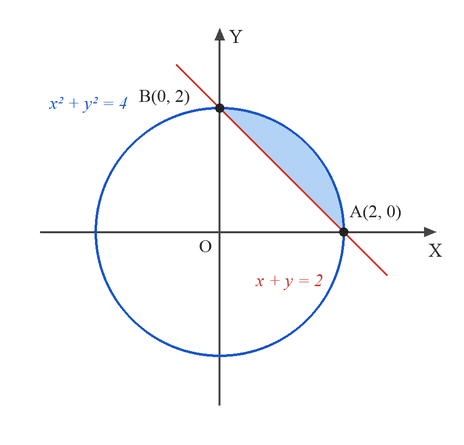
Step 3 — Write the area as one integral.
The upper boundary is the arc , and the lower boundary is the line .
Step 4 — Integrate under the arc.
We use the standard result , taking .
Step 5 — Integrate under the chord.
An antiderivative of is .
Step 6 — Subtract.
The segment is the quarter-circle region minus the triangle .
Therefore, the smaller area enclosed by the circle and the line is sq units.
- 25 marks
Board paper question 2
Find the area of the region bound by the curves and .
Solve with AIWritten solution
Solution:
Key idea: The area between two curves is , where and are the -co-ordinates of the points where the curves meet.
Step 1 — Find where the curves meet.
We set the two expressions for equal to each other.
So or . The curves meet at and at .
Step 2 — Sketch the region and decide which curve is on top.
The curve is a downward parabola with vertex .
The curve is an upward parabola with vertex .
At the first curve gives , while the second gives . So the first curve is the upper one between the meeting points.
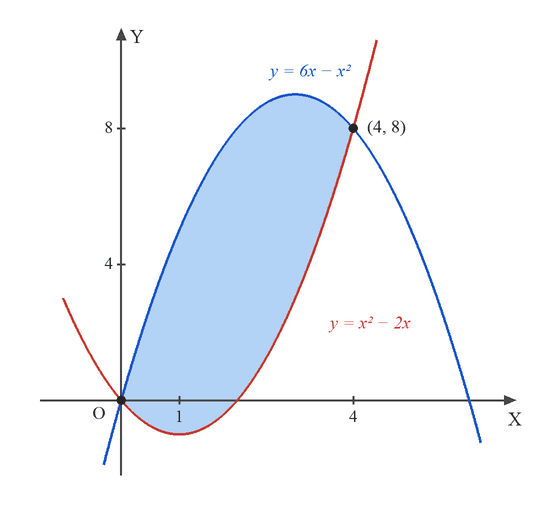
Step 3 — Write the area as an integral.
We subtract the lower curve from the upper curve.
Step 4 — Integrate and put in the limits.
An antiderivative of is .
Therefore, the area of the region bounded by the two curves is sq units.
- 35 marks
Board paper question 3
Draw a rough sketch of the curve and find the area of region enclosed by the curve and the line .
Solve with AIWritten solution
Solution:
Key idea: The area between two curves is between the -co-ordinates of their meeting points. For , the upper half is .
Step 1 — Find where the curve and the line meet.
We put into the equation of the parabola.
So or . They meet at and .
Step 2 — Sketch the curve and the region.
The curve is a parabola with vertex , opening to the right and symmetric about the -axis.
The line cuts its upper half at .
Between and the parabola lies above the line. For example, at the parabola gives , while the line gives .

Step 3 — Write the area as an integral.
The upper boundary is and the lower boundary is .
Step 4 — Integrate and put in the limits.
An antiderivative of is , and of is .
Since , the upper limit gives the following.
Therefore, the area enclosed by the curve and the line is sq units.
- 44 marks
Board paper question 4
Draw a rough sketch of the curve and find the area of the region bounded by curve and the line .
Solve with AIWritten solution
Solution:
Key idea: The parabola is symmetric about the -axis.
So the area cut off by the line is twice the area between the upper half of the parabola and the -axis, from the vertex to that line.
Step 1 — Find where the line meets the curve.
We put into the equation of the parabola.
So the line meets the parabola at and .
Step 2 — Sketch the region.
The parabola has vertex and opens to the right. The region is enclosed between the parabola and the vertical line .

Step 3 — Use symmetry.
The part above the -axis is bounded by , and the part below is its mirror image.
Step 4 — Integrate and put in the limits.
An antiderivative of is , and .
Therefore, the area bounded by the curve and the line is sq units.
- 54 marks
Board paper question 5
Sketch the graph of . Using integration, find the area of the region bounded by the curve and and .
Solve with AIWritten solution
Solution:
Key idea: The graph of is a V shape with its corner at .
To integrate it, we split the interval at that corner, where the expression inside the modulus changes sign.
Step 1 — Write the function without the modulus.
For , , so .
For , , so .
Step 2 — Sketch the graph and the region.
The graph is two straight lines meeting at . It passes through and .
The line is the -axis itself.
The region lies between the graph and the -axis, from the line to the -axis.
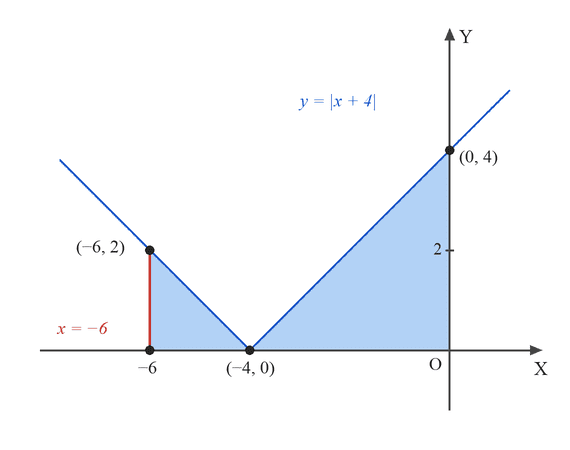
Step 3 — Split the area at x = −4.
The graph never goes below the -axis, so the area is the integral of , split into two parts.
Step 4 — Evaluate the left part.
An antiderivative of is .
Step 5 — Evaluate the right part.
An antiderivative of is .
Step 6 — Add the two parts.
We add the areas of the two triangles.
As a check, the left triangle has base and height (area ), and the right triangle has base and height (area ).
Therefore, the required area is sq units.
- 66 marks
Board paper question 6
Draw a rough sketch and find the area bounded by the curve and .
Solve with AIWritten solution
Solution:
Key idea: The area between a line and a parabola is , where and are the -co-ordinates of their meeting points.
Step 1 — Find where the curve and the line meet.
The parabola is and the line is . We set them equal.
So or . The meeting points are and .
Step 2 — Sketch the region.
The curve is an upward parabola with vertex .
The line cuts it at and .
Between and the line lies above the parabola. For example, at the line gives , while the parabola gives .
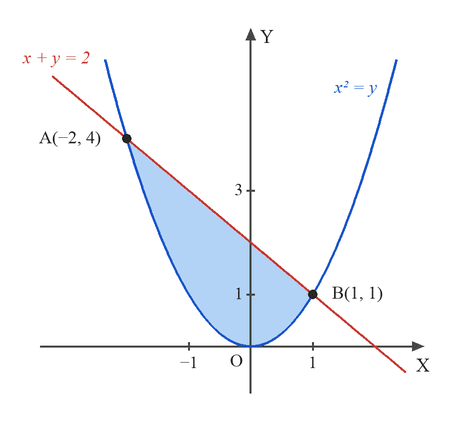
Step 3 — Write the area as an integral.
The upper boundary is and the lower boundary is .
Step 4 — Integrate.
An antiderivative of is .
Step 5 — Put in the limits.
At the bracket gives , and at it gives .
Therefore, the area bounded by and is sq units.
All 13 board paper questions for this chapter, solved the same way.
Class 12 Maths Ch 15 questions students ask
How many questions are there in Class 12 Maths Ch 15?
40 questions. Every one is solved step by step on this page.
Are these Class 12 Maths solutions free?
Yes. Every question and its full working is free to read, with no account needed.
Can I download the Class 12 Maths Ch 15 solutions as a PDF?
There is no PDF to download. Every solution is on this page instead, which means it is searchable, always the current syllabus, and readable on a phone. Use your browser's print option if you want it on paper.