
Question 213 marksMedium
Make a rough sketch of the following curves. Also, find the area enclosed between the curves and the axes.
(i) ,
(ii) ,
(iii) ,
(iv) ,
Confirming your payment
Sign up now and get 250 free tokens.
Application of Integrals: Area Under the Curve · Question 21 of 40
Make a rough sketch of the following curves. Also, find the area enclosed between the curves and the axes.
(i) ,
(ii) ,
(iii) ,
(iv) ,
Solution:
Key idea: On each of these intervals the curve is never below the -axis, so the area enclosed by the curve and the axes is the plain integral over the interval.
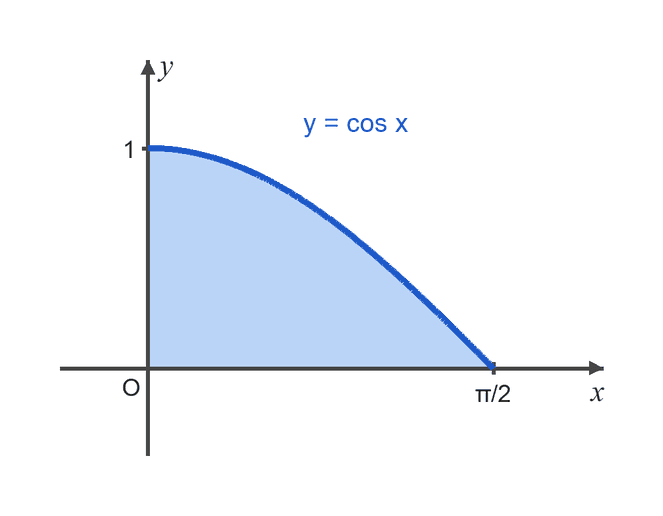
Step 1 — Part (i): sketch on .
The curve starts at height on the -axis and falls to at , so the region is bounded by the curve and both axes.
Step 2 — Part (i): integrate.
An antiderivative of is .
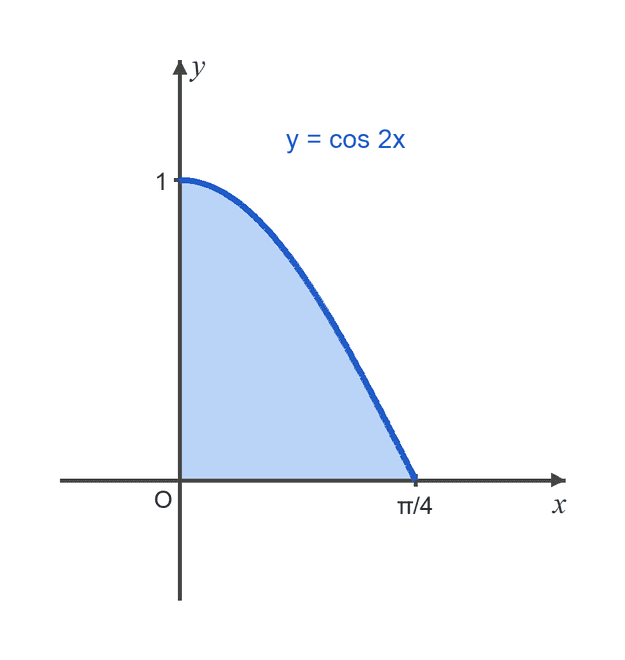
Step 3 — Part (ii): sketch on .
The curve starts at height on the -axis and falls to at , where reaches .
Step 4 — Part (ii): integrate.
An antiderivative of is .
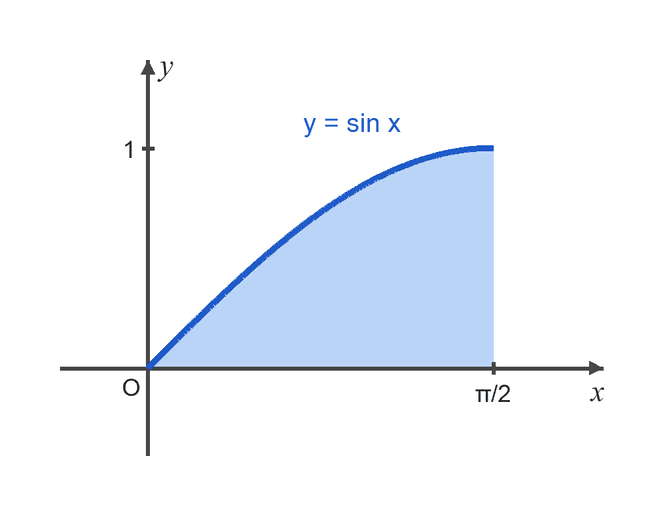
Step 5 — Part (iii): sketch on .
The curve rises from the origin to height at ; the region is bounded by the curve, the -axis and the line .
Step 6 — Part (iii): integrate.
An antiderivative of is .
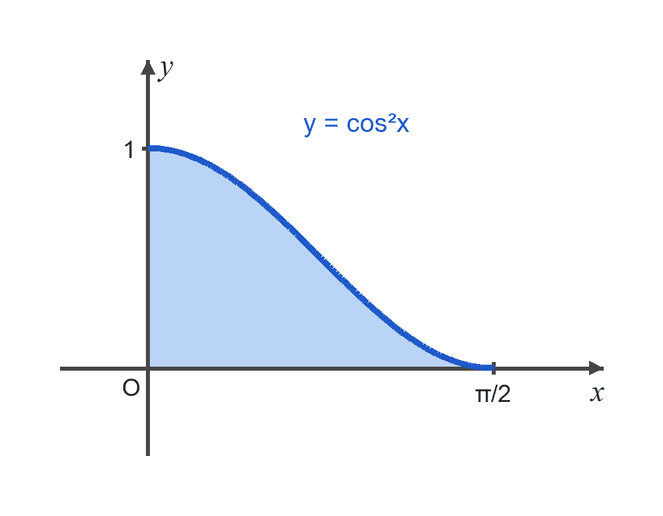
Step 7 — Part (iv): sketch on .
The curve starts at height on the -axis and falls to at , where it touches the -axis.
Step 8 — Part (iv): rewrite and integrate.
We use the identity , since has no simple antiderivative of its own.
Therefore, the areas are (i) sq unit, (ii) sq unit, (iii) sq unit and (iv) sq unit.