
Opening your dashboard
Class 12 Maths Chapter 15 Application of Integrals: Area Under the Curve: Previous Year Questions
13 questions on Chapter 15, each solved step by step. Class 12 Maths, ICSE 2026-27.
13 questions with solutions
4–6 marks · Medium difficulty
The first 10 solutions are on this page. This chapter is a long one, so the rest open on their own page to keep this one quick to load.
- 15 marks
Question 1
Find the smaller area enclosed by the circle and the line .
Solve with AIWritten solution
Solution:
Key idea: The smaller region cut off from a circle by a chord is a segment. Its area is the area under the arc minus the area under the chord, both found by integration between the points where the line meets the circle.
Note: The paper prints the circle as with no right-hand side. We take the circle , because the line meets the axes at and , and these points lie on the circle of radius about the origin.
Step 1 — Find where the line meets the circle.
We put into the equation of the circle, and solve for .
So or , giving the points and .
Step 2 — Sketch the region.
The circle has centre and radius . The chord cuts off a small segment in the first quadrant, shaded below. Between and the arc lies above the chord.
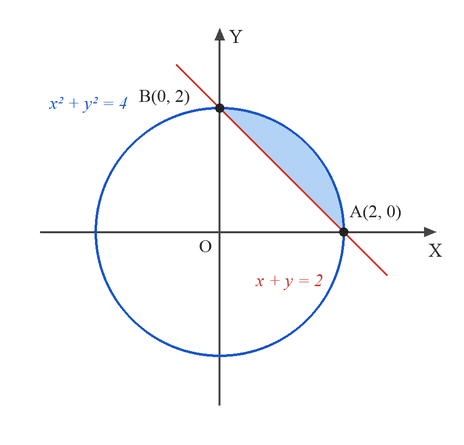
Step 3 — Write the area as one integral.
The upper boundary is the arc , and the lower boundary is the line .
Step 4 — Integrate under the arc.
We use the standard result , taking .
Step 5 — Integrate under the chord.
An antiderivative of is .
Step 6 — Subtract.
The segment is the quarter-circle region minus the triangle .
Therefore, the smaller area enclosed by the circle and the line is sq units.
- 25 marks
Question 2
Find the area of the region bound by the curves and .
Solve with AIWritten solution
Solution:
Key idea: The area between two curves is , where and are the -co-ordinates of the points where the curves meet.
Step 1 — Find where the curves meet.
We set the two expressions for equal to each other.
So or . The curves meet at and at .
Step 2 — Sketch the region and decide which curve is on top.
The curve is a downward parabola with vertex .
The curve is an upward parabola with vertex .
At the first curve gives , while the second gives . So the first curve is the upper one between the meeting points.
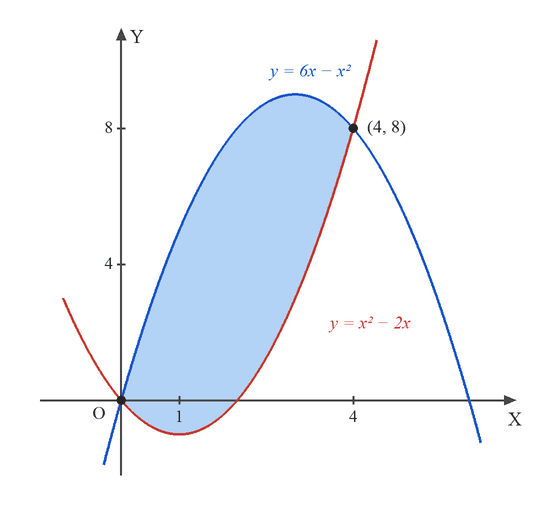
Step 3 — Write the area as an integral.
We subtract the lower curve from the upper curve.
Step 4 — Integrate and put in the limits.
An antiderivative of is .
Therefore, the area of the region bounded by the two curves is sq units.
- 35 marks
Question 3
Draw a rough sketch of the curve and find the area of region enclosed by the curve and the line .
Solve with AIWritten solution
Solution:
Key idea: The area between two curves is between the -co-ordinates of their meeting points. For , the upper half is .
Step 1 — Find where the curve and the line meet.
We put into the equation of the parabola.
So or . They meet at and .
Step 2 — Sketch the curve and the region.
The curve is a parabola with vertex , opening to the right and symmetric about the -axis.
The line cuts its upper half at .
Between and the parabola lies above the line. For example, at the parabola gives , while the line gives .

Step 3 — Write the area as an integral.
The upper boundary is and the lower boundary is .
Step 4 — Integrate and put in the limits.
An antiderivative of is , and of is .
Since , the upper limit gives the following.
Therefore, the area enclosed by the curve and the line is sq units.
- 44 marks
Question 4
Draw a rough sketch of the curve and find the area of the region bounded by curve and the line .
Solve with AIWritten solution
Solution:
Key idea: The parabola is symmetric about the -axis.
So the area cut off by the line is twice the area between the upper half of the parabola and the -axis, from the vertex to that line.
Step 1 — Find where the line meets the curve.
We put into the equation of the parabola.
So the line meets the parabola at and .
Step 2 — Sketch the region.
The parabola has vertex and opens to the right. The region is enclosed between the parabola and the vertical line .

Step 3 — Use symmetry.
The part above the -axis is bounded by , and the part below is its mirror image.
Step 4 — Integrate and put in the limits.
An antiderivative of is , and .
Therefore, the area bounded by the curve and the line is sq units.
- 54 marks
Question 5
Sketch the graph of . Using integration, find the area of the region bounded by the curve and and .
Solve with AIWritten solution
Solution:
Key idea: The graph of is a V shape with its corner at .
To integrate it, we split the interval at that corner, where the expression inside the modulus changes sign.
Step 1 — Write the function without the modulus.
For , , so .
For , , so .
Step 2 — Sketch the graph and the region.
The graph is two straight lines meeting at . It passes through and .
The line is the -axis itself.
The region lies between the graph and the -axis, from the line to the -axis.
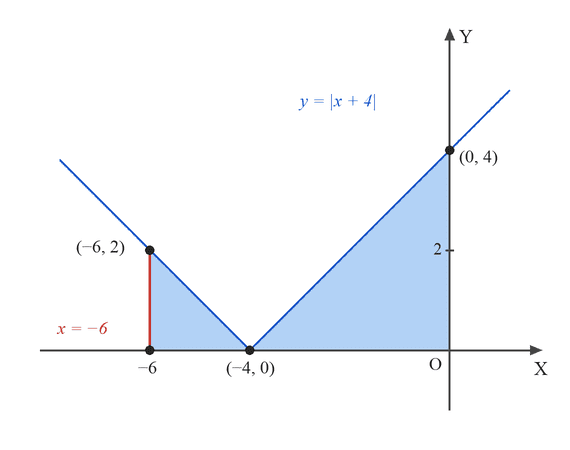
Step 3 — Split the area at x = −4.
The graph never goes below the -axis, so the area is the integral of , split into two parts.
Step 4 — Evaluate the left part.
An antiderivative of is .
Step 5 — Evaluate the right part.
An antiderivative of is .
Step 6 — Add the two parts.
We add the areas of the two triangles.
As a check, the left triangle has base and height (area ), and the right triangle has base and height (area ).
Therefore, the required area is sq units.
- 66 marks
Question 6
Draw a rough sketch and find the area bounded by the curve and .
Solve with AIWritten solution
Solution:
Key idea: The area between a line and a parabola is , where and are the -co-ordinates of their meeting points.
Step 1 — Find where the curve and the line meet.
The parabola is and the line is . We set them equal.
So or . The meeting points are and .
Step 2 — Sketch the region.
The curve is an upward parabola with vertex .
The line cuts it at and .
Between and the line lies above the parabola. For example, at the line gives , while the parabola gives .
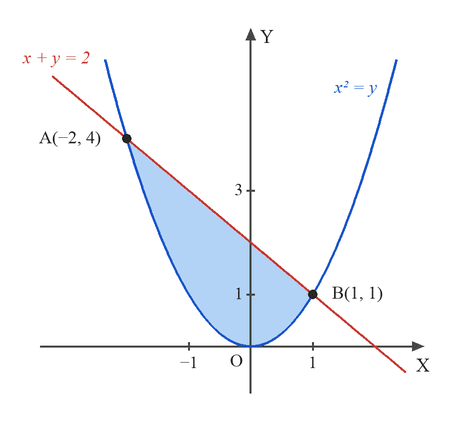
Step 3 — Write the area as an integral.
The upper boundary is and the lower boundary is .
Step 4 — Integrate.
An antiderivative of is .
Step 5 — Put in the limits.
At the bracket gives , and at it gives .
Therefore, the area bounded by and is sq units.
- 76 marks
Question 7
Draw a rough sketch of the curves and and find the area enclosed between them
Solve with AIWritten solution
Solution:
Key idea: Both curves are parabolas that open sideways, so it is easier to integrate with respect to : area . The region is symmetric about the -axis.
Step 1 — Find where the curves meet.
Both equations give , so we set the right-hand sides equal.
Then , so . The curves meet at and .
Step 2 — Sketch the curves.
The curve has vertex and opens to the right.
The second curve can be written with as the subject.
This second parabola has vertex and opens to the left.
The enclosed region lies between them, from down to .
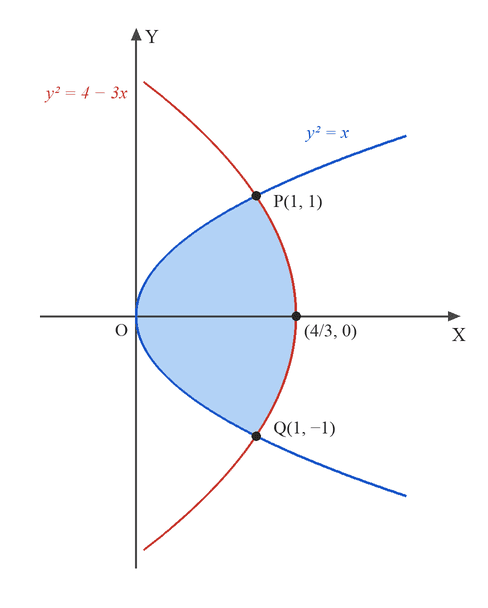
Step 3 — Write the area with respect to y.
For each between and , the left boundary is and the right boundary is .
By symmetry about the -axis, we take twice the part above the -axis.
Step 4 — Integrate and put in the limits.
An antiderivative of is .
Therefore, the area enclosed between the curves and is sq units.
- 84 marks
Question 8
Find the area of the region bounded by the curve and the line
Solve with AIWritten solution
Solution:
Key idea: Write both boundaries as in terms of , find their meeting points, and integrate (upper lower) between them.
Step 1 — Write both boundaries as y in terms of x.
We divide the equation of the parabola by , and rearrange the equation of the line.
Step 2 — Find where they meet.
We set the two expressions for equal and multiply by .
So or . The meeting points are and .
Step 3 — Sketch the region.
The parabola has vertex and opens upwards.
Between and the line lies above the parabola. For example, at the line gives , while the parabola gives .
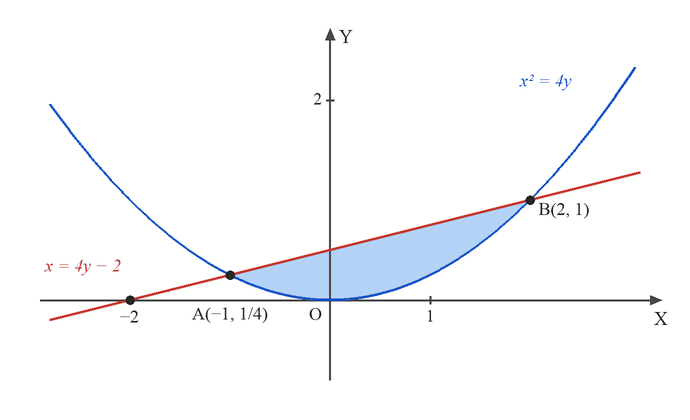
Step 4 — Write the area as an integral.
We subtract the parabola from the line.
Step 5 — Integrate and put in the limits.
An antiderivative of is . At it gives , and at it gives .
Therefore, the area bounded by the curve and the line is sq units.
- 94 marks
Question 9
Using integration, find the area bounded by the curve and the line .
Solve with AIWritten solution
Solution:
Key idea: The parabola (with ) is symmetric about the -axis.
So the region cut off by the line has twice the area between the upper half of the parabola and the -axis, from the vertex to that line.
Step 1 — Find where the line meets the curve.
We put into the equation of the parabola.
So the line meets the parabola at and . (We take , the usual meaning of this standard parabola.)
Step 2 — Sketch the region.
The parabola has vertex and opens to the right. The region lies between the parabola and the line , the latus rectum through the focus .
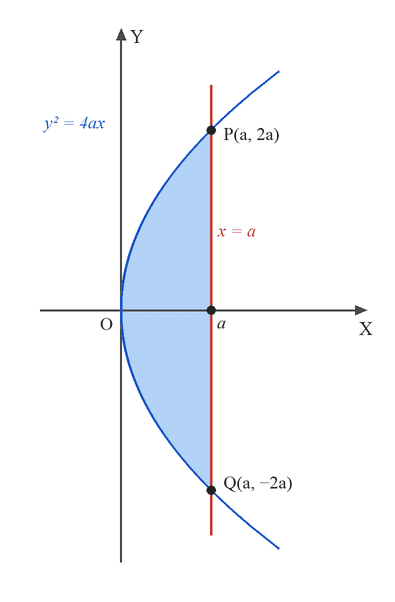
Step 3 — Use symmetry.
The upper half of the parabola is .
Step 4 — Integrate and put in the limits.
An antiderivative of is .
Since , the area simplifies.
Therefore, the area bounded by and the line is sq units.
- 104 marks
Question 10
Using integration, find the area of the region bounded by the curve and .
Solve with AIWritten solution
Solution:
Key idea: The two parabolas are mirror images of each other in the line .
The area between them is , taken between their meeting points.
Step 1 — Find where the curves meet.
The second parabola gives .
We put this into the equation of the first parabola.
So or . The curves meet at and .
Step 2 — Sketch the region.
The parabola opens to the right, and the parabola opens upwards.
Between and the upper half of the first parabola, , lies above the second. For example, at it gives , while gives .
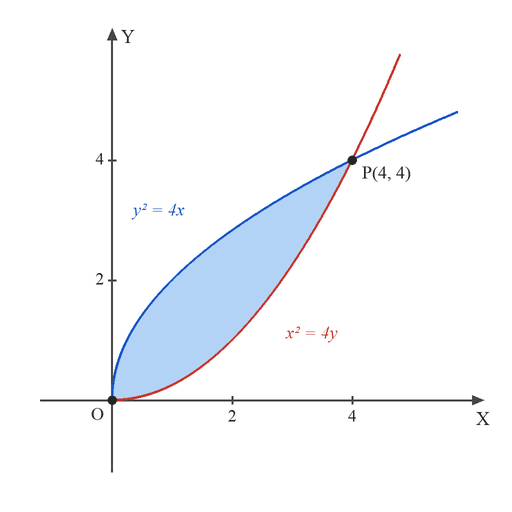
Step 3 — Write the area as an integral.
We subtract the lower curve from the upper curve.
Step 4 — Integrate and put in the limits.
An antiderivative of is , and of is .
Since , the upper limit gives the following.
Therefore, the area of the region bounded by and is sq units.
- 114 marks
Question 11
The equation represents a parabola.
(a) Make a rough sketch of the graph of the given function. [1]
(b) Determine the area enclosed between the curve, the -axis, the lines and [2]
(c) Hence, find the area bounded by the parabola and the -axis. [1]
- 124 marks
Question 12
A farmer has a field bounded by three lines , , . Using integration, find the area of the region bounded by these lines.
- 134 marks
Question 13
Find the area of the region bounded by and axis using integration.