
Question 124 marksAsked 2025Medium
A farmer has a field bounded by three lines , , . Using integration, find the area of the region bounded by these lines.
Confirming your payment
Sign up now and get 250 free tokens.
Previous Year Questions · Question 12 of 13
A farmer has a field bounded by three lines , , . Using integration, find the area of the region bounded by these lines.
Solution:
Key idea: Find the three corners of the triangle where the lines meet in pairs. The area is ; when the upper boundary changes at a corner, split the integral there.
Step 1 — Write each line as y in terms of x.
We make the subject of each equation, in the printed order.
Step 2 — Find the corners.
The first two lines give , so and . This is the corner .
The second and third lines give , so and . This is the corner .
The first and third lines give , so and . This is the corner .
Step 3 — Sketch the field.
The field is the triangle .
Its lower side is , on the first line, all the way from to .
Its upper side is (on ) from to , and then (on ) from to .
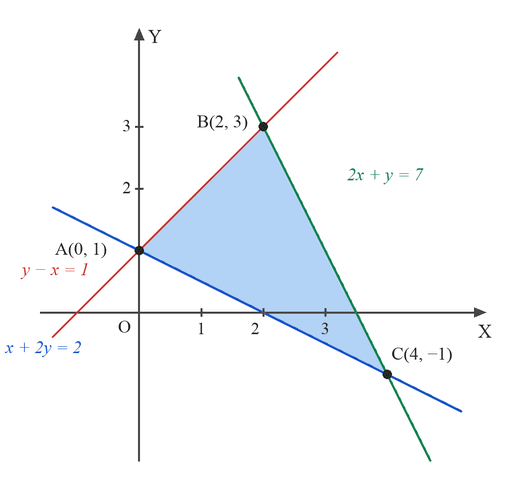
Step 4 — Write the area as two integrals.
We split at , where the upper side changes.
Each bracket simplifies to a single linear expression.
Step 5 — Evaluate the first integral.
An antiderivative of is .
Step 6 — Evaluate the second integral.
An antiderivative of is .
Step 7 — Add the two parts.
We add the results of Steps 5 and 6.
As a check, we use the triangle-area formula with the corners , and .
Therefore, the area of the field bounded by the three lines is sq units.