Solution:
Key idea: The area between a curve y=f(x)≥0, the x-axis and the lines x=a, x=b is ∫abf(x)dx. The parabola y=4−x2 is symmetric about the y-axis, so its two halves above the x-axis have equal areas.
(a) Sketch the graph.
The parabola y=4−x2 opens downwards and has its vertex at (0,4).
On the x-axis y is 0, so x2=4. The curve cuts the x-axis at (−2,0) and (2,0).
It is symmetric about the y-axis.
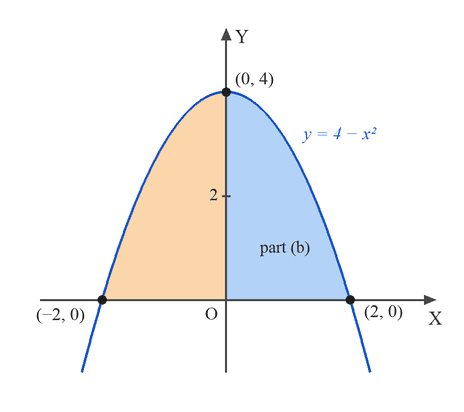
The region of part (b) is shaded blue; the orange part is its mirror image, used in part (c).
(b) Area between the curve, the x-axis and the two lines.
Step 1 — Write the area as an integral.
Between x=0 and x=2 the curve is on or above the x-axis, so the area is the integral of 4−x2.
Area=∫02(4−x2)dx
Step 2 — Integrate and put in the limits.
An antiderivative of 4−x2 is 4x−3x3.
Area=[4x−3x3]02
Area=8−38
Area=316
So the area in part (b) is 316 sq units.
(c) Area between the parabola and the x-axis.
Step 3 — Use symmetry.
The whole region runs from (−2,0) to (2,0).
Because the parabola is symmetric about the y-axis, the left half has the same area as the right half found in part (b).
Total area=2×316
Total area=332
Therefore, the area in (b) is 316 sq units, and the area bounded by the parabola and the x-axis in (c) is 332 sq units.
