
Question 253 marksMedium
(i) Calculate the area bounded by the curve , the -axis and the line .
(ii) Calculate the approximate increase in this area, if the line is changed to .
Confirming your payment
Sign up now and get 250 free tokens.
Application of Integrals: Area Under the Curve · Question 25 of 40
(i) Calculate the area bounded by the curve , the -axis and the line .
(ii) Calculate the approximate increase in this area, if the line is changed to .
Solution:
Key idea: The region lies between the horizontal lines and , inside the parabola, so we use horizontal strips of length . For part (ii) we treat the area as a function of the top line and use .
Step 1 — Part (i): write in terms of .
We rearrange the equation of the curve, so .
Step 2 — Part (i): describe the region.
The parabola has vertex . It cuts the -axis at , and the line at . The region is the shaded part between the -axis and the line ; the small cap below the -axis is not bounded by the line, so it is not included.
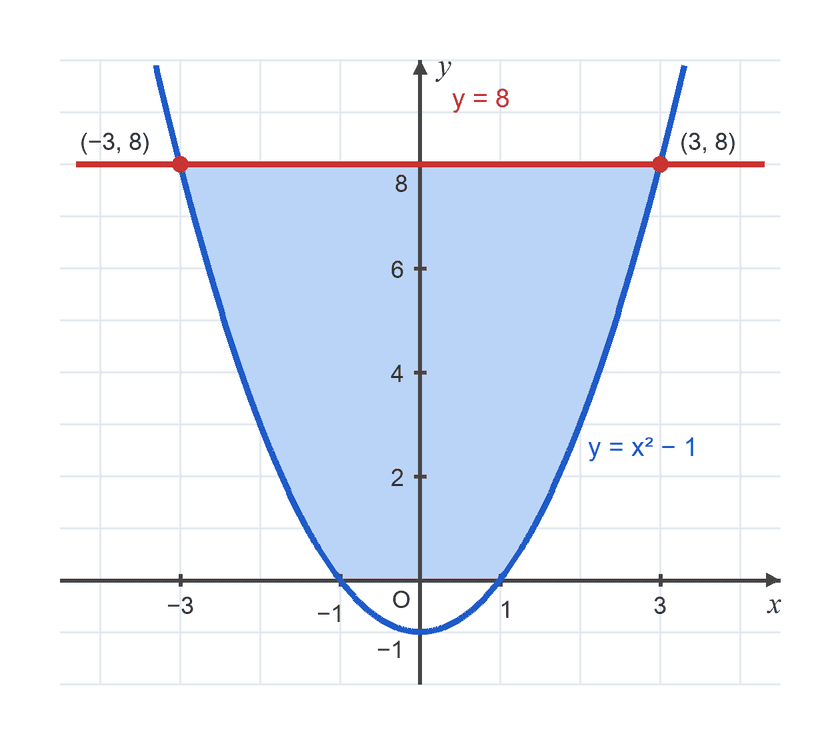
Step 3 — Part (i): integrate the strip length.
Each strip has length , and .
This is sq units.
Step 4 — Part (ii): write the area as a function of the top line.
If the top line is , the area is an integral with upper limit , and its derivative is the integrand at .
Step 5 — Part (ii): use the approximation.
At the rate is , or , and the change in is .
This makes sense: the extra strip is about high and wide, from to .
Therefore, (i) the area is sq units, and (ii) the approximate increase is sq unit.