Solution:
Key idea: We write the equation of each side of the triangle. The area is (area under the upper side or sides) − (area under the lower side), each found by integration over the right x-interval.
Step 1 — Part (i): write the equations of the sides.
Let A(−1,0), B(1,3) and C(3,2). We use the two-point form for each side.
AB:y=23(x+1)
BC:y=27−x
AC:y=2x+1
Here AB and BC form the upper boundary, and AC the lower one.
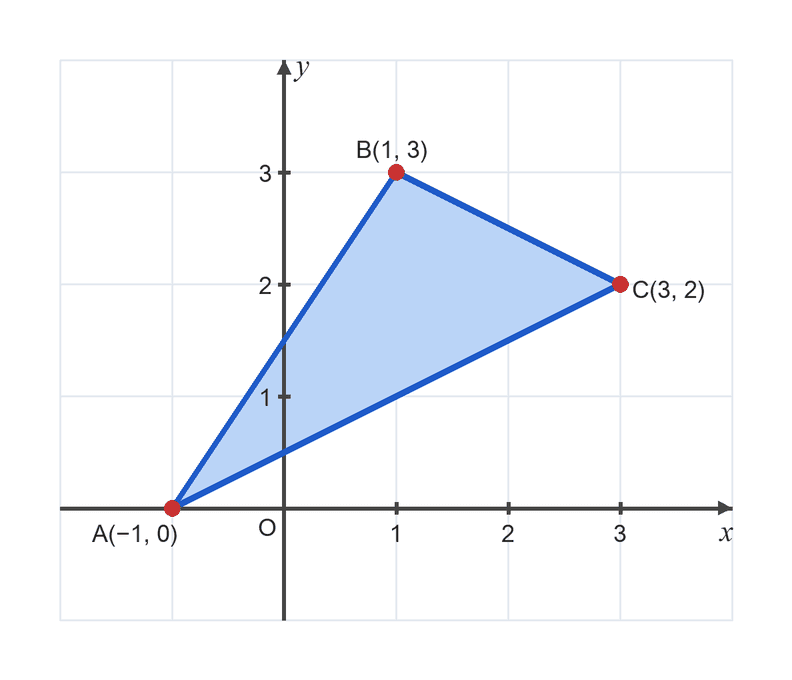
Step 2 — Part (i): find the area under AB.
We integrate over [−1,1].
∫−1123(x+1)dx=23[2(x+1)2]−11=23(2)=3
Step 3 — Part (i): find the area under BC.
We integrate over [1,3].
∫1327−xdx=21[7x−2x2]13=21(233−213)=5
Step 4 — Part (i): find the area under AC and subtract.
We integrate over [−1,3] and remove this from the two upper areas.
∫−132x+1dx=21[2(x+1)2]−13=21(8)=4
Area=3+5−4=4
Step 5 — Part (ii): write the equations of the sides.
Let A(2,5), B(4,7) and C(6,2). We again use the two-point form.
AB:y=x+3
BC:y=17−25x
AC:y=213−43x
Here AB and BC form the upper boundary, and AC the lower one.
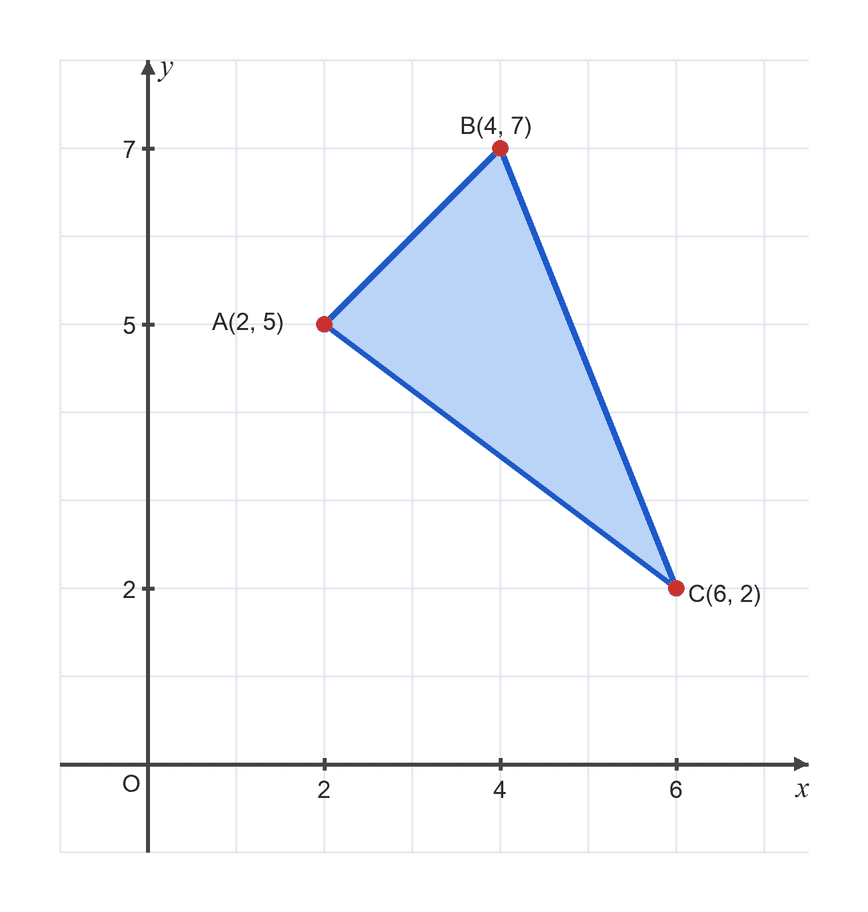
Step 6 — Part (ii): find the areas under the three sides.
We integrate each side over its own interval.
∫24(x+3)dx=[2x2+3x]24=20−8=12
∫46(17−25x)dx=[17x−45x2]46=(102−45)−(68−20)=9
∫26(213−43x)dx=[213x−83x2]26=(39−227)−(13−23)=14
Step 7 — Part (ii): combine the areas.
We add the areas under the upper sides and subtract the area under the lower side.
Area=12+9−14=7
Check: The coordinate formula 21∣x1(y2−y3)+x2(y3−y1)+x3(y1−y2)∣ gives 4 for part (i) and 7 for part (ii).
Note: The book's answer list gives only "4 sq units" for this question, which is the value of part (i); part (ii) works out to 7 sq units.
Therefore, the areas of the triangles are (i) 4 sq units and (ii) 7 sq units.
