
Question 13 marksEasy
Using integration, find the area of the region bounded by
(i) the line , the -axis and the lines and .
(ii) , the -axis and the lines and .
Confirming your payment
Sign up now and get 250 free tokens.
Application of Integrals: Area Under the Curve · Question 1 of 40
Using integration, find the area of the region bounded by
(i) the line , the -axis and the lines and .
(ii) , the -axis and the lines and .
Solution:
Key idea: If a curve stays above the -axis for , the area between the curve, the -axis and the lines , is . So in each part we first check that the line is above the -axis on the interval, and then integrate.
Step 1 — Part (i): write in terms of and check its sign.
We divide by 3 so that stands alone.
At , the height is , and at , the height is . The line meets the -axis only at , which is outside , so the line is above the -axis on the whole interval (the shaded region).

Step 2 — Part (i): integrate over .
An antiderivative of is , so we keep the factor outside and put in the limits.
Step 3 — Part (ii): write in terms of and check its sign.
We divide by 2.
At , the height is , and at , the height is . The line meets the -axis only at , which is outside , so the line is above the -axis on the whole interval.
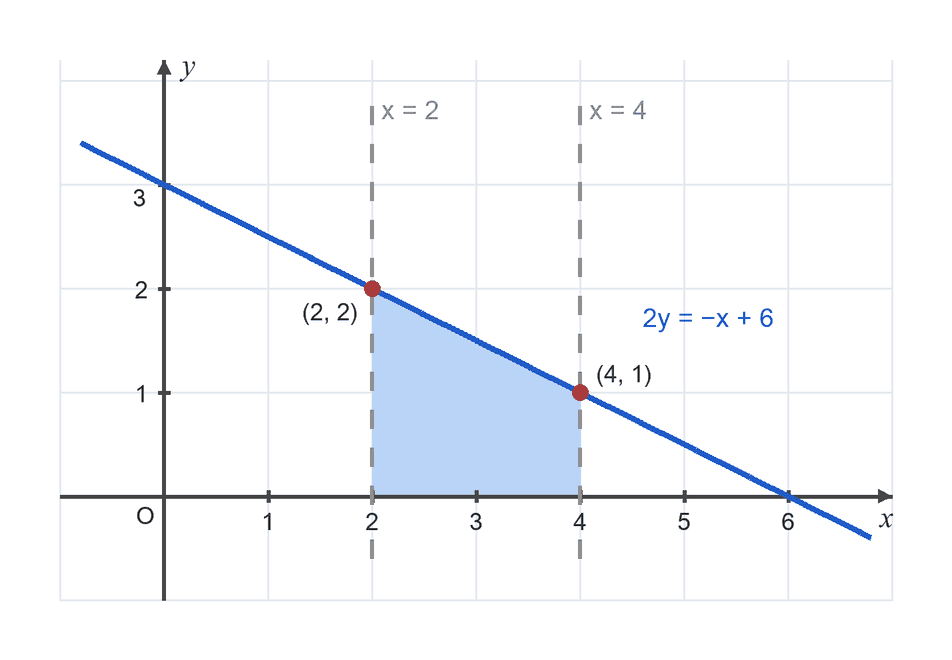
Step 4 — Part (ii): integrate over .
An antiderivative of is , so we keep the factor outside and put in the limits.
Check: Each region is a trapezium. In (i) the parallel sides are and with width , so the area is ; in (ii) the sides are and with width , so the area is .
Therefore, the areas are (i) sq units and (ii) sq units.