
Opening your dashboard
Class 12 Chemistry Chapter 1: Solid State Solutions
236 textbook questions with step-by-step answers, free to read, for ISC 2026-27.
Get talked through Ch 1, not just shown the answer
Reading a finished solution is not the same as being able to do it. The AI tutor takes one question at a time and works it with you, in your own words, until you can.
- Ask it out loud, in your own words
- It gives you the next step, not the answer
- Stuck on part (ii)? Start there
236 questions with solutions
1–5 marks · Mixed difficulty
The first 36 solutions are on this page. This chapter is a long one, so the rest open on their own page to keep this one quick to load.
- 11 mark
Question 1
Which of the following is a good conductor of heat and electricity?
Solve with AIAnswer
(A) Anthracine
(B) Diamond
(C) Charcoal
- Correct
(D) Graphite
Answer: (D) Graphite
Key idea: A solid conducts electricity only if it has mobile charge carriers, such as delocalised electrons. Free electrons also carry heat quickly through a solid.
Step 1 — Look at the bonding in graphite.
In graphite each carbon atom forms three σ bonds to neighbours in its own layer. Its fourth valence electron is delocalised over the whole layer.
Step 2 — Link the bonding to conduction.
The delocalised electrons move along the layers when a voltage is applied, so graphite conducts electricity. These mobile electrons, together with the strong bonding within each layer, also make graphite a good conductor of heat along the layers.
Why the other options are wrong:
- (A) is wrong: Anthracene (printed as "Anthracine") is a molecular solid of molecules held by weak van der Waals forces; it has no free electrons and is an electrical insulator.
- (B) is wrong: Although diamond conducts heat very well (through vibrations of its rigid lattice), but every valence electron is held in a C–C σ bond, so it is an electrical insulator.
- (C) is wrong: As an impure, largely amorphous form of carbon, charcoal conducts heat and electricity much less well than graphite.
Therefore, the good conductor of both heat and electricity is graphite: option (D).
- 21 mark
Question 2
Difference between diamond and graphite is due to:
Solve with AIAnswer
(A) graphite combines with to form but diamond does not
(B) the atoms of each have different masses
- Correct
(C) the crystal structure in diamond is different from that in graphite
(D) all of the above
Answer: (C) the crystal structure in diamond is different from that in graphite
Key idea: Diamond and graphite are both made only of carbon atoms, so any difference between them must come from the way those atoms are arranged and bonded.
Step 1 — Compare the two structures.
In diamond each carbon atom is bonded to four others in a rigid three-dimensional network. In graphite each carbon atom is bonded to three others in flat hexagonal layers, and the layers are held together by weak forces.
Step 2 — Link the structure to the difference.
The different arrangement of the same atoms gives the two forms their different properties, such as hardness and electrical conduction. So the difference is due to the crystal structure.
Why the other options are wrong:
- (A) is wrong: Diamond also burns in oxygen when it is heated strongly and forms , so this is not a difference between them.
- (B) is wrong: Both are made of the same carbon atoms, which have the same masses in each.
- (D) is wrong: Options (A) and (B) are false, so "all of the above" cannot be correct.
Therefore, diamond and graphite differ because their crystal structures are different: option (C).
- 31 mark
Question 3
Diamond and graphite are:
Solve with AIAnswer
(A) isomers
(B) isotopes
- Correct
(C) allotropes
(D) polymers
Answer: (C) allotropes
Key idea: Allotropes are different physical forms of the same element, in which the atoms are arranged or bonded differently.
Step 1 — Identify what diamond and graphite are made of.
Both diamond and graphite consist only of carbon atoms, so they are forms of one element, not compounds.
Step 2 — Name the relationship.
The carbon atoms are arranged differently in the two solids (a three-dimensional network in diamond, flat layers in graphite), so diamond and graphite are allotropes of carbon.
Why the other options are wrong:
- (A) is wrong: Compounds with the same molecular formula but different structures are isomers; diamond and graphite are forms of an element, not compounds.
- (B) is wrong: Atoms of one element with different mass numbers, such as carbon-12 and carbon-14, are isotopes; diamond and graphite are whole solids containing the same mix of carbon isotopes.
- (D) is wrong: A polymer is a large molecule made of repeating monomer units; diamond and graphite are network solids of carbon atoms.
Therefore, diamond and graphite are allotropes of carbon: option (C).
- 41 mark
Question 4
Graphite conducts electricity because of:
Solve with AIAnswer
(A) weak van der Waals' forces between layers
(B) covalent bonding between carbon atoms of layers
- Correct
(C) delocalised electrons in each layer
(D) hybridization of C-atoms in each layer
Answer: (C) delocalised electrons in each layer
Key idea: A solid conducts electricity when it contains charge carriers that are free to move. In graphite these carriers are electrons that are delocalised over each layer.
Step 1 — Count the electrons each carbon atom uses in σ bonds.
Each carbon atom in a graphite layer is hybridised and forms three σ bonds to its neighbours. This uses three of its four valence electrons.
Step 2 — Follow the fourth electron.
The fourth electron of each carbon atom is in an unhybridised p orbital. These p orbitals overlap across the whole layer, so these electrons are delocalised and move when a voltage is applied. They carry the current.
Why the other options are wrong:
- (A) is wrong: The weak van der Waals forces between the layers make graphite soft and slippery; they do not provide any charge carriers.
- (B) is wrong: The electrons in the C–C σ bonds within a layer are held between two atoms and cannot carry a current.
- (D) is wrong: The hybridisation is real, and it is the reason one electron per atom is left over; but the current is carried by the delocalised electrons themselves, so option (C) is the direct reason.
Therefore, graphite conducts electricity because of the delocalised electrons in each layer: option (C).
- 51 mark
Question 5
Potassium crystallises in BCC lattice, the co-ordination number of potassium in potassium metal is
Solve with AIAnswer
(A) 12
(B) 4
(C) 6
- Correct
(D) 8
Answer: (D) 8
Key idea: The co-ordination number of an atom in a metal is the number of nearest neighbours that touch it.
Step 1 — Picture the bcc unit cell.
In a body-centred cubic (bcc) cell there is an atom at each of the corners and one atom at the centre of the cube.
Step 2 — Count the nearest neighbours.
The atom at the body centre touches all corner atoms along the body diagonals. Every atom in the lattice is equivalent, so each potassium atom has nearest neighbours.
Why the other options are wrong:
- (A) is wrong: 12 is the co-ordination number in ccp (fcc) and hcp structures, not in bcc.
- (B) is wrong: 4 is the co-ordination number of a tetrahedral arrangement, as in diamond or ZnS.
- (C) is wrong: 6 is the co-ordination number in a simple cubic lattice.
Therefore, the co-ordination number of potassium in its bcc lattice is 8: option (D).
- 61 mark
Question 6
The one that is a good conductor of electricity in the following list of solids is:
Solve with AIAnswer
(A)
(B) diamond
- Correct
(C) graphite
(D) dry ice
Answer: (C) graphite
Key idea: A solid conducts electricity only if it contains charge carriers (electrons or ions) that are free to move.
Step 1 — Check each solid for mobile charge carriers.
Solid NaCl has ions, but they are fixed at lattice sites. In diamond every valence electron is held in a bond, and dry ice is made of separate molecules. Graphite has one delocalised electron per carbon atom in each layer.
Step 2 — Pick the conductor.
Only graphite has charge carriers that can move through the solid, so it is the only good conductor in the list.
Why the other options are wrong:
- (A) is wrong: In solid the ions are held at fixed lattice sites, so it does not conduct; it conducts only when molten or dissolved.
- (B) is wrong: In diamond all four valence electrons of each carbon atom are used in σ bonds, so it is an insulator.
- (D) is wrong: Solid (dry ice) is a molecular solid with no free ions or electrons, so it is an insulator.
Therefore, the good conductor of electricity in the list is graphite: option (C).
- 71 mark
Question 7
Indicate the nature of bonding in solid helium
Solve with AIAnswer
(A) covalent
(B) ionic
(C) co-ordinate
- Correct
(D) van der Waals
Answer: (D) van der Waals
Key idea: Helium atoms have a complete shell, so they do not form chemical bonds. Separate atoms in a solid can then be held together only by weak van der Waals (London dispersion) forces.
Step 1 — Decide whether helium forms bonds.
A helium atom has a stable duet of electrons and a very high ionisation enthalpy. It does not share, give or accept electrons, so it forms no covalent, ionic or co-ordinate bonds.
Step 2 — Name the force in the solid.
In solid helium the atoms are held together only by very weak London dispersion forces, a kind of van der Waals force. These forces are so weak that helium becomes solid only under pressure (about atm), even close to K.
Why the other options are wrong:
- (A) is wrong: A covalent bond needs shared electron pairs, and helium, with its complete duet, shares none.
- (B) is wrong: An ionic bond needs ions, and helium atoms do not lose or gain electrons.
- (C) is wrong: A co-ordinate bond needs a lone-pair donor and an acceptor with an empty orbital, and helium does not act as either.
Therefore, the particles in solid helium are held together by van der Waals forces: option (D).
- 81 mark
Question 8
Solid is a bad conductor of electricity, since
Solve with AIAnswer
(A) in solid there are no ions
(B) solid is covalent
- Correct
(C) in solid ions are not mobile
(D) in solid there are no electrons
Answer: (C) in solid ions are not mobile
Key idea: An electric current needs charged particles that can move. An ionic solid has charged particles, but they must be free to move for the solid to conduct.
Step 1 — Identify the particles in solid NaCl.
Solid sodium chloride is made of and ions, so it does contain charged particles.
Step 2 — Check whether the ions can move.
The ions are held at fixed lattice sites by strong electrostatic forces and can only vibrate there. Because they cannot move through the crystal, no current flows. When NaCl melts or dissolves, the ions become free to move and it conducts.
Why the other options are wrong:
- (A) is wrong: Solid does contain ions; they are simply not free to move.
- (B) is wrong: is an ionic solid, held by electrostatic attraction between ions, not by covalent bonds.
- (D) is wrong: Every ion contains electrons, but they are tightly bound to their ions; what is missing is a mobile charge carrier.
Therefore, solid NaCl is a bad conductor because its ions are not mobile: option (C).
- 91 mark
Question 9
In CCP arrangement the pattern of successive layers will be designated as
Solve with AIAnswer
(A) ab, ab, ab .... etc.
- Correct
(B) abc, abc, abc ..... etc.
(C) ab, abc, ab, abc .... etc.
(D) none of these
Answer: (B) abc, abc, abc ..... etc.
Key idea: Close-packed layers can be stacked in two regular ways. If every third layer lies directly over the first, the pattern is AB AB … (hcp); if the third layer lies over the octahedral voids instead, the pattern is ABC ABC … (ccp).
Step 1 — Place the third layer in ccp.
In cubic close packing the spheres of the third layer sit over the octahedral voids formed between the first two layers. So the third layer is not directly over the first layer, and it is called C.
Step 2 — Find where the pattern repeats.
The fourth layer lies directly over the first, so the sequence repeats after every three layers: ABC ABC …
Why the other options are wrong:
- (A) is wrong: The pattern AB AB …, in which every third layer lies over the first, is hexagonal close packing (hcp), not ccp.
- (C) is wrong: This pattern mixes hcp and ccp stacking, so it is neither of the two regular close-packed arrangements and is not ccp.
- (D) is wrong: A correct description is offered, because option (B) gives the ccp pattern.
Therefore, the successive layers in ccp follow the pattern abc, abc, abc …: option (B).
- 101 mark
Question 10
The number of nearest neighbours to each sphere in HCP pattern is
Solve with AIAnswer
(A) 4
(B) 6
(C) 8
- Correct
(D) 12
Answer: (D) 12
Key idea: In any close-packed arrangement (hcp or ccp) each sphere touches the greatest possible number of equal spheres around it.
Step 1 — Count the neighbours in the sphere's own layer.
In a close-packed layer each sphere is surrounded by others that touch it.
Step 2 — Count the neighbours in the layers above and below.
Each sphere also touches spheres of the layer above and of the layer below, which sit in the hollows around it. We add the three groups.
Why the other options are wrong:
- (A) is wrong: 4 neighbours means a tetrahedral arrangement, as in diamond, not close packing.
- (B) is wrong: 6 is only the number of neighbours within the sphere's own layer.
- (C) is wrong: 8 is the co-ordination number in a bcc lattice, which is not close-packed.
Therefore, each sphere in hcp has 12 nearest neighbours: option (D).
- 111 mark
Question 11
Copper has face-centred cubic structure. The co-ordination number of each ion is:
Solve with AIAnswer
(A) 4
- Correct
(B) 12
(C) 14
(D) 8
Answer: (B) 12
Key idea: A face-centred cubic (fcc) lattice is the same as cubic close packing, and every atom in a close-packed structure has nearest neighbours.
Step 1 — Pick one atom and count its neighbours in its own plane.
Take a copper atom at the centre of a cube face. In the plane of that face it touches the atoms at the corners of the face.
Step 2 — Add the neighbours in front and behind.
It also touches face-centre atoms of the cell on one side of that face and face-centre atoms of the cell on the other side. We add the three groups.
The stem says "ion"; in a metal the lattice points are often pictured as kernels (positive ions in the electron sea), and the count is the same.
Why the other options are wrong:
- (A) is wrong: 4 is the number of atoms per fcc unit cell, not the number of nearest neighbours.
- (C) is wrong: 14 is the number of lattice points drawn in one fcc unit cell (8 corners + 6 face centres), not the number of neighbours.
- (D) is wrong: 8 is the co-ordination number in a bcc lattice.
Therefore, the co-ordination number of each copper atom in its fcc lattice is 12: option (B).
- 121 mark
Question 12
MgO and NaCl have similar structure. In MgO magnesium is surrounded by how many O-atoms.
Solve with AIAnswer
(A) 2
(B) 4
- Correct
(C) 6
(D) 1
Answer: (C) 6
Key idea: In the rock-salt (NaCl) structure the anions form an fcc (ccp) lattice and the cations fill all the octahedral voids, so each ion has nearest neighbours of the opposite charge (6 : 6 co-ordination).
Step 1 — Use the structure given in the stem.
MgO has the same structure as NaCl, so takes the place of and takes the place of .
Step 2 — Count the neighbours.
Each ion sits in an octahedral void of the oxide lattice, so it is surrounded by ions at the corners of an octahedron. (The stem says "O-atoms"; in MgO they are oxide ions.)
Why the other options are wrong:
- (A) is wrong: Two neighbours would mean a linear arrangement, which is not found in the rock-salt structure.
- (B) is wrong: 4 : 4 co-ordination, with ions in tetrahedral voids, is found in the zinc blende (ZnS) structure, not in rock salt.
- (D) is wrong: A single neighbour cannot hold an ion in place inside a three-dimensional ionic lattice, where each ion is surrounded on all sides.
Therefore, each Mg²⁺ ion in MgO is surrounded by 6 oxide ions: option (C).
- 131 mark
Question 13
The co-ordination number of a metal crystallising in a face-centred close-packed structure is:
Solve with AIAnswer
- Correct
(A) 12
(B) 4
(C) 8
(D) 6
Answer: (A) 12
Key idea: A face-centred close-packed structure is the same as cubic close packing (fcc), and close packing gives each atom the largest possible number of touching neighbours.
Step 1 — Count the neighbours in one close-packed layer.
Each atom touches atoms in its own close-packed layer.
Step 2 — Count the neighbours above and below.
It also touches atoms in the layer above and in the layer below. We add the three groups.
Why the other options are wrong:
- (B) is wrong: 4 is the number of atoms per fcc unit cell, not the co-ordination number.
- (C) is wrong: 8 is the co-ordination number in a bcc lattice.
- (D) is wrong: 6 is the co-ordination number in a simple cubic lattice.
Therefore, a metal with a face-centred close-packed structure has a co-ordination number of 12: option (A).
- 141 mark
Question 14
The number of atoms in 100 g of an FCC crystal with density and cell edge equal to 100 pm is equal to:
Solve with AIAnswer
- Correct
(A)
(B)
(C)
(D)
Answer: (A)
Key idea: The number of unit cells in a sample is its volume divided by the volume of one cell, and an fcc unit cell contains atoms.
Step 1 — Find the volume of the crystal.
We divide the mass by the density.
Step 2 — Find the volume of one unit cell.
We convert the edge to centimetres, using , and then cube it.
Step 3 — Find the number of unit cells.
We divide the volume of the crystal by the volume of one cell.
Step 4 — Find the number of atoms.
Each fcc unit cell contains atoms, so we multiply the number of cells by .
Why the other options are wrong:
- (B) is wrong: It counts only the face-centre atoms of each cell () and leaves out the atom from the corners, so it uses atoms per cell instead of .
- (C) is wrong: It uses atoms per cell, the count for a bcc cell, not for an fcc cell.
- (D) is wrong: It is the number of unit cells; it leaves out the atoms in each cell.
Note: These data are idealised. With atoms per cell, a density of g cm⁻³ and an edge of pm, the molar mass would be only about g mol⁻¹, so no real element fits them; the question tests the method.
Therefore, 100 g of the crystal contains atoms: option (A).
- 151 mark
Question 15
On heating one end of a piece of a metal, the other end becomes hot because of:
Solve with AIAnswer
(A) resistance of a metal
(B) mobility of atoms in the metal
- Correct
(C) energised electrons moving to the other end
(D) minor perturbation in the energy of atoms
Answer: (C) energised electrons moving to the other end
Key idea: A metal contains a "sea" of free electrons that can move through the whole lattice. These electrons carry heat as well as electric charge.
Step 1 — See what happens at the hot end.
At the heated end the free electrons gain kinetic energy.
Step 2 — Follow the energy to the cold end.
These energetic electrons move quickly through the metal and pass their energy on by collisions further along, so the cold end warms up. That is why metals are good conductors of heat.
Why the other options are wrong:
- (A) is wrong: Resistance describes how a metal opposes an electric current; it does not carry heat along the metal.
- (B) is wrong: The metal atoms (kernels) only vibrate about fixed positions; they do not travel through the metal to the other end.
- (D) is wrong: Vibrations of the atoms do pass on some heat, but in a metal most of the heat is carried by the free electrons, so this is not the main reason.
Therefore, the other end becomes hot mainly because energised electrons carry the energy there: option (C).
- 161 mark
Question 16
An fcc crystal contains how many atoms in each unit cell?
Solve with AIAnswer
- Correct
(A) 4
(B) 6
(C) 3
(D) 8
Answer: (A) 4
Key idea: An atom at a corner of a cubic cell is shared by cells, and an atom at a face centre is shared by cells.
Step 1 — Count the corner contribution.
An fcc cell has corner atoms, and each counts to the cell.
Step 2 — Count the face-centre contribution.
The cell has face-centre atoms, and each counts to the cell.
Step 3 — Add the two contributions.
We add the corner and face-centre shares to get the total for one cell.
Why the other options are wrong:
- (B) is wrong: 6 is the number of face-centre positions, but each face-centre atom is shared by two cells.
- (C) is wrong: 3 counts only the face-centre atoms and leaves out the corner contribution of .
- (D) is wrong: 8 is the number of corner positions, but each corner atom is shared by eight cells.
Therefore, an fcc unit cell contains 4 atoms: option (A).
- 171 mark
Question 17
If we mix a pentavalent impurity in a crystal lattice of germanium, what type of semiconductor formation will occur?
Solve with AIAnswer
(A) -type semi conductor
- Correct
(B) -type semiconductor
(C) both of these
(D) none of these
Answer: (B) -type semiconductor
Key idea: Doping a group 14 semiconductor with a group 15 (pentavalent) element adds extra electrons and gives an -type semiconductor; doping with a group 13 (trivalent) element creates holes and gives a -type semiconductor.
Step 1 — Count the electrons used in bonding.
Germanium has valence electrons and forms covalent bonds. A pentavalent atom (P, As or Sb) that takes the place of a Ge atom uses of its valence electrons to form these bonds.
Step 2 — Follow the fifth electron.
The fifth electron is not needed for bonding, so it is only loosely held and becomes free to move. Conduction is mainly by these extra negative electrons, so an -type semiconductor forms.
Why the other options are wrong:
- (A) is wrong: A -type semiconductor forms with a trivalent impurity (B, Al, Ga), which leaves one bond short of an electron and so creates a hole.
- (C) is wrong: A pentavalent impurity only adds extra electrons; it cannot make holes the main carriers, so it gives only the -type.
- (D) is wrong: Doping does produce a semiconductor here, of the -type.
Therefore, a pentavalent impurity in germanium gives an -type semiconductor: option (B).
- 181 mark
Question 18
An element (atomic mass = 100) having bcc structure has unit cell edge 400 pm. Then, density of the element is:
Solve with AIAnswer
(A) 10.376 g/c.c.
- Correct
(B) 5.188 g/c.c.
(C) 7.286 g/c.c.
(D) 2.144 g/c.c.
Answer: (B) 5.188 g/c.c.
Key idea: The density of a cubic crystal is
where is the number of atoms per unit cell ( for bcc), the molar mass, the Avogadro constant and the edge length in cm.
Step 1 — Convert the edge length and find the cell volume.
We convert the edge to centimetres, using , and then cube it.
Step 2 — Put the values into the density formula.
We use , g mol⁻¹ and mol⁻¹, the value that gives the printed options.
With mol⁻¹ the value is g cm⁻³, the same to three significant figures.
Why the other options are wrong:
- (A) is wrong: This value is twice the bcc density; it is what (an fcc cell) would give, about g cm⁻³, but the element is bcc.
- (C) is wrong: This value would need about atoms per cell, which is not a whole number, so no cubic cell can give it.
- (D) is wrong: This value would need about atoms per cell, fewer than the single atom that even a simple cubic cell holds, so it is impossible.
Therefore, the density of the element is about 5.188 g cm⁻³: option (B).
- 191 mark
Question 19
Schottky defect in crystals is observed when:
Solve with AIAnswer
(A) an ion leaves its normal site and occupies an interstitial site.
(B) unequal number of cations and anions are missing from the lattice.
(C) density of the crystal is increased.
- Correct
(D) equal number of cations and anions are missing from the lattice.
Answer: (D) equal number of cations and anions are missing from the lattice.
Key idea: A Schottky defect is a vacancy defect in an ionic solid: cations and anions are missing from their lattice sites in the ratio of the formula, so the crystal stays electrically neutral. In the usual examples, AB-type solids such as NaCl, KCl, CsCl and AgBr, this means that equal numbers of cations and anions are missing.
Step 1 — Recall what is missing in a Schottky defect.
In a crystal such as NaCl, for every ion that is missing from its site, one ion is also missing. The ions leave the lattice altogether; they do not move to interstitial sites.
Step 2 — Check the neutrality.
The missing positive charge equals the missing negative charge, so the crystal stays neutral. This matches option (D).
Step 3 — Note the effect on density.
Ions are removed while the volume of the crystal stays the same, so a Schottky defect lowers the density.
Why the other options are wrong:
- (A) is wrong: An ion that leaves its normal site and moves into an interstitial site gives a Frenkel defect, not a Schottky defect.
- (B) is wrong: In an AB crystal such as NaCl, losing unequal numbers of cations and anions would leave the crystal charged. Even in a crystal such as , where one ion is lost with two ions, the ions are lost in the formula ratio; the defect is defined by this neutral balance, not by the numbers being unequal.
- (C) is wrong: A Schottky defect lowers the density, because ions are removed while the volume stays the same.
Note: Some printed answer keys give the option "unequal number of cations and anions are missing from the lattice". That is a slip: the vacancies of a Schottky defect always keep the crystal neutral, which in the usual AB-type examples means equal numbers of cation and anion vacancies.
Therefore, a Schottky defect is observed when equal numbers of cations and anions are missing from the lattice: option (D).
- 201 mark
Question 20
The edge length of face centred cubic unit cell is 508 pm. If the radius of the cation is 110 pm, the radius of the anion is:
Solve with AIAnswer
(A) 288 pm
(B) 398 pm
- Correct
(C) 144 pm
(D) 618 pm
Answer: (C) 144 pm
Key idea: In an fcc ionic crystal of the NaCl type, each cell edge runs from an anion at one corner, through the cation at the middle of the edge, to the anion at the next corner. The ions touch along the edge, so the edge holds two anion radii and one cation diameter.
Step 1 — Find the sum of the two radii.
We divide the edge length by .
Step 2 — Subtract the cation radius.
The cation radius is pm, so we subtract it from the sum.
Why the other options are wrong:
- (A) is wrong: It comes from , as if the edge held only one cation diameter and one anion radius; with as pm the edge would have to be , or pm, not the given pm.
- (B) is wrong: It comes from , which treats the whole edge as a single cation–anion distance instead of twice that distance.
- (D) is wrong: It comes from , which adds the cation radius to the edge; an ionic radius can never be larger than the cell edge itself.
Therefore, the radius of the anion is 144 pm: option (C).
- 211 mark
Question 21
The second order Bragg diffraction of X-rays with Å from a set of parallel planes in a metal occurs at an angle 60°. The distance between the scattering planes in the crystals is:
Solve with AIAnswer
(A) 0.575 Å
(B) 1.00 Å
(C) 2.00 Å
- Correct
(D) 1.15 Å
Answer: (D) 1.15 Å
Key idea: Bragg's equation links the X-ray wavelength , the order of reflection , the spacing between the planes and the glancing angle .
Step 1 — Rearrange the equation for d.
We divide both sides by .
Step 2 — Put in the data.
For second-order diffraction, ; the wavelength is Å; the angle is , and .
Why the other options are wrong:
- (A) is wrong: It matches first-order diffraction (), which halves the spacing to about Å; the question is about second order.
- (B) is wrong: It equals the wavelength; it would need , a glancing angle of instead of .
- (C) is wrong: It is alone ( Å), without dividing by .
Note: In the book this option is printed as 1.17 Å. That is a slip: the given data, with , give Å, so the option is shown here with its true value.
Therefore, the distance between the scattering planes is about 1.15 Å: option (D).
- 221 mark
Question 22
In crystals of which of the following ionic compounds would you expect maximum distance between centres of cations and anions?
Solve with AIAnswer
(A)
(B)
- Correct
(C)
(D)
Answer: (C)
Key idea: In an ionic crystal the distance between the centres of neighbouring cations and anions is about , the sum of the ionic radii. Ionic radii increase down a group.
Step 1 — Compare the cations.
Lithium and caesium are both in group 1, and ionic radii grow down the group, so (about pm) is much larger than (about pm).
Step 2 — Compare the anions.
Fluorine and iodine are both in group 17, so (about pm) is much larger than (about pm).
Step 3 — Pick the largest sum.
CsI combines the largest cation with the largest anion, so it has the largest sum and the largest cation–anion distance.
Why the other options are wrong:
- (A) is wrong: LiF combines the smallest cation with the smallest anion, so it has the shortest cation–anion distance of the four.
- (B) is wrong: CsF has the large ion but the small ion, so its sum of radii is smaller than that of CsI.
- (D) is wrong: LiI has the large ion but the small ion, so its sum of radii is smaller than that of CsI.
Therefore, the maximum distance between the centres of cations and anions is expected in CsI: option (C).
- 231 mark
Question 23
A compound formed by elements A and B crystallises in the cubic structure where A atoms are at the corners of a cube and B atoms are at the face centres. The formula of the compound is:
Solve with AIAnswer
(A)
- Correct
(B)
(C) AB
(D)
Answer: (B)
Key idea: A corner atom of a cubic cell is shared by cells and a face-centre atom by cells. The ratio of the atoms per cell gives the formula.
Step 1 — Count the A atoms per cell.
The A atoms sit at the corners, and each counts to the cell.
Step 2 — Count the B atoms per cell.
The B atoms sit at the face centres, and each counts to the cell.
Step 3 — Write the formula.
The ratio A : B is , so the simplest formula is .
Why the other options are wrong:
- (A) is wrong: This formula has a 1 : 1 ratio of A to B, but the cell has 1 A atom for every 3 B atoms.
- (C) is wrong: A 1 : 1 ratio would need as many A atoms per cell as B atoms, but the cell has 1 A and 3 B.
- (D) is wrong: This reverses the ratio, as if A were at the face centres and B at the corners.
Therefore, the formula of the compound is AB₃: option (B).
- 241 mark
Question 24
In bcc structure of a lattice with constant 'a' the minimum distance between atoms is:
Solve with AIAnswer
- Correct
(A)
(B)
(C)
(D)
Answer: (A)
Key idea: In a bcc lattice the atoms touch along the body diagonal of the cube, so the shortest distance between atoms is from a corner atom to the body-centre atom.
Step 1 — Find the length of the body diagonal.
The body diagonal is the hypotenuse of a right-angled triangle whose other two sides are an edge and a face diagonal . We use Pythagoras' theorem.
Step 2 — Find the nearest-neighbour distance.
The body-centre atom lies halfway along the body diagonal, so its distance from a corner atom is half the diagonal.
This is shorter than the edge , so it is the minimum distance between atoms.
Why the other options are wrong:
- (B) is wrong: The face diagonal has this length, and it is longer even than the edge, so it is not a nearest-neighbour distance.
- (C) is wrong: This is the nearest-neighbour distance in an fcc lattice, where atoms touch along a face diagonal; in bcc they touch along the body diagonal.
- (D) is wrong: Half the edge is the atomic radius in a simple cubic lattice, not a distance between two atom centres in bcc.
Therefore, the minimum distance between atoms in a bcc lattice is : option (A).
- 251 mark
Question 25
Zn is converted from its melted state to its solid state, it has hcp structure, then find out no. of nearest atoms:
Solve with AIAnswer
(A) 6
(B) 8
- Correct
(C) 12
(D) 4
Answer: (C) 12
Key idea: In the hcp structure the atoms are close-packed, and in a close-packed structure each atom touches others.
Step 1 — Count the neighbours in the atom's own layer.
In a close-packed layer each zinc atom is surrounded by atoms.
Step 2 — Count the neighbours above and below.
It also touches atoms in the layer above and in the layer below. We add the three groups.
Why the other options are wrong:
- (A) is wrong: 6 is only the number of neighbours within the atom's own layer.
- (B) is wrong: 8 is the co-ordination number in a bcc lattice.
- (D) is wrong: 4 is the co-ordination number of a tetrahedral arrangement, as in diamond.
Note: This uses the ideal hcp model the question states. Real zinc has a stretched hcp cell, so its neighbours in the same layer (about pm away) are a little closer than the in the layers above and below (about pm away).
Therefore, in the hcp structure each zinc atom has 12 nearest neighbours: option (C).
- 261 mark
Question 26
Which one of the following is a good electrolyte in aqueous solution?
Solve with AIAnswer
(A) Metallic solid
(B) Covalent solid
(C) Molecular solid
- Correct
(D) Ionic solid
Answer: (D) Ionic solid
Key idea: A solution conducts electricity only when it contains ions that are free to move. A good electrolyte is a substance that dissolves in water and releases many ions.
Step 1 — Recall what makes a solution conduct.
A current flows through a solution only if charged particles can move through it. In water these charge carriers are ions, so a good electrolyte must dissolve and give plenty of free ions.
Step 2 — See what an ionic solid does in water.
An ionic solid such as NaCl is built from and ions held together by electrostatic attraction. Polar water molecules pull these ions out of the lattice and surround them (hydration), so the solution fills with free ions.
Step 3 — Choose the option.
Of the four kinds of solid, only the ionic solid is made of ions that go into solution, so an ionic solid is the good electrolyte.
Why the other options are wrong:
- (A) is wrong: A metal conducts in the solid state through its mobile electrons, but it does not dissolve in water as ions; a very reactive metal such as sodium reacts with water instead and forms a new substance (NaOH).
- (B) is wrong: Covalent network solids such as diamond and silica () are held by strong covalent bonds throughout the crystal; they do not dissolve in water and give no ions.
- (C) is wrong: Most molecular solids, such as sugar and urea, dissolve as neutral molecules, so their solutions hardly conduct; only a few polar molecules (for example HCl) ionise in water, so molecular solids as a class are not good electrolytes.
Therefore, an ionic solid is a good electrolyte in aqueous solution: option (D).
- 271 mark
Question 27
What is the co-ordination number of a body centred cube?
Solve with AIAnswer
- Correct
(A) 8
(B) 6
(C) 4
(D) 12
Answer: (A) 8
Key idea: The co-ordination number of an atom is the number of nearest neighbours that touch it. In a body-centred cubic (bcc) cell the atoms touch along the body diagonals.
Step 1 — Picture the bcc unit cell.
A body-centred cubic cell has one atom at each of the 8 corners and one atom at the centre of the cube.
Step 2 — Count the neighbours of the centre atom.
The centre atom touches all 8 corner atoms along the four body diagonals, and no other atom is as close. Every atom in the lattice is equivalent, because each corner atom is the body-centre atom of another cell. This is the co-ordination number of every atom in a bcc lattice.
Why the other options are wrong:
- (B) is wrong: 6 is the co-ordination number in a simple cubic lattice, where each atom touches its neighbours along the three axes (two along x, two along y, two along z).
- (C) is wrong: 4 is the co-ordination number of an atom in a tetrahedral site, as in diamond or zinc blende, not in a bcc metal.
- (D) is wrong: 12 is the co-ordination number of the close-packed structures (ccp and hcp), which pack more tightly than bcc.
Therefore, the co-ordination number in a body-centred cubic lattice is 8: option (A).
- 281 mark
Question 28
The material used in the solar cells contains:
Solve with AIAnswer
(A) Cs
- Correct
(B) Si
(C) Sn
(D) Ti
Answer: (B) Si
Key idea: A solar cell turns light directly into electricity. The light must lift electrons across the band gap of a semiconductor, and silicon (band gap about 1.1 eV) is the material used in most solar cells.
Step 1 — State what the material of a solar cell must do.
A photon of sunlight must give an electron enough energy to cross the band gap, creating a free electron and a hole. So the material must be a semiconductor whose band gap suits the energy of sunlight, roughly 1 to 2 eV.
Step 2 — Identify the material.
Silicon has a band gap of about 1.1 eV, which suits sunlight, and it is abundant. Doped silicon is made into a p–n junction whose built-in electric field drives the freed electrons and holes round the circuit as a current. Most of the world's solar panels are made of silicon.
Why the other options are wrong:
- (A) is wrong: Caesium is an alkali metal with a very low ionisation energy; it is used in photo-emissive (photoelectric) cells, which release electrons into a vacuum, not as the semiconductor of a solar cell.
- (C) is wrong: Ordinary (white) tin is a metal and a good conductor, so it has no band gap to separate electrons and holes; it is not the light-absorbing material of a solar cell.
- (D) is wrong: Titanium is a transition metal and a conductor; titanium dioxide does appear in some newer dye-sensitised cells, but the standard solar-cell material is silicon.
Therefore, the material used in solar cells contains silicon: option (B).
- 291 mark
Question 29
In the calcium fluoride structure, the co-ordination number of the cations and the anions are respectively:
Solve with AIAnswer
(A) 6 and 6
- Correct
(B) 8 and 4
(C) 4 and 4
(D) 4 and 8
Answer: (B) 8 and 4
Key idea: In fluorite () the ions form a face-centred cubic lattice and the ions fill all the tetrahedral voids. Every Ca–F contact is counted once from each side, so the ion that is twice as numerous has half the co-ordination number.
Step 1 — Count the ions in one unit cell.
The fcc lattice of ions has ions at the 8 corners (shared by 8 cells) and the 6 face centres (shared by 2 cells).
An fcc cell has 8 tetrahedral voids, all filled by fluoride ions, so the cell holds 8 ions, giving the formula .
Step 2 — Find the co-ordination number of the fluoride ion.
A tetrahedral void is surrounded by 4 lattice points, so each ion touches 4 ions.
Step 3 — Find the co-ordination number of the calcium ion.
The total number of Ca–F contacts is the same whether we count from the fluoride side or the calcium side. Since there are twice as many ions as ions, each must have twice as many neighbours.
Each ion sits at the centre of a cube of 8 ions.
Why the other options are wrong:
- (A) is wrong: Equal co-ordination of 6 for both ions belongs to the rock-salt (NaCl) structure, a 1 : 1 compound in which the cations fill the octahedral voids.
- (C) is wrong: Equal co-ordination of 4 for both ions belongs to zinc blende (ZnS), a 1 : 1 compound in which the cations fill half of the tetrahedral voids.
- (D) is wrong: Giving the cation the smaller number reverses the order; that pattern is the antifluorite structure (for example ), in which the cations are twice as numerous as the anions.
Therefore, the co-ordination numbers of the cation and the anion in calcium fluoride are 8 and 4: option (B).
- 301 mark
Question 30
The co-ordination number of a metal crystallising in a hexagonal close packed structure is:
Solve with AIAnswer
- Correct
(A) 12
(B) 4
(C) 8
(D) 6
Answer: (A) 12
Key idea: In any close packing (hcp or ccp) each sphere touches 6 spheres in its own layer, 3 in the layer above and 3 in the layer below.
Step 1 — Count the neighbours in the same layer.
In a close-packed layer each sphere is surrounded by 6 others arranged in a hexagon.
Step 2 — Count the neighbours in the layers above and below.
The next layer sits in the hollows of this layer, so 3 of its spheres touch the chosen sphere. The layer below also gives 3, so we add the three groups.
Why the other options are wrong:
- (B) is wrong: 4 is the co-ordination number of a tetrahedral site (as in diamond), not of an atom in a close-packed metal.
- (C) is wrong: 8 is the co-ordination number of a bcc metal, which is not close packed.
- (D) is wrong: 6 counts only the neighbours in the atom's own layer and leaves out the 3 above and the 3 below.
Therefore, the co-ordination number of a metal atom in hexagonal close packing is 12: option (A).
- 311 mark
Question 31
A molecule contains atoms and so that occurs at the corners of the cube while at the face centre. The formula of the molecule can be:
Solve with AIAnswer
- Correct
(A)
(B)
(C)
(D)
Answer: (A)
Key idea: An atom at a corner of a cubic unit cell is shared by 8 cells, so it counts ; an atom at a face centre is shared by 2 cells, so it counts .
Step 1 — Count the x atoms.
The x atoms sit at the 8 corners, and the cell owns one-eighth of each.
Step 2 — Count the y atoms.
The y atoms sit at the 6 face centres, and the cell owns one-half of each.
Step 3 — Write the formula.
The ratio of x to y in the cell is 1 : 3, so the simplest formula is .
Why the other options are wrong:
- (B) is wrong: A 1 : 1 ratio would need y on only 2 face centres (2 halves make 1 atom), but all 6 face centres are filled.
- (C) is wrong: means a 1 : 2 ratio; it would need y on only 4 face centres (4 halves make 2 atoms).
- (D) is wrong: needs 2 x atoms for every y atom, but the cell holds 1 x atom and 3 y atoms, so x is the smaller part, not the larger.
Note: The stem says 'molecule', but a crystal like this has no separate molecules; is the formula of the solid, its simplest whole-number ratio.
Therefore, the formula of the compound is xy₃: option (A).
- 321 mark
Question 32
Compounds consisting of equal number of cations and anions in a 3- lattice separated by equal distances in space are:
Solve with AIAnswer
(A) molecular compounds
- Correct
(B) ionic compounds
(C) covalent
(D) amorphous
Answer: (B) ionic compounds
Key idea: An ionic crystal is a regular three-dimensional array of cations and anions held together by electrostatic attraction.
Step 1 — Read the clues in the stem.
The particles are cations and anions, they are present in equal numbers, and they repeat at equal distances in a three-dimensional lattice.
Step 2 — Match the clues to a kind of solid.
Oppositely charged ions arranged in a regular 3-D lattice are the mark of an ionic compound. In NaCl, for example, and ions alternate at equal spacing along every axis.
Why the other options are wrong:
- (A) is wrong: Neutral molecules held by weak intermolecular forces make up molecular compounds; they contain no cations and anions.
- (C) is wrong: Neutral atoms joined by shared electron pairs make up a covalent solid, not oppositely charged ions.
- (D) is wrong: Without long-range order, the particles of an amorphous solid do not repeat at equal distances in space.
Therefore, such compounds are ionic compounds: option (B).
- 331 mark
Question 33
In a solid 'AB' having the NaCl structure, 'A' atoms occupy the corners of the cubic unit cell. If all the face-centred atoms along one of the axes are removed, then the resultant stoichiometry of the solids is:
Solve with AIAnswer
(A)
(B)
(C)
- Correct
(D)
Answer: (D)
Key idea: Count the atoms with the share rule: corner , edge centre , face centre , body centre 1. A face-centre atom belongs half to this cell and half to the next.
Step 1 — Count A and B in the NaCl-type cell before removal.
The stem puts A at the corners, so in the NaCl structure A forms the fcc lattice and sits at the 8 corners and the 6 face centres.
B fills the octahedral voids: the 12 edge centres (each shared by 4 cells) and the body centre.
Step 2 — Remove the face-centred atoms along one axis.
One axis (say the vertical axis) passes through two opposite face centres, those of the top and bottom faces. Each of these A atoms counts only one-half in this cell, so removing both takes away one A atom per cell.
Step 3 — Find the new formula.
We subtract the removed share from the original count of A; the B atoms are not touched.
With 4 B atoms left in the cell, the ratio A : B is 3 : 4, so the formula is .
Watch out: A face-centre atom is shared by two cells, so removing two of them takes away only one atom from the cell.
Why the other options are wrong:
- (A) is wrong: Removing the two face-centre atoms as if each were a whole atom gives this formula: 4 − 2 leaves 2 A for 4 B.
- (B) is wrong: needs more A than B, but removing A atoms can only leave fewer A atoms than B atoms.
- (C) is wrong: would follow from removing one B atom and no A atoms, the reverse of what the stem describes.
Note: The book gives as the answer; that result counts each removed face-centre atom as a whole atom instead of a half, so the correct formula is .
Therefore, the resultant stoichiometry is A₃B₄: option (D).
- 341 mark
Question 34
In NaCl, the chloride ions occupy the space in a fashion of
Solve with AIAnswer
- Correct
(A) fcc
(B) bcc
(C) both
(D) none
Answer: (A) fcc
Key idea: In rock salt the larger ions are cubic close packed (an fcc lattice) and the ions fill all the octahedral voids.
Step 1 — Locate the chloride ions.
In the NaCl unit cell the ions sit at the 8 corners and the 6 face centres, which is the face-centred cubic arrangement.
Step 2 — Locate the sodium ions.
The ions occupy the octahedral voids at the 12 edge centres and the body centre. They form a second fcc lattice shifted by half an edge, so the chloride ions themselves follow the fcc pattern.
Why the other options are wrong:
- (B) is wrong: A bcc arrangement of chloride would put a ion at the body centre, but in NaCl the body centre holds an ion.
- (C) is wrong: The chloride ions follow one arrangement only, the fcc one, so 'both' cannot be right.
- (D) is wrong: The chloride ions do form a definite lattice, the fcc lattice, so 'none' is wrong.
Therefore, the chloride ions in NaCl are arranged in the fcc fashion: option (A).
- 351 mark
Question 35
When molten zinc is cooled to solid state, it assumes hcp structure, the number of nearest neighbours of zinc atom will be
Solve with AIAnswer
(A) 4
(B) 6
(C) 8
- Correct
(D) 12
Answer: (D) 12
Key idea: Hexagonal close packing (ABAB…) is a close packing, so in the ideal model each atom touches 6 atoms in its own layer, 3 above and 3 below.
Step 1 — Recall the structure of solid zinc.
When molten zinc solidifies, its atoms pack in hexagonal close packing, with the layers in the order ABAB…
Step 2 — Count the nearest neighbours.
Each zinc atom touches 6 atoms in its own layer, 3 atoms in the layer above and 3 in the layer below, so we add the three groups.
Why the other options are wrong:
- (A) is wrong: 4 is the co-ordination number of a tetrahedral site, as in diamond, not of an atom in a close-packed metal.
- (B) is wrong: 6 counts only the neighbours in the atom's own layer and leaves out the 3 above and the 3 below.
- (C) is wrong: 8 is the co-ordination number of a bcc metal, which is not close packed.
Note: Real zinc has a slightly stretched hcp cell (axial ratio c/a about 1.86 instead of the ideal 1.63), so its 6 in-layer neighbours are a little closer than the other 6. The answer 12 is for the ideal hcp model that the question uses.
Therefore, a zinc atom in hcp has 12 nearest neighbours: option (D).
- 361 mark
Question 36
How many unit cells are present in a cube shaped ideal crystal of NaCl of mass 1.00 g? [Atomic masses: Na = 23, Cl = 35.51]
Solve with AIAnswer
- Correct
(A)
(B)
(C)
(D)
Answer: (A)
Key idea: The number of unit cells equals the number of formula units in the sample divided by the formula units in one cell. NaCl has an fcc unit cell with 4 formula units ().
Step 1 — Find the molar mass of NaCl.
We add the atomic masses given in the stem.
Step 2 — Find the number of formula units in 1.00 g.
The amount in moles is the mass divided by the molar mass, and each mole holds formula units.
Step 3 — Divide by the formula units in one unit cell.
An NaCl unit cell holds 4 and 4 ions, so it holds 4 formula units.
Why the other options are wrong:
- (B) is wrong: Dividing by 2 instead of 4 (as for a cell with 2 units) doubles the count: .
- (C) is wrong: Dividing by 8, as if each of the 8 ions were a formula unit, halves the count to about .
- (D) is wrong: Dividing by 6, the co-ordination number, instead of by 4 gives about ; the co-ordination number is not the number of units per cell.
Note: The book gives as the answer; that value divides by 2 formula units per cell, but an NaCl cell holds 4, so the correct count is .
Therefore, 1.00 g of NaCl contains 2.57 × 10²¹ unit cells: option (A).
- 371 mark
Question 37
Body centred cubic lattice has a coordination number
- 381 mark
Question 38
A crystalline solid
- 391 mark
Question 39
The ratio of cationic radius to anionic radius in an ionic crystal is greater than 0.732. Its coordination number is
- 401 mark
Question 40
What is the co-ordination number of in NaCl crystal?
- 411 mark
Question 41
What is the number of free electrons present on each carbon atom in graphite?
- 421 mark
Question 42
Glass is a
- 431 mark
Question 43
A substance of crystallises in a face centred cubic (fcc) lattice in which atoms 'A' occupy each corner of the cube and atoms 'B' occupy the centres of each face of the cube. Identify the correct formula of the compound.
- 441 mark
Question 44
Graphite is a good conductor of electricity because
- 451 mark
Question 45
Which of the following statements are correct?
(a) The coordination number of each type of ion in CsCl is 8.
(b) A metal that crystallises in bcc structure has a coordination number of 12.
(c) A unit cell of an ionic crystal shares some of its ions with other unit cells.
(d) The length of the unit cell in NaCl is 552 pm ( pm; pm)
- 461 mark
Question 46
The density of a crystal is 250 g cm⁻³ and the atomic mass is 300. The cell edge of F.C.C. will be
- 471 mark
Question 47
The coordination number of lead crystal is
- 481 mark
Question 48
Dry ice is an example of a crystalline solid which is
- 491 mark
Question 49
An element A with atomic mass 60, has a simple cubic structure of edge 100 pm. The density of the crystal (), is
- 501 mark
Question 50
An ideal radius of cation that can slip into tetrahedral void developed by spheres of radius 200 pm is
- 511 mark
Question 51
The pycnometric density of sodium chloride crystal is kg m⁻³ while its X-ray density is kg m⁻³. The fraction of the unoccupied sites in sodium chloride crystal is
- 521 mark
Question 52
What is the coordination number of in NaCl crystal?
- 531 mark
Question 53
The liquefied metal expanding on solidification is
- 541 mark
Question 54
The crystal system of a compound with unit cell dimensions , and nm and and is
- 551 mark
Question 55
What type of crystal defect is indicated in the diagram below?
- 561 mark
Question 56
If the distance between and ions in sodium chloride crystal is X pm, the length of the edge of the unit cell is
- 571 mark
Question 57
Which has no rotation of symmetry?
- 581 mark
Question 58
A p-type material is electrically ......
- 591 mark
Question 59
The hardest substance amongst the following is
- 601 mark
Question 60
The number of tetrahedral voids in the unit cell of a face-centred cubic lattice of similar atoms is
- 611 mark
Question 61
Which of the following FCC structure contains cations in alternate tetrahedral voids?
- 621 mark
Question 62
If 'Z' is the number of atoms in the unit cell that represents the closest packing sequence .....ABC ABC....., the number of tetrahedral voids in the unit cell is equal to
- 631 mark
Question 63
In a face-centred cubic lattice, unit cell is shared equally by how many unit cells?
- 641 mark
Question 64
In an antifluorite structure, cations occupy
- 651 mark
Question 65
Metallic lustre is explained by:
- 661 mark
Question 66
In face-centred cubic unit cell, edge length is:
- 671 mark
Question 67
Diamond is a:
- 681 mark
Question 68
If the limiting radius ratio is in the range of 0.225 to 0.414, there is:
(a) tetrahedral voids
(b) co-ordination number 4
(c) zinc blende structure
(d) NaCl type structure
- 691 mark
Question 69
Certain crystals produce electric signals on application of pressure. This phenomenon is called:
- 701 mark
Question 70
When electrons are trapped into the crystal in anion vacancy, the defect is known as:
- 711 mark
Question 71
CsBr crystallises in a body centred cubic lattice. The unit cell length is 436.6 pm. Given that the atomic mass of Cs = 133 and that of Br = 80 amu and Avogadro number being 6.02 × 10²³ mol⁻¹, the density of CsBr is:
- 721 mark
Question 72
How many unit cells are present in a cube shaped ideal crystal of NaCl of mass 1.00 g?
[Atomic masses: Na = 23, Cl = 35.5]
- 731 mark
Question 73
Graphite is a soft solid lubricant extremely difficult to melt. The reason for this anomalous behaviour is that, graphite
- 741 mark
Question 74
The radius ratio in CsCl is 0.93. The expected lattice structure is
- 751 mark
Question 75
In NaCl crystal each ion is surrounded by
- 761 mark
Question 76
The lattice points of a crystal of hydrogen iodide are occupied by
- 771 mark
Question 77
The fraction of total volume occupied by the atoms present in a simple cube is:
- 781 mark
Question 78
If NaCl is doped with mol % of , the concentration of cation vacancies will be ( = 6.02 × 10²³ mol⁻¹):
- 791 mark
Question 79
Which of the following statements is not correct?
(a) The fraction of the total volume occupied by the atoms in a primitive cell is 0.48
(b) Molecular solids are generally volatile
(c) The number of carbon atoms in an unit cell of diamond is 4
(d) The number of Bravais lattices in which a crystal can be categorized is 14
- 801 mark
Question 80
If 'a' stands for the edge length of the cubic systems: simple cubic, body centred cubic and face centred cubic, then the ratio of radii of the spheres in these systems will be respectively.
- 811 mark
Question 81
Percentage of free space in a body centred cubic unit cell is
- 821 mark
Question 82
With which one of the following elements silicon should be doped so as to give p-type of semiconductor?
- 831 mark
Question 83
Copper crystallises in a face-centred cubic lattice with a unit cell length of 361 pm. What is the radius of copper atom in pm?
- 841 mark
Question 84
Lithium metal crystallises in a body centred cubic crystal. If the length of the side of the unit cell of lithium is 351 pm, the atomic radius of the lithium will be
- 851 mark
Question 85
Use the following information in answering the question.
In hexagonal system of crystals, a frequently encountered arrangement of atoms is described as a hexagonal prism. Here, the top and bottom of the cell are regular hexagons and three atoms are sandwiched in between them. A space-filling model of this structure, called hexagonal close-packed (HCP), is constituted of a sphere on a flat surface surrounded in the same plane by six identical spheres as closely as possible. Three spheres are then placed over the first layer so that they touch each other and represent the second layer. Each one of the three spheres touches three spheres of the bottom layer. Finally, the second layer is covered with a third layer that is identical to the bottom layer in relative position. Assume radius of every sphere to be 'r'.
The number of atoms in this HCP unit cell is
- 861 mark
Question 86
Use the following information in answering the question.
In hexagonal system of crystals, a frequently encountered arrangement of atoms is described as a hexagonal prism. Here, the top and bottom of the cell are regular hexagons and three atoms are sandwiched in between them. A space-filling model of this structure, called hexagonal close-packed (HCP), is constituted of a sphere on a flat surface surrounded in the same plane by six identical spheres as closely as possible. Three spheres are then placed over the first layer so that they touch each other and represent the second layer. Each one of the three spheres touches three spheres of the bottom layer. Finally, the second layer is covered with a third layer that is identical to the bottom layer in relative position. Assume radius of every sphere to be 'r'.
The volume of this HCP unit cell is
- 871 mark
Question 87
Use the following information in answering the question.
In hexagonal system of crystals, a frequently encountered arrangement of atoms is described as a hexagonal prism. Here, the top and bottom of the cell are regular hexagons and three atoms are sandwiched in between them. A space-filling model of this structure, called hexagonal close-packed (HCP), is constituted of a sphere on a flat surface surrounded in the same plane by six identical spheres as closely as possible. Three spheres are then placed over the first layer so that they touch each other and represent the second layer. Each one of the three spheres touches three spheres of the bottom layer. Finally, the second layer is covered with a third layer that is identical to the bottom layer in relative position. Assume radius of every sphere to be 'r'.
The empty space in this HCP unit cell is
- 881 mark
Question 88
The correct statement (s) regarding defects in solids is (are)
(a) Frenkel defect is usually favoured by a very small difference in the sizes of cation and anion.
(b) Frenkel defect is a dislocation defect.
(c) Trapping of an electron in the lattice leads to the formation of F-centre.
(d) Schottky defects have no effect on the physical properties of solids.
- 891 mark
Question 89
In the crystal of sodium chloride, the number of sodium ions is
- 901 mark
Question 90
Which defect causes decrease in the density of crystal?
- 911 mark
Question 91
Relationship between atomic radius, r and edge length, a of a body centred cubic unit cell is
- 921 mark
Question 92
The crystal with metal deficiency defect is
- 931 mark
Question 93
Which one of the following compound exhibits both Schottky and Frenkel defects?
- 941 mark
Question 94
Relationship between atomic radius (r) and the edge length a of a body centred cubic unit cell is
- 951 mark
Question 95
Which of the following is a molecular crystal?
- 961 mark
Question 96
A solid is formed by the elements P and Q. The element Q forms cubic close packing and atoms of P occupy two-third of tetrahedral voids. The formula of the compound is?
- 971 mark
Question 97
Given:
Column A Column B A. Ionic solid I. NaCl B. Metallic solid II. Fe C. Covalent solid III. C (graphite) D. Molecular solid IV. Dry ice Which of the following is correct?
- 981 mark
Question 98
AB crystallises in a body centred cubic lattice with length 'a' equal to 387 pm. The distance between the oppositely charged ions in the lattice is:
- 991 mark
Question 99
In zinc blende structure, the coordination number of cation is
- 1001 mark
Question 100
CsCl has co-ordination number ratio
- 1011 mark
Question 101
For co-ordination number-4, the maximum limiting radius ratio is
- 1021 mark
Question 102
Radius ratio of an ionic compound is 0.93. The structure of the above ionic compound is of
- 1031 mark
Question 103
Co-ordination number of cations in rock salt structure NaCl is:
- 1041 mark
Question 104
Percentage of free space in bcc lattice is:
- 1051 mark
Question 105
The empty space in the body centred cubic lattice is:
- 1061 mark
Question 106
Molecules/ions and their magnetic properties are given below:
Molecule/ion Magnetic property (i) (1) Antiferromagnetic (ii) (2) Ferrimagnetic (iii) MnO (3) Ferromagnetic (iv) (4) Paramagnetic (v) (5) Diamagnetic The correctly matched pairs in the above is:
- 1071 mark
Question 107
A metal crystallises into a lattice containing a sequence of layers of atoms of AB AB AB ........ . What is the percentage by volume of this lattice having empty space?
- 1081 mark
Question 108
Total number of metal atoms per unit cell in a face centred cubic lattice is:
- 1091 mark
Question 109
The existence of a substance in more than one physical forms is known as:
- 1101 mark
Question 110
In a face centred cubic arrangement of A and B atoms in which 'A' atoms are at the corners of the unit cell and 'B' atoms are at the face centres. One of the 'A' atoms is missing from one corner in unit cell. The simplest formula of compound is
- 1111 mark
Question 111
Crystalline solids have …… melting point while amorphous solids do not.
- 1121 mark
Question 112
Crystals of , and Cu metal have ……, …… and …… shape.
- 1131 mark
Question 113
Solids have …… density and …… compressibility.
- 1141 mark
Question 114
The diffusion of solids is extremely …….
- 1151 mark
Question 115
Solids are of two types: (a) …… (b) ……
- 1161 mark
Question 116
For an ionic crystal to dissolve in a polar solvent the solvation energy must be …… than the lattice energy of the ionic crystal.
- 1171 mark
Question 117
Higher is the lattice energy of an ionic crystal, greater will be its ……
- 1181 mark
Question 118
In NaCl ionic crystal each ion is surrounded by …… ions and each ion is surrounded by …… ions.
- 1191 mark
Question 119
The crystal of diamond is made of …… while that of calcium chloride is made of ……
- 1201 mark
Question 120
Crystals of …… and …… have face centred cubic lattices. (sodium chloride, copper, diamond, graphite, caesium chloride)
- 1211 mark
Question 121
What happens when is doped with ? What is the name of this defect?
Or
What type of defect is shown by NaCl in
(i) stoichiometric defects and
(ii) non-stoichiometric defects.
- 1221 mark
Question 122
Analysis shows that FeO has a non-stoichiometric composition with molecular formula , give reason.
- 1231 mark
Question 123
Following is the schematic alignment of magnetic moments:

Identify the type of magnetism. What happens when these substances are heated?
- 1241 mark
Question 124
Name any one solid in which both Frenkel and Schottky defects occur.
- 1251 mark
Question 125
What is the effect of temperature on the conductivity of metals and semi-metals?
- 1261 mark
Question 126
Why is Frenkel defect not found in pure alkali metal halides?
- 1271 mark
Question 127
What is the effect of presence of Schottky defects on the density of the crystal?
- 1281 mark
Question 128
What is the difference in the semi-conductors obtained by doping silicon with As or Ga?
- 1291 mark
Question 129
What type of semiconductor is obtained when:
(i) Ge is doped with In.
(ii) Si is doped with P.
- 1301 mark
Question 130
Name a salt which is added to so as to produce cation vacancies.
- 1311 mark
Question 131
Which point defect lowers the density of a crystal?
- 1321 mark
Question 132
How does the electrical conductivity of semi-conductors vary with temperature?
- 1331 mark
Question 133
Name the non-stoichiometric point defect responsible for colour in alkali metal halides.
- 1342 marks
Question 134
Give reason
(a) Why is Frenkel found in and not in ?
(b) What is the difference between phosphorus doped and gallium doped silicon semiconductors?
- 1352 marks
Question 135
Why does ZnO appear golden yellow at high temperature? Explain.
- 1362 marks
Question 136
The electrical conductivity of metals decreases with rise in temperature while that of a semiconductor increases. Explain.
- 1372 marks
Question 137
What is difference between anti-ferromagnetic and ferrimagnetic substances? What is the cause of this difference?
- 1382 marks
Question 138
Why does LiCl acquire pink colour when heated in Li vapours?
- 1392 marks
Question 139
What happens when a ferromagnetic substance is heated to high temperature?
- 1402 marks
Question 140
A compound is formed by two element X and Y. Atoms of element Y (as anions) make ccp and those of the element X (as cations) occupy all the octahedral voids. What is the formula of the compound?
- 1413 marks
Question 141
X-ray diffraction studies show that copper crystallises in an fcc unit cell with cell edge of cm. In a separate experiment, copper is determined to have a density of 8.92 g/cm³, calculate the atomic mass of copper.
- 1423 marks
Question 142
Silver forms ccp lattice and X-rays studies of its crystals show that the edge length of its unit cell is 408.6 pm. Calculate the density of silver (atomic mass = 107.9 u)
- 1433 marks
Question 143
A compound forms hexagonal close packed structure. What is the total number of voids in 0.5 mol of it? How many of these are tetrahedral voids?
- 1443 marks
Question 144
An element with molar mass kg mol⁻¹ forms a cubic unit cell with edge length 405 pm. If its density is kg m⁻³. What is the nature of the cubic unit cell?
- 1452 marks
Question 145
What type of defect can arise when a solid is heated? Which physical property is affected by it and in what way?
- 1462 marks
Question 146
What type of stoichiometric defect is shown by: (i) ZnS (ii) AgBr
- 1472 marks
Question 147
Explain how vacancies are introduced in an ionic solid when a cation of higher valence is added as an impurity in it.
- 1482 marks
Question 148
Ionic solids which have anionic vacancies due to metal excess defect develop colour. Explain with the help of a suitable example.
- 1492 marks
Question 149
A group 14 element is to be converted into n-type semiconductor by doping with a suitable impurity. To which group should this impurity belong?
- 1502 marks
Question 150
What type of substances would make better permanent magnets, ferromagnetic or ferrimagnetic? Justify your answer.
- 1512 marks
Question 151
Non-stoichiometric cuprous oxide, can be prepared in laboratory. In this oxide, copper to oxygen ratio is slightly less than 2 : 1. Can you account for the fact that this substance is a p-type semiconductor?
- 1522 marks
Question 152
Ferric oxide crystallises in a hexagonal close packed array of oxide ions with two out of every three octahedral holes occupied by ferric ions. Derive the formula of the ferric oxide.
- 1532 marks
Question 153
Classify each of the following as being either a p-type or a n-type semiconductor:
(i) Ge doped with In
(ii) B doped with Si
- 1543 marks
Question 154
Gold (atomic radius = 0.144 nm) crystallises in a face centered unit cell. What is the length of a side, of the cell?
- 1553 marks
Question 155
KCl and NaCl crystallize in the same form and
Calculate
(i) ratio of the side of the unit cell for KCl to that for NaCl.
(ii) the ratio of density of KCl to that of NaCl.
- 1563 marks
Question 156
A metal crystallises into two cubic phases, face centred cubic (fcc) and body centred cubic (bcc), whose unit cell lengths are 3.5 Å and 3.0 Å respectively. Calculate the ratio of densities of fcc and bcc.
- 1573 marks
Question 157
The CsCl has cubic structure of ions in which ion is present in the body centre of the cube. Its density is 3.99 g cm⁻³.
(i) Calculate the length of the edge of unit cell.
(ii) What is the distance between and ions?
(iii) What is the radius of ion if the radius of ion is 180 pm?
- 1583 marks
Question 158
Lithium borohydride () crystallises in an orthorhombic system having 4 molecules per unit cell. The unit cell dimensions are: a = 6.81 Å, b = 4.43 Å and c = 7.17 Å. Calculate the density of the crystal (At. mass of Li = 7, B = 11, H = 1 u).
- 1593 marks
Question 159
Iron crystallises in several forms. At 1185 K, the body centred cubic α-form of iron changes to the face centred cubic γ-form of iron. Assuming that the distance between the nearest neighbours is the same in two forms at the transition temperature, calculate the ratio of the density of α-form to that of γ-form at the transition temperature.
- 1603 marks
Question 160
An element crystallises into a structure which may be described by a cubic type of unit cell having one atom at each corner of the cube and two atoms on one of its body diagonals. If the volume of this unit cell is cm³ and density of the element is 7.2 g cm⁻³, calculate the number of atoms present in 100 g of the element.
- 1615 marks
Question 161
Explain the following:
(i) Solids have high density and low compressibility.
(ii) Solids have definite shape and are rigid.
(iii) Amorphous solids like glass and pitch are regarded as super-cooled liquids.
(iv) A crystalline solid has definite geometrical shape while an amorphous substance does not.
(v) The melting point of a crystalline solid is sharp while that of an amorphous substance is not.
- 1625 marks
Question 162
Differentiate between:
(i) Crystalline and amorphous solids
(ii) Isotropic and anisotropic substances.
- 1635 marks
Question 163
What are ionic crystals? How will you explain their following properties:
(i) They are crystalline solids but never liquids or gases under ordinary conditions of temperature and pressure.
(ii) They do not conduct electricity in the solid state but they are good conductors of electricity in solution or in the fused (molten) state.
(iii) They are quite hard and have high melting and boiling points.
(iv) They are freely soluble in polar solvents.
(v) They are highly brittle.
(vi) They have high density.
- 1645 marks
Question 164
Explain the following:
(i) With the rise of temperature, the electrical conductivity of most metallic crystals decreases.
(ii) Metallic crystals have lustre.
- 1655 marks
Question 165
What are atomic (covalent) crystals? What are the two types of atomic crystals? Explain the following properties of atomic crystals:
(i) They are usually hard and have high melting points.
(ii) Covalent crystals consisting of giant molecules are bad conductors of electricity.
(iii) Covalent crystals are readily soluble in non-polar solvents but are insoluble in polar solvents.
- 1665 marks
Question 166
What are molecular crystals? Name the two types of forces holding the constituent molecules forming these crystals. Describe the properties of these crystals.
- 1675 marks
Question 167
How does enantiotropy differ from monotropy?
- 1685 marks
Question 168
Compare, in the form of a table, the properties of ionic, metallic, atomic and molecular crystals.
- 1695 marks
Question 169
In the sodium chloride lattice how many sodium ions and how many chloride ions are situated closest to any sodium ion?
- 1705 marks
Question 170
How many ions are present in a unit cell of NaCl crystal?
- 1715 marks
Question 171
What are coordination number of in the NaCl crystal and Cu in Cu crystal?
- 1725 marks
Question 172
What are the coordination numbers of Na and Cl in NaCl crystal?
- 1735 marks
Question 173
A metal crystallises in a face-centred cubic structure. How many closest neighbours will an atom of the metal have?
- 1745 marks
Question 174
How many C-atoms are closest to any C-atom in each of the structures: diamond and graphite?
- 1755 marks
Question 175
What type of bonds are present between the particles in crystals of NaCl, Cu, diamond and graphite?
- 1765 marks
Question 176
What is the number of closest neighbours of C-atom in diamond? How are these neighbours oriented? To what type of arrangement of atoms does the structure of diamond belong? How are the atoms held together?
- 1775 marks
Question 177
Compare crystals of copper and diamond and indicate one similarity and one difference.
- 1785 marks
Question 178
(a) How many spheres are required to form face-centred cubic structure?
(b) How are sodium and chloride ions arranged in a crystal of sodium chloride? How many closest neighbours of chloride ions does a sodium ion have? What is the kind of lattice arrangement of sodium ions and chloride ions taken independently?
- 1795 marks
Question 179
(i) Account for the statement that graphite is anisotropic with respect to conduction of electricity.
(ii) Mention two differences between crystalline and amorphous substances.
- 1805 marks
Question 180
What do you understand by lattice structure of a crystalline substance? Explain why diamond is hard and graphite is soft?
- 1815 marks
Question 181
What type of lattice does diamond crystallise in? How many carbon atoms are present per unit cell? How many C-atoms surround each C-atom and how they are arranged.
[Hint: (i) Diamond crystallises in face centred cubic structure (zinc blende structure)
(ii) There are eight C-atoms present in a unit cell of diamond.
(iii) Four C-atoms surround each C-atom and hence these four C-atoms are arranged in a tetrahedral manner.]
- 1825 marks
Question 182
Describe the unit cell of NaCl with a neat diagram stating:
(i) type of bonding
(ii) type of unit cell
(iii) Number of nearest neighbours around and ions.
- 1835 marks
Question 183
(i) Correct the following statement:
Graphite has a two dimensional sheet like structure in which each carbon atom is hybridized.
(ii) State the main characteristics of an ionic and a network type of crystal citing a suitable example of each.
- 1845 marks
Question 184
(i) Name the crystal structure of copper metal.
(ii) What is the co-ordination number of copper in its crystalline state?
- 1855 marks
Question 185
(i) How many sodium ions and chloride ions are present in a unit cell of sodium chloride?
(ii) What is the co-ordination number of sodium and chloride ions in sodium chloride crystals?
- 1865 marks
Question 186
For diamond state of the element present at the lattice sites, the number of nearest neighbours for each atom and the type of cell. State the hybridisation of carbon atom in diamond.
- 1873 marks
Question 187
An element crystallises in FCC structure with an edge of 200 pm. Calculate density if 200 g of this element contains atoms.
- 1883 marks
Question 188
An element A (atomic mass 100) has a BCC structure. If the radius of the atom is 173.2 pm, calculate its density. [ atoms/mole]
Hint: Length of the side of BCC unit cell cm
- 1893 marks
Question 189
Polonium crystallises in a simple cubic unit cell. It has an atomic mass of 209 and density 91.5 kg m. What is the edge length of its unit cell?
- 1903 marks
Question 190
The nearest neighbour Ag atoms in the silver crystal are m apart. What is the density of silver? Silver crystallises in FCC form. [At. wg. of Ag = 108]
- 1913 marks
Question 191
The compound CuCl has the ZnS (cubic) structure. Its density is 3.04 g cm. What is the length of the edge of unit cell? (At. masses Cu = 63.5, Cl = 35.5)
- 1923 marks
Question 192
The density of KBr is 2.75 g cm. The length of the edge of the unit cell is 654 pm. Show that KBr has a FCC structure. ( mole, At. mass K = 39; Br = 80)
- 1933 marks
Question 193
Copper crystals has a FCC structure. Its density is 8.93 g cm. What is the length of unit cell? (At mass of Cu = 63.5)
- 1943 marks
Question 194
The cell edge of FCC element of atomic mass 108 is 409 pm. Calculate its density. [ mol]
- 1953 marks
Question 195
An element “A” (atomic mass 100) having BCC structure and has unit cell edge of 400 pm. Calculate the density of A and the number of unit cells for 10 g of A. [ mol]
- 1963 marks
Question 196
An element “A” crystallises in FCC structure. 208 g of it has atoms. Calculate the edge length of the unit cell, if density of “A” is 7.2 g/cm.
- 1973 marks
Question 197
Aluminium forms FCC cubic crystals. The density of aluminium is 2.7 g cm. Calculate the length of the edge of the unit cell of Al. [At. wt. of Al = 27]
- 1983 marks
Question 198
(a) Why is an ionic crystal of NaCl, a non-conductor?
(b) A solid AB has NaCl like crystal structure. If the radius of cation is 120 pm, what value of radius may be expected for the anion?
- 1993 marks
Question 199
(a) How does doping of an NaCl crystal with SrCl change its structure?
(b) Chromium metal crystallises with a body centred cubic lattice. The length of unit cell is found to be 287 pm. Calculate atomic radius, the number of atoms per unit cell and density of chromium. [Atomic mass of Cr = 52 g mol and mol]
- 2003 marks
Question 200
Cr has mono atomic body-centred cubic structure. Its edge is 3000 pm. What is density? [Atomic mass of Cr = 52 g mol, ]
- 2013 marks
Question 201
The edge length of the unit is 408 pm. Its density is 10.6 g cm. Predict whether the metal X is body-centred or face-centred or simple cube.
[Molar mass of metal X = 107.9 g mol, mol]
- 2023 marks
Question 202
The unit cell of an element of atomic mass 96 and density 10.3 g cm is a cube with edge length of 314 pm. Find the structure of the crystal lattice. (simple cubic, FCC or BCC). [ mol]
- 2033 marks
Question 203
A body centred cubic element of atomic mass 96 has edge length 314 pm. Calculate its density.
- 2043 marks
Question 204
Chromium crystallises in body centred cubic structure. If its atomic diameter is 245 pm, find its density. [Atomic mass of Cr. = 52 a.m.u., mol]
- 2053 marks
Question 205
An element ‘A’ (atomic mass 100) having BCC structure has unit cell edge 400 pm. Calculate the density of A and the number of unit cells for 10 g of A []
- 2063 marks
Question 206
The nearest neighbour silver atoms in the silver crystals are m apart. What is the density of silver? Silver crystallises in FCC form. [Atomic mass of Ag = 108]
- 2073 marks
Question 207
Silver crystallises in fcc lattice. If edge length of the cell is cm and density is 10.5 g cm, calculate the atomic mass of silver.
- 2083 marks
Question 208
Aluminium crystallises in a cubic close-packed structures. Its metallic radius is 125 pm.
(a) What is the length of the side of the unit cell?
(b) How many unit cells are there in 1.00 cm of aluminium?
- 2093 marks
Question 209
Determine the type of cubic lattice to which a given crystal belongs if its unit cell has an edge length of 290 pm and crystal density is 7.80 g cm. [Molecular mass of constituting particles = 56 g mol, ]
- 2103 marks
Question 210
(a) What is Curie temperature?
(b) Iron (II) oxide unit cell has a cubic structure and each of the unit cell sides is 5 Å. If density of this oxide is 4 g cm, calculate the number of Fe and O ions present in each unit cell.
[Given: Atomic mass of iron = 56 a.m.u. and oxygen = 16 a.m.u. and 1 Å = cm]
- 2113 marks
Question 211
(a) What are F-centres? Illustrate with an example.
(b) An element has BCC structure, atomic mass 50 a.m.u. edge length 290 pm. Calculate density.
- 2123 marks
Question 212
An element of atomic mass 98.5 g mol occurs in FCC structure. If its unit cell edge length is 500 pm and its density is 5.22 g cm. What will be the value of Avogadro’s constant?
- 2133 marks
Question 213
Gold crystallises in face-centred cubic arrangement. (Given that the observed unit cell edge length is 40.70 nm). Calculate the radius of a gold atom.
- 2143 marks
Question 214
A substance forms face-centred cubic crystals. If the edge length of the unit cell is 630 pm and density of the substance is 1.984 g cm, calculate the molar mass of substance.
- 2153 marks
Question 215
The density of Cr is 7.2 g cm. If the unit cell is cubic with an edge length of 289 pm, determine the type of unit cell (simple, body centred or face-centred). [Atomic mass of Cr = 52 a.m.u., mol]
- 2163 marks
Question 216
A solid AB has NaCl type close-packed structure. If the anion has a radius of 241.5 pm, what should be the minimum radius of the cation? Can a cation C, having a radius of 50 pm be fitted into tetrahedral hole of the crystal AB?
- 2173 marks
Question 217
A compound AB crystallises in bcc lattice with unit cell edge length of 380 pm. Calculate
(i) The distance between oppositely charged ions in the lattice,
(ii) Radius of A if radius of B is 175 pm.
- 2183 marks
Question 218
Copper crystallises in face-centred cubic lattice and has a density of 8.930 g cm at 293 K. Calculate the radius of copper atom. [At. mass of Cu = 63.55 a.m.u., Avogadro’s constant ]
- 2193 marks
Question 219
The compound of CuCl has ZnS structure and the edge length of unit cell is 500 pm. Calculate its density. [At. mass of Cu = 63, Cl = 35.5, mol]
- 2203 marks
Question 220
The edge length of NaCl unit cell is 564 pm. What is the density of NaCl in g/cm?
[, Na = 23.0, Cl = 35.5 a.m.u.]
- 2213 marks
Question 221
An element occurs in BCC structure. It has a cell edge length of 250 pm. Calculate its molar mass if its density is 8.0 g cm.
- 2223 marks
Question 222
A solid AB has NaCl structure. If the radius of cation A is 110 pm, calculate the maximum value of the radius of the anion B.
- 2233 marks
Question 223
A solid AB has NaCl structure. If the radius of cation A is 170 pm, calculate the maximum possible value of the radius of the anion B.
- 2243 marks
Question 224
NaCl crystallises in face-centred cubic lattice. If the density is 2.165 g cm and the distance between the adjacent Na and Cl is 281 pm. Calculate Avogadro’s constant. [Molar mass of NaCl = 58.5 g mol]
- 2253 marks
Question 225
What is the distance between Na and Cl in NaCl crystal if the density is 2.165 g cm? NaCl crystallises in face-centred cubic lattice. [, atomic mass of Na = 23, Cl = 35.5 a.m.u.]
- 2263 marks
Question 226
An element (atomic mass = 60) having face-centred cubic structure has a cell edge of 400 pm. What is its density? [].
- 2273 marks
Question 227
An element (atomic mass = 60) having face-centred cubic unit cell has a density of 6.23 g cm. What is its edge length of unit cell?
- 2283 marks
Question 228
A metallic element exists as body-centred cubic lattice. Each edge of the unit cell is 288 pm. The density of metal is 7.2 g cm. How many atoms and unit cells are there in 100 g of the metal?
- 2293 marks
Question 229
A metal (atomic mass = 50) has a body-centred cubic crystal lattice. The density of the metal is 5.91 g cm. Find out the volume of the unit cell. [].
- 2303 marks
Question 230
A metal has a face-centred cubic lattice structure. The length of the unit cell is 404 pm. What is the molar mass of the metal atoms if the density of the metal is 2.72 g cm? [ atoms mol]
- 2313 marks
Question 231
Crystalline CsBr has a BCC structure. Calculate the unit cell edge length if the density of CsBr crystal is 4.24 g cm. [, At. mass of Cs = 133, Br = 80 a.m.u.].
- 2323 marks
Question 232
PbS has an NaCl type structure. What is its density? The edge length of the unit cell of PbS is 500 pm. [, Pb = 207.2, S = 32 a.m.u.]
- 2333 marks
Question 233
The density of KBr is 2.75 g cm. The length of unit cell is 654 pm. Show that KBr has a face-centred cubic structure. [ mol, At. mass of K = 39, Br = 80]
- 2343 marks
Question 234
KF has NaCl structure. The density of KF is 2.48 g cm. Calculate the distance between K and F. [ mol, At. mass of K = 39, F = 19]
- 2353 marks
Question 235
Structure of CsBr is the same as that of CsCl. Sketch the unit cell of CsBr showing the position of Cs ion and Br ion. Find out the total number of Cs and Br ions per unit cell.
- 2363 marks
Question 236
The edge length of unit cell of a metal having molecular weight 75 g/mol is 5 Å which crystallises in cubic lattice. If the density is 2 g/cc then find the radius of metal atom, (). Give the answer in pm.
What Class 12 Chemistry Ch 1 covers
The sections of the chapter, in the order the book takes them. Every question above comes from one of these.
- 01Classification of Solids
- 02Crystal Lattices and Unit Cells
- 03Packing Fraction and Density of Cubic Crystals
- 04Close Packing and Interstitial Voids
- 05Ionic Crystals: Radius Ratio and Structures
- 06Classification of Crystalline Solids on the Basis of Bonding
- 07Imperfections in Crystalline Solids
More ways to study this chapter
The same chapter asked three other ways. Practise it, revise it, and see what the board has set on Ch 1 before.
- Competency-Based Questions (CBQ)Case study questions: a situation, and the part of the chapter that answers it.40questionsOpen
- Previous Year QuestionsQuestions that have actually appeared in board papers, each tagged with its year.21questionsOpen
- Practice QuestionsExtra questions per chapter, for when one attempt at a method is not enough.136questionsOpen
Ch 1 in past ISC papers
The same chapter as the board has actually asked it. These are worded differently from the textbook exercise, which is the point of reading them.
- 11 mark
Board paper question 1
Fill in the blanks by choosing the appropriate word/words from those given in the brackets:
(increases, decreases, positive, efficient, 68, non-efficient, no -hydrogen, -hydrogen, negative, Rosenmund's, greater, Cannizzaro, 74, common-ion effect, lesser, buffer action, diamagnetic, paramagnetic)
Both ccp and hcp are ______ packings and occupy about ______% of the available space.
Solve with AIWritten solution
Solution:
Key idea: In both cubic close packing (ccp) and hexagonal close packing (hcp) each sphere touches 12 others, the highest number possible for equal spheres, so the spheres fill space as fully as equal spheres can.
Step 1 — Describe the packing.
Both ccp and hcp are close packings with a coordination number of 12, so they are efficient packings.
Step 2 — Recall the fraction of space filled.
The packing fraction of both arrangements is , so the spheres occupy about 74 % of the space; the remaining 26 % is the voids.
Therefore, both ccp and hcp are efficient packings and occupy about 74 % of the available space.
- 21 mark
Board paper question 2
Name the crystal structure of the copper metal.
Solve with AIWritten solution
Solution:
Key idea: Many metals crystallise in a close-packed structure. Cubic close packing (ccp) is the same arrangement as the face-centred cubic (fcc) lattice.
Step 1 — State the structure of copper.
Copper atoms are arranged in cubic close packing, so copper has a face-centred cubic (fcc) crystal structure.
Step 2 — Describe what this means.
Each copper atom touches 12 neighbours (coordination number 12), and each unit cell contains atoms.
Therefore, copper has a face-centred cubic (cubic close-packed) crystal structure.
- 32 marks
Board paper question 3
Chromium metal crystallises with a body centered cubic lattice. The edge length of the unit cell is found to be . Calculate the atomic radius. What would be the density of chromium in ? (atomic mass of )
Solve with AIWritten solution
Solution:
Key idea: In a body-centred cubic (bcc) cell the atoms touch along the body diagonal, and each cell holds two atoms.
The density is , with in cm, the atomic mass and the Avogadro constant ().
Step 1 — Relate the radius to the edge length.
In a body-centred cubic cell the atoms touch along the body diagonal. The body diagonal of a cube of edge is , and it spans one full atom in the middle plus a radius at each end, which together make four radii.
Step 2 — Find the atomic radius.
We substitute and .
Step 3 — Find the volume of the unit cell in cm³.
We convert the edge to centimetres: , so .
Step 4 — Find the density.
We put , and into the density formula.
Note: The paper gives the atomic mass of chromium as 52.99; the accepted value is 52.00 g mol⁻¹, which with the same edge length gives about 7.31 g cm⁻³ (the measured density of chromium is about 7.19 g cm⁻³).
Therefore, the atomic radius of chromium is about 124 pm and its density, with the given data, is about 7.44 g cm⁻³.
- 41 mark
Board paper question 4
Why does sodium chloride on heating with sodium vapours acquire yellow colour?
Solve with AIWritten solution
Solution:
Key idea: Heating an ionic crystal in the vapour of its own metal creates a metal-excess defect. Electrons trapped in anion vacancies are called F-centres (from the German Farbe, colour), and they give the crystal its colour.
Step 1 — Describe what happens at the surface.
Sodium atoms from the vapour settle on the surface of the crystal and lose their electrons, forming ions.
Chloride ions move out from inside the crystal to the surface and combine with these new ions, so the crystal grows by extra NaCl units at its surface.
Step 2 — Explain where the electrons go.
Each chloride ion that leaves its site inside the crystal leaves an anion vacancy behind. The released electrons diffuse into the crystal and occupy these vacant anion sites. An anion site occupied by an electron is an F-centre, and the crystal now has an excess of sodium.
Step 3 — Explain the colour.
The electrons in the F-centres absorb part of the visible light falling on the crystal (in the blue region) and are excited. The light that is not absorbed makes the crystal look yellow.
Therefore, NaCl turns yellow because excess sodium creates anion vacancies occupied by electrons (F-centres), which absorb visible light.
- 52 marks
Board paper question 5
For a crystal of sodium chloride, state:
(i) The type of lattice in which it crystallises.
(ii) The coordination number of each sodium ion and chloride ion in the crystal lattice.
(iii) The number of sodium ions and chloride ions present in a unit cell of sodium chloride.
(iv) The structural arrangement of the sodium chloride crystal.
Solve with AIWritten solution
Solution:
Key idea: In sodium chloride the larger chloride ions form a cubic close-packed (face-centred cubic) array, and the smaller sodium ions fill all the octahedral voids. The radius ratio decides which voids the cations fit.
Step 1 — (i) State the type of lattice.
Sodium chloride crystallises in a face-centred cubic (fcc) lattice.
Step 2 — (ii) State the coordination numbers.
Each ion is surrounded octahedrally by 6 ions, and each ion is surrounded by 6 ions, so the coordination numbers are 6 and 6 (6 : 6 coordination). This fits the radius ratio, which lies in the range 0.414–0.732 for octahedral coordination.
Step 3 — (iii) Count the ions in a unit cell.
In the NaCl unit cell the chloride ions sit at the 8 corners and the 6 face centres, and the sodium ions sit at the 12 edge centres and the body centre. A corner is shared by 8 cells, a face by 2 cells and an edge by 4 cells, while the body centre belongs to one cell only.
So each unit cell contains 4 NaCl formula units.
Step 4 — (iv) Describe the arrangement.
The figure shows the unit cell. The ions are in cubic close packing (at the corners and face centres), and the ions occupy all the octahedral voids (at the edge centres and the body centre). This is called the rock-salt structure; it can also be pictured as two interpenetrating fcc lattices, one of and one of ions.
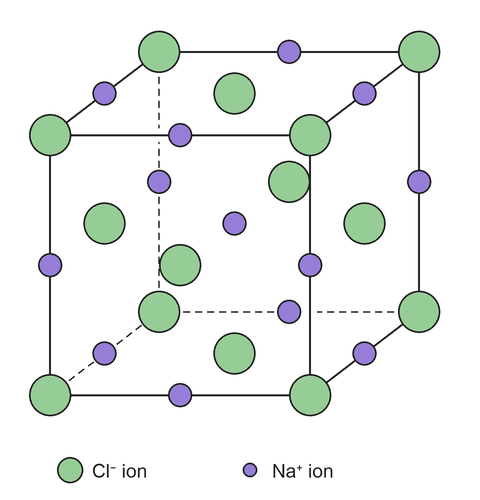
Therefore, NaCl has (i) a face-centred cubic lattice, (ii) coordination number 6 for both Na⁺ and Cl⁻, (iii) 4 Na⁺ and 4 Cl⁻ ions per unit cell, and (iv) the rock-salt arrangement, with Cl⁻ in ccp and Na⁺ in all the octahedral voids.
- 61 mark
Board paper question 6
Answer the following questions:
The edge length of unit cell of a body centered cubic (bcc) crystal is . Calculate the radius of the atom.
Solve with AIWritten solution
Solution:
Key idea: In a body-centred cubic (bcc) crystal the atoms touch along the body diagonal of the cube, so .
Step 1 — Relate the radius to the edge length.
In a body-centred cubic cell the atoms touch along the body diagonal. The body diagonal of a cube of edge is , and it spans one full atom in the middle plus a radius at each end, which together make four radii.
Step 2 — Substitute the edge length.
We put and .
Therefore, the radius of the atom is about 152 pm.
All 21 board paper questions for this chapter, solved the same way.
Class 12 Chemistry Ch 1 questions students ask
How many questions are there in Class 12 Chemistry Ch 1?
236 questions. Every one is solved step by step on this page.
Are these Class 12 Chemistry solutions free?
Yes. Every question and its full working is free to read, with no account needed.
Can I download the Class 12 Chemistry Ch 1 solutions as a PDF?
There is no PDF to download. Every solution is on this page instead, which means it is searchable, always the current syllabus, and readable on a phone. Use your browser's print option if you want it on paper.