Solution:
Key idea: In sodium chloride the larger chloride ions form a cubic close-packed (face-centred cubic) array, and the smaller sodium ions fill all the octahedral voids. The radius ratio rNa+/rCl− decides which voids the cations fit.
Step 1 — (i) State the type of lattice.
Sodium chloride crystallises in a face-centred cubic (fcc) lattice.
Step 2 — (ii) State the coordination numbers.
Each Na+ ion is surrounded octahedrally by 6 Cl− ions, and each Cl− ion is surrounded by 6 Na+ ions, so the coordination numbers are 6 and 6 (6 : 6 coordination). This fits the radius ratio, which lies in the range 0.414–0.732 for octahedral coordination.
rCl−rNa+=181 pm102 pm
rCl−rNa+≈0.564
Step 3 — (iii) Count the ions in a unit cell.
In the NaCl unit cell the chloride ions sit at the 8 corners and the 6 face centres, and the sodium ions sit at the 12 edge centres and the body centre. A corner is shared by 8 cells, a face by 2 cells and an edge by 4 cells, while the body centre belongs to one cell only.
Cl− per cell=8×81+6×21
Cl− per cell=1+3
Cl− per cell=4
Na+ per cell=12×41+1×1
Na+ per cell=3+1
Na+ per cell=4
So each unit cell contains 4 NaCl formula units.
Step 4 — (iv) Describe the arrangement.
The figure shows the unit cell. The Cl− ions are in cubic close packing (at the corners and face centres), and the Na+ ions occupy all the octahedral voids (at the edge centres and the body centre). This is called the rock-salt structure; it can also be pictured as two interpenetrating fcc lattices, one of Na+ and one of Cl− ions.
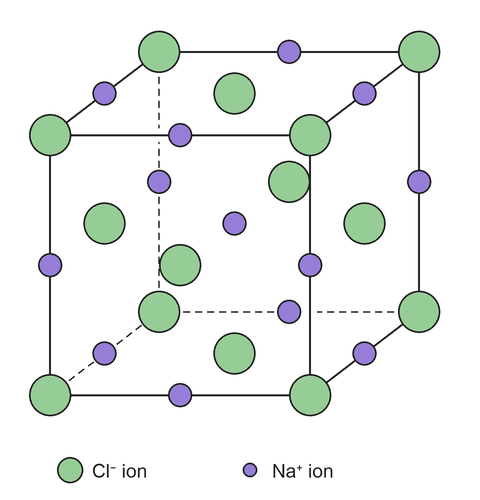
Therefore, NaCl has (i) a face-centred cubic lattice, (ii) coordination number 6 for both Na⁺ and Cl⁻, (iii) 4 Na⁺ and 4 Cl⁻ ions per unit cell, and (iv) the rock-salt arrangement, with Cl⁻ in ccp and Na⁺ in all the octahedral voids.
