
Opening your dashboard
Class 12 Chemistry Chapter 1 Solid State: Previous Year Questions
21 questions on Chapter 1, each solved step by step. Class 12 Chemistry, ICSE 2026-27.
21 questions with solutions
1–4 marks · Mixed difficulty
- 11 mark
Question 1
Fill in the blanks by choosing the appropriate word/words from those given in the brackets:
(increases, decreases, positive, efficient, 68, non-efficient, no -hydrogen, -hydrogen, negative, Rosenmund's, greater, Cannizzaro, 74, common-ion effect, lesser, buffer action, diamagnetic, paramagnetic)
Both ccp and hcp are ______ packings and occupy about ______% of the available space.
Solve with AIWritten solution
Solution:
Key idea: In both cubic close packing (ccp) and hexagonal close packing (hcp) each sphere touches 12 others, the highest number possible for equal spheres, so the spheres fill space as fully as equal spheres can.
Step 1 — Describe the packing.
Both ccp and hcp are close packings with a coordination number of 12, so they are efficient packings.
Step 2 — Recall the fraction of space filled.
The packing fraction of both arrangements is , so the spheres occupy about 74 % of the space; the remaining 26 % is the voids.
Therefore, both ccp and hcp are efficient packings and occupy about 74 % of the available space.
- 21 mark
Question 2
Name the crystal structure of the copper metal.
Solve with AIWritten solution
Solution:
Key idea: Many metals crystallise in a close-packed structure. Cubic close packing (ccp) is the same arrangement as the face-centred cubic (fcc) lattice.
Step 1 — State the structure of copper.
Copper atoms are arranged in cubic close packing, so copper has a face-centred cubic (fcc) crystal structure.
Step 2 — Describe what this means.
Each copper atom touches 12 neighbours (coordination number 12), and each unit cell contains atoms.
Therefore, copper has a face-centred cubic (cubic close-packed) crystal structure.
- 32 marks
Question 3
Chromium metal crystallises with a body centered cubic lattice. The edge length of the unit cell is found to be . Calculate the atomic radius. What would be the density of chromium in ? (atomic mass of )
Solve with AIWritten solution
Solution:
Key idea: In a body-centred cubic (bcc) cell the atoms touch along the body diagonal, and each cell holds two atoms.
The density is , with in cm, the atomic mass and the Avogadro constant ().
Step 1 — Relate the radius to the edge length.
In a body-centred cubic cell the atoms touch along the body diagonal. The body diagonal of a cube of edge is , and it spans one full atom in the middle plus a radius at each end, which together make four radii.
Step 2 — Find the atomic radius.
We substitute and .
Step 3 — Find the volume of the unit cell in cm³.
We convert the edge to centimetres: , so .
Step 4 — Find the density.
We put , and into the density formula.
Note: The paper gives the atomic mass of chromium as 52.99; the accepted value is 52.00 g mol⁻¹, which with the same edge length gives about 7.31 g cm⁻³ (the measured density of chromium is about 7.19 g cm⁻³).
Therefore, the atomic radius of chromium is about 124 pm and its density, with the given data, is about 7.44 g cm⁻³.
- 41 mark
Question 4
Why does sodium chloride on heating with sodium vapours acquire yellow colour?
Solve with AIWritten solution
Solution:
Key idea: Heating an ionic crystal in the vapour of its own metal creates a metal-excess defect. Electrons trapped in anion vacancies are called F-centres (from the German Farbe, colour), and they give the crystal its colour.
Step 1 — Describe what happens at the surface.
Sodium atoms from the vapour settle on the surface of the crystal and lose their electrons, forming ions.
Chloride ions move out from inside the crystal to the surface and combine with these new ions, so the crystal grows by extra NaCl units at its surface.
Step 2 — Explain where the electrons go.
Each chloride ion that leaves its site inside the crystal leaves an anion vacancy behind. The released electrons diffuse into the crystal and occupy these vacant anion sites. An anion site occupied by an electron is an F-centre, and the crystal now has an excess of sodium.
Step 3 — Explain the colour.
The electrons in the F-centres absorb part of the visible light falling on the crystal (in the blue region) and are excited. The light that is not absorbed makes the crystal look yellow.
Therefore, NaCl turns yellow because excess sodium creates anion vacancies occupied by electrons (F-centres), which absorb visible light.
- 52 marks
Question 5
For a crystal of sodium chloride, state:
(i) The type of lattice in which it crystallises.
(ii) The coordination number of each sodium ion and chloride ion in the crystal lattice.
(iii) The number of sodium ions and chloride ions present in a unit cell of sodium chloride.
(iv) The structural arrangement of the sodium chloride crystal.
Solve with AIWritten solution
Solution:
Key idea: In sodium chloride the larger chloride ions form a cubic close-packed (face-centred cubic) array, and the smaller sodium ions fill all the octahedral voids. The radius ratio decides which voids the cations fit.
Step 1 — (i) State the type of lattice.
Sodium chloride crystallises in a face-centred cubic (fcc) lattice.
Step 2 — (ii) State the coordination numbers.
Each ion is surrounded octahedrally by 6 ions, and each ion is surrounded by 6 ions, so the coordination numbers are 6 and 6 (6 : 6 coordination). This fits the radius ratio, which lies in the range 0.414–0.732 for octahedral coordination.
Step 3 — (iii) Count the ions in a unit cell.
In the NaCl unit cell the chloride ions sit at the 8 corners and the 6 face centres, and the sodium ions sit at the 12 edge centres and the body centre. A corner is shared by 8 cells, a face by 2 cells and an edge by 4 cells, while the body centre belongs to one cell only.
So each unit cell contains 4 NaCl formula units.
Step 4 — (iv) Describe the arrangement.
The figure shows the unit cell. The ions are in cubic close packing (at the corners and face centres), and the ions occupy all the octahedral voids (at the edge centres and the body centre). This is called the rock-salt structure; it can also be pictured as two interpenetrating fcc lattices, one of and one of ions.
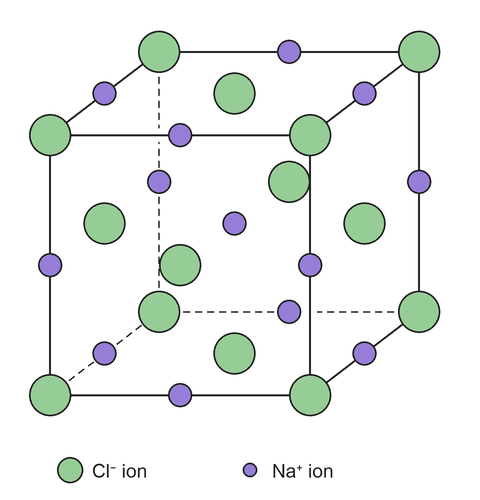
Therefore, NaCl has (i) a face-centred cubic lattice, (ii) coordination number 6 for both Na⁺ and Cl⁻, (iii) 4 Na⁺ and 4 Cl⁻ ions per unit cell, and (iv) the rock-salt arrangement, with Cl⁻ in ccp and Na⁺ in all the octahedral voids.
- 61 mark
Question 6
Answer the following questions:
The edge length of unit cell of a body centered cubic (bcc) crystal is . Calculate the radius of the atom.
Solve with AIWritten solution
Solution:
Key idea: In a body-centred cubic (bcc) crystal the atoms touch along the body diagonal of the cube, so .
Step 1 — Relate the radius to the edge length.
In a body-centred cubic cell the atoms touch along the body diagonal. The body diagonal of a cube of edge is , and it spans one full atom in the middle plus a radius at each end, which together make four radii.
Step 2 — Substitute the edge length.
We put and .
Therefore, the radius of the atom is about 152 pm.
- 71 mark
Question 7
Graphite is anisotropic with respect to conduction of electric current. Explain.
Solve with AIWritten solution
Solution:
Key idea: A solid is anisotropic when a physical property, such as electrical conductivity, has different values in different directions. This happens when the particles are arranged differently along different directions.
Step 1 — Describe the structure of graphite.
Graphite is made of flat layers of carbon atoms. In each layer every carbon atom is hybridised and bonded to three others, forming hexagonal rings. The fourth valence electron of each carbon is delocalised over the whole layer. The layers are about 340 pm apart and are held together only by weak van der Waals forces.
Step 2 — Explain the difference in conduction.
The delocalised electrons can move freely within a layer, so graphite conducts electricity well along (parallel to) the layers. Electrons cannot move easily from one layer to the next, so conduction perpendicular to the layers is very much smaller.
Therefore, graphite is anisotropic in conduction because its delocalised electrons move freely within the layers but not across them, so its conductivity depends on direction.
- 82 marks
Question 8
In a body centred and face centred arrangement of atoms of an element, what will be the number of atoms present in respective unit cells? Justify your answer with calculation.
Solve with AIWritten solution
Solution:
Key idea: An atom at a corner of a cube is shared by 8 unit cells (contributes ), an atom at a face centre is shared by 2 cells (contributes ), and an atom at the body centre belongs wholly to one cell.
Step 1 — Picture the two cells.
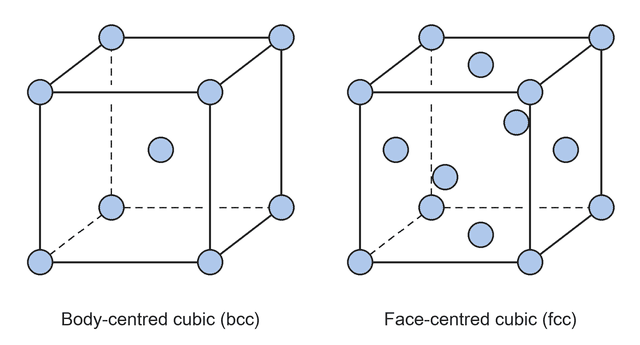
The figure shows a body-centred cubic (bcc) cell, with atoms at the 8 corners and one at the body centre, and a face-centred cubic (fcc) cell, with atoms at the 8 corners and at the centres of the 6 faces.
Step 2 — Count the atoms in the bcc cell.
We add the corner shares and the body-centre atom.
Step 3 — Count the atoms in the fcc cell.
We add the corner shares and the face-centre shares.
Therefore, a body-centred cubic unit cell contains 2 atoms and a face-centred cubic unit cell contains 4 atoms.
- 92 marks
Question 9
A compound AB has a simple cubic structure and has molecular mass 99. Its density is . What will be the edge length of the unit cell?
Solve with AIWritten solution
Solution:
Key idea: The density of a crystal is , so . For a compound AB in a simple cubic structure (one ion at the corners, the other at the body centre, as in CsCl), each unit cell holds one formula unit, so .
Step 1 — Write down the data.
The data are , , and .
Step 2 — Find the volume of the unit cell.
We rearrange the density formula for and substitute.
Step 3 — Take the cube root.
Writing as makes the power of ten a perfect cube.
Step 4 — Convert to picometres.
Since , .
Therefore, the edge length of the unit cell is about 3.64 × 10⁻⁸ cm, that is, about 364 pm.
- 101 mark
Question 10
Complete the following statements by selecting the correct alternative from the choices given:
In a face-centred cubic lattice, atom (A) occupies the corner positions and atom (B) occupies the face centre positions. If one atom of (B) is missing from one of the face-centred points, the formula of the compound is:
Solve with AIAnswer
- Correct
(A)
(B)
(C)
(D)
Answer: (A)
Key idea: A corner atom contributes of itself to a unit cell, and a face-centre atom contributes . The formula is the simplest whole-number ratio of the atoms per cell.
Step 1 — Count the A atoms.
Atom A occupies all 8 corners.
Step 2 — Count the B atoms.
A cube has 6 face centres, but one B atom is missing, so only 5 face centres are occupied.
Step 3 — Write the formula.
We write the ratio of A to B and multiply both terms by 2 to clear the fraction.
So the formula is .
Why the others are wrong:
- (B) needs 1.5 B atoms per A, which would mean three of the six face-centre atoms were missing, not one.
- (C) comes from subtracting the missing atom as a whole atom (3 − 1 = 2), but a face-centre atom contributes only half an atom to the cell.
- (D) needs only 0.5 B atom per A, which would mean only one face centre was occupied.
Therefore, the formula of the compound is A₂B₅, option (A).
- 111 mark
Question 11
How many sodium ions and chloride ions are present in a unit cell of sodium chloride crystal?
Solve with AIWritten solution
Solution:
Key idea: Each ion contributes to a unit cell according to its position: a corner ion , a face-centre ion , an edge-centre ion and a body-centre ion 1.
Step 1 — Recall the positions of the ions.
In the NaCl (rock-salt) structure the chloride ions are in cubic close packing and the sodium ions fill all the octahedral voids.
Step 2 — Count the ions.
In the NaCl unit cell the chloride ions sit at the 8 corners and the 6 face centres, and the sodium ions sit at the 12 edge centres and the body centre. A corner is shared by 8 cells, a face by 2 cells and an edge by 4 cells, while the body centre belongs to one cell only.
Therefore, a unit cell of sodium chloride contains 4 sodium ions and 4 chloride ions (4 NaCl formula units).
- 121 mark
Question 12
Lead sulphide has a face-centred cubic crystal structure. If the edge length of the unit cell of lead sulphide is , calculate the density of the crystal.
(at. wt. of , )
Solve with AIWritten solution
Solution:
Key idea: Lead sulphide has the rock-salt (NaCl-type) face-centred cubic structure, so each unit cell holds 4 PbS formula units.
The density is , with in cm.
Step 1 — Find the molar mass of PbS.
We add the atomic masses of lead and sulphur.
Step 2 — Find the volume of the unit cell.
The edge is .
Step 3 — Find the density.
We use and .
Note: Real lead sulphide (galena) has an edge length of about 594 pm and a density of about 7.6 g cm⁻³; the answer above follows the edge length printed in the question.
Therefore, with the given edge length, the density of lead sulphide is about 13.1 g cm⁻³.
- 132 marks
Question 13
Frenkel defect does not change the density of the ionic crystal whereas, Schottky defect lowers the density of ionic crystal. Give a reason.
Solve with AIWritten solution
Solution:
Key idea: Density is mass divided by volume. A defect changes the density only if it changes the mass of the crystal without changing its volume in the same proportion.
Step 1 — Picture the two defects.
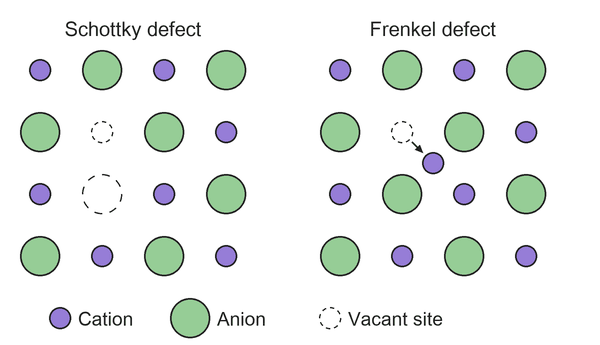
The figure shows both defects in a layer of an ionic crystal.
Step 2 — Explain why a Frenkel defect leaves the density unchanged.
In a Frenkel defect an ion (usually the smaller cation) leaves its lattice site and moves into an interstitial site within the same crystal. No ion leaves the crystal, so its mass stays the same, and its volume is also practically unchanged. Hence the density does not change.
Step 3 — Explain why a Schottky defect lowers the density.
In a Schottky defect an equal number of cations and anions are missing from their lattice sites, so the crystal stays electrically neutral. These ions are missing from the crystal altogether, so its mass falls while its volume stays practically the same. Hence the density decreases.
Therefore, a Frenkel defect only shifts an ion within the crystal, so mass and density stay the same, while a Schottky defect removes ions from the crystal, so its mass and hence its density decrease.
- 141 mark
Question 14
Fill in the blanks by choosing the appropriate word/words from those given in the brackets:
(square pyramidal, electrical, 74, 26, , , chemical, 68, 32, tetrahedral, yellow, white, iodoform, Lucas)
The percentage of unoccupied spaces in bcc and fcc arrangements are ______ and ______ respectively.
Solve with AIWritten solution
Solution:
Key idea: The percentage of unoccupied space is 100 % minus the packing efficiency. The packing efficiency is about 68 % for a body-centred cubic (bcc) arrangement and about 74 % for a face-centred cubic (fcc) arrangement.
Step 1 — Find the empty space in bcc.
In bcc the two atoms of a unit cell fill a fraction (about 0.68) of the cell, so 68 % of the space is occupied.
Step 2 — Find the empty space in fcc.
In fcc the four atoms of a unit cell fill a fraction (about 0.74) of the cell, so 74 % of the space is occupied.
Therefore, the percentages of unoccupied space in bcc and fcc arrangements are 32 and 26 respectively.
- 153 marks
Question 15
Examine the defective crystal given below and answer the question that follows :
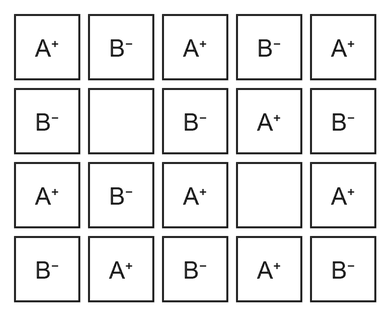
State if the above defect is stoichiometric or non-stoichiometric. How does this defect affect the density of the crystal ? Also, write the term used for this type of defect.
Solve with AIWritten solution
Solution:
Key idea: A stoichiometric defect leaves the ratio of cations to anions exactly as in the formula. When equal numbers of cations and anions are missing from their lattice sites, the defect is a Schottky defect, and the crystal loses mass but keeps practically the same volume.
Step 1 — Count the ions and the vacant sites.
The figure has 20 sites. Nine are occupied by ions and nine by ions. Two sites are empty: one is a cation site (second row, second column) and the other is an anion site (third row, fourth column).
Step 2 — Decide whether the defect is stoichiometric.
One cation and one anion are missing, so the crystal still has equal numbers of and ions (9 : 9 = 1 : 1). The ratio matches the formula AB and the crystal stays electrically neutral, so the defect is stoichiometric.
Step 3 — Find the effect on density.
The missing ions are absent from the crystal altogether, so the mass of the crystal decreases, while its volume stays practically the same. Therefore the density of the crystal decreases.
Step 4 — Name the defect.
A defect in which equal numbers of cations and anions are missing from their lattice sites is called a Schottky defect (a vacancy defect of an ionic solid).
Therefore, the defect is stoichiometric, it lowers the density of the crystal, and it is called a Schottky defect.
- 163 marks
Question 16
An element occurs in body centered cubic structure. Its density is . If the cell edge is . Calculate the atomic mass of an atom of this element.
()
Solve with AIWritten solution
Solution:
Key idea: The density of a cubic crystal is .
Rearranged, the molar (atomic) mass is . A body-centred cubic cell holds two atoms.
Step 1 — Find the volume of the unit cell.
The edge is .
Step 2 — Find the atomic mass.
We put , and into the rearranged formula.
Step 3 — Find the mass of a single atom.
One mole contains atoms, so we divide the molar mass by .
Therefore, the atomic mass of the element is about 37.6 u (37.6 g mol⁻¹), and one atom has a mass of about 6.25 × 10⁻²³ g.
- 171 mark
Question 17
Select the correct alternative from the choices given:
The packing efficiency of simple cubic structure, body centered cubic structure and face centered cubic structure respectively is:
Solve with AIAnswer
(A) 52.4%, 74%, 68%
(B) 74%, 68%, 52.4%
- Correct
(C) 52.4%, 68%, 74%
(D) 68%, 74%, 52.4%
Answer: (C) 52.4%, 68%, 74%
Key idea: Packing efficiency is the percentage of the unit-cell volume filled by the atoms. It depends on how many atoms the cell holds and on how the atom radius is related to the edge .
Step 1 — Find the packing efficiency of the simple cubic structure.
The cell holds one atom, and the atoms touch along an edge (). The fraction of the cell filled by the atoms is found from these two facts.
So 52.4 % of the space is filled.
Step 2 — Find the packing efficiency of the body-centred cubic structure.
The cell holds two atoms, and the atoms touch along the body diagonal (). The fraction of the cell filled by the atoms is found from these two facts.
So 68 % of the space is filled.
Step 3 — Find the packing efficiency of the face-centred cubic structure.
The cell holds four atoms, and the atoms touch along a face diagonal (). The fraction of the cell filled by the atoms is found from these two facts.
So 74 % of the space is filled.
Why the others are wrong:
- (A) This option gives 74 % to the body-centred cubic structure and 68 % to the face-centred cubic one, swapping the two values.
- (B) This option lists the values in the reverse order, giving the face-centred cubic value (74 %) to the simple cubic structure.
- (D) This option gives the body-centred cubic value (68 %) to the simple cubic structure and the simple cubic value (52.4 %) to the face-centred cubic one.
Therefore, the packing efficiencies of simple cubic, bcc and fcc structures are 52.4 %, 68 % and 74 % respectively, option (C).
- 184 marks
Question 18
Match the following:
(i) Silicon and phosphorus (a) Acetaldehyde (ii) Iodoform test (b) Xenon hexafluoride (iii) Arrhenius equation (c) n-type of semiconductors (iv) Distorted octahedral structure (d) Frequency factor Solve with AIWritten solution
Solution:
Key idea: Each item on the left is linked to one fact on the right from different chapters: doping of semiconductors, the iodoform test for the group, the Arrhenius equation for rate constants, and the shapes of xenon fluorides.
Step 1 — Match item (i).
Silicon has 4 valence electrons and phosphorus has 5. When silicon is doped with phosphorus, each phosphorus atom forms four bonds and has one extra electron free to carry current. Negative electrons are the carriers, so this gives an n-type semiconductor. So (i) matches (c).
Step 2 — Match item (ii).
The iodoform test (warming with iodine and sodium hydroxide) gives a yellow precipitate of iodoform, , with compounds containing the group. Acetaldehyde, , has this group, so it gives the test. So (ii) matches (a).
Step 3 — Match item (iii).
The Arrhenius equation is , where is the frequency factor (pre-exponential factor). So (iii) matches (d).
Step 4 — Match item (iv).
In xenon hexafluoride, , xenon has six bond pairs and one lone pair ( hybridisation). The lone pair pushes the bonds out of a regular octahedron, giving a distorted octahedral structure. So (iv) matches (b).
Therefore, the matches are (i) matches (c), (ii) matches (a), (iii) matches (d) and (iv) matches (b).
- 192 marks
Question 19
An element has atomic weight and density . If the edge length of its unit cell is , identify the type of unit cell. ()
Solve with AIWritten solution
Solution:
Key idea: The number of atoms per unit cell is . The value of identifies the cell: 1 for simple cubic, 2 for body-centred cubic and 4 for face-centred cubic.
Step 1 — Find the volume of the unit cell.
The edge is .
Step 2 — Find the number of atoms per cell.
We put , and into the formula.
Step 3 — Identify the unit cell.
The value of is 2 to within the accuracy of the data, and a cubic cell with 2 atoms is body-centred cubic.
Note: The question does not name the element. Niobium (atomic weight 92.9) is the element with this atomic weight, and it really is body-centred cubic, but its real edge length is about 330 pm and its density about 8.57 g cm⁻³, not 300 pm and 11.5 g cm⁻³; the real values also give Z ≈ 2.00. The answer above follows the data printed in the question.
Therefore, Z ≈ 2, so the unit cell is body-centred cubic (bcc).
- 202 marks
Question 20
Calculate the radius of copper atom. The atomic weight of copper is . It crystallises in face centered cubic lattice and has density of at 298. ()
Solve with AIWritten solution
Solution:
Key idea: A face-centred cubic (fcc) cell holds four atoms, and its edge follows from .
In fcc the atoms touch along a face diagonal, so the radius is .
Step 1 — Find the volume of the unit cell.
We put , , and into the formula. (The temperature, printed as 298, is 298 K; it only tells us at which temperature the density was measured.)
Step 2 — Find the edge length.
Writing as makes the power of ten a perfect cube.
So .
Step 3 — Find the radius.
In fcc the face diagonal equals .
Therefore, the radius of the copper atom is about 128 pm (127.8 pm).
- 212 marks
Question 21
An alloy of gold (Au) and cadmium (Cd) crystallises with a cubic structure in which gold atoms occupy the corners and cadmium atoms fit into the face centres. What is the formula of this alloy?
Solve with AIWritten solution
Solution:
Key idea: An atom at a corner contributes of itself to a unit cell, and an atom at a face centre contributes . The formula is the simplest ratio of the atoms per cell.
Step 1 — Count the gold atoms.
Gold atoms occupy the 8 corners.
Step 2 — Count the cadmium atoms.
Cadmium atoms occupy the 6 face centres.
Step 3 — Write the formula.
The ratio is .
Therefore, the formula of the alloy is AuCd₃.