Solution:
Key idea: A stoichiometric defect leaves the ratio of cations to anions exactly as in the formula. When equal numbers of cations and anions are missing from their lattice sites, the defect is a Schottky defect, and the crystal loses mass but keeps practically the same volume.
Step 1 — Count the ions and the vacant sites.
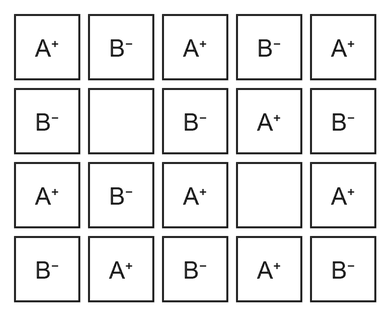
The figure has 20 sites. Nine are occupied by A+ ions and nine by B− ions. Two sites are empty: one is a cation site (second row, second column) and the other is an anion site (third row, fourth column).
Step 2 — Decide whether the defect is stoichiometric.
One cation and one anion are missing, so the crystal still has equal numbers of A+ and B− ions (9 : 9 = 1 : 1). The ratio matches the formula AB and the crystal stays electrically neutral, so the defect is stoichiometric.
Step 3 — Find the effect on density.
The missing ions are absent from the crystal altogether, so the mass of the crystal decreases, while its volume stays practically the same. Therefore the density of the crystal decreases.
Step 4 — Name the defect.
A defect in which equal numbers of cations and anions are missing from their lattice sites is called a Schottky defect (a vacancy defect of an ionic solid).
Therefore, the defect is stoichiometric, it lowers the density of the crystal, and it is called a Schottky defect.