
Question 132 marksAsked 2017Medium
Frenkel defect does not change the density of the ionic crystal whereas, Schottky defect lowers the density of ionic crystal. Give a reason.
Confirming your payment
Sign up now and get 250 free tokens.
Previous Year Questions · Question 13 of 21
Frenkel defect does not change the density of the ionic crystal whereas, Schottky defect lowers the density of ionic crystal. Give a reason.
Solution:
Key idea: Density is mass divided by volume. A defect changes the density only if it changes the mass of the crystal without changing its volume in the same proportion.
Step 1 — Picture the two defects.
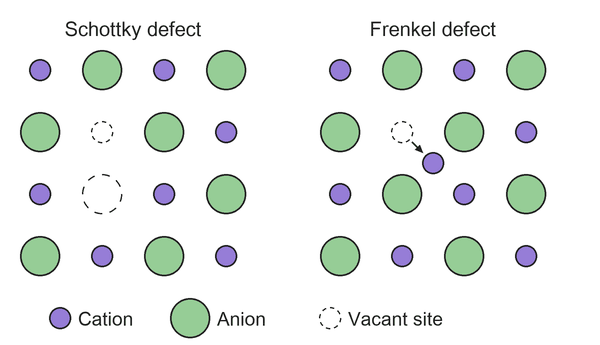
The figure shows both defects in a layer of an ionic crystal.
Step 2 — Explain why a Frenkel defect leaves the density unchanged.
In a Frenkel defect an ion (usually the smaller cation) leaves its lattice site and moves into an interstitial site within the same crystal. No ion leaves the crystal, so its mass stays the same, and its volume is also practically unchanged. Hence the density does not change.
Step 3 — Explain why a Schottky defect lowers the density.
In a Schottky defect an equal number of cations and anions are missing from their lattice sites, so the crystal stays electrically neutral. These ions are missing from the crystal altogether, so its mass falls while its volume stays practically the same. Hence the density decreases.
Therefore, a Frenkel defect only shifts an ion within the crystal, so mass and density stay the same, while a Schottky defect removes ions from the crystal, so its mass and hence its density decrease.