
Question 1825 marksMedium
Describe the unit cell of NaCl with a neat diagram stating:
(i) type of bonding
(ii) type of unit cell
(iii) Number of nearest neighbours around and ions.
Confirming your payment
Sign up now and get 250 free tokens.
Solid State · Question 182 of 236
Describe the unit cell of NaCl with a neat diagram stating:
(i) type of bonding
(ii) type of unit cell
(iii) Number of nearest neighbours around and ions.
Solution:
Key idea: Sodium chloride has the rock-salt structure. The larger ions are in cubic close packing (face-centred cubic arrangement), and the smaller ions fill all the octahedral voids. A corner ion is shared by 8 cells, an edge-centre ion by 4, a face-centre ion by 2, and a body-centre ion belongs to one cell only.
Step 1 — Draw and describe the unit cell.
In the unit cell drawn below, the ions occupy the 8 corners and the 6 face centres of a cube. The ions occupy all the octahedral voids, which are the 12 edge centres and the body centre.
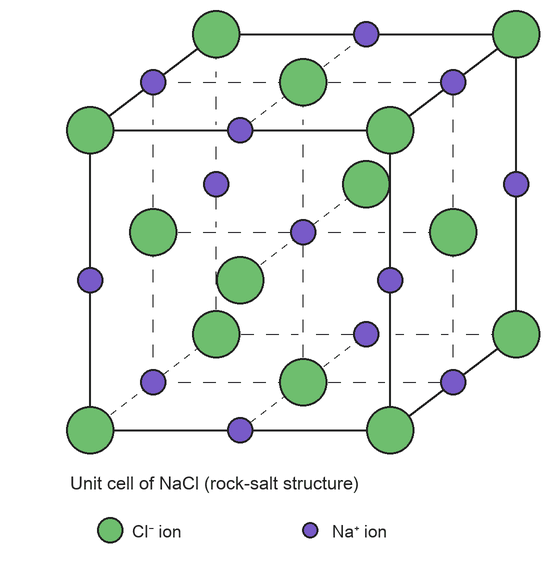
Step 2 — Count the ions in one unit cell.
We use the shares of the corner and face-centre positions for .
We use the shares of the edge-centre and body-centre positions for .
So each unit cell holds 4 NaCl formula units.
Step 3 — State the type of bonding (part i).
The particles are oppositely charged ions, and they are held by strong, non-directional electrostatic attraction. So the bonding is ionic.
Step 4 — State the type of unit cell (part ii).
The ions form a face-centred cubic lattice, and the ions form a second face-centred cubic lattice displaced by half an edge, the two interpenetrating. So the unit cell is face-centred cubic.
Step 5 — Count the nearest neighbours (part iii).
Each ion in an octahedral void touches six ions at the corners of an octahedron, and each ion is likewise surrounded by six ions. This 6 : 6 coordination fits the radius ratio (Pauling radii).
The value lies in the octahedral range 0.414 to 0.732.
Therefore, the NaCl unit cell has Cl⁻ at the corners and face centres and Na⁺ at the edge centres and body centre (4 NaCl units per cell); (i) the bonding is ionic, (ii) the unit cell is face-centred cubic, and (iii) each Na⁺ has 6 nearest Cl⁻ ions and each Cl⁻ has 6 nearest Na⁺ ions.