Solution:
Key idea: A face-centred cubic (fcc) unit cell has particles at the 8 corners and at the centres of the 6 faces. A corner particle is shared by 8 cells and a face-centre particle by 2 cells. Sodium chloride is built from an fcc arrangement of Cl− ions with Na+ ions in the octahedral voids.
Step 1 — Count the spheres needed to build an fcc unit cell (part a).
To make a model of one fcc unit cell we need one sphere at each corner and one at each face centre.
N=8+6
N=14
So 14 spheres are needed to build the cell. Because the corner spheres are shared by 8 cells and the face spheres by 2, fewer spheres belong to one cell.
Z=8×81+6×21
Z=4
Step 2 — Describe the arrangement of the ions in NaCl (part b).
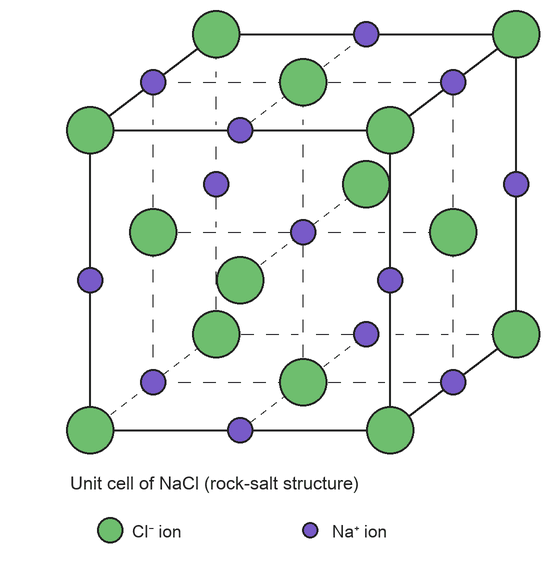
NaCl has the rock-salt structure, shown in the figure. The larger Cl− ions are in cubic close packing, at the corners and face centres of the unit cell. The smaller Na+ ions fill all the octahedral voids, at the 12 edge centres and the body centre. Each ion is surrounded octahedrally by six ions of the opposite charge.
Step 3 — Count the chloride ions closest to a sodium ion (part b).
A Na+ ion in an octahedral void touches the six Cl− ions at the corners of the octahedron. So a sodium ion has 6 closest chloride ions (coordination number 6).
Step 4 — Describe the lattice of each kind of ion taken alone (part b).
If we look only at the Cl− ions, they sit at the corners and face centres, which is a face-centred cubic lattice. If we look only at the Na+ ions, the edge centres and body centre of this cell are the corners and face centres of an identical cube shifted by half an edge, so they too form a face-centred cubic lattice. The NaCl crystal is two fcc lattices interpenetrating each other, one displaced from the other by a/2 along a cell edge.
Therefore, (a) 14 spheres are needed to build an fcc unit cell (4 of them belong to the cell); (b) in NaCl the Cl⁻ ions are in cubic close packing with Na⁺ in all the octahedral voids, each Na⁺ has 6 closest Cl⁻ ions, and the Na⁺ ions and the Cl⁻ ions taken separately each form a face-centred cubic lattice.
