
Opening your dashboard
Class 12 Chemistry Chapter 1 Solid State: Practice Questions
136 questions on Chapter 1, each worked through on its own page with the AI tutor. Class 12 Chemistry, ICSE 2026-27.
136 questions
1–4 marks · Mixed difficulty
- 11 mark
Question 1
Two colourless solids X and Y are tested. X melts sharply at one temperature, and when cut with a sharp knife it splits into pieces with flat, smooth faces. Y softens slowly over a range of temperature, and when cut it breaks into pieces with irregular, curved surfaces. Which conclusion is correct?
- 21 mark
Question 2
The refractive index of a transparent solid is measured along three different directions in the solid. Two directions give 1.544 and the third gives 1.553. What can be concluded about the solid?
- 32 marks
Question 3
(Hypothetical data.) Two white solids P and Q are heated at a steady rate and their temperature is noted every minute.
Solid P: the temperature rises to 80 °C, stays at 80 °C for 4 minutes while the solid melts, and then rises again.
Solid Q: the temperature keeps rising without any pause; Q starts to soften at 60 °C and is completely liquid at 75 °C.
(a) Which solid is crystalline and which is amorphous?
(b) Why does the temperature of P stay constant for 4 minutes?
- 43 marks
Question 4
Crystalline quartz can be melted, and when the melt is cooled very quickly it forms quartz glass.
(a) Why does rapid cooling give an amorphous solid instead of crystals?
(b) State two properties in which a piece of quartz glass differs from a crystal of quartz.
- 52 marks
Question 5
What is meant by short-range order and long-range order in a solid? Which kind of order is present in (i) a crystal of naphthalene and (ii) a piece of rubber?
- 61 mark
Question 6
Which crystal system has all four kinds of unit cell: primitive, body-centred, face-centred and end-centred?
- 71 mark
Question 7
A unit cell is a cube. Identical atoms sit at all eight corners and at the centre of each of the twelve edges, and nowhere else. How many atoms belong to one unit cell?
- 82 marks
Question 8
A unit cell is fully described by six parameters. Name these parameters. How do their values for a tetragonal unit cell differ from those for a cubic unit cell?
- 93 marks
Question 9
(Hypothetical data.) A compound of elements P and Q has a unit cell shaped like a rectangular box. Atoms of P are at all eight corners. Atoms of Q are at the centres of the top face and the bottom face only.
(a) How many atoms of P and of Q belong to one unit cell?
(b) What is the formula of the compound?
(c) If all the atoms were of one element, what name would be given to this type of unit cell?
- 103 marks
Question 10
White tin has a tetragonal unit cell with pm and pm. Its density is 7.28 g cm⁻³. Calculate the number of tin atoms in one unit cell. (Atomic mass of Sn = 119 u; mol⁻¹)
- 111 mark
Question 11
In a body-centred cubic (bcc) arrangement of identical atoms, along which line do the atoms touch one another?
- 121 mark
Question 12
Metal P crystallises in an fcc lattice and metal Q in a bcc lattice. Their unit cells have the same edge length, and the two metals have the same density. The ratio of their molar masses, , is
- 132 marks
Question 13
Show that the packing efficiency of a simple cubic lattice does not depend on the size of its atoms. What does this tell you about two simple cubic metals with very different atomic radii?
- 143 marks
Question 14
An element crystallises in a body-centred cubic lattice. The radius of its atom is 124 pm. Calculate
(a) the edge length of the unit cell,
(b) the volume occupied by the atoms in one unit cell, and
(c) the fraction of the unit-cell volume that is empty.
- 153 marks
Question 15
A sheet of gold leaf is 0.100 µm thick. Gold crystallises in an fcc lattice with an edge length of 407.8 pm. (Atomic mass of Au = 197 u; mol⁻¹)
(a) Calculate the density of gold.
(b) About how many unit cells are stacked across the thickness of the sheet?
(c) What is the mass of a 1.00 cm² piece of this gold leaf?
- 161 mark
Question 16
In hexagonal close packing (hcp), the spheres of the third layer are placed
- 171 mark
Question 17
In a face-centred cubic unit cell of edge length , what is the distance between a tetrahedral void and the nearest corner of the cube?
- 183 marks
Question 18
A metal crystallises in cubic close packing (ccp). Using its face-centred cubic unit cell, show that the number of octahedral voids equals the number of atoms, and the number of tetrahedral voids is twice the number of atoms.
- 193 marks
Question 19
(Hypothetical data.) The atoms of a metal M, of radius 140 pm, form a cubic close-packed lattice.
(a) What is the largest radius of an atom that can fit into a tetrahedral void without pushing the M atoms apart?
(b) What is the largest radius for an octahedral void?
(c) Into which kind of void can an atom of radius 50 pm fit without distorting the lattice?
- 202 marks
Question 20
Hexagonal close packing and cubic close packing differ in the way their layers are stacked, yet both have a packing efficiency of 74%. Explain why.
- 211 mark
Question 21
(Hypothetical data.) The radii of the cation and the anion in four ionic solids of formula AX are given below (in pm). Which solid is expected to have a caesium chloride type structure?
- 221 mark
Question 22
In the sodium chloride structure the edge length of the unit cell is . What is the shortest distance between two ions?
- 233 marks
Question 23
In an ionic solid with the caesium chloride structure, the anions are at the corners of a cube and the cation is at the body centre, touching all eight anions. Show that the smallest radius ratio for which this arrangement is stable is 0.732.
- 242 marks
Question 24
How is the coordination number of an ionic crystal affected by (a) an increase of pressure and (b) an increase of temperature? Give one example of each.
- 251 mark
Question 25
A dark violet solid X is soft, melts at 114 °C and gives off vapour on gentle warming. It hardly dissolves in water but dissolves readily in carbon tetrachloride. It does not conduct electricity either as a solid or when melted. X is most likely
- 264 marks
Question 26
For each solid below, state the type of crystalline solid, the particles at the lattice points and the force holding them together.
(a) Silicon carbide (carborundum), SiC
(b) Magnesium oxide, MgO
(c) Brass (an alloy of copper and zinc)
(d) White phosphorus,
- 273 marks
Question 27
Arrange solid argon, solid hydrogen chloride and ice in increasing order of melting point. Justify the order in terms of the forces between the particles.
- 281 mark
Question 28
Which statement correctly compares the electrical conduction of sodium chloride and copper?
- 292 marks
Question 29
Carbon and silicon are in the same group, yet carbon dioxide is a gas at room temperature while silicon dioxide (quartz) melts only at about 1700 °C. Explain.
- 301 mark
Question 30
In which of the following solids are the forces holding the particles together the weakest?
- 311 mark
Question 31
A crystal of KCl contains 1 mol of sites, and 1 site in every is vacant because of Schottky defects. How many sites are vacant in this crystal? (Hypothetical data.) ( mol⁻¹)
- 322 marks
Question 32
What is an electronic imperfection? Why are electrons and holes produced in equal numbers in pure germanium?
- 332 marks
Question 33
Pure solid sodium chloride is called an insulator, yet a crystal heated to just below its melting point conducts a very small current. Explain the role of crystal defects in this.
- 341 mark
Question 34
A metal deficiency defect caused by extra anions occupying interstitial sites is rarely observed. The main reason is that
- 353 marks
Question 35
Potassium chloride has the rock-salt (NaCl-type) structure with a unit-cell edge of 629 pm.
(a) Calculate the density of a perfect KCl crystal.
(b) A sample has 0.20% of its K⁺ sites and the same percentage of its Cl⁻ sites vacant because of Schottky defects. Find the density you would expect for this sample, and state the decrease. (Hypothetical data.)
(K = 39, Cl = 35.5; mol⁻¹)
- 364 marks
Question 36
Name the defect described in each case and state how the crystal stays electrically neutral.
(a) A KCl crystal has some K⁺ sites and an equal number of Cl⁻ sites empty.
(b) In a AgI crystal some Ag⁺ ions have left their sites and sit in interstitial positions.
(c) A KCl crystal has some Cl⁻ sites empty, and each empty site holds an electron.
(d) In a nickel oxide crystal some Ni²⁺ sites are empty and some of the remaining nickel ions are Ni³⁺.
- 371 mark
Question 37
An oxide MO of a metal M (normally M²⁺) shows a metal deficiency defect. For every M²⁺ site that is vacant, how many M²⁺ ions must change to M³⁺ to keep the crystal neutral?
- 382 marks
Question 38
Non-stoichiometric oxides such as those of iron and nickel are common, but such oxides of sodium or magnesium are not found. Give a reason.
- 391 mark
Question 39
Three solids P, Q and R are studied. P has a forbidden gap of 0.7 eV, Q has a forbidden gap of 6.0 eV, and in R the valence band overlaps the conduction band. (Hypothetical data.) The solids are respectively
- 402 marks
Question 40
A student says, "An n-type semiconductor is negatively charged because it has extra electrons." Is the student right? Explain with silicon doped with arsenic as the example.
- 412 marks
Question 41
Indium phosphide (InP) and zinc selenide (ZnSe) behave as semiconductors, much like silicon. Explain why, using the positions of the elements in the periodic table.
- 421 mark
Question 42
Which observation shows that a substance is ferromagnetic rather than simply paramagnetic?
- 432 marks
Question 43
Anhydrous copper(II) sulphate is attracted by a magnetic field, while zinc sulphate is weakly repelled. Explain using the electronic configurations of the metal ions. (Cu: Z = 29; Zn: Z = 30)
- 441 mark
Question 44
In a certain crystal the electric dipoles point in alternately opposite directions, so the net dipole moment is zero and the crystal shows no ferroelectric behaviour. Such a crystal is called
- 452 marks
Question 45
Every ferroelectric crystal is piezoelectric, but not every piezoelectric crystal is ferroelectric. Explain this statement.
- 463 marks
Question 46
A piece of lithium metal weighs 3.5 g. (Li: Z = 3, atomic mass 7; mol⁻¹)
(a) How many molecular orbitals make up the 2s band of this piece?
(b) How many of these molecular orbitals are filled?
(c) Use your answers to explain why lithium is a good conductor of electricity.
- 472 marks
Question 47
Magnesium has the configuration , so the 3s band of the metal is completely filled. Yet magnesium is a good conductor. Explain using band theory.
- 481 mark
Question 48
Which of the following does NOT favour the formation of a metallic bond?
- 492 marks
Question 49
Sodium melts at about 98 °C, while magnesium, its neighbour in period 3, melts at about 650 °C. Explain the difference in terms of metallic bonding.
- 503 marks
Question 50
(i) Draw the structure of sulphur hexafluoride molecule. State the hybridization of the central atom and the geometry of the molecule. How many sigma bonds are present in the molecule?
(ii) Lead (II) sulphide has FCC crystal structure. The edge length of the unit cell of PbS crystal is 500 pm. What is its density? [Pb = 207.2, S = 32]
(iii) Compare the crystals of copper and diamond giving one similarity and one difference.
- 513 marks
Question 51
(a) Define piezoelectricity and give one use of piezoelectric crystals.
(b) (i) What are semiconductors? What is the effect of increasing temperature on the conductivity of a semiconductor?
(ii) A compound AB has a cubic structure and molecular mass 99. Its density is 3.4 g cm⁻³. What is the length of the edge of the unit cell?
- 523 marks
Question 52
(a) (i) What are F-centres in an ionic crystal?
(ii) Why are crystals having F-centres paramagnetic?
(b) For a crystal of diamond, state:
(i) The hybridisation of the carbon atom.
(ii) The co-ordination number of each carbon atom.
(iii) The type of lattice in which it crystallises.
(iv) The number of carbon atoms present per unit cell.
- 533 marks
Question 53
(a) Complete the following statement by selecting the correct alternative from the choices given.
Copper has face centred cubic structure. The co-ordination number of each ion is:
(i) 4 (ii) 12 (iii) 14 (iv) 8.
(b) What is Schottky defect in solids?
(c) A bcc element (atomic mass 65) has a cell edge of 420 pm. Calculate the density in gms/cm³.
- 543 marks
Question 54
(i) The edge length of a unit cell of a body-centred cubic (bcc) crystal is 352 pm. Calculate the radius of the atom.
(ii) Graphite is anisotropic with respect to conduction of electric current. Explain.
(iii) In a body-centred and face-centred arrangement of atoms an element, what will be the number of atoms present in respective unit cell. Justify your answer with calculation.
(iv) A compound AB has a simple cubic structure and has molecular mass 99. Its density is 3.4 g cm⁻³. What will be the edge length of the unit cell?
- 553 marks
Question 55
(i) Fill in the blanks.
The crystal of graphite is made of ................ while that of sodium chloride is made of ............
(ii) An ionic compound is made up of A cations and B anions if A cation are present at the alternate corners and B anion is present on the body of the diagonal, what will be formula of the ionic compound?
(iii) In a crystal of diamond:
(a) How many carbon atoms are present per unit cell?
(b) What type of lattice does diamond crystallise in?
(c) How many carbon atoms surround each carbon atom?
(d) How are they arranged?
(iv) Ionic solids conduct electricity in the molten state but not in the solid state explain the reason why.
- 563 marks
Question 56
(i) The edge length of unit cell of a body centred cubic (bcc) crystal is 352 pm. Calculate the radius of its atom.
(ii) Graphite is anisotropic with respect to conduction of electric current. Explain.
- 573 marks
Question 57
(i) In a body centred and face centred arrangement of atoms of an element, what will be the number of atoms present in respective unit cells? Justify your answer with calculation.
(ii) A compound AB has a simple cubic structure and has molecular mass 99. Its density is 3.4 g cm⁻³. What will be the edge length of the unit cell?
- 583 marks
Question 58
(i) In a face centered cube lattice, atom (A) occupies the corner positions and atom (B) occupies the face centre positions. If one atom of (B) is missing from one of the face centered points, the formula of the compound is
(1) A₂B₅ (2) A₂B₃ (3) AB₂ (4) A₂B
(ii) How many sodium ions and chloride ions are present in a unit cell of sodium chloride crystal?
- 593 marks
Question 59
(i) Lead sulphide has face centered cubic crystal structure. If the edge length of the unit cell of lead sulphide is 495 pm, calculate the density of the crystal. (At. wt. Pb = 207, S = 32)
(ii) Frenkel defect does not change the density of the ionic crystal whereas, Schottky defect lowers the density of ionic crystal. Give a reason.
- 603 marks
Question 60
(i) Fill in the blanks.
The percentage of unoccupied spaces in bcc and fcc arrangement are ........... and ........... respectively.
(ii) Examine the defective crystal given below and answer the question that follows:
A⁺ B⁻ A⁺ B⁻ A⁺ B⁻ B⁻ A⁺ B⁻ A⁺ B⁻ A⁺ A⁺ B⁻ B⁻ A⁺ B⁻ State if the above defect is stoichiometric or non-stoichiometric. How does this defect affect the density?
- 613 marks
Question 61
(i) Explain the reason why ion is paramagnetic but ion is diamagnetic.
(ii) An element occurs in body centred cubic structure (bcc). Its density is 8.0 g cm⁻³, if the cell edge is 250 pm, calculate the atomic mass of this element. [N_A = 6.023 × 10²³]
- 623 marks
Question 62
(i) Select the correct alternative from the choices given.
The packing efficiency of simple cubic structure, body centered cubic structure and face centered cubic structure respectively is:
(1) 52.4%, 74%, 68% (2) 74%, 68%, 52.4%
(3) 52.4%, 68%, 74% (4) 68%, 74%, 52.4%
(ii) What kind of semiconductors are formed by silicon and phosphorus?
(iii) An alloy of gold (Au) and cadmium (Cd) crystallises with a cubic structure in which gold atoms occupy the corners and cadmium atoms fit into the face centers. What is the formula of this alloy?
- 633 marks
Question 63
An element has atomic weight 93 g mol⁻¹ and density 11.5 g cm⁻³. If the edge length of the unit cell is 300 pm, identify the type of unit cell. [N_A = 6.023 × 10²³ mol⁻¹]
- 643 marks
Question 64
Calculate the radius of copper atom. The atomic weight of copper is 63.55 g mol⁻¹. It crystallises in face centred cubic lattice and has density of 8.93 g cm⁻³ at 298 K. [N_A = 6.023 × 10²³ mol⁻¹]
- 653 marks
Question 65
(i) Fill in the blanks:
Paramagnetic compounds are generally ................ and contain ............ electrons.
(ii) Why are compounds of transition elements coloured?
- 661 mark
Question 66
The edge length of a face centred cubic cell of an ionic substance is 508 pm. If the radius of the cation is 110 pm, the radius of the anion is:
- 671 mark
Question 67
Percentage of free space in cubic close packed structure and in body centred packed structure are respectively:
- 681 mark
Question 68
The packing efficiency of the two dimensional square unit cell shown is:
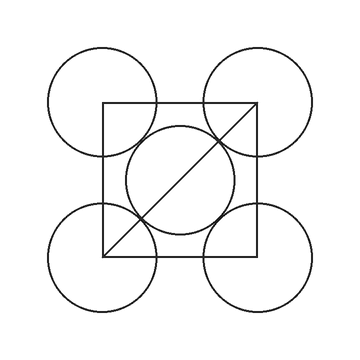
- 691 mark
Question 69
In a face centred cubic lattice, atom A occupies the corner positions and atom B occupies the face centre position. If one atom of B is missing from one of the face centred points, the formula of the compound is
- 701 mark
Question 70
Copper crystallises in fcc lattice with a unit cell edge of 361 pm. The radius of copper atom is:
- 711 mark
Question 71
Lithium forms body centred cubic structure. The length of the side of its unit cell is 351 pm. Atomic radius of the lithium will be
- 721 mark
Question 72
A compound has cubic close packing (ccp) arrangement of X. Its unit cell structure is shown below. The empirical formula of the compound is
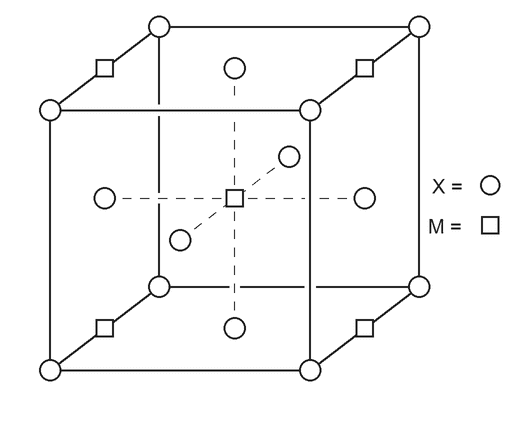
- 731 mark
Question 73
With respect to graphite and diamond, which of the statement(s) given is (are) correct?
(A) Graphite is harder than diamond.
(B) Graphite has higher electrical conductivity than diamond.
(C) Graphite has higher thermal conductivity than diamond.
(D) Graphite has higher C—C bond order than diamond.
- 741 mark
Question 74
Which of the following exists as covalent crystals in the solid state?
- 751 mark
Question 75
Experimentally it was found that a metal oxide has formula . Metal M, present as and in its oxide. Fraction of the metal which exists as would be
- 761 mark
Question 76
The arrangement of ions around ion in solid AX is given in the figure (not drawn to scale). If the radius of is 250 pm, the radius of is

- 771 mark
Question 77
CsCl crystals in body centred cubic lattice. If '' is its edge length then which of the following expressions is correct?
- 781 mark
Question 78
Sodium metal crystallises in a body centred cubic lattice with a unit cell edge of 4.29 Å. The radius of sodium atom is approximately:
- 791 mark
Question 79
If the unit cell of a mineral has cubic close packed (ccp) array of oxygen atoms with fraction of octahedral holes occupied by aluminium ions and fraction of tetrahedral holes occupied by magnesium ions, and respectively, are
- 801 mark
Question 80
Which of the following compound is metallic and ferromagnetic?
- 811 mark
Question 81
The correct statements for cubic close packed (ccp) in three dimensional structure is (are)
(A) the number of the nearest neighbours of an atom present in the top most layer is 12.
(B) the efficiency of atom packing is 74%
(C) the number of octahedral and tetrahedral voids of atom are 1 and 2, respectively.
(D) the unit cell edge length is times the radius of the atom.
- 821 mark
Question 82
A metal crystallises in a face centred cubic structure. If the edge length of its unit cell is '', the closest approach between two atoms in metallic crystal will be
- 831 mark
Question 83
At 100°C, copper (Cu) has FCC unit cell structure with cell edge length of Å. What is the approximate density of Cu (in g cm⁻³) at this temperature? [Atomic Mass of Cu = 63.55 u]
- 841 mark
Question 84
A compound of formula has the hcp lattice. Which atoms form the hcp lattice and what fraction of tetrahedral voids is occupied by the other atoms?
- 851 mark
Question 85
A solid having density of 9 × 10³ kg m⁻³ forms face centred cubic crystals of edge pm. What is the molar mass of the solid? (Avogadro constant ≅ 6 × 10²³ mol⁻¹, π (≅ 3))
- 861 mark
Question 86
The radius of the largest sphere which fits properly at the centre of the edge of body centred cubic unit cell is: (edge length is represented by '')
- 871 mark
Question 87
Element 'B' forms ccp structure and 'A' occupies half of the octahedral voids, while oxygen atoms occupy all the tetrahedral voids. The structure of bimetallic oxide is:
- 881 mark
Question 88
Consider the bcc unit cells of the solids 1 and 2 with the position of atoms as shown below. The radius of atoms B is twice that of atoms A. The unit cell edge length is 50% more in solid 2 than in 1. What is the approximate packing efficiency in solid 2?
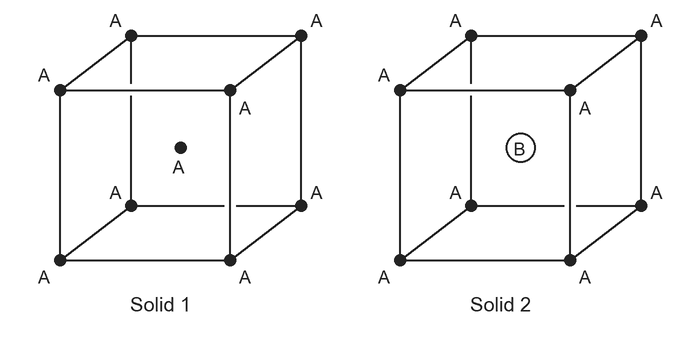
- 891 mark
Question 89
The ratio of number of atoms present in a simple cubic, body centred cubic and face centred cubic structure are, respectively:
- 901 mark
Question 90
Which of the following compound is likely to show both Frenkel and Schottky defects in its crystalline form?
- 911 mark
Question 91
An element crystallises in a face centred cubic (fcc) unit cell with cell edge . The distance between the centres of two nearest octahedral voids in the crystal lattice is:
- 921 mark
Question 92
A crystal is made up of metal ions '' and '' and oxide ions. Oxide ions form a ccp lattice structure. The cation '' occupies 50% of octahedral voids and the cation '' occupies 12.5% of tetrahedral voids of oxide lattice. The oxidation numbers of '' and '' are respectively:
- 931 mark
Question 93
A diatomic molecule has body centred cubic (bcc) structure with a cell edge of 300 pm. The density of the molecule is 6.17 g cm⁻³. The number of molecules present in 200 g of is:
- 941 mark
Question 94
An element with molar mass 2.7 × 10⁻² kg mol⁻¹ forms a cubic unit cell with edge length 405 pm. If its density is 2.7 × 10³ kg m⁻³, the radius of the element approximately ______ × 10⁻¹² m (to the nearest integer).
- 951 mark
Question 95
The cubic unit cell structure of a compound containing cation M and anion X is shown below. When compared to the anion, the cation has smaller ionic radius. Choose correct statement(s).
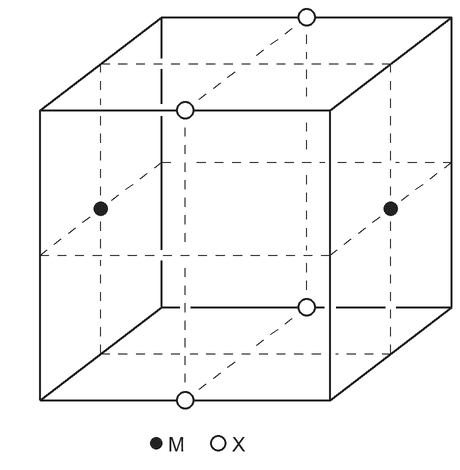
(A) The empirical formula of the compound is MX.
(B) The cation M and anion X have different coordination geometries.
(C) The ratio of M—X bond length to the cubic unit cell edge length is 0.866.
(D) The ratio of the ionic radii of cation M to anion X is 0.414.
- 961 mark
Question 96
In a binary compound, atoms of element A form a hcp structure and those of element M occupy 2/3 of the tetrahedral voids of the hcp structure. The formula of the binary compound is:
- 971 mark
Question 97
Given below are two statements.
Statement I: Frenkel defects are vacancy as well as interstitial defects.
Statement II: Frenkel defect leads to colour in ionic solids due to presence of F-centres.
Choose the most appropriate answer for the statement from the options given below:
- 981 mark
Question 98
A copper complex crystallising in a ccp lattice with a cell edge of 0.4518 nm has been revealed by employing X-ray diffraction studies. The density of the copper complex found to be 7.62 g cm⁻³. The molar mass of copper complex is ______ g mol⁻¹. (nearest integer) [Given: = 6.022 × 10²³ mol⁻¹]
- 991 mark
Question 99
Diamond has a three dimensional structure of C atoms formed by covalent bonds. The structure of diamond has face centred cubic lattice where 50% of the tetrahedral voids are also occupied by carbon atoms. The number of carbon atoms present per unit cell of diamond is ______
- 1001 mark
Question 100
The unit cell of copper corresponds to a face centred cube of edge length 3.596 Å with one copper atom at each lattice point. The calculated density of copper in kg/m³ is ______ [Molar mass Cu = 63.54 g; Avogadro number = 6.022 × 10²³]
- 1011 mark
Question 101
A certain element crystallises in a bcc lattice of unit edge length 27 Å. If the same element under the same conditions crystallises in the fcc lattice, the edge length of the unit cell in Å will be ______. (Rounded off to the nearest integer). [Assume each lattice point has a single atom] [Assume = 1.73, = 1.41]
- 1021 mark
Question 102
KBr is doped with 10⁻⁵ mole per cent of . The number of cationic vacancies in 1 g of KBr crystal is ______ × 10¹⁴ (Rounded off to the nearest integer). [Atomic mass: K : 39.1 u, Br: 79.9 u, = 6.023 × 10²³]
- 1031 mark
Question 103
Ga (atomic mass 70 u) crystallises in a hexagonal close packed structure. The total number of voids in 0.581 g of Ga is ______ × 10²¹. (Rounded off to the nearest integer)
- 1041 mark
Question 104
For the given close-packed structure of a salt made of cation X and anion Y shown below (ions of only one face are shown for clarity), the packing fraction is approximately (packing fraction = packing efficiency/100)

- 1051 mark
Question 105
In a binary compound, atoms of element A form a hcp structure and those of element M occupy 2/3 of the tetrahedral voids of the hcp structure. The formula of the binary compound is:
- 1061 mark
Question 106
The oxide that shows magnetic property is:
- 1071 mark
Question 107
A hard substance melts at high temperature and is an insulator in both solid and in molten state. This solid is most likely to be a/an:
- 1081 mark
Question 108
Given below are two statements. One is labelled as Assertion A and the other is labelled as Reason R.
Assertion A: Sharp glass edge becomes smooth on heating it upto its melting point.
Reason R: The viscosity of glass decreases on melting.
Choose the most appropriate answer from the options given below.
- 1091 mark
Question 109
The parameters of the unit cell of a substance are = 2.5, = 3.0, = 4.0, α = 90°, β = 120°, γ = 90°. The crystal system of the substance is:
- 1101 mark
Question 110
Given below are two statements:
Statement I: Frenkel defects are vacancy as well as interstitial defects.
Statement II: Frenkel defects leads to colour in ionic solids due to presence of F-centres.
Choose the most appropriate answer for the statement from the options given below:
- 1111 mark
Question 111
Match items of List-I with those of List-II:
List-I (Property) List-II (Example) P. Diamagnetism (i) MnO Q. Ferrimagnetism (ii) R. Paramagnetism (iii) NaCl S. Antiferromagnetism (iv) Choose the most appropriate answer from the options given below:
- 1121 mark
Question 112
Select the correct statements.
(P) Crystalline solids have long range order.
(Q) Crystalline solids are isotropic.
(R) Amorphous solids are sometimes called pseudo solids.
(S) Amorphous solids soften over a range of temperatures.
(T) Amorphous solids have a definite heat of fusion.
Choose the most appropriate answer from the options given, below:
- 1131 mark
Question 113
The coordination number of an atom in a body-centered cubic structure is ______. [Assume that the lattice is made up of atoms.]
- 1141 mark
Question 114
The number of octahedral voids per lattice site in a lattice is ______. (Rounded off to the nearest integer)
- 1151 mark
Question 115
The empirical formula for a compound with a cubic close packed arrangement of anions and with cations occupying all the octahedral sites in . The value of is ______ (Integer answer)
- 1161 mark
Question 116
A metal crystallises with a face-centred cubic lattice. The edge of the unit cell is 408 pm. The diameter of the metal atom is
- 1171 mark
Question 117
The mass percentage of iron present as Fe (III) in is
- 1181 mark
Question 118
The number of octahedral void(s) per atom present in a cubic close-packed structure is
- 1191 mark
Question 119
A metal crystallises with a face-centred cubic lattice. The edge of the unit cell is 408 pm. The diameter of the metal atom is
- 1201 mark
Question 120
A metal has a fcc lattice. The edge length of the unit cell is 404 pm. The density of the metal is 2.72 g cm⁻³. The molar mass of the metal is:
(Avogadro's constant, mol⁻¹)
- 1211 mark
Question 121
The number of carbon atoms per unit cell of diamond unit cell is
- 1221 mark
Question 122
If is the length of the side of a cube, the distance between the body centred atom and one corner atom in the cube will be
- 1231 mark
Question 123
The correct statement regarding defects in crystalline solids is:
- 1241 mark
Question 124
A given metal crystallises out with a cubic structure having edge length of 361 pm. If there are four metal atoms in one unit cell, what is the radius of one atom?
- 1251 mark
Question 125
Lithium has a bcc structure. Its density is 530 kg m⁻³ and its atomic mass is 6.94 g mol⁻¹. Calculate the edge length of a unit cell of lithium metal. ( mol⁻¹)
- 1261 mark
Question 126
The ionic radii of and ions are m and m. The coordination number of each ion in AB is
- 1271 mark
Question 127
In calcium fluoride, having the fluorite structure, the coordination numbers for calcium ion () and fluoride ion () are
- 1281 mark
Question 128
Which is the incorrect statement?
- 1291 mark
Question 129
Iron exhibits bcc structure at room temperature. Above 900 °C, it transforms to fcc structure. The ratio of density of iron at room temperature to that at 900 °C (assuming molar mass and atomic radii of iron remain constant with temperature) is
- 1301 mark
Question 130
A solid has a structure in which W atoms are located at the corners of a cubic lattice. O atoms at the centre of edges and Na atom at centre of the cube.
The formula for the compound is
- 1311 mark
Question 131
Formula of nickel oxide with metal deficiency defect in its crystal is . The crystal contains and ions. The fraction of nickel existing as ions in the crystal is
- 1321 mark
Question 132
A compound is formed by cation C and anion A. The anions form hexagonal close packed (hcp) lattice and the cations occupy 75% of octahedral voids. The formula of the compound is:
- 1331 mark
Question 133
An element has a body centred cubic (bcc) structure with cell edge length of 288 pm. The atomic radius is
- 1341 mark
Question 134
Which one of the following compound shows both, Frenkel as well as Schottky defects?
- 1351 mark
Question 135
Right option for the number of tetrahedral and octahedral voids in hexagonal primitive unit cell are
- 1361 mark
Question 136
The correct option for the number of body centred unit cell in all 14 types of Bravais lattice unit cells is: