
Opening your dashboard
Class 12 Biology Chapter 15: Biotechnology: Principles and Processes Solutions
49 textbook questions with step-by-step answers, free to read, for ISC 2026-27.
Get talked through Ch 15, not just shown the answer
Reading a finished solution is not the same as being able to do it. The AI tutor takes one question at a time and works it with you, in your own words, until you can.
- Ask it out loud, in your own words
- It gives you the next step, not the answer
- Stuck on part (ii)? Start there
49 questions with solutions
1–5 marks · Mixed difficulty
- 11 mark
Question 1
Name the enzyme used to cut a segment of DNA in rDNA technology.
Solve with AIWritten solution
Solution:
Key idea: In recombinant DNA (rDNA) technology, the desired gene is cut out of the source DNA, and the vector DNA is opened at a matching site, before the two are joined.
Step 1 — Identify the job to be done. The enzyme needed must cut DNA at a particular, predictable site, so that the same cut can be made in the gene's DNA and in the vector.
Step 2 — Name the enzyme. Restriction enzymes (restriction endonucleases), such as EcoRI, recognise a specific palindromic sequence and cut both strands of DNA there. Because they cut DNA so precisely, they are called 'molecular scissors'.
Therefore, the enzyme used to cut DNA in rDNA technology is a restriction enzyme (restriction endonuclease), e.g. EcoRI.
- 21 mark
Question 2
What is another term given for a genetically modified organism?
Solve with AIWritten solution
Solution:
Key idea: A genetically modified organism (GMO) is one whose genes have been altered by genetic engineering, most often by adding a gene from another organism.
Step 1 — Describe what has been added. The gene brought in from another organism is called a transgene, and it is now part of the organism's own genome.
Step 2 — Name the organism. An organism that carries such a foreign gene is called a transgenic organism. Bt cotton, which carries a cry gene from the bacterium Bacillus thuringiensis, is an example.
Therefore, another term for a genetically modified organism is a transgenic organism.
- 31 mark
Question 3
What is the work of DNA ligase?
Solve with AIWritten solution
Solution:
Key idea: When a gene and a vector cut by the same restriction enzyme are mixed, their sticky ends pair by hydrogen bonds, but the sugar–phosphate backbone of each strand is still broken.
Step 1 — Locate the gaps. After the sticky ends pair, each strand has a break (a nick) where the 3′ end of one nucleotide meets the 5′ end of the next.
Step 2 — State what DNA ligase does. DNA ligase forms a phosphodiester bond across each nick, so the two DNA fragments become one continuous molecule. In this way it joins the desired gene to the cut plasmid to form recombinant DNA; it is often called 'molecular glue'.
Therefore, DNA ligase joins the cut ends of DNA fragments by forming phosphodiester bonds between them.
- 41 mark
Question 4
Which enzyme is used to isolate a desired gene?
Solve with AIWritten solution
Solution:
Key idea: To isolate a desired gene, it must be cut out of the large source DNA at exactly the right places.
Step 1 — Identify the job to be done. An enzyme is needed that recognises specific sequences on either side of the gene and cuts the DNA there, releasing the gene as a separate fragment.
Step 2 — Name the enzyme. Restriction endonucleases do this: each one cuts DNA only at its own recognition sequence, so the gene is cut out with defined (often sticky) ends that can later be joined to a vector.
Therefore, a restriction endonuclease is used to isolate (cut out) the desired gene.
- 51 mark
Question 5
What is the extra-chromosomal circular DNA in bacteria called as?
Solve with AIWritten solution
Solution:
Key idea: Besides its main chromosome, a bacterial cell often contains small DNA molecules that are separate from the chromosome and replicate on their own.
Step 1 — Describe the DNA. These molecules are small, circular and double-stranded, and they lie in the cytoplasm outside the chromosome (extra-chromosomal).
Step 2 — Name it. Such extra-chromosomal circular DNA is called a plasmid; pBR322 of E. coli is a well-known example used as a cloning vector.
Therefore, the extra-chromosomal circular DNA in bacteria is called a plasmid.
- 61 mark
Question 6
What is the role of a plasmid in rDNA technology?
Solve with AIWritten solution
Solution:
Key idea: A vector is a DNA molecule that carries a foreign gene into a host cell and is copied there.
Step 1 — List the plasmid features that matter. A plasmid has an origin of replication (Ori), so it can copy itself inside the host; a selectable marker such as an antibiotic-resistance gene; and cloning sites where a foreign gene can be inserted.
Step 2 — State its role. The desired gene is joined into the plasmid, and the plasmid then carries it into the host cell (such as E. coli). As the plasmid multiplies there, many copies of the gene are made.
Therefore, in rDNA technology a plasmid acts as a vector: it carries the desired DNA into the host cell and multiplies it there.
- 71 mark
Question 7
Name the enzymes involved in rDNA technology.
Solve with AIWritten solution
Solution:
Key idea: Making recombinant DNA needs enzymes to cut DNA, to join DNA, and to copy DNA.
Step 1 — Name the cutting enzyme. Restriction endonucleases cut DNA at specific recognition sequences, e.g. EcoRI.
Step 2 — Name the joining enzyme. DNA ligase joins the cut DNA fragments, for example the desired gene to the vector.
Step 3 — Name the copying enzyme. DNA polymerase makes copies of DNA, for example the heat-stable Taq polymerase that amplifies a gene in PCR.
Note: Other enzymes are used while isolating the DNA: lysozyme, cellulase or chitinase to break the cell wall, and ribonuclease and protease to remove RNA and proteins.
Therefore, the enzymes involved in rDNA technology are restriction endonucleases, DNA ligase and DNA polymerase.
- 81 mark
Question 8
Which enzyme is used to insert, isolate gene into the plasmid?
Solve with AIWritten solution
Solution:
Key idea: Once the desired gene and the plasmid have been cut with the same restriction enzyme, their matching sticky ends pair, but the strands still have to be sealed.
Step 1 — Identify the job to be done. The isolated gene must be joined permanently into the opened plasmid, which means sealing the sugar–phosphate backbone at each junction.
Step 2 — Name the enzyme. DNA ligase does this by forming phosphodiester bonds, so the gene becomes part of the plasmid.
Therefore, DNA ligase is used to insert (join) the isolated gene into the plasmid.
- 91 mark
Question 9
Which mechanism helps in insertion of plasmid into bacteria E. coli?
Solve with AIWritten solution
Solution:
Key idea: DNA is hydrophilic and cannot pass through the cell membrane on its own, so a bacterial cell must first be made 'competent' to take it up.
Step 1 — Treat the cells with calcium ions. E. coli cells are treated with a specific concentration of a divalent cation, usually calcium chloride (), which makes the cell membrane more permeable to DNA.
Step 2 — Give the heat shock. The cells are kept on ice with the recombinant plasmid, given a brief heat shock at 42 °C, and returned to ice. The cells then take up the plasmid.
Note: Electroporation, in which a brief electric pulse opens temporary pores in the membrane, is another way of putting plasmids into E. coli.
Therefore, treating E. coli with calcium chloride and then giving a heat shock at 42 °C helps it take up the plasmid.
- 101 mark
Question 10
Name a few cloning vectors.
Solve with AIWritten solution
Solution:
Key idea: A cloning vector is a DNA molecule that can carry a foreign gene into a host cell and be copied there.
Step 1 — Name the plasmid and phage vectors. Plasmids of bacteria, such as pBR322 of E. coli and the Ti plasmid of Agrobacterium tumefaciens, and bacteriophages, such as phage lambda, are used as vectors.
Step 2 — Name the other vectors. Disarmed plant and animal viruses (for example retroviruses), transposons, and artificial chromosomes of bacteria (BAC), yeast (YAC) and mammals are also used as vectors.
Therefore, plasmids, bacteriophages, disarmed plant and animal viruses, transposons and artificial chromosomes (BAC, YAC) are cloning vectors.
- 111 mark
Question 11
What is the term used for the pairs of sequence of nucleotide that read the same on two strands of DNA in their 5′–3′ direction?
Solve with AIWritten solution
Solution:
Key idea: The two strands of DNA run in opposite directions, so each strand is read 5′→3′ in its own direction.
Step 1 — Look at an example. The EcoRI site is 5′-GAATTC-3′ on one strand; its partner strand, read 5′→3′, is also GAATTC.
Step 2 — Name the sequence. A sequence that reads the same on the two strands, each read 5′→3′, is called a palindromic nucleotide sequence (a palindrome). Restriction enzymes recognise such sequences.
Therefore, the term is palindromic nucleotide sequence (palindrome).
- 121 mark
Question 12
What is the meaning of sticky ends?
Solve with AIWritten solution
Solution:
Key idea: Many restriction enzymes cut the two strands of DNA a few bases apart, not straight across.
Step 1 — Describe the cut ends. EcoRI, for example, cuts 5′-GAATTC-3′ between G and A on each strand, so each fragment is left with a short single-stranded overhang, 5′-AATT.
Step 2 — Explain the name. These overhangs are called sticky ends because they form hydrogen bonds with matching overhangs. DNA cut by the same enzyme therefore pairs up, and DNA ligase can then join the pieces.
Therefore, sticky ends are the short single-stranded overhangs left at DNA ends cut by a restriction enzyme, which can pair with matching ends.
- 131 mark
Question 13
Name the bacteria which is a natural vector and transfers its Ti plasmid to the plant cells to produce cancerous cells.
Solve with AIWritten solution
Solution:
Key idea: Some bacteria transfer part of their DNA into plant cells naturally, and such bacteria can serve as natural vectors.
Step 1 — Recall the Ti plasmid. The Ti (tumour-inducing) plasmid carries T-DNA, which the bacterium transfers into the plant cell's genome when it infects a wounded plant.
Step 2 — Name the bacterium. The T-DNA genes make the plant cells produce the hormones auxin and cytokinin, so the cells divide without control and form a tumour called crown gall. The bacterium that does this is Agrobacterium tumefaciens.
Note: The stem calls these 'cancerous' cells. Crown gall is a plant tumour caused by the T-DNA hormone genes; it is not cancer in the medical sense.
Therefore, the bacterium is Agrobacterium tumefaciens.
- 141 mark
Question 14
Name a few vector-less or direct methods of gene transfer.
Solve with AIWritten solution
Solution:
Key idea: In vector-less (direct) gene transfer, the recombinant DNA is put into the host cell without a plasmid or virus to carry it.
Step 1 — Name the electrical method. In electroporation, a brief high-voltage pulse makes temporary pores in the plasma membrane, and the DNA enters through them.
Step 2 — Name the mechanical methods. In microinjection, the DNA is injected straight into the nucleus with a fine micropipette. In biolistics (the gene gun), gold or tungsten particles coated with the DNA are fired into the cells.
Therefore, electroporation, microinjection and biolistics (gene gun) are vector-less methods of gene transfer.
- 151 mark
Question 15
Scientific term for a foreign gene that is inserted in rDNA.
Solve with AIWritten solution
Solution:
Key idea: In rDNA technology a gene from one organism is put into the genome of another organism.
Step 1 — Identify the gene. The inserted gene is foreign to the host: it came from a different organism.
Step 2 — Name it. Such a foreign gene is called a transgene, and the organism that carries it is called transgenic.
Therefore, a foreign gene inserted in rDNA is called a transgene.
- 162 marks
Question 16
What is recombinant DNA?
Solve with AIWritten solution
Solution:
Key idea: Genetic engineering joins DNA from different sources to form a new combination of genes.
Step 1 — Define recombinant DNA. Recombinant DNA (rDNA) is a DNA molecule formed by combining DNA from two different sources, usually a gene from one organism joined to the DNA of a vector such as a plasmid.
Step 2 — Show how it is made. The desired gene and the plasmid are cut with the same restriction enzyme, so they get matching sticky ends. The sticky ends pair, and DNA ligase seals the joins.
Step 3 — State what it is used for. The rDNA is put into a host cell such as E. coli, where it is copied and the foreign gene can be expressed, for example to make human insulin.
Therefore, recombinant DNA is DNA formed by joining DNA from two different sources, such as a foreign gene joined to a plasmid with the help of a restriction enzyme and DNA ligase.
- 172 marks
Question 17
Give the basic tools required for the formation of rDNA.
Solve with AIWritten solution
Solution:
Key idea: Making rDNA needs something to cut and join DNA, something to carry the gene, and a cell in which to copy it.
Step 1 — Name the enzymes. Restriction endonucleases cut DNA at specific sites, DNA ligase joins the fragments, and DNA polymerase copies DNA.
Step 2 — Name the cloning vectors. Vectors, such as plasmids and bacteriophages, carry the desired gene into the host and multiply there.
Step 3 — Name the host. A competent host organism, such as E. coli, takes up the rDNA and makes many copies of it.
Therefore, the basic tools for rDNA are enzymes (restriction endonucleases, DNA ligase, DNA polymerase), cloning vectors and a competent host organism.
- 182 marks
Question 18
Name important enzymes essential for rDNA technology.
Solve with AIWritten solution
Solution:
Key idea: Three groups of enzymes are central to rDNA technology: one cuts DNA, one joins it and one copies it.
Step 1 — Describe restriction endonucleases. They are 'molecular scissors': each recognises a specific palindromic sequence and cuts DNA there, often leaving sticky ends.
Step 2 — Describe DNA ligase. It joins the foreign DNA to the cut plasmid by forming phosphodiester bonds across the nicks.
Step 3 — Describe DNA polymerase. It makes new DNA strands on a template; heat-stable Taq polymerase is used in PCR to make many copies of a gene.
Therefore, the essential enzymes are restriction endonucleases (cut DNA), DNA ligase (join DNA) and DNA polymerase (copy DNA).
- 192 marks
Question 19
What is a cloning vector?
Solve with AIWritten solution
Solution:
Key idea: To make many copies of a gene, it has to be carried into a host cell by a DNA molecule that can replicate there.
Step 1 — Define a cloning vector. A cloning vector is a DNA molecule (a gene carrier) into which the desired gene is inserted to form recombinant DNA.
Step 2 — List its features. It has an origin of replication (Ori) so it can copy itself in the host, a selectable marker such as an antibiotic-resistance gene to pick out transformed cells, and cloning sites where the gene is inserted.
Step 3 — Explain how it clones the gene. As the vector multiplies inside the host cell, many copies of the rDNA, and so of the gene, are produced. Plasmid pBR322 of E. coli is an example.
Therefore, a cloning vector is a self-replicating DNA carrier, such as plasmid pBR322, into which a gene is inserted so that many copies of it are made in the host.
- 202 marks
Question 20
Name a few cloning vectors used in rDNA technology.
Solve with AIWritten solution
Solution:
Key idea: A cloning vector must be able to carry foreign DNA into a host cell and be copied there.
Step 1 — Name the bacterial vectors. Plasmids such as pBR322 of E. coli and the Ti plasmid of Agrobacterium tumefaciens, and bacteriophages such as phage lambda, are widely used.
Step 2 — Name the virus vectors. Disarmed plant and animal viruses, such as retroviruses, carry genes into eukaryotic cells.
Step 3 — Name the other vectors. Transposons and artificial chromosomes of bacteria (BAC), yeast (YAC) and mammals carry larger pieces of DNA.
Therefore, cloning vectors include plasmids (pBR322, Ti plasmid), bacteriophages, disarmed viruses such as retroviruses, transposons and artificial chromosomes (BAC, YAC).
- 212 marks
Question 21
What is the role of restriction endonuclease?
Solve with AIWritten solution
Solution:
Key idea: Restriction endonucleases are 'molecular scissors' that cut DNA only at their own recognition sequences.
Step 1 — Describe how the enzyme finds its site. The enzyme moves along the DNA until it finds its specific palindromic sequence, such as 5′-GAATTC-3′ for EcoRI, and then binds there.
Step 2 — Describe the cut. It cuts both strands at that site. Many such enzymes cut the two strands a few bases apart and leave single-stranded sticky ends.
Step 3 — Explain its use. When the desired gene and the plasmid are cut with the same enzyme, they carry matching sticky ends that pair, so they can be joined by DNA ligase to form recombinant DNA.
Therefore, a restriction endonuclease cuts DNA at a specific palindromic site, leaving sticky ends that allow a gene and a vector to be joined into recombinant DNA.
- 222 marks
Question 22
Name two important enzymes used in the formation of recombinant DNA.
Solve with AIWritten solution
Solution:
Key idea: Forming recombinant DNA needs one enzyme to cut DNA at matching sites and another to join the pieces.
Step 1 — Name the cutting enzyme. A restriction endonuclease, such as EcoRI, cuts the desired gene and the plasmid at specific sites, leaving matching sticky ends.
Step 2 — Name the joining enzyme. DNA ligase seals the paired sticky ends, joining the desired gene into the cut plasmid.
Therefore, the two important enzymes are restriction endonuclease and DNA ligase.
- 232 marks
Question 23
Study the linking of DNA fragments shown below.
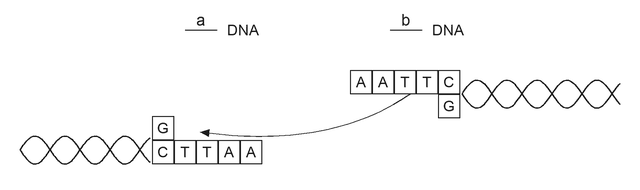
(i) Name 'a' DNA and 'b' DNA.
(ii) Name the restriction enzyme that recognises this palindrome.
(iii) Name the enzyme that can link these two DNA fragments.
Solve with AIWritten solution
Solution:
Key idea: When the vector and the foreign DNA are cut with the same restriction enzyme, their sticky ends are complementary, so the two pieces pair and can be sealed into recombinant DNA.
Step 1 — Name the two DNAs in part (i). In the figure, fragment 'b' is moved (arrow) towards fragment 'a' and joined to it. So 'b' is the piece being inserted, the foreign DNA (desired gene), and 'a' is the DNA that receives it, the vector DNA (plasmid).
Step 2 — Read the sticky ends for part (ii). Fragment 'a' ends in G on the upper strand with CTTAA on the lower strand, and fragment 'b' starts with AATTC on the upper strand with G on the lower strand. When they pair, the upper strand reads 5′-GAATTC-3′ and the lower strand, read 5′→3′, also reads GAATTC. This palindrome is the recognition site of EcoRI, which cuts it between G and A and leaves 5′-AATT sticky ends.
Step 3 — Name the linking enzyme for part (iii). The paired sticky ends are held only by hydrogen bonds; DNA ligase forms the phosphodiester bonds that seal the backbone and link the two fragments.
Therefore, (i) 'a' is vector DNA and 'b' is foreign DNA; (ii) the enzyme is EcoRI; (iii) DNA ligase links the fragments.
- 242 marks
Question 24
(i) What are 'molecular scissors'? Give one example.
(ii) Explain their role in recombinant DNA technology.
Solve with AIWritten solution
Solution:
Key idea: Restriction endonucleases cut DNA only at specific recognition sequences, as precisely as scissors cut paper along a marked line.
Step 1 — Answer part (i). Restriction endonucleases are called 'molecular scissors' because they cut DNA at specific sites; EcoRI, which cuts at 5′-GAATTC-3′, is an example.
Step 2 — Explain the cutting in part (ii). The desired gene and the vector are cut with the same restriction enzyme, so both carry complementary sticky ends.
Step 3 — Explain the joining. These sticky ends pair by hydrogen bonds, and DNA ligase seals them, forming recombinant DNA that can be put into a host cell.
Therefore, molecular scissors are restriction endonucleases (e.g. EcoRI); they cut the gene and the vector with matching sticky ends so that the two can be joined into recombinant DNA.
- 252 marks
Question 25
Why is Agrobacterium tumefaciens a good cloning vector? Explain.
Solve with AIWritten solution
Solution:
Key idea: Agrobacterium tumefaciens is a soil bacterium that infects wounded dicot plants and causes crown gall by transferring part of its Ti (tumour-inducing) plasmid into the plant genome.
Step 1 — Describe its natural gene transfer. On infection the bacterium transfers a segment of the Ti plasmid, the T-DNA, into the genome of plants such as tomato, tobacco and potato, without any human help. For this reason it is called a 'natural genetic engineer' of plants.
Step 2 — Explain how it is made into a vector. Scientists remove the tumour-causing genes from the T-DNA (a disarmed Ti plasmid) and put the desired gene in their place. The bacterium then delivers the desired gene into plant cells without causing a tumour.
Step 3 — State its use. This modified Ti plasmid is used to make transgenic plants. With improved laboratory methods it now transforms cereals such as rice and maize as well as dicots.
Therefore, Agrobacterium tumefaciens is a good cloning vector because it naturally transfers T-DNA of its Ti plasmid into plant cells, and a disarmed Ti plasmid can carry a desired gene into plants.
- 262 marks
Question 26
DNA being hydrophilic cannot pass through the cell membrane of host cell. Explain how does recombinant DNA get introduced into the host cell to transfer the latter.
Solve with AIWritten solution
Solution:
Key idea: DNA is a hydrophilic molecule, so it cannot cross the lipid cell membrane by itself; the host cell must first be made 'competent' to take up DNA.
Step 1 — Treat the cells with a divalent cation. Bacterial cells are treated with a specific concentration of a divalent cation such as calcium chloride (), which makes the cell membrane more permeable to DNA.
Step 2 — Give the heat shock. The cells are incubated with the recombinant DNA on ice, given a brief heat shock at 42 °C, and put back on ice. During this treatment the bacteria take up the rDNA and are transformed.
Step 3 — Mention the other methods. Bacteria can also be made to take up DNA by electroporation. Animal cells can receive DNA by microinjection into the nucleus, and plant cells by biolistics (gene gun).
Note: The words 'to transfer the latter' in the stem are read as 'to transform the host cell'.
Therefore, rDNA is introduced into a host cell by making the cell competent, mainly by treatment and a heat shock at 42 °C, or by methods such as electroporation, microinjection and the gene gun.
- 272 marks
Question 27
Mention the role of vectors in recombinant DNA technology. Give any two examples.
Solve with AIWritten solution
Solution:
Key idea: A vector is a self-replicating DNA molecule that carries a foreign gene into a host cell.
Step 1 — State the carrier role. The desired gene is joined into the vector, and the vector delivers this foreign DNA into the host cell.
Step 2 — State the cloning role. Because the vector has its own origin of replication, it multiplies inside the host, so many copies of the rDNA are produced (gene cloning); its selectable marker helps pick out the transformed cells.
Step 3 — Give two examples. Plasmid pBR322 of E. coli and the Ti plasmid of Agrobacterium tumefaciens are two examples; disarmed retroviruses are used for animal cells.
Therefore, vectors carry the desired gene into the host cell and multiply it there; examples are plasmid pBR322 and the Ti plasmid of Agrobacterium tumefaciens.
- 282 marks
Question 28
With the help of diagrammatic representation only, show the steps of recombinant DNA technology.
Solve with AIWritten solution
Solution:
Key idea: Recombinant DNA (rDNA) technology joins a chosen gene to a carrier DNA called a vector, puts the joined DNA into a host cell and lets the host multiply. A flow diagram shows these stages as boxes joined by arrows, in the order in which they happen.
Step 1 — Draw the first box: open the vector.
The first box shows a plasmid taken out of a bacterium such as Escherichia coli. A restriction endonuclease cuts the circular plasmid at one site, so it opens out with short single-stranded sticky ends.
Plasmid from E. coli → cut by a restriction endonuclease → opened plasmid with sticky ends
Step 2 — Draw the second box: cut out the gene.
The second box shows DNA from the donor cell. The same restriction endonuclease cuts out the desired gene, so the gene carries sticky ends that match the sticky ends of the opened plasmid.
Donor-cell DNA → cut by the same restriction endonuclease → desired gene with matching sticky ends
Step 3 — Join the two boxes: make the recombinant plasmid.
The arrows from the first two boxes meet in the third box. The sticky ends pair by complementary bases, and DNA ligase seals the joins, so the plasmid becomes a closed circle again that now carries the gene. This is the recombinant plasmid (rDNA).
Opened plasmid + desired gene → DNA ligase → recombinant plasmid (rDNA)
Step 4 — Show the entry into the host.
The fourth box shows E. coli cells that have no plasmid. They are made competent by treating them with calcium chloride () and giving a brief heat shock at about 42 °C, so they take up the recombinant plasmid. This uptake is called transformation.
Plasmid-free E. coli + and heat shock → transformed E. coli carrying rDNA
Step 5 — Show cloning and the product.
The last boxes show the transformed bacterium dividing again and again. Every daughter cell copies the recombinant plasmid, so a clone of identical cells, each with the desired gene, is formed. The clones then express the gene and make the required protein, which is collected.
Transformed E. coli → repeated cell division → clones carrying the gene → clones make the required protein
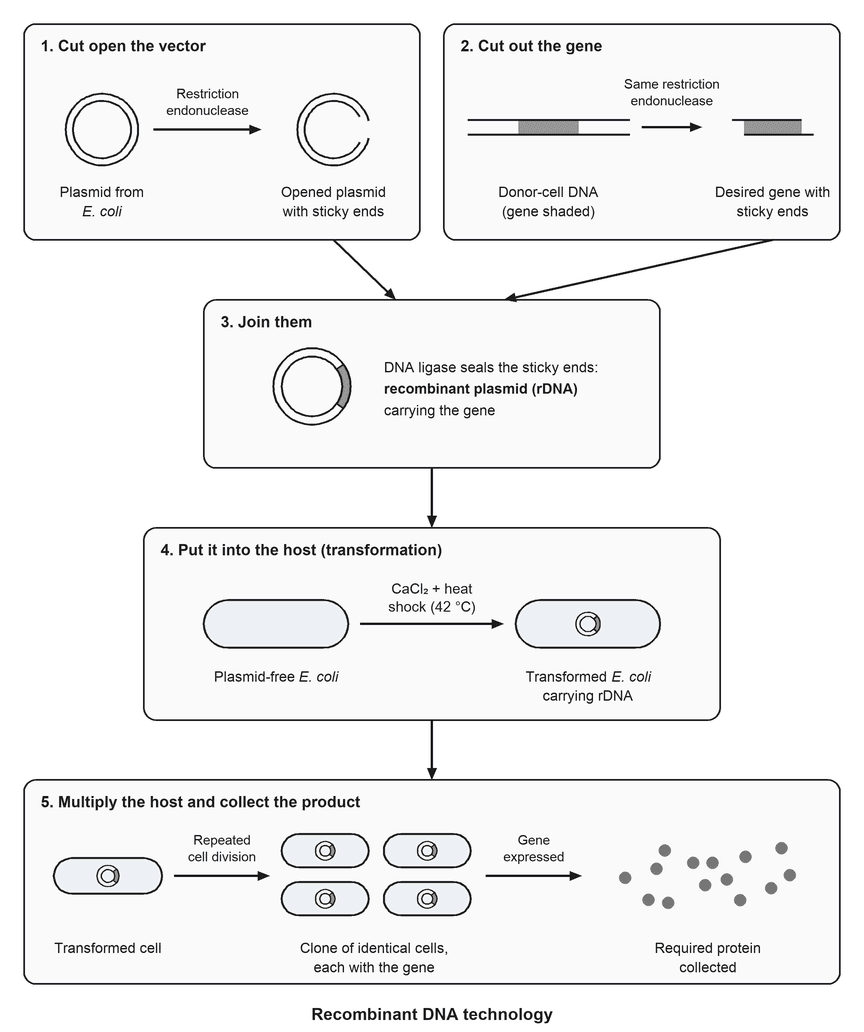
Therefore, the flow diagram runs: plasmid cut by a restriction endonuclease and desired gene cut by the same enzyme, joined by DNA ligase into a recombinant plasmid, taken up by CaCl₂ and heat-shock treated E. coli, which multiplies into clones that make the required protein.
- 293 marks
Question 29
What are the two basic steps in rDNA technology? Name the enzymes involved in these steps.
Solve with AIWritten solution
Solution:
Key idea: In recombinant DNA (rDNA) technology a gene is first cut out of one DNA molecule and then joined into another DNA molecule. Each of these two basic steps needs its own enzyme.
Step 1 — Describe the first basic step: cutting.
The first step is cutting, or isolating, the segment of DNA that carries the desired gene. The same enzyme is also used to cut open the vector DNA (for example a plasmid) at one site, so that the gene can be fitted into it.
Step 2 — Name the enzyme for cutting.
The cutting is done by a restriction enzyme, also called a restriction endonuclease. It recognises a specific short base sequence and cuts both strands of the DNA there, often leaving short single-stranded sticky ends.
Step 3 — Describe the second basic step: joining.
The second step is joining, or transferring, the cut gene into the DNA of a different organism, usually the cut vector. The sticky ends of the gene pair with the matching sticky ends of the vector.
Step 4 — Name the enzyme for joining.
The joining is done by DNA ligase. It forms phosphodiester bonds between the sugar–phosphate backbones of the two pieces, so the gene and the vector become one continuous DNA molecule.
Step 5 — Note what happens next.
The new DNA, which now contains foreign DNA, is called recombinant DNA (rDNA). After it enters a host cell, the host's DNA polymerase copies it each time the cell divides, so many copies (clones) of the gene are made.
Therefore, the two basic steps are cutting (isolating) the desired DNA segment, done by a restriction endonuclease, and joining it into the DNA of another organism, done by DNA ligase; DNA polymerase then copies the rDNA during cloning.
- 303 marks
Question 30
Explain the following steps in rDNA technology.
(i) Isolation of desired gene
(ii) Role of plasmid
(iii) Cloning of gene
Solve with AIWritten solution
Solution:
Key idea: Recombinant DNA technology needs three things in turn: the gene must be cut out of the donor DNA, carried into a host cell by a vector, and copied many times inside the multiplying host.
Step 1 — Explain the isolation of the desired gene.
The donor DNA is first purified and then treated with a restriction endonuclease, which acts like a pair of molecular scissors. The enzyme cuts both DNA strands only at its specific recognition sequence, so the desired gene is released as a separate fragment with sticky ends. The fragment is then separated from the other fragments by agarose gel electrophoresis.
Step 2 — Explain why a plasmid is needed.
A plasmid is a small, circular DNA molecule found in bacteria (for example Escherichia coli) outside the main chromosome, and it can copy itself on its own. A gene alone cannot replicate inside a host, but a gene joined to a plasmid is copied along with the plasmid.
Step 3 — Explain the role of the plasmid as a vector.
The plasmid is cut with the same restriction endonuclease, so its sticky ends match those of the gene. DNA ligase joins the gene into the plasmid, giving a recombinant plasmid. This recombinant plasmid acts as the vector, the carrier that takes the gene into the host bacterium and lets it replicate there.
Step 4 — Explain the cloning of the gene.
The bacterium that has taken up the recombinant plasmid divides again and again, and each daughter cell receives copies of the plasmid. The result is a clone, a population of identical cells, so millions of identical copies of the desired gene are formed.
Therefore, (i) the desired gene is isolated by cutting the donor DNA with a restriction endonuclease, (ii) the plasmid, cut with the same enzyme and joined to the gene by ligase, acts as the vector that carries the gene into the host and lets it replicate, and (iii) the multiplying host forms clones that make millions of copies of the gene.
- 313 marks
Question 31
Give the role of following enzymes in formation of transgenic cell.
(i) Restriction endonuclease
(ii) DNA ligase
(iii) DNA polymerase
Solve with AIWritten solution
Solution:
Key idea: A transgenic cell is a cell that carries a foreign gene. To make it, DNA must be cut at exact places, the pieces must be joined, and the joined DNA must be copied; each job is done by a different enzyme.
Step 1 — Give the role of restriction endonuclease.
Restriction endonuclease works as molecular scissors. It finds its specific recognition sequence (a palindrome) in both the plasmid and the foreign DNA and cuts both strands there. Many such enzymes leave short single-stranded sticky ends, so the foreign gene and the opened plasmid get matching ends.
Step 2 — Give the role of DNA ligase.
DNA ligase works as molecular glue. After the sticky ends of the foreign gene and the opened plasmid pair up, ligase forms phosphodiester bonds across the joins. The plasmid becomes a closed circle again, now carrying the foreign gene, and is called a recombinant plasmid.
Step 3 — Give the role of DNA polymerase.
DNA polymerase makes a new DNA strand by adding nucleotides that are complementary to an existing template strand. Inside the host it copies the recombinant plasmid each time the cell divides, and in the laboratory a heat-stable form (Taq polymerase) copies the gene many times in PCR. In this way it helps in cloning, that is, in making many copies of the gene.
Therefore, (i) restriction endonuclease cuts the plasmid and the foreign DNA at specific sites, (ii) DNA ligase joins the foreign gene into the plasmid to form the recombinant plasmid, and (iii) DNA polymerase copies the DNA so that the gene is cloned.
- 323 marks
Question 32
How do restriction endonucleases cut DNA? Explain with one example.
Solve with AIWritten solution
Solution:
Key idea: A restriction endonuclease cuts DNA only at a particular short base sequence called its recognition sequence. This sequence is a palindrome: it reads the same 5′ → 3′ on both strands.
Step 1 — Explain how the enzyme finds its site.
The enzyme moves along the DNA molecule and inspects its length. When it finds its own recognition sequence, usually 4 to 8 base pairs long, it binds to the DNA at that place.
Step 2 — Explain how the enzyme cuts.
The enzyme breaks one phosphodiester bond in the sugar–phosphate backbone of each strand. Because the sequence is a palindrome, the cut lies at the same point in the sequence on both strands when each is read 5′ → 3′.
Step 3 — Explain how sticky ends form.
Many restriction enzymes cut the two strands a little away from the centre of the palindrome, between the same two bases on each strand. The cuts are therefore staggered, and each piece is left with a short single-stranded overhang. These overhangs are called sticky ends, because they can pair with any complementary overhang made by the same enzyme. (Some enzymes, such as SmaI, cut both strands at the centre and leave blunt ends instead.)
Step 4 — Work through the example of EcoRI.
EcoRI recognises this six-base-pair palindrome:
5′-GAATTC-3′
3′-CTTAAG-5′
It cuts each strand between G and A (5′-G↓AATTC-3′). The two pieces are therefore:
5′-…G-3′ with 3′-…CTTAA-5′ on the left, and 5′-AATTC…-3′ with 3′-G…-5′ on the right.
Each piece has a four-base single-stranded overhang, 5′-AATT-3′, which can pair with any other DNA cut by EcoRI.
Therefore, a restriction endonuclease inspects the DNA, binds at its palindromic recognition sequence and cuts the backbone of both strands there, often in a staggered way that leaves sticky ends; for example, EcoRI cuts GAATTC between G and A on each strand, leaving AATT sticky ends.
- 333 marks
Question 33
How is a plasmid named? Give one example. What is EcoRI? What does the name signify?
Solve with AIWritten solution
Solution:
Key idea: Plasmids and restriction enzymes are named by fixed conventions, so that the name itself tells where the molecule came from.
Step 1 — State how a plasmid is named.
A plasmid name begins with a small letter p, which stands for plasmid. The capital letters that follow are the initials of the scientist or scientists (or the laboratory) who made or isolated it. The number at the end is a code number that tells this plasmid apart from the others made in the same laboratory.
Step 2 — Give an example.
In pBR322, p stands for plasmid, B and R stand for Francisco Bolivar and Raymond Rodriguez, who constructed it in 1977, and 322 is its code number. In the same way, pSC101 is a plasmid named after Stanley Cohen (S and C are his initials), with 101 as its code number.
Step 3 — State what EcoRI is.
EcoRI is a restriction endonuclease, an enzyme that cuts DNA at a specific palindromic sequence (5′-GAATTC-3′). It was isolated from the bacterium Escherichia coli strain RY13.
Step 4 — Explain what each part of the name EcoRI means.
The first letter, E, comes from the genus Escherichia. The next two letters, co, come from the species coli. The letter R stands for the strain RY13. The Roman numeral I shows that it was the first restriction enzyme isolated from this strain.
Therefore, a plasmid is named p (plasmid) + initials of its makers + a code number, for example pBR322 (Bolivar and Rodriguez) or pSC101 (Stanley Cohen); EcoRI is a restriction endonuclease whose name means E = Escherichia, co = coli, R = strain RY13 and I = the first enzyme isolated from that strain.
- 343 marks
Question 34
What is the significance of (i) Ori, (ii) selectable marker and (iii) cloning site in rDNA technology?
Solve with AIWritten solution
Solution:
Key idea: A cloning vector must be able to copy itself in the host, must let us pick out the cells that took it up, and must have a place where foreign DNA can be put in. These three needs are met by the ori, the selectable marker and the cloning site.
Step 1 — Explain the significance of ori.
Ori (origin of replication) is the base sequence at which replication of the vector starts. Any piece of DNA linked to the ori can be made to replicate inside the host cell along with the vector. The ori also controls the copy number, that is, how many copies of the linked DNA are made in each cell, so a vector with a high-copy ori is chosen when many copies of the gene are wanted.
Step 2 — Explain the significance of a selectable marker.
A selectable marker is a gene that lets us tell transformed host cells from non-transformed ones. Genes for resistance to antibiotics such as ampicillin () or tetracycline () are common markers in E. coli. When the cells are grown on a medium containing that antibiotic, only the cells that have taken up the vector survive, because ordinary E. coli cells have no resistance to it.
Step 3 — Explain the significance of a cloning site.
A cloning site is a recognition site for a restriction enzyme at which the foreign DNA is inserted. It should be present only once (or very few times) in the vector, so that the enzyme opens the vector at just one place and does not cut it into many pieces. For example, pBR322 has a single BamHI site, which lies inside its tetracycline-resistance gene.
Therefore, (i) ori starts replication and controls the copy number of the linked DNA, (ii) the selectable marker picks out transformed cells from non-transformed ones, and (iii) the cloning site is a single restriction site where the foreign DNA is inserted.
- 353 marks
Question 35
What is the meaning of indirect method of gene transfer? Give one example. List some direct methods also.
Solve with AIWritten solution
Solution:
Key idea: A desired gene can enter a host cell in two ways: carried by a vector (indirect transfer) or pushed in without any vector (direct transfer).
Step 1 — State the meaning of the indirect method.
In the indirect method the desired gene is first joined to a vector, a carrier such as a plasmid, a virus or a disarmed (made harmless) pathogen. The vector then carries the gene into the host cell, where it may become part of the host's DNA.
Step 2 — Give an example of the indirect method.
Agrobacterium tumefaciens is a soil bacterium that infects many dicot plants. Its Ti (tumour-inducing) plasmid naturally transfers a piece of its DNA, the T-DNA, into the plant cell's chromosome. Scientists replace the tumour-causing genes in the T-DNA with a useful gene, so the disarmed Ti plasmid delivers that gene into the plant without causing tumours. In the same way, disarmed retroviruses are used to carry genes into animal cells.
Step 3 — List some direct methods.
The direct (vector-less) methods put the DNA straight into the cell:
- electroporation, in which short pulses of electricity open temporary pores in the cell membrane through which the DNA enters;
- microinjection, in which the DNA is injected straight into the nucleus of an animal cell with a very fine glass micropipette;
- biolistics (the gene gun), in which tiny gold or tungsten particles coated with DNA are shot into plant cells at high speed.
Therefore, the indirect method transfers a gene through a vector, for example the Ti plasmid of Agrobacterium tumefaciens in dicot plants, while direct methods include electroporation, microinjection and biolistics (gene gun).
- 363 marks
Question 36
How can the product of a gene be obtained at a large scale? What is its significance?
Solve with AIWritten solution
Solution:
Key idea: Once a gene has been cloned and its expression in the host has been worked out, the host cells must be grown in very large numbers, because each cell makes only a tiny amount of the protein.
Step 1 — State where large-scale production is done.
The recombinant cells are grown in bioreactors, large vessels in which raw materials are converted into the product by the cells. The bioreactors described at school level hold about 100 to 1,000 litres of culture, and industrial bioreactors can be much larger, holding many thousands of litres.
Step 2 — Explain how the cells are kept growing.
The cells are often kept in a continuous culture system. Used medium is drained out from one side while fresh medium is added from the other side, so the cells stay in their most active, exponential (log) phase of growth for a long time. This gives a larger yield of biomass and of the desired protein than a single batch would.
Step 3 — Explain what the bioreactor provides.
The bioreactor keeps the best growth conditions for the cells: a steady temperature and pH, enough substrate (food), salts and vitamins, and a good supply of oxygen. It also stirs the culture so that all cells get the same conditions.
Step 4 — State the significance.
A small laboratory culture cannot give the amount of protein needed for use as a medicine or in industry. Large-scale culture in bioreactors gives large amounts of the desired protein, such as insulin or a vaccine protein, at a cost that makes it available to the many people who need it.
Therefore, the gene product is obtained on a large scale by growing the recombinant cells in bioreactors (continuous culture under controlled conditions), and this matters because only large-scale production gives enough of the desired protein for medical and industrial use.
- 373 marks
Question 37
What is the need for a downstream processing? Give basic important systems present in a bioreactor.
Solve with AIWritten solution
Solution:
Key idea: The broth that comes out of a bioreactor contains the product mixed with cells, medium and many other substances. It must be cleaned up and tested before it can be sold or used.
Step 1 — Define downstream processing.
Downstream processing is the series of steps that separate and purify the product after the biosynthetic stage in the bioreactor is over, and then turn it into a finished product ready for the market.
Step 2 — Explain why it is needed.
It is needed for three reasons. First, the product must be separated from the cells and the medium and then purified, because impurities could be harmful. Second, the purified product has to be formulated with suitable preservatives so that it stays stable. Third, a medicine made this way must pass clinical trials for safety and effectiveness, and every batch must pass strict quality-control tests before it is sold.
Step 3 — List the important systems of a bioreactor.
A stirred-tank bioreactor has these basic systems:
- an agitator (stirrer) system, which mixes the culture evenly;
- an oxygen delivery system, which supplies sterile air or oxygen;
- a foam control system, which stops foam from building up;
- a temperature control system;
- a pH control system;
- sampling ports, through which small volumes of the culture are taken out for testing.
Therefore, downstream processing (separation, purification, formulation with preservatives, clinical trials and quality control) is needed to turn the crude product into a safe, pure finished product, and a bioreactor has an agitator, an oxygen delivery system, a foam control system, temperature and pH control systems and sampling ports.
- 383 marks
Question 38
List various steps in the process of recombinant DNA technology. Explain (i) amplification and (ii) annealing.
Solve with AIWritten solution
Solution:
Key idea: Recombinant DNA technology moves a chosen gene from one organism into another in a fixed order of steps. Amplification (by PCR) and annealing (a stage of each PCR cycle) are part of this sequence.
Step 1 — List the steps of recombinant DNA technology.
The steps, in order, are:
- isolation of the genetic material (DNA);
- cutting of the DNA at specific places by restriction endonucleases;
- separation and isolation of the desired DNA fragment;
- amplification of the gene of interest by PCR;
- joining (ligation) of the gene into a cut vector to form recombinant DNA;
- insertion of the recombinant DNA into a host cell (transformation);
- culturing the host cells and obtaining the foreign gene product.
Step 2 — Explain amplification.
Amplification means making many copies of the gene of interest in a test tube by the polymerase chain reaction (PCR). Each PCR cycle has three stages: denaturation, annealing and extension. Every cycle doubles the number of copies, so after cycles one double-stranded DNA molecule gives copies.
For 30 cycles the number of copies is:
So about a billion copies are made in a few hours.
Step 3 — Explain annealing.
Annealing is the second stage of each PCR cycle. First, heating to about 94–98 °C separates (denatures) the two DNA strands. The mixture is then cooled to about 50–65 °C, and the two primers, short single-stranded DNA pieces, pair (anneal) with their complementary bases on the single strands at the two ends of the region to be copied. These primers give the DNA polymerase a starting point for the extension stage that follows at about 72 °C.
Therefore, the steps are isolation of DNA, cutting by restriction enzymes, isolation of the desired fragment, amplification by PCR, ligation into a vector, insertion into a host and obtaining the product; amplification is making about a billion copies of the gene by repeated PCR cycles, and annealing is the pairing of primers with the single-stranded template on cooling to about 50–65 °C.
- 392 marks
Question 39
Differentiate between Plasmid DNA and Chromosomal DNA.
Solve with AIWritten solution
Solution:
Key idea: A bacterial cell has two kinds of DNA: the main chromosome, which carries the genes it needs to live, and small extra DNA circles called plasmids, which carry extra genes and copy themselves on their own.
Step 1 — Recall what each kind of DNA is.
Chromosomal DNA forms the chromosome, the main genetic material of the cell. Plasmid DNA is extra-chromosomal DNA: small circular DNA found in bacteria (and in some yeasts) in addition to the chromosome.
Step 2 — Compare the two point by point.
The table compares them feature by feature.
Feature Plasmid DNA Chromosomal DNA Nature Extra-chromosomal DNA, not part of the chromosome Forms the chromosome, the main genetic material Genes carried Extra genes that are useful but not essential, such as antibiotic resistance Genes needed for the cell's life and growth (the genome) Location in a bacterium Free in the cytoplasm, outside the nucleoid In the nucleoid region Size Small, usually a few thousand base pairs Large, millions of base pairs Replication Replicates on its own, independently of the chromosome Replicates once before each cell division Number per cell Often several to many copies Usually one copy Therefore, plasmid DNA is small, extra-chromosomal, non-essential DNA in the cytoplasm that replicates independently and is often present in many copies, while chromosomal DNA is the large main genetic material in the nucleoid that carries the essential genes and replicates with cell division.
- 402 marks
Question 40
Differentiate between Endonuclease and Exonuclease.
Solve with AIWritten solution
Solution:
Key idea: Nucleases are enzymes that break the phosphodiester bonds of nucleic acids. They are grouped by where they act: inside the DNA chain (endonucleases) or at its ends (exonucleases).
Step 1 — Describe an endonuclease.
An endonuclease breaks phosphodiester bonds at positions within the DNA molecule, so it cuts a DNA chain into pieces. Restriction endonucleases are endonucleases that cut only at specific recognition sequences, such as EcoRI at GAATTC.
Step 2 — Describe an exonuclease.
An exonuclease removes nucleotides one at a time from the free end of a DNA strand, working inwards from the 5′ end or the 3′ end. It cannot act on a closed circular DNA, because such a molecule has no free end.
Step 3 — Set out the differences.
The table compares them feature by feature.
Feature Endonuclease Exonuclease Site of action Breaks bonds within the DNA molecule Removes nucleotides from the ends of the DNA Result Cuts DNA into fragments Shortens a strand one nucleotide at a time Circular DNA Can cut it (opens the circle) Cannot act on it (no free end) Use in rDNA work Restriction endonucleases cut DNA at specific sites Used, for example, to trim the ends of DNA fragments Therefore, an endonuclease cuts DNA by breaking phosphodiester bonds within the molecule (restriction enzymes are examples), while an exonuclease removes nucleotides one by one from the ends of a DNA strand.
- 412 marks
Question 41
Differentiate between DNA ligase and DNA polymerase.
Solve with AIWritten solution
Solution:
Key idea: Both enzymes form phosphodiester bonds in DNA, but DNA ligase only seals a gap between two existing pieces, while DNA polymerase builds a whole new strand by copying a template.
Step 1 — Describe DNA ligase.
DNA ligase joins two pieces of DNA. When the sticky ends of a gene and an opened plasmid pair up, a nick (a missing bond) is left in each backbone; ligase forms a phosphodiester bond across each nick. It adds no new nucleotides and copies no template.
Step 2 — Describe DNA polymerase.
DNA polymerase makes a new DNA strand. It reads a template strand and adds complementary nucleotides one by one to the 3′ end of a primer or growing strand.
Step 3 — Set out the differences.
The table compares them feature by feature.
Feature DNA ligase DNA polymerase Function Seals the backbone between two DNA pieces (molecular glue) Synthesises a new DNA strand Template Does not copy a template Copies a template, adding complementary nucleotides Nucleotides added None Many, one at a time Role in rDNA technology Joins the foreign gene to the cut vector to form rDNA Copies the DNA, for example the gene in PCR (cloning, amplification) Common example T4 DNA ligase (from bacteriophage T4) or E. coli DNA ligase Taq polymerase from Thermus aquaticus, used in PCR Therefore, DNA ligase joins existing DNA fragments by sealing their backbones without copying a template, while DNA polymerase builds a new strand by adding nucleotides complementary to a template.
- 422 marks
Question 42
Differentiate between Normal cell and a Transgenic cell.
Solve with AIWritten solution
Solution:
Key idea: A transgenic cell is a cell into which a gene from another organism (a transgene) has been put by genetic engineering; a normal cell has only its own genes.
Step 1 — Describe a normal cell.
A normal cell carries only the genes it inherited from its parent cell, and it makes only the proteins coded by those genes.
Step 2 — Describe a transgenic cell.
A transgenic cell has received a foreign gene through recombinant DNA technology, for example with a plasmid vector. The foreign gene is expressed, so the cell also makes the protein coded by that gene, such as human insulin made in a bacterial cell.
Step 3 — Set out the differences.
The table compares them feature by feature.
Feature Normal cell Transgenic cell Genes Only its own genes Its own genes plus a foreign gene (transgene) DNA Normal DNA of the organism Carries recombinant DNA Proteins made Only its own proteins Also the protein of the introduced gene Origin Arises naturally by cell division Made by genetic engineering (rDNA technology) Therefore, a normal cell has and expresses only its own genes, while a transgenic cell also carries and expresses a foreign gene introduced by recombinant DNA technology.
- 432 marks
Question 43
Differentiate between Indirect and Direct methods of gene transfer.
Solve with AIWritten solution
Solution:
Key idea: DNA is a large, charged, water-loving molecule, so it cannot pass through a cell membrane by itself. It can be carried in by a vector (indirect transfer) or forced in by physical or chemical means (direct transfer).
Step 1 — Describe the indirect method.
In the indirect method the gene is first joined to a vector, such as a plasmid or a virus, and the vector takes it into the host cell. The Ti plasmid of Agrobacterium tumefaciens (for dicot plants) and disarmed retroviruses (for animal cells) are examples.
Step 2 — Describe the direct method.
In the direct method no vector is used. The DNA is taken into the cell by physical or chemical means, for example by electric pulses (electroporation), by a fine needle (microinjection) or by DNA-coated metal particles (biolistics, the gene gun).
Step 3 — Set out the differences.
The table compares them feature by feature.
Feature Indirect method Direct method Vector Gene is carried by a vector No vector is used (vector-less) Means of entry Biological: the vector's own entry mechanism Physical or chemical means Examples Ti plasmid of Agrobacterium tumefaciens, disarmed retroviruses Electroporation, microinjection, biolistics (gene gun) Therefore, in the indirect method the gene enters the host through a vector such as the Ti plasmid or a retrovirus, while in the direct method it is introduced without a vector by electroporation, microinjection or a gene gun.
- 445 marks
Question 44
Give the tools needed for genetic engineering.
Solve with AIWritten solution
Solution:
Key idea: Genetic engineering (recombinant DNA technology) needs three basic tools: enzymes to cut, join and copy DNA; a cloning vector to carry the gene; and a host organism in which the recombinant DNA can multiply and be expressed.
Step 1 — Name the first tool: enzymes.
Three kinds of enzymes do the cutting, joining and copying.
- Restriction endonucleases are the molecular scissors. Each one cuts both DNA strands at a specific recognition sequence. They are used to cut the vector and the foreign DNA with the same enzyme, so that both get matching single-stranded sticky ends. These enzymes are obtained from bacteria, where they defend the cell against viruses.
- DNA ligase is the molecular glue. It seals the sugar–phosphate backbones after the sticky ends of the gene and the vector have paired, so the vector becomes a closed circle carrying the gene.
- DNA polymerase copies DNA by adding complementary nucleotides to a template. It replicates the recombinant DNA and, as heat-stable Taq polymerase, amplifies genes in PCR, so it helps in cloning.
Step 2 — Name the second tool: cloning vectors.
A cloning vector is a DNA molecule that can carry a foreign gene into a host and replicate there, so that many copies of the recombinant DNA are made. Common vectors are plasmids (such as pBR322 in E. coli and the Ti plasmid of Agrobacterium tumefaciens for plants), bacteriophages, disarmed plant and animal viruses (such as retroviruses), and artificial chromosomes such as BAC (bacterial artificial chromosome) and YAC (yeast artificial chromosome), which carry very large pieces of DNA.
Step 3 — State the features of a good vector.
A good cloning vector has three features:
- an origin of replication (ori), where its replication starts and which controls its copy number;
- a selectable marker, such as an antibiotic-resistance gene ( or ), to pick out transformed cells;
- a unique cloning (restriction) site where the foreign DNA can be inserted, so that the enzyme opens the vector at only one place.
Step 4 — Name the third tool: a competent host.
The host is the living cell into which the recombinant DNA is put, very often the bacterium E. coli, or yeast, plant or animal cells. DNA is a large, charged, water-loving (hydrophilic) molecule and cannot pass through the cell membrane by itself, so the host must first be made competent. Bacteria are treated with a divalent cation such as calcium () and given a brief heat shock at about 42 °C; other cells receive the DNA by electroporation, microinjection or a gene gun.
Therefore, the tools of genetic engineering are enzymes (restriction endonucleases to cut, DNA ligase to join and DNA polymerase to copy DNA), cloning vectors (plasmids, phages, viruses, BAC and YAC with an ori, a selectable marker and a unique cloning site) and a competent host organism such as E. coli.
- 455 marks
Question 45
Explain various steps involved in rDNA technique.
Solve with AIWritten solution
Solution:
Key idea: Recombinant DNA (rDNA) technology takes a gene out of one organism, multiplies it, joins it to a vector, puts it into a host and lets the host make the gene's product. Each step prepares the material for the next.
Step 1 — Isolate the genetic material (DNA).
The cells are first broken open so that the DNA is released. The cell wall or membrane is digested with lysozyme for bacteria, cellulase for plant cells and chitinase for fungi. The DNA is mixed with RNA, proteins and other molecules, so RNA is removed with ribonuclease and proteins with protease. Chilled ethanol is then added; the purified DNA comes out of solution as fine threads, which are collected by spooling (winding them on a glass rod).
Step 2 — Cut the DNA at specific places.
The purified DNA is incubated with a restriction endonuclease at the conditions best for that enzyme. The progress of the cutting is checked by agarose gel electrophoresis. The vector DNA is cut with the same enzyme, so the two get matching sticky ends.
Step 3 — Separate and amplify the gene of interest.
The desired fragment is separated from the others by gel electrophoresis and cut out of the gel (elution). It is then amplified by the polymerase chain reaction (PCR). In each cycle the DNA is denatured by heating to about 94–98 °C, two primers anneal to the single strands on cooling to about 50–65 °C, and heat-stable Taq DNA polymerase extends the primers at about 72 °C. Each cycle doubles the DNA, so about 30 cycles give about a billion copies.
Step 4 — Form the recombinant DNA.
The gene and the cut vector (for example a plasmid) are mixed, their sticky ends pair, and DNA ligase seals the joins. The vector, now carrying the gene, is the recombinant DNA.
Step 5 — Insert the recombinant DNA into the host.
The host cells, usually bacteria, are made competent, for example by treating them with calcium chloride (), keeping them on ice with the rDNA, giving a heat shock at about 42 °C and returning them to ice. DNA can also be put into cells by electroporation, microinjection or a gene gun. The cells that took up the rDNA are selected with the marker; for example, cells carrying an ampicillin-resistance gene grow on a medium containing ampicillin, while the others die.
Step 6 — Obtain the foreign gene product.
The recombinant cells are grown on a large scale in bioreactors, where they express the gene and make the desired protein. The product is then separated and purified, formulated, tested and checked for quality; this stage is called downstream processing.
Therefore, the steps of rDNA technology are isolation of DNA, cutting by restriction endonucleases, separation and PCR amplification of the gene, ligation into a vector to form rDNA, insertion into a competent host with selection of transformants, and large-scale culture in bioreactors followed by downstream processing to obtain the product.
- 465 marks
Question 46
What are the various ways by which the desired genes can be transferred?
Solve with AIWritten solution
Solution:
Key idea: A desired gene can be transferred into a host cell in two ways: indirectly, by a vector (a natural carrier of DNA), or directly, by physical or chemical means without any vector.
Step 1 — Explain gene transfer by Agrobacterium tumefaciens (indirect method).
Agrobacterium tumefaciens is a soil bacterium that infects many dicot plants, such as tomato, tobacco and potato. It carries a large tumour-inducing (Ti) plasmid. During infection it transfers one part of this plasmid, the T-DNA, into the plant cell's chromosome, and the T-DNA genes make the cells grow into a tumour called a crown gall. Because it moves its own genes into plants naturally, it is called a natural genetic engineer. Scientists remove the tumour-causing genes from the T-DNA and put a useful gene in their place. This disarmed Ti plasmid then delivers the useful gene into plant cells without causing disease.
Step 2 — Explain gene transfer by retroviruses (indirect method).
Retroviruses are RNA viruses that, after infecting an animal cell, make a DNA copy of their genome and insert it into the host's chromosome. Disarmed retroviruses, whose disease-causing genes have been removed, are used to carry desirable genes into animal cells in the same way.
Step 3 — Explain the direct method of chemical treatment with calcium ions.
Bacterial cells are treated with a divalent cation such as calcium chloride (), which makes them competent to take up DNA. The cells are kept on ice with the recombinant DNA, given a brief heat shock at about 42 °C and put back on ice; during this treatment the rDNA enters the cells.
Step 4 — Explain electroporation (direct method).
In electroporation the cells, mixed with the DNA, are given short pulses of high-voltage electricity. The pulses open temporary pores (holes) in the plasma membrane, and the DNA enters through these pores before they close again.
Step 5 — Explain microinjection (direct method).
In microinjection the recombinant DNA is injected directly into the nucleus of a cell, usually an animal cell such as a fertilised egg, through a very fine glass micropipette.
Step 6 — Explain biolistics, the gene gun (direct method).
In biolistics, microscopic particles of gold or tungsten are coated with the foreign DNA and shot into the target cells at high velocity. This method suits plant cells, whose tough cell walls block most other methods.
Therefore, desired genes are transferred either indirectly by vectors (the disarmed Ti plasmid of Agrobacterium tumefaciens for plants and disarmed retroviruses for animals) or directly without vectors (calcium chloride treatment with heat shock, electroporation, microinjection and the biolistic gene gun).
- 475 marks
Question 47
Explain the contribution of Thermus aquaticus in the amplification of a gene of interest.
Solve with AIWritten solution
Solution:
Key idea: The polymerase chain reaction (PCR), developed by Kary Mullis in 1983, makes millions to billions of copies of a gene of interest in a test tube. Every cycle includes heating the DNA almost to boiling, so PCR needs a DNA polymerase that is not destroyed by heat. That enzyme comes from the bacterium Thermus aquaticus.
Step 1 — Identify Thermus aquaticus.
Thermus aquaticus is a bacterium that lives in hot springs at around 70 °C. Its enzymes are thermostable (stable at high temperature). Its DNA polymerase, called Taq polymerase, stays active after repeated heating to about 95 °C and copies DNA rapidly at about 72 °C, the usual extension temperature.
Step 2 — Describe denaturation.
The DNA containing the gene of interest is mixed with two primers (short single-stranded DNA pieces, about 20–30 nucleotides long, that match the two ends of the region to be copied), the four deoxynucleotides and Taq polymerase. The mixture is heated to about 94–98 °C, so the two strands of the DNA separate into single strands.
Step 3 — Describe annealing.
The mixture is cooled to about 50–65 °C. The primers pair (anneal) with their complementary bases on the single strands, at the two ends of the region to be copied.
Step 4 — Describe extension.
The temperature is raised to about 72 °C. Taq polymerase adds nucleotides to the 3′ end of each primer, copying the template, so each single strand becomes a double strand again. At the end of the cycle there are two copies of the region where there was one.
Step 5 — Count the copies.
The three stages are repeated, and each cycle doubles the number of copies: 2, 4, 8, 16 and so on. After cycles one molecule gives copies.
For 20 cycles the number of copies is:
So 20 cycles give about a million copies, and 30 cycles give , about a billion copies. Each cycle takes only a few minutes, so this takes a few hours at most.
Step 6 — State the contribution of Thermus aquaticus.
An ordinary DNA polymerase would be destroyed every time the mixture is heated for denaturation, and fresh enzyme would have to be added after every cycle. Taq polymerase survives the heating, so the same enzyme works through all the cycles in a closed tube, and the cycles can run automatically one after another in a PCR machine. This is what made rapid, automated amplification of genes possible.
The flow of one PCR run can be summarised as: double-stranded DNA (region to be amplified) → heating (denaturation) → cooling (primers anneal) → extension by Taq polymerase with deoxynucleotides → repeat about 30 times → about a billion copies.
Therefore, Thermus aquaticus provides the heat-stable Taq DNA polymerase, which survives the repeated denaturation steps of PCR, so one batch of enzyme extends the primers in every cycle and the gene of interest is amplified about a billion times in about 30 cycles.
- 485 marks
Question 48
Name and explain the techniques used in the separation and isolation of DNA fragments to be used in recombinant DNA technology.
Solve with AIWritten solution
Solution:
Key idea: DNA fragments are separated by agarose gel electrophoresis. DNA carries a negative charge on every phosphate group, so in an electric field all fragments move towards the positive electrode, and the gel lets smaller fragments move faster than larger ones.
Step 1 — Explain why separation is needed.
When a restriction endonuclease cuts the source DNA, it cuts at every place where its recognition sequence occurs. A large DNA molecule therefore gives many fragments of different sizes, and the fragment carrying the desired gene must be separated from all the others.
Step 2 — Explain how the fragments are loaded.
The commonest matrix is agarose, a natural polymer extracted from seaweeds. The digested DNA is placed in wells at one end of an agarose gel slab, and an electric current is passed through the gel.
Step 3 — Explain how the fragments separate.
DNA is negatively charged, so the fragments move towards the anode (the positive electrode). The agarose gel works like a sieve: smaller fragments slip through its pores easily and move farther, while larger fragments move more slowly and stay nearer the wells. The fragments are thus separated by size.
Step 4 — Explain how the bands are seen.
DNA is invisible, so the gel is stained with ethidium bromide and then exposed to ultraviolet (UV) light. The DNA fragments are seen as bright orange bands. Ethidium bromide is a mutagen, so it is handled with gloves, and many laboratories now use safer stains.
Step 5 — Explain how the DNA is recovered.
The band containing the desired fragment is cut out of the gel, and the DNA is extracted from the gel piece. This step is called elution.
Step 6 — State how the purified fragments are used.
The purified DNA fragments are joined to cloning vectors to make recombinant DNA.
A diagram of the gel shows a slab with wells at the end near the cathode; lane 1 carries uncut DNA as a single band near the wells, and the other lanes carry cut DNA, with the largest fragments nearest the wells and the smallest farthest away, towards the anode.
Therefore, DNA fragments are separated and isolated by agarose gel electrophoresis: the negatively charged fragments move through the agarose gel towards the anode and separate by size, smaller ones moving farther; they are seen as orange bands after ethidium bromide staining under UV light, and the desired band is cut out and its DNA eluted.
- 495 marks
Question 49

(a) Identify the selectable markers in the diagram of E. coli vector shown above.
(b) How is the coding sequence of β-galactosidase considered a better marker than the ones identified by you in the diagram? Explain.
Solve with AIWritten solution
Solution:
Key idea: A selectable marker is a gene in a cloning vector that lets us pick out transformed cells from non-transformed ones. In the E. coli vector pBR322 shown, the markers are two antibiotic-resistance genes.
Step 1 — Identify the selectable markers in the diagram.
The diagram of pBR322 shows two antibiotic-resistance genes: , which gives resistance to ampicillin, and , which gives resistance to tetracycline. These are the selectable markers. (The ori and the rop gene are not markers: ori starts replication and rop helps control the plasmid's copy number.)
Step 2 — Explain how the antibiotic markers pick out recombinants.
Suppose the foreign DNA is inserted at the BamHI site, which lies inside . The insert breaks this gene, so it no longer works; this is called insertional inactivation. All transformed cells still grow on ampicillin, but recombinant cells (with the insert) do not grow on tetracycline, while non-recombinant cells (plasmid without the insert) do.
Step 3 — Explain the drawback of antibiotic markers.
To find which colonies are recombinant, the colonies must be grown on ampicillin and then copied (replica-plated) onto a second plate containing tetracycline, and the two plates must be compared. This needs simultaneous plating on two different antibiotic media, so it is cumbersome and slow.
Step 4 — Explain how the β-galactosidase marker works.
In vectors that carry the coding sequence of the enzyme β-galactosidase (the lacZ gene), the cloning site lies inside this gene. When the bacteria are grown on a medium containing a chromogenic substrate (for example X-gal), the active enzyme breaks the substrate and the colony turns blue. If foreign DNA is inserted into the coding sequence, the gene is inactivated by insertional inactivation, no enzyme is made, and the colony stays white.
Step 5 — Explain why it is a better marker.
Blue colonies carry the plasmid without an insert, and white colonies carry the recombinant plasmid. The recombinants can therefore be picked out on a single plate, just by their colour, without the second antibiotic plating. This is quicker, simpler and more reliable.
Therefore, (a) the selectable markers in pBR322 are the ampicillin-resistance gene ampR and the tetracycline-resistance gene tetR, and (b) the β-galactosidase coding sequence is a better marker because insertion of foreign DNA inactivates it, so recombinant colonies stay white and non-recombinants turn blue on a chromogenic substrate, letting recombinants be picked out by colour on one plate instead of by plating on two antibiotics.
What Class 12 Biology Ch 15 covers
The sections of the chapter, in the order the book takes them. Every question above comes from one of these.
- 01Principles of Biotechnology
- 02Tools of Recombinant DNA Technology
- 03Restriction Endonucleases
- 04Separation and Isolation of DNA Fragments
- 05Cloning Vectors
- 06Competent Host for rDNA Insertion
- 07Process of Recombinant DNA Technology
More ways to study this chapter
The same chapter asked three other ways. Practise it, revise it, and see what the board has set on Ch 15 before.
- Competency-Based Questions (CBQ)Case study questions: a situation, and the part of the chapter that answers it.40questionsOpen
- Previous Year QuestionsQuestions that have actually appeared in board papers, each tagged with its year.29questionsOpen
- Practice QuestionsExtra questions per chapter, for when one attempt at a method is not enough.117questionsOpen
Ch 15 in past ISC papers
The same chapter as the board has actually asked it. These are worded differently from the textbook exercise, which is the point of reading them.
- 11 mark
Board paper question 1
Expand the following abbreviations:
rDT
Solve with AIWritten solution
Solution:
Key idea: Biotechnology techniques that join DNA from different sources are grouped under one name, usually shortened to three letters.
Step 1 — Expand the abbreviation.
The letters rDT stand for recombinant DNA technology.
Step 2 — Say what it means.
It is the set of methods used to cut a gene out of one organism's DNA, join it to a vector (such as a plasmid) and put this recombinant DNA into a host cell, where the gene is copied and expressed.
Therefore, rDT = Recombinant DNA Technology.
- 21 mark
Board paper question 2
Expand the following abbreviations:
BAC
Solve with AIWritten solution
Solution:
Key idea: Artificial chromosomes are cloning vectors that can carry very large pieces of DNA.
Step 1 — Expand the abbreviation.
BAC stands for bacterial artificial chromosome.
Step 2 — Say what it is.
A BAC is a vector built from the F plasmid of E. coli. It can carry DNA inserts of about 100–300 kb and is copied in E. coli.
Therefore, BAC = Bacterial Artificial Chromosome.
- 34 marks
Board paper question 3
Give an account of artificial chromosomes in transfer of genetic material.
Solve with AIWritten solution
Solution:
Key idea: Plasmid vectors can carry only small pieces of DNA (up to about 10 kb). Artificial chromosomes are vectors made from the working parts of natural chromosomes or plasmids, so that very large pieces of DNA can be cloned and transferred into host cells.
Step 1 — Describe the bacterial artificial chromosome (BAC).
A BAC is built from the F (fertility) plasmid of E. coli. It has the F plasmid's origin of replication and genes that keep one or two copies per cell, a selectable marker (an antibiotic-resistance gene) and cloning sites. It can carry DNA inserts of about 100–300 kb, which are copied faithfully in E. coli.
Step 2 — Describe the yeast artificial chromosome (YAC).
A YAC is made from the parts a yeast chromosome needs: a centromere (for proper separation at cell division), two telomeres (to protect the ends) and an autonomously replicating sequence (ARS, the origin of replication), together with selectable marker genes. It behaves like a small extra chromosome in yeast cells and can carry very large inserts, from about 100 kb up to about 1,000 kb (1 Mb).
Step 3 — Explain their use in transferring genetic material.
A large piece of foreign DNA, such as a whole gene with its control regions, is joined into the BAC or YAC, which is then put into the host cell (E. coli or yeast). There it is copied along with the cell's own DNA and passed on to the daughter cells. Artificial chromosomes were used to build gene libraries and to map and sequence large genomes, including the human genome, and they can carry large genes into eukaryotic cells.
Step 4 — Mention other artificial chromosomes.
Other kinds include P1-derived artificial chromosomes (PACs) and human artificial chromosomes (HACs), which are being developed to carry genes into human cells.
Therefore, artificial chromosomes such as BACs (about 100–300 kb inserts, copied in E. coli) and YACs (centromere, telomeres and ARS; up to about 1 Mb inserts, copied in yeast) are vectors that carry and maintain very large pieces of DNA in host cells.
- 42 marks
Board paper question 4
Give one significant difference between:
(i) Electroporation and Gene Gun.
(ii) ECG and EEG
Solve with AIWritten solution
Solution:
Key idea: Each pair is told apart by one key feature: how DNA is pushed into a cell in (i), and which organ's electrical activity is recorded in (ii).
Step 1 — Differentiate electroporation and gene gun, (i).
In electroporation, cells are given short pulses of high-voltage electricity, which open temporary pores in the cell membrane through which DNA enters. In a gene gun (biolistics), tiny particles of gold or tungsten coated with DNA are shot at high speed into the cells; it is used mainly for plant cells.
Step 2 — Differentiate ECG and EEG, (ii).
An ECG (electrocardiogram) is a record of the electrical activity of the heart. An EEG (electroencephalogram) is a record of the electrical activity of the brain.
Therefore, (i) electroporation uses electric pulses to make pores for DNA, while a gene gun shoots DNA-coated metal particles into cells; (ii) an ECG records the heart's electrical activity, while an EEG records the brain's.
- 51 mark
Board paper question 5
Give one significant contribution of each of the following scientists :
H. Boyer
Solve with AIWritten solution
Solution:
Key idea: Recombinant DNA technology began in the early 1970s with the work of Stanley Cohen and Herbert Boyer.
Step 1 — State the contribution.
In 1972–73, Herbert Boyer, working with Stanley Cohen, made the first recombinant DNA: an antibiotic-resistance gene was cut out with a restriction enzyme and joined into a plasmid, which was then copied in E. coli.
Step 2 — Add why it mattered.
This showed that a gene from one source can be cloned in another organism. Boyer later co-founded one of the first biotechnology companies, which made human insulin in bacteria.
Therefore, H. Boyer (with S. Cohen) constructed the first recombinant DNA molecule.
- 65 marks
Board paper question 6
What does PCR stand for ? Describe the different steps of PCR.
Solve with AIWritten solution
Solution:
Key idea: PCR copies a chosen stretch of DNA again and again in a test tube. Each cycle doubles the number of copies, so many millions of copies are made in a few hours.
Step 1 — Expand PCR.
PCR stands for polymerase chain reaction. It was developed by Kary Mullis in the 1980s.
Step 2 — List what the reaction needs.
The tube holds the template DNA, two short single-stranded DNA primers (each complementary to one end of the target region), the four deoxynucleotides (dATP, dGTP, dCTP, dTTP), the heat-stable enzyme Taq polymerase (from the bacterium Thermus aquaticus) and a buffer with magnesium ions.
Step 3 — Denaturation.
The mixture is heated to about 94 °C. The hydrogen bonds between the two strands break, so the double-stranded DNA separates into two single strands.
Step 4 — Annealing.
The mixture is cooled to about 50–60 °C. The two primers pair (anneal) with their complementary sequences at the 3′ end of the target region on each strand.
Step 5 — Extension.
The temperature is raised to about 72 °C. Taq polymerase adds nucleotides to the 3′ end of each primer, building a new strand complementary to the template in the 5′ → 3′ direction. Taq polymerase is used because it is not destroyed at the high temperature of the denaturation step.

Step 6 — Repeat the cycle.
These three steps form one cycle, which takes a few minutes in a machine called a thermal cycler. The cycle is repeated about 25–35 times. Since each cycle doubles the target DNA, cycles give up to copies; for example, 30 cycles give about a billion () copies.
Therefore, PCR (polymerase chain reaction) amplifies DNA through repeated cycles of denaturation (about 94 °C), primer annealing (about 50–60 °C) and extension by Taq polymerase (about 72 °C).
All 29 board paper questions for this chapter, solved the same way.
Class 12 Biology Ch 15 questions students ask
How many questions are there in Class 12 Biology Ch 15?
49 questions. Every one is solved step by step on this page.
Are these Class 12 Biology solutions free?
Yes. Every question and its full working is free to read, with no account needed.
Can I download the Class 12 Biology Ch 15 solutions as a PDF?
There is no PDF to download. Every solution is on this page instead, which means it is searchable, always the current syllabus, and readable on a phone. Use your browser's print option if you want it on paper.