
Question 282 marksMedium
With the help of diagrammatic representation only, show the steps of recombinant DNA technology.
Confirming your payment
Sign up now and get 250 free tokens.
Biotechnology: Principles and Processes · Question 28 of 49
With the help of diagrammatic representation only, show the steps of recombinant DNA technology.
Solution:
Key idea: Recombinant DNA (rDNA) technology joins a chosen gene to a carrier DNA called a vector, puts the joined DNA into a host cell and lets the host multiply. A flow diagram shows these stages as boxes joined by arrows, in the order in which they happen.
Step 1 — Draw the first box: open the vector.
The first box shows a plasmid taken out of a bacterium such as Escherichia coli. A restriction endonuclease cuts the circular plasmid at one site, so it opens out with short single-stranded sticky ends.
Plasmid from E. coli → cut by a restriction endonuclease → opened plasmid with sticky ends
Step 2 — Draw the second box: cut out the gene.
The second box shows DNA from the donor cell. The same restriction endonuclease cuts out the desired gene, so the gene carries sticky ends that match the sticky ends of the opened plasmid.
Donor-cell DNA → cut by the same restriction endonuclease → desired gene with matching sticky ends
Step 3 — Join the two boxes: make the recombinant plasmid.
The arrows from the first two boxes meet in the third box. The sticky ends pair by complementary bases, and DNA ligase seals the joins, so the plasmid becomes a closed circle again that now carries the gene. This is the recombinant plasmid (rDNA).
Opened plasmid + desired gene → DNA ligase → recombinant plasmid (rDNA)
Step 4 — Show the entry into the host.
The fourth box shows E. coli cells that have no plasmid. They are made competent by treating them with calcium chloride () and giving a brief heat shock at about 42 °C, so they take up the recombinant plasmid. This uptake is called transformation.
Plasmid-free E. coli + and heat shock → transformed E. coli carrying rDNA
Step 5 — Show cloning and the product.
The last boxes show the transformed bacterium dividing again and again. Every daughter cell copies the recombinant plasmid, so a clone of identical cells, each with the desired gene, is formed. The clones then express the gene and make the required protein, which is collected.
Transformed E. coli → repeated cell division → clones carrying the gene → clones make the required protein
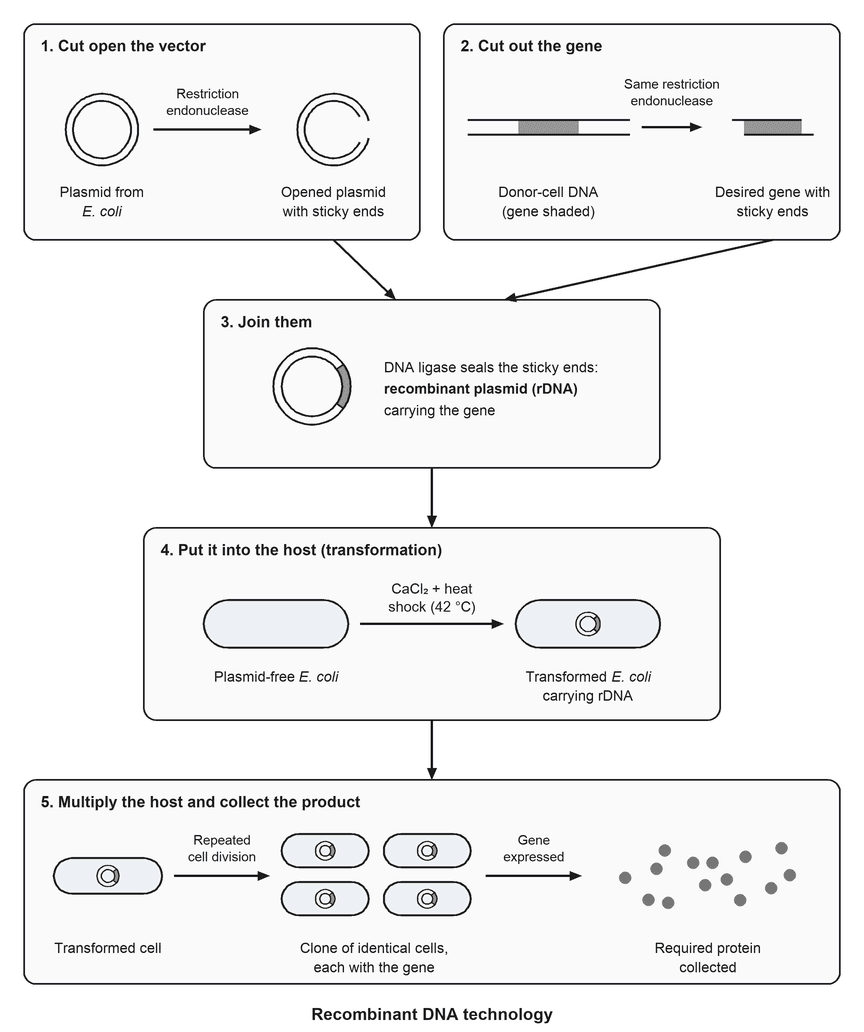
Therefore, the flow diagram runs: plasmid cut by a restriction endonuclease and desired gene cut by the same enzyme, joined by DNA ligase into a recombinant plasmid, taken up by CaCl₂ and heat-shock treated E. coli, which multiplies into clones that make the required protein.