
Question 232 marksEasy
Study the linking of DNA fragments shown below.
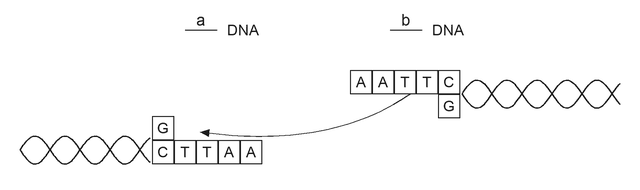
(i) Name 'a' DNA and 'b' DNA.
(ii) Name the restriction enzyme that recognises this palindrome.
(iii) Name the enzyme that can link these two DNA fragments.
Confirming your payment
Sign up now and get 250 free tokens.
Biotechnology: Principles and Processes · Question 23 of 49
Study the linking of DNA fragments shown below.
(i) Name 'a' DNA and 'b' DNA.
(ii) Name the restriction enzyme that recognises this palindrome.
(iii) Name the enzyme that can link these two DNA fragments.
Solution:
Key idea: When the vector and the foreign DNA are cut with the same restriction enzyme, their sticky ends are complementary, so the two pieces pair and can be sealed into recombinant DNA.
Step 1 — Name the two DNAs in part (i). In the figure, fragment 'b' is moved (arrow) towards fragment 'a' and joined to it. So 'b' is the piece being inserted, the foreign DNA (desired gene), and 'a' is the DNA that receives it, the vector DNA (plasmid).
Step 2 — Read the sticky ends for part (ii). Fragment 'a' ends in G on the upper strand with CTTAA on the lower strand, and fragment 'b' starts with AATTC on the upper strand with G on the lower strand. When they pair, the upper strand reads 5′-GAATTC-3′ and the lower strand, read 5′→3′, also reads GAATTC. This palindrome is the recognition site of EcoRI, which cuts it between G and A and leaves 5′-AATT sticky ends.
Step 3 — Name the linking enzyme for part (iii). The paired sticky ends are held only by hydrogen bonds; DNA ligase forms the phosphodiester bonds that seal the backbone and link the two fragments.
Therefore, (i) 'a' is vector DNA and 'b' is foreign DNA; (ii) the enzyme is EcoRI; (iii) DNA ligase links the fragments.