
Opening your dashboard
Class 12 Biology Chapter 15 Biotechnology: Principles and Processes: Competency-Based Questions (CBQ)
40 questions on Chapter 15, each worked through on its own page with the AI tutor. Class 12 Biology, ICSE 2026-27.
40 questions
1–5 marks · Mixed difficulty
- 11 mark
Question 1
A Class 12 student is listing activities for a project on biotechnology. She uses its meaning as the use of live microorganisms, plant or animal cells, or enzymes from them, to make products useful to humans. Which activity should not be on her list?
- 21 mark
Question 2
Assertion (A): Making idli by fermenting a batter of soaked rice and pulses is a process of old biotechnology.
Reason (R): In old biotechnology, only the natural capabilities of the cells or organisms were exploited.
- 31 mark
Question 3
At an agricultural fair, four exhibits carry a label saying "improved". Which exhibit is a transgenic organism (genetically modified organism)?
- 41 mark
Question 4
Assertion (A): Genetic engineering alters the chemistry of the genetic material (DNA or RNA) of an organism.
Reason (R): Chemical engineering in biotechnology maintains a sterile, contamination-free environment so that only the desired microbes or cells grow.
- 53 marks
Question 5
A laboratory in Hyderabad has two unlabelled tubes of DNA-cutting enzymes, M and N. Each enzyme is tested on a linear DNA fragment and on a circular plasmid. (Hypothetical data.)
Enzyme Effect on linear DNA Effect on circular plasmid M becomes shorter and shorter from both ends; no new pieces appear no change N cut into two pieces at one place inside the molecule cut open into one linear molecule (a) Which enzyme is an exonuclease and which is an endonuclease? Give a reason from the table.
(b) Why does enzyme M have no effect on the plasmid?
(c) The lab wants to open the plasmid to insert a gene. Which enzyme should it use, and what kind of ends should the cut leave so that the gene can be joined in easily?
- 63 marks
Question 6
A student cuts a gene out of donor DNA with EcoRI, which recognises 5′-GAATTC-3′ and cuts each strand between G and A. She opens a plasmid with a different enzyme, Z, which recognises 5′-AAGCTT-3′ and cuts each strand between the two A's. She mixes the two with DNA ligase, but no recombinant plasmid forms. (Hypothetical example.)
(a) Write the single-stranded overhang (5′ → 3′) left at a cut end of the gene, and at a cut end of the plasmid.
(b) Use your answer to (a) to explain why the gene and the plasmid did not join.
(c) How should the student change her method so that a recombinant plasmid forms?
- 71 mark
Question 7
Assertion (A): A plasmid can replicate on its own, independently of the chromosomal DNA of the bacterium.
Reason (R): The plasmid lies inside the nucleoid region of the bacterial cell, along with the chromosomal DNA.
- 81 mark
Question 8
A student mixes a gene cut with EcoRI and a plasmid cut with EcoRI. The sticky ends pair up by base pairing. When the mixture is tested later, no permanently sealed circular recombinant plasmid is found. Which step did the student most likely leave out?
- 93 marks
Question 9
In a college biotechnology lab, a student is given four short stretches of double-stranded DNA. Only the top strand is written, 5′ → 3′:
P: 5′-GTCGAC-3′
Q: 5′-GATCAG-3′
R: 5′-CTGCAG-3′
S: 5′-AACGTA-3′
(a) Which of these are palindromic nucleotide sequences?
(b) Write the complementary strand of R, 5′ → 3′, and use it to explain why one restriction endonuclease can cut both strands at this site.
(c) Sequence S can be made palindromic by changing only its first base. To which base must it be changed?
- 103 marks
Question 10
(Hypothetical data.) A 12 kb linear DNA from a donor cell carries a gene of interest from the 4.0 kb to the 7.0 kb position, measured from the left end (kb = kilobase pairs). Two restriction endonucleases are available:
Enzyme Positions of its recognition sites (kb from the left end) X 3.0, 5.5 and 9.0 Y 3.5 and 8.0 (a) Which enzyme should be used to cut out the gene in working condition? Why is the other enzyme unsuitable?
(b) What is the size of the fragment that carries the gene?
(c) The plasmid that will receive the gene has one recognition site for X and one for Y. Which enzyme must be used to open the plasmid? Give a reason.
- 111 mark
Question 11
A researcher has four restriction endonucleases in the freezer, with these recognition sequences (top strand, 5′ → 3′): BamHI GGATCC, EcoRI GAATTC, SalI GTCGAC and PstI CTGCAG. She has to cut a short double-stranded DNA whose top strand is:
5′-TTGGATCCAGTCGACACTGCAGTT-3′
Which enzyme will not cut this DNA?
- 121 mark
Question 12
In a class test, four students explained why the single-stranded ends left after EcoRI cuts DNA are called sticky ends. Which explanation is correct?
- 131 mark
Question 13
Assertion (A): Restriction endonucleases are called 'molecular scissors'.
Reason (R): Restriction endonucleases join together DNA fragments that have complementary sticky ends.
- 143 marks
Question 14
(Hypothetical data.) A university lab in Chennai runs an agarose gel. Lane 1 has four DNA fragments of known size; lane 2 has one fragment, U, of unknown size. After the run, the distance of each band from the wells is measured.
Lane Fragment Distance from the wells (cm) 1 5,000 bp 1.2 1 2,000 bp 2.6 1 1,000 bp 3.5 1 500 bp 4.6 2 U 3.0 (a) Between which two sizes does the size of U lie? Give a reason.
(b) If the current had been switched off at half the time, would the order of the bands from the wells be different? Explain.
(c) All the fragments carry a negative charge and are pulled towards the same electrode. Why, then, do they end up at different places in the gel?
- 151 mark
Question 15
Assertion (A): In agarose gel electrophoresis, larger DNA fragments travel farther from the wells than smaller fragments.
Reason (R): DNA fragments move through the gel and separate according to their size.
- 163 marks
Question 16
(Hypothetical data.) In a college laboratory, E. coli cells were treated with a plasmid that carries an ampicillin-resistance gene. Then cells were spread on an agar plate containing ampicillin, and the same number of cells on a plate without any antibiotic. Next day, the ampicillin plate had 400 colonies, while the plate without antibiotic was covered with an even layer of growth.
(a) What fraction of the cells spread on the ampicillin plate took up the plasmid?
(b) Use your answer to (a) to explain why a vector must carry a selectable marker gene.
(c) Why could the plate without antibiotic not be used to find the transformed cells?
- 171 mark
Question 17
(Hypothetical situation.) A lab wants to clone a gene in a strain of bacterium that is naturally resistant to tetracycline but is killed by ampicillin. Its vector carries a gene for ampicillin resistance and a gene for tetracycline resistance. How should the lab pick out the transformed cells?
- 181 mark
Question 18
A seed company in Gujarat wants to use Agrobacterium tumefaciens to carry a useful gene into potato plants. What must be done to the bacterium's Ti plasmid before it can serve as the vector?
- 191 mark
Question 19
Assertion (A): In the gene gun method, the foreign DNA is first placed in a Ti plasmid, which then carries it into the plant cells.
Reason (R): Biolistics is a vector-less method in which microparticles of gold or tungsten coated with foreign DNA are bombarded into the target cells at high velocity.
- 204 marks
Question 20
(Hypothetical data.) The display of a PCR machine in a hospital laboratory shows the stages of one cycle:
Stage Temperature of the reaction mixture 1 about 98 °C 2 about 60 °C 3 about 72 °C, enzyme from Thermus aquaticus at work (a) Name stages 1 and 2, and state what happens to the DNA in each.
(b) One night the cooling unit fails, and the mixture stays at about 98 °C throughout the run. Predict the result, with a reason.
(c) For stage 3, what must be supplied along with the enzyme, and how many copies of the original DNA fragment are present at the end of one cycle?
- 211 mark
Question 21
Assertion (A): In a PCR run, fresh DNA polymerase need not be added in every cycle.
Reason (R): PCR primers are small, chemically synthesised oligonucleotides, about 20–30 nucleotides long.
- 221 mark
Question 22
Assertion (A): PCR is a quicker way of getting many copies of a gene than cloning the gene in a bacterium.
Reason (R): In PCR, DNA polymerase copies the gene directly in vitro, without waiting for repeated cell divisions of a host.
- 234 marks
Question 23
(Hypothetical data.) A company in Bengaluru makes an enzyme using recombinant bacteria. In the laboratory, a 500 mL flask of culture gives 0.2 g of the purified enzyme. A customer now needs 60 g of the enzyme every month.
(a) At the same yield, what volume of culture must be processed each month?
(b) Name the kind of vessel the company should use, and give two of its features that make it suitable.
(c) Before the enzyme is sold, it must go through one more stage of processing. Name this stage and state what it involves.
- 241 mark
Question 24
(Hypothetical situation.) During a run of a simple stirred-tank bioreactor, thick foam keeps rising on top of the culture broth as it is stirred and aerated. Which part of the bioreactor is meant to deal with this?
- 251 mark
Question 25
Assertion (A): Downstream processing is carried out before the cells are grown in the bioreactor.
Reason (R): Downstream processing involves the separation and purification of the bioproduct formed.
- 264 marks
Question 26
A linear DNA molecule is 10 kb long (kb = kilobase pairs). Enzyme P cuts it at the 2 kb and 7 kb positions, and enzyme Q cuts it at the 5 kb position, measured from the same end. (Hypothetical data.)
(a) Give the sizes of the fragments when the DNA is cut with P alone.
(b) Give the sizes of the fragments with Q alone, and the number of bands they would form on an agarose gel.
(c) Give the sizes of the fragments when it is cut with P and Q together, and the number of bands they would form.
- 275 marks
Question 27
Read the sources given and answer any four from the questions given below.
A plasmid is a small, extrachromosomal DNA molecule within a cell that is physically separated and distinct from chromosomal DNA and can replicate independently. They are most commonly found as small circular, double-stranded DNA molecules.
Plasmids naturally exist in all bacterial cells but can be seen in some archaebacteria and eukaryotes. Often, the genes carried in plasmids provide bacteria with genetic advantages, such as antibiotic resistance.
The most commonly used cloning vectors are E. coli plasmids which include three functional regions: (1) an origin of replication (Ori), (2) a drug-resistance gene and (3) a region where DNA can be inserted without interfering with plasmid replication or expression of the drug-resistance gene. The replication origin (Ori) is a specific DNA sequence of 50–100 base pairs that must be present in a plasmid for it to replicate.
1. Where are plasmids in bacteria located?
(a) inside the nucleus of bacteria (b) outside the nuclear matter of bacteria (c) as a part of chromosomal segment of bacteria (d) on the surface of bacteria
2. How many origins of replication are present in a bacterial plasmid?
(a) one (b) two (c) three (d) many
3. Most bacterial plasmids have the following structure.
(a) large circular DNA molecule (b) small circular DNA molecule (c) large circular RNA molecule (d) linear DNA molecule
4. Most commonly used cloning vector E. coli plasmid has the following functional regions.
(a) a drug resistance gene (b) a region where DNA can be inserted (c) both (a) and (b) (d) Ori having specific RNA sequence
5. Plasmids can be seen in
(a) all bacteria (b) all eukaryotes (c) all viruses (d) both (a) and (c)
- 285 marks
Question 28
Read the sources given and answer any four from the questions given below.
Restriction endonucleases are enzymes that are produced by bacteria and cut the double-stranded DNA molecule at specific recognition sequences known as restriction sites. The sequences recognised by endonucleases are typically 4–6 nucleotides long and are palindromes called palindromic nucleotide sequences. A palindrome is a base sequence that reads the same on two strands but in the opposite direction, for example, 5' GAATTC 3', 3' CTTAAG 5'. After cleavage, each DNA strand has a little single-stranded hanging portion at the end. These are called sticky ends. When cut by the same restriction enzyme, the resultant DNA fragments have the same kind of sticky ends which can be joined together by DNA ligases.
1. The function of restriction endonuclease is to
(a) cut RNA at specific restriction sites (b) cut DNA at specific recognition sequences (c) form rDNA (d) cut double-stranded RNA
2. Which of the following sequence is a palindrome?
(a) 5' GAATTC 3', 3' GAATTC 5' (b) 5' CCATGG 3', 3' GGTACC 5' (c) 5' AAGCTT 3', 3' GAATTC 5' (d) 5' GGATCC 3', 5' CCAAGG 3'
3. The overhanging parts of two strands of DNA of cut DNA
(a) are called sticky ends (b) have single strands of RNA (c) are of no use for rDNA (d) are cut and deleted from DNA
4. Function of DNA ligase is to
(a) cut and join DNA (b) form sticky ends (c) join fragments of DNA (d) recognise restriction sites
5. Restriction endonucleases are present in the following
(a) eukaryotes (b) bacteria (c) humans (d) higher plants
- 295 marks
Question 29
Read the sources given and answer any four from the questions given below.
Agrobacterium tumefaciens is a plant pathogenic bacterium that can naturally transfer part of its plasmid DNA as it infects the host plant. The bacterium Agrobacterium contains large tumour-inducing plasmids, Ti-plasmids and passes on this tumour-causing gene into the genome of the host plant. The host plant could be any dicotyledonous plant. Ti-plasmids are used as gene vectors to transfer foreign genes into target host cells.
Vector-less methods involve the transfer of gene, i.e., rDNA containing foreign gene by a direct method without any vector. These can be done by electroporation, microinjection and biolistic guns. In electroporation, temporary holes are produced in the plasma membrane of the host cell to facilitate the entry of foreign DNA. This is done by treating the bacterial cells with specific concentration of divalent cations like CaCl. In microinjection foreign genes (rDNA) are introduced directly into the nucleus of plant or animal cells by using micropipettes. By using biolistic or gene particle gun, the microparticles of gold or tungsten particles coated with foreign DNA are bombarded into the target host cells with high velocity.
1. Agrobacterium is used as a vector because it
(a) infects dicot plants (b) contains plasmid (c) is easily available bacteria (d) can transfer foreign gene into target host cell
2. Which of the following statements are true for Ti plasmid?
(a) has a tumour-causing gene (b) has foreign gene (c) used in electroporation technique (d) contains chromosomal DNA of bacteria
3. Microparticles of gold coated with rDNA are used in the following technique:
(a) electroporation (b) biolistic gun (c) microinjection (d) Ti plasmid
4. What is done in the electroporation technique?
(a) Cells are treated with divalent cations (b) Temporary holes are created in the plasma membrane (c) both (a) and (b) (d) plasmids are used
5. rDNA are introduced directly into the nucleus of a plant by fine pipettes in the following technique:
(a) Agrobacterium (b) microinjection (c) electroporation (d) gene particle gun
- 303 marks
Question 30
Make a chart (with diagrammatic representation) showing a restriction enzyme, the substrate DNA on which it acts, the site at which it cuts DNA and the product it produces.
- 313 marks
Question 31
Can you think and answer how a reporter enzyme can be used to monitor transformation of host cells by foreign DNA in addition to a selectable marker?
- 323 marks
Question 32
Describe briefly the following:
(a) Origin of replication
(b) Bioreactors
(c) Downstream processing
- 333 marks
Question 33
Complete the steps for separation and isolation of DNA fragments.
(i) Cutting of DNA by ______.
(ii) During ______ DNA fragments move to ______.
(iii) ______ separate in matrix of ______.
(iv) ______ fragments move ______ whereas large remains nearer.
(v) DNA fragments are stained with ______.
(vi) Stained fragments are exposed to ______.
(vii) Fragments are extruded from gel piece. This is known as ______.
- 343 marks
Question 34
Complete the labelling in the following PCR:
(i)
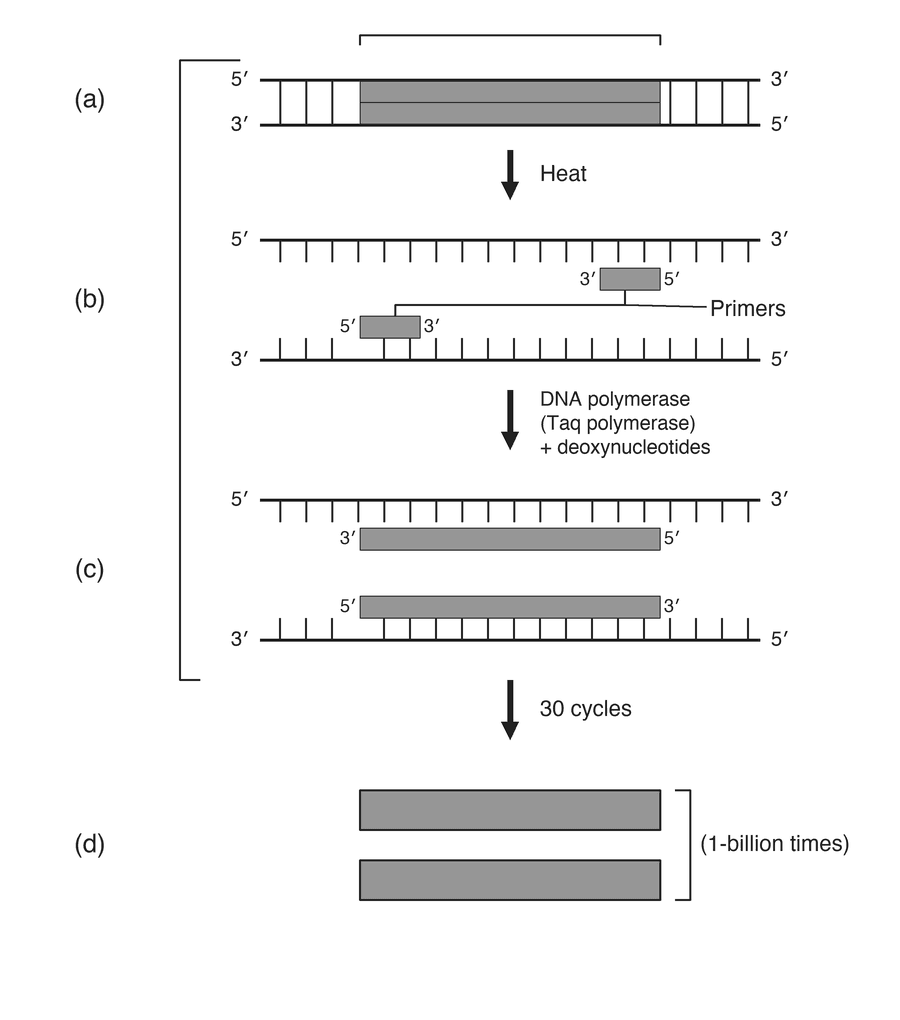
(ii) Expand the word PCR.
(iii) Give the origin of 'Taq'.
(iv) Why is heating done in the procedure?
- 353 marks
Question 35
What is a bioreactor? Explain important features of Stirred tank bioreactor.
- 363 marks
Question 36
Name and describe the technique that helps in the separation and isolation of DNA fragments.
- 375 marks
Question 37
Explain the various steps involved in recombinant DNA technology.
- 385 marks
Question 38
(i) What are restriction endonucleases? Give the rules of their nomenclature.
(ii) Explain the mechanism of action of restriction endonucleases that makes them suitable for genetic engineering.
- 395 marks
Question 39
(i) Explain what are the desirable characteristics of an ideal cloning vector used in rDNA technology.
(ii) Describe two vectorless methods of gene transfer used in rDNA technology.
- 405 marks
Question 40
What does PCR stand for? Describe the different steps of PCR.