
Opening your dashboard
Class 11 Physics Chapter 24: Sound Waves Solutions
48 textbook questions with step-by-step answers, free to read, for ISC 2026-27.
Get talked through Ch 24, not just shown the answer
Reading a finished solution is not the same as being able to do it. The AI tutor takes one question at a time and works it with you, in your own words, until you can.
- Ask it out loud, in your own words
- It gives you the next step, not the answer
- Stuck on part (ii)? Start there
48 questions with solutions
1–5 marks · Mixed difficulty
The first 35 solutions are on this page. This chapter is a long one, so the rest open on their own page to keep this one quick to load.
- 11 mark
Question 1
Sound waves transfer
Solve with AIAnswer
(A) Only energy not momentum
(B) Energy
(C) Momentum
- Correct
(D) Both energy and momentum
Answer: (D) Both energy and momentum
Concept: A sound wave is a travelling disturbance in a medium. It carries energy from the source, and it also carries momentum: a sound wave falling on a surface pushes on it with a small, steady force (acoustic radiation pressure).
Step 1 — Check the energy. A sound wave makes the particles of the medium vibrate, and the energy of these vibrations is passed on from layer to layer. This is how sound can make an eardrum or a window vibrate, so sound transfers energy.
Step 2 — Check the momentum. A wave that carries energy at speed also carries momentum. The force of strong sound waves on a surface can be measured; powerful ultrasound can even push small particles and drops of liquid along. So sound transfers momentum as well.
Step 3 — Choose the option. Both are transferred, so the complete answer is "both energy and momentum".
- (A) Sound waves do carry momentum, as their small but measurable push on a surface shows, so "not momentum" is false.
- (B) This is true but incomplete: sound transfers energy, and it also transfers momentum.
- (C) This is true but incomplete: sound transfers momentum, and it also transfers energy.
Therefore, the answer is (D): sound waves transfer both energy and momentum.
- 21 mark
Question 2
The wavelength of light in visible part () and for sound () are related as
Solve with AIAnswer
(A)
- Correct
(B)
(C)
(D) None of these
Answer: (B)
Concept: For any wave, wavelength . Visible light has wavelengths of about 400 nm to 700 nm.
Step 1 — Find the range of wavelengths of audible sound in air. Audible sound has frequencies from to , and its speed in air is about . The shortest wavelength is:
The longest is .
Step 2 — Compare with light. Even the shortest audible sound wavelength, 1.7 cm, is about 24 000 times the longest visible wavelength, . So the wavelength of sound is much greater.
- (A) Visible light has wavelengths below a micrometre, far shorter than the centimetres to metres of audible sound.
- (C) Even the closest ends of the two ranges, 1.7 cm for sound and 700 nm for light, differ by a factor of about 24 000, so the wavelengths cannot be equal.
- (D) A definite relation does hold, , so "none of these" is wrong.
Therefore, the answer is (B): the wavelength of sound is greater than that of visible light.
- 31 mark
Question 3
Velocity of sound is maximum in
Solve with AIAnswer
(A) Air
(B) Water
(C) Vacuum
- Correct
(D) Steel
Answer: (D) Steel
Concept: The speed of sound is . Solids are so much stiffer than liquids and gases that sound is fastest in solids, slower in liquids and slowest in gases.
Step 1 — Recall the speeds. At ordinary temperatures sound travels at about to in air, about in water and about in steel.
Step 2 — Pick the largest. Steel, a stiff solid, has the greatest speed of sound.
- (A) Air is a gas with very small elasticity, so sound is slowest in it among the media listed.
- (B) Water is a liquid; sound travels in it about 4.5 times faster than in air but only about a third as fast as in steel.
- (C) Sound cannot travel through a vacuum at all, because it needs a material medium.
Therefore, the answer is (D): the velocity of sound is maximum in steel.
- 41 mark
Question 4
At which temperature, the speed of sound in hydrogen will be same as that of speed of sound in oxygen at 100°C?
Solve with AIAnswer
(A)
(B)
(C)
- Correct
(D)
Answer: (D)
Concept: By Laplace's formula, the speed of sound in a gas is ; using the gas equation , this can also be written , where is the absolute temperature and the molar mass of the gas. Hydrogen and oxygen are both diatomic, so they have the same .
Step 1 — Write the condition for equal speeds. With and the same for both gases, equal speeds need equal values of :
Step 2 — Put in the values. Oxygen is at (373 K) with ; for hydrogen, :
Step 3 — Convert to the Celsius scale. We subtract 273:
- (A) At (125 K) hydrogen would have , more than five times oxygen's , so its sound would still be faster.
- (B) At (60.5 K) hydrogen would have , still about 2.6 times oxygen's value.
- (C) is below absolute zero (), so no gas can have this temperature.
Therefore, the answer is (D): the speeds are equal when hydrogen is at about (23.3 K).
- 51 mark
Question 5
The intensity of sound increases at night due to
Solve with AIAnswer
- Correct
(A) Increase in density of air
(B) Decreases in density of air
(C) Low temperature
(D) None of these
Answer: (A) Increase in density of air
Concept: For a sound wave of amplitude and frequency travelling at speed in a medium of density , the intensity is . For given and , a denser medium carries a greater intensity.
Step 1 — See how the air near the ground changes at night. At night the ground cools quickly, so the layer of air next to it becomes cooler than the air above. At the same pressure, cooler air is denser.
Step 2 — Apply the intensity formula. In the denser air near the ground, is larger, so for the same amplitude and frequency the intensity of the sound is greater. This is the textbook reason for sounds being heard louder at night.
Step 3 — Note the main effect. The density effect on its own is small: if the air near the ground cools from about to , its density rises by only about 3.5 %, so rises by less than 2 %. The main reason is refraction. Because sound travels more slowly in the cooler air near the ground than in the warmer air above, sound waves that start upwards are bent back down towards the ground. Less sound escapes upwards, so sounds carry farther at night; the quieter surroundings also help.
Note: the slightly higher amount of carbon dioxide in the air at night is far too small to change the density of air noticeably; the change in density comes from the cooling of the air near the ground.
- (B) The air near the ground becomes denser, not less dense, at night, because it is cooler.
- (C) Low temperature is what makes the air near the ground denser, so it is the cause behind the key rather than a separate answer; the formula links the intensity directly to the density, which is why (A) is the expected answer.
- (D) A reason is listed, the increase in the density of the air, so "none of these" is wrong.
Therefore, the answer is (A): the expected reason is the increase in the density of the air near the ground, although the bending of sound back towards the ground is the larger real effect.
- 61 mark
Question 6
Consider the following
I. Waves created on the surfaces of a water pond by a vibrating source.
II. Wave created by an oscillating electric field in air.
III. Sound waves travelling under water.
Which of these can be polarised?
Solve with AIAnswer
(A) I and II
- Correct
(B) II only
(C) II and III
(D) I, II and III
Answer: (B) II only
Concept: Only transverse waves can be polarised, because only they have vibrations at right angles to the direction of travel that can be confined to one plane. Longitudinal waves vibrate along the direction of travel, so there is nothing to polarise.
Step 1 — Judge wave II. An oscillating electric field produces an electromagnetic wave. Its electric and magnetic fields vibrate at right angles to the direction of travel, so it is transverse and can be polarised.
Step 2 — Judge wave III. Sound waves in water are longitudinal: the water particles vibrate along the direction of travel. They cannot be polarised.
Step 3 — Judge wave I. In waves on the surface of water, each particle moves in a loop that has both a longitudinal and a transverse part. These are not purely transverse waves, and they cannot be polarised in the way light is.
Step 4 — Choose the option. Only wave II can be polarised.
- (A) Wave I, the ripple on a pond, is a mixed longitudinal–transverse wave, not a transverse wave that can be polarised.
- (C) Wave III is a sound wave, which is longitudinal, so it cannot be polarised.
- (D) Waves I and III cannot be polarised, so not all three can.
Therefore, the answer is (B): only the wave produced by the oscillating electric field can be polarised.
- 71 mark
Question 7
When a sound wave of frequency 300 Hz passes through a medium, the maximum displacement of a particle of the medium is 0.1 cm. The maximum velocity of the particle is equal to
Solve with AIAnswer
- Correct
(A) cm/s
(B) cm/s
(C) 30 cm/s
(D) 60 cm/s
Answer: (A) cm/s
Concept: Each particle of the medium performs simple harmonic motion with the frequency of the wave. Its greatest speed is , where is the amplitude (the maximum displacement) and .
Step 1 — Find the angular frequency. We multiply the frequency by :
Step 2 — Find the maximum velocity. We multiply by the amplitude :
- (B) cm/s comes from taking instead of .
- (C) 30 cm/s is ; it leaves out the whole factor .
- (D) 60 cm/s is ; it leaves out the factor .
Therefore, the answer is (A): the maximum velocity of the particle is cm/s (about 188 cm/s).
- 81 mark
Question 8
The ratio of the speed of sound in nitrogen gas to that in helium gas, at 300 K is
Solve with AIAnswer
(A)
(B)
- Correct
(C)
(D)
Answer: (C)
Concept: By Laplace's formula, the speed of sound in a gas is ; using the gas equation , this can also be written , where is the absolute temperature and the molar mass of the gas. Nitrogen is diatomic (, ) and helium is monatomic (, ).
Step 1 — Write the ratio. Both gases are at 300 K, so and cancel:
Step 2 — Put in the values. We substitute the values of and :
- (A) is what we get by leaving out and also taking helium's molar mass as 8 instead of 4.
- (B) uses only the molar masses; it leaves out the different values of .
- (D) is what we get by taking helium's molar mass as 8 instead of 4 while keeping the values of .
Therefore, the answer is (C): the ratio is (about 0.35).
- 91 mark
Question 9
Which of the following do not require medium for transmission?
(A) Cathode ray
(B) Electromagnetic wave
(C) Sound wave
(D) None of the above
Solve with AIWritten solution
Solution:
Concept: A mechanical wave, such as sound, needs a material medium, because it travels by making the particles of the medium vibrate. Electromagnetic waves and streams of charged particles need no medium; they travel best through a vacuum.
Step 1 — Judge option (A). Cathode rays are streams of fast electrons. They are produced in a highly evacuated tube and travel through the vacuum inside it; gas in their path only scatters and slows them. So cathode rays do not need a medium.
Step 2 — Judge option (B). An electromagnetic wave consists of changing electric and magnetic fields that sustain each other. It travels through empty space, which is how light from the Sun reaches the Earth.
Step 3 — Judge option (C). A sound wave is a mechanical wave and cannot travel through a vacuum, so it does need a medium.
Step 4 — Judge option (D). Options (A) and (B) are correct, so "none of the above" is wrong.
Note: the expected answer is (B), the electromagnetic wave, which is the wave in the list that needs no medium; but cathode rays, which are not waves, also travel through a vacuum, so (A) is correct as well.
Therefore, both (A) cathode rays and (B) electromagnetic waves do not require a medium; only the sound wave does.
- 101 mark
Question 10
When the temperature of an ideal gas is increased by 600 K, the velocity of sound in the gas becomes times the initial velocity in it. The initial temperature of the gas is
Solve with AIAnswer
(A)
- Correct
(B)
(C)
(D)
Answer: (B)
Concept: For a given gas, , so the speed of sound is proportional to the square root of the absolute temperature: .
Step 1 — Write the ratio of the speeds. Let the initial temperature be (in kelvin). The new temperature is :
Step 2 — Use the given ratio. The ratio is , so squaring both sides:
Step 3 — Convert to the Celsius scale. We subtract 273:
- (A) is 200 K; heating it to 800 K would double the speed (), not multiply it by .
- (C) is 400 K; heating it to 1000 K would multiply the speed by .
- (D) is 600 K; heating it to 1200 K would multiply the speed by .
Therefore, the answer is (B): the initial temperature is 300 K ().
- 111 mark
Question 11
Speed of sound at constant temperature depends on
Solve with AIAnswer
(A) Pressure
(B) Density of gas
(C) Above both
- Correct
(D) None of the above
Answer: (D) None of the above
Concept: For a gas, . By Boyle's law, at constant temperature the density of a given mass of gas is proportional to its pressure, so is constant.
Step 1 — Change the pressure at constant temperature. If the pressure of the gas is doubled, its density also doubles, so and hence the speed do not change.
Step 2 — Change the density at constant temperature. For the same gas, the density can be changed at constant temperature only by changing the pressure in the same ratio, so again , and the speed, stay the same.
Step 3 — Choose the option. At constant temperature the speed of sound in a given gas depends on neither the pressure nor the density.
Note: When different gases are compared at the same temperature and pressure, the denser gas does carry sound more slowly, since ; the question is about one given gas, whose density can change at constant temperature only together with its pressure.
- (A) A change of pressure changes the density in the same ratio, so the speed stays the same.
- (B) For a given gas, the density can change at constant temperature only along with the pressure, and the two changes cancel in .
- (C) Since the speed depends on neither the pressure nor the density, it cannot depend on both.
Therefore, the answer is (D): at constant temperature the speed of sound in a gas depends on neither its pressure nor its density.
- 121 mark
Question 12
Sound velocity is maximum in
Solve with AIAnswer
- Correct
(A)
(B)
(C) He
(D)
Answer: (A)
Concept: By Laplace's formula, the speed of sound in a gas is ; using the gas equation , this can also be written , where is the absolute temperature and the molar mass of the gas. At the same temperature, the speed is proportional to .
Step 1 — Find for each gas. We take all the gases at the same temperature:
- hydrogen: , , so ;
- helium: , , so ;
- nitrogen: , , so ;
- oxygen: , , so .
Step 2 — Pick the largest. Hydrogen has the largest , so sound travels fastest in it (about at ).
- (B) Nitrogen has the same as hydrogen but is 14 times heavier, so sound is about times slower in it.
- (C) Helium has a larger than hydrogen but is twice as heavy; its of 0.42 is less than hydrogen's 0.70.
- (D) Oxygen is 16 times heavier than hydrogen with the same , so sound is 4 times slower in it.
Therefore, the answer is (A): at the same temperature, sound travels fastest in hydrogen.
- 131 mark
Question 13
A man stands in front of a hillock and fires a gun. He hears an echo after 1.5 s. The distance of the hillock from the man is (velocity of sound in air is 330 m/s)
Solve with AIAnswer
(A) 220 m
- Correct
(B) 247.5 m
(C) 268.5 m
(D) 292.5 m
Answer: (B) 247.5 m
Concept: The echo travels from the man to the hillock and back, a total distance , so .
Step 1 — Write the relation. We substitute and :
- (A) For 220 m the echo would return after , not 1.5 s.
- (C) For 268.5 m the echo would return after .
- (D) For 292.5 m the echo would return after .
Therefore, the answer is (B): the hillock is 247.5 m from the man.
- 141 mark
Question 14
The velocity of sound is in air. If the density of air is increased to 4 times, then the new velocity of sound will be
Solve with AIAnswer
- Correct
(A)
(B)
(C)
(D)
Answer: (A)
Concept: For a gas, . At a given pressure, .
Step 1 — Write the ratio of the speeds. We take the pressure (and ) to be unchanged while the density becomes :
Step 2 — Find the new speed. So .
- (B) The speed would fall to only if the density rose 144 times, not 4 times.
- (C) A denser medium at the same pressure carries sound more slowly, so the speed cannot rise to .
- (D) has the unit , so it is not a speed at all.
Therefore, the answer is (A): the new velocity of sound is .
- 151 mark
Question 15
Find the frequency of minimum distance between compression and rarefaction of a wire. If the length of the wire is 1 m and velocity of sound in air is 360 m/s.
Solve with AIAnswer
(A) 90
- Correct
(B) 180
(C) 120
(D) 360
Answer: (B) 180
Concept: In a longitudinal wave, a compression and the next rarefaction are half a wavelength apart, so the minimum distance between them is . The frequency is .
Step 1 — Read the question. The question means that the minimum distance between a compression and the neighbouring rarefaction is equal to the length of the wire, 1 m, and that the wave travels at .
Step 2 — Find the wavelength. Half a wavelength is 1 m:
Step 3 — Find the frequency. We divide the speed by the wavelength:
- (A) 90 comes from taking the compression-to-rarefaction distance as ; then m.
- (C) 120 would need m, a compression-to-rarefaction distance of 1.5 m, not 1 m.
- (D) 360 comes from taking the distance as a whole wavelength, m.
Therefore, the answer is (B): the frequency is 180 (180 Hz).
- 161 mark
Question 16
Velocity of sound measured in hydrogen and oxygen gas at a given temperature will be in the ratio
Solve with AIAnswer
(A) 1 : 4
- Correct
(B) 4 : 1
(C) 2 : 1
(D) 1 : 1
Answer: (B) 4 : 1
Concept: By Laplace's formula, the speed of sound in a gas is ; using the gas equation , this can also be written , where is the absolute temperature and the molar mass of the gas. Hydrogen and oxygen are both diatomic, so they have the same ; at the same temperature .
Step 1 — Write the ratio. We substitute the molar masses and :
- (A) 1 : 4 is the ratio the wrong way round; sound is faster in the lighter gas, hydrogen.
- (C) 2 : 1 would need oxygen to be only 4 times as heavy as hydrogen; it is 16 times as heavy, and .
- (D) 1 : 1 would mean the speed does not depend on the molar mass, but at the same temperature it varies as .
Therefore, the answer is (B): the speeds in hydrogen and oxygen are in the ratio 4 : 1.
- 171 mark
Question 17
If is the velocity of sound in moist air, is the velocity of sound in dry air, under identical conditions of pressure and temperature
Solve with AIAnswer
- Correct
(A)
(B)
(C)
(D)
Answer: (A)
Concept: At a given pressure, , so a less dense gas carries sound faster. Water vapour (molar mass 18 g/mol) is lighter than dry air (about 29 g/mol).
Step 1 — Compare the densities. At the same pressure and temperature, moist air has some of its nitrogen and oxygen molecules replaced by lighter water molecules, so moist air is less dense than dry air: .
Step 2 — Compare the speeds. Since at the same pressure:
This is greater than 1, so .
- (B) This would need moist air to be denser than dry air, but water vapour is lighter than air.
- (C) The speeds would be equal only if the two densities were equal, but moist air is less dense.
- (D) The product of two speeds has the unit , so it cannot equal the pure number 1.
Therefore, the answer is (A): sound travels faster in moist air, .
- 181 mark
Question 18
What is sound?
Solve with AIWritten solution
Solution:
Concept: Sound is a mechanical wave, produced by a vibrating body and carried by a material medium.
Step 1 — Give the definition. Sound is a form of energy produced by vibrating bodies and transmitted, as a wave, through a material medium such as air, water or a solid.
Step 2 — Say what kind of wave it is. In air (and in any gas or liquid) sound travels as longitudinal waves: the particles of the medium vibrate to and fro along the direction in which the wave travels. In solids it can travel as transverse waves as well.
Therefore, sound is a form of energy produced by vibrating bodies and carried through a material medium as a wave, longitudinal in air.
- 191 mark
Question 19
What is AF? Give its range.
Solve with AIWritten solution
Solution:
Concept: The human ear can hear sound only within a certain range of frequencies.
Step 1 — Expand the term. AF stands for audible frequency: the frequency of a sound that the human ear can hear.
Step 2 — Give the range. For a person with normal hearing, the vibrating body must have a frequency between about and (the upper limit falls with age).
Therefore, AF is the audible frequency, the range of frequencies the human ear can hear: about 20 Hz to 20 000 Hz.
- 201 mark
Question 20
What are infrasonics?
Solve with AIWritten solution
Solution:
Concept: Sounds are named by their frequency compared with the audible range, 20 Hz to 20 000 Hz.
Step 1 — Give the definition. Infrasonics (infrasonic waves) are sound waves of frequency less than , too low for the human ear to hear.
Step 2 — Give examples. Earthquakes, volcanic eruptions and large animals such as elephants and whales produce infrasonic waves.
Therefore, infrasonics are sound waves with frequencies below 20 Hz.
- 211 mark
Question 21
What are ultrasonics?
Solve with AIWritten solution
Solution:
Concept: Sounds are named by their frequency compared with the audible range, 20 Hz to 20 000 Hz.
Step 1 — Give the definition. Ultrasonics (ultrasonic waves) are sound waves of frequency greater than , too high for the human ear to hear.
Step 2 — Give examples. Bats and dolphins produce ultrasonic waves, and they are used in sonar and in medical ultrasound scans.
Therefore, ultrasonics are sound waves with frequencies above 20 000 Hz.
- 221 mark
Question 22
Mention two properties of sound.
Solve with AIWritten solution
Solution:
Concept: Sound is a mechanical wave, so it shows the properties of waves and needs a medium.
Step 1 — State the first property. A material medium is necessary for the propagation of sound; sound cannot travel through a vacuum.
Step 2 — State the second property. Sound waves are reflected when they meet the boundary separating two different media, obeying the laws of reflection (an echo is reflected sound).
Therefore, two properties of sound are: (i) it needs a material medium to travel, and (ii) it is reflected at the boundary between two media (it is also refracted, shows interference and diffraction, and is absorbed by the medium).
- 231 mark
Question 23
Write down Newton's formula for the speed of sound in gas.
Solve with AIWritten solution
Solution:
Concept: Newton assumed that when sound passes through a gas, the compressions and rarefactions take place at constant temperature (isothermally), so the elasticity of the gas equals its pressure .
Step 1 — Write the formula. Newton's formula for the speed of sound in a gas is:
Step 2 — Name the symbols. Here is the pressure of the gas and is its density.
Therefore, Newton's formula is , where is the pressure and the density of the gas.
- 241 mark
Question 24
How does the speed of sound in a medium change when temperature is raised?
Solve with AIWritten solution
Solution:
Concept: For a gas, , so the speed of sound is proportional to the square root of the absolute temperature: .
Step 1 — State the effect. When the temperature of a gas such as air is raised, the speed of sound in it increases, in proportion to .
Step 2 — Give its size in air. Near room temperature, the speed of sound in air increases by about for every rise in temperature.
Step 3 — Compare liquids and solids. The rule holds only for gases. In water the speed of sound also rises with temperature, but only up to about ; above that it falls slightly. In most solids the speed falls slightly as the temperature rises, because the material becomes a little less stiff.
Therefore, in a gas such as air the speed of sound increases when the temperature is raised, as (about more for each ), while in most solids it falls slightly.
- 251 mark
Question 25
In which air sound travels faster, humid air or dry air?
Solve with AIWritten solution
Solution:
Concept: At a given pressure and temperature, , so sound travels faster in the less dense gas.
Step 1 — Compare the densities. Water vapour (molar mass 18 g/mol) is lighter than dry air (about 29 g/mol), so humid air is less dense than dry air at the same pressure and temperature.
Step 2 — Compare the speeds. The less dense humid air carries sound faster.
Therefore, sound travels faster in humid air than in dry air.
- 261 mark
Question 26
What is the effect of wind on the speed of sound in a medium?
Solve with AIWritten solution
Solution:
Concept: Wind carries the air, and with it the sound waves, along. The speed of sound relative to the ground is the speed of sound in the air plus the velocity of the air.
Step 1 — Wind in the same direction. If the wind blows with speed in the direction in which the sound travels, the speed of the sound relative to the ground increases to .
Step 2 — Wind in the opposite direction. If the wind blows opposite to the direction of propagation of the sound, the speed decreases to . (For a wind at an angle to the sound, the speed is .)
Therefore, wind blowing along the direction of the sound increases its speed (relative to the ground), and wind blowing opposite to it decreases its speed.
- 271 mark
Question 27
What is Mach number?
Solve with AIWritten solution
Solution:
Concept: The Mach number compares the speed of a moving object, such as an aircraft, with the speed of sound in the medium around it.
Step 1 — Give the definition. The Mach number is the ratio of the speed of the object to the speed of sound in the undisturbed medium through which it travels:
Step 2 — Say what it shows. It is a pure number. means the object is slower than sound (subsonic), and means it is faster than sound (supersonic).
Therefore, the Mach number is , the ratio of the speed of an object to the speed of sound in the medium around it.
- 282 marks
Question 28
How will you prove that sound waves are longitudinal waves?
Solve with AIWritten solution
Solution:
Concept: In a longitudinal wave the particles of the medium vibrate along the direction in which the wave travels, producing alternate compressions (condensations) and rarefactions. In a transverse wave they vibrate at right angles to it.
Step 1 — Set up a vibrating tuning fork. Strike a tuning fork and hold it so that its prong A faces along a line in the air, as in the figure.
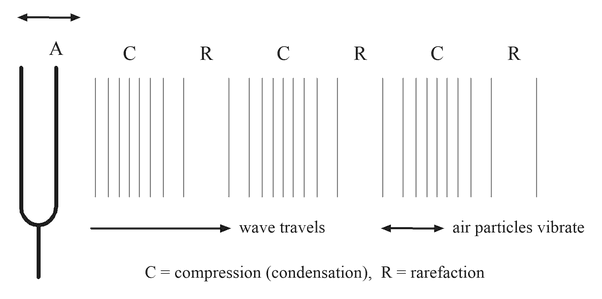
Step 2 — Follow the motion of the air. When prong A moves outwards, it pushes the layer of air next to it and crowds the air into a compression C. When it moves back, it leaves a region of lower density and pressure, a rarefaction R. As the prong keeps vibrating, alternate compressions and rarefactions are produced and travel outward through the air.
Step 3 — Compare the two directions. The prong, and with it each layer of air, moves to and fro along the same line along which the compressions and rarefactions travel. The particles vibrate along the direction of propagation, which is exactly what a longitudinal wave is. A transverse wave would make crests and troughs, not compressions and rarefactions.
Step 4 — Add a second check. Sound waves cannot be polarised, unlike transverse waves such as light, which also shows that sound in air is longitudinal.
Therefore, sound waves are longitudinal because the vibrating prong produces alternate compressions and rarefactions, and the air particles vibrate along the same direction as the wave travels.
- 292 marks
Question 29
What are the primary components of a sound source?
Solve with AIWritten solution
Solution:
Concept: Any source of sound has two parts: one that vibrates and one that makes the vibration loud enough to be heard.
Step 1 — Name the components. The primary components of a sound source are (i) a mechanism for producing a vibration and (ii) a resonant structure that vibrates with it and sends the sound out strongly.
Step 2 — Give an example. In a stringed instrument such as a violin, the vibrating string is the mechanism for producing vibration, and the hollow wooden body containing air is the resonant structure. In the human voice, the vocal cords vibrate and the throat, mouth and nasal cavities resonate.
Therefore, a sound source has (i) a mechanism for producing vibration and (ii) a resonant structure, for example the string and the hollow body of a violin.
- 302 marks
Question 30
Give an experiment to show that a medium is necessary for the propagation of sound.
Solve with AIWritten solution
Solution:
Concept: Sound is a mechanical wave: it travels by making the particles of a medium vibrate. If there is no medium, sound cannot travel.
Step 1 — Set up the apparatus. An electric bell is hung inside a glass bell jar that stands, airtight, on a base plate. The bell is connected through the neck of the jar to a battery and a switch K, and the base has an outlet to a vacuum pump, as shown.
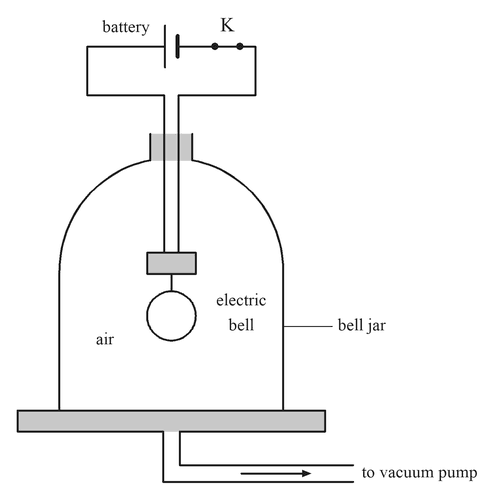
Step 2 — Ring the bell in air. Close the switch K. The hammer strikes the gong, and the sound of the bell is heard clearly outside the jar, because the air inside carries it to the glass and on to us.
Step 3 — Pump out the air. Keep the bell ringing and start the vacuum pump. As more and more air is removed, the sound becomes fainter and fainter, although the hammer can still be seen striking the gong.
Step 4 — Look at the result. When nearly all the air has been pumped out, the sound is hardly heard at all. (A faint sound remains because a little air is left and some vibration passes through the wires and supports.) When air is let back in, the sound is heard again.
Therefore, since the sound fades away as the air is removed although the bell keeps ringing, a material medium is necessary for the propagation of sound.
- 312 marks
Question 31
Name the factors on which the velocity of transverse wave depends.
Solve with AIWritten solution
Solution:
Concept: When one end of a stretched string is fixed and the other end is given a sudden jerk, a transverse wave travels along the string with speed .
Step 1 — Name the first factor. The speed depends on the tension in the string: a tighter string carries the wave faster, with .
Step 2 — Name the second factor. The speed depends on the mass per unit length (the linear density) of the string: a heavier string carries the wave more slowly, with .
Therefore, the velocity of a transverse wave on a string depends on (i) the tension in the string and (ii) its mass per unit length , as .
- 322 marks
Question 32
Write down the Newton's formula for the speed of sound in a gas. Why did his formula give wrong results?
Solve with AIWritten solution
Solution:
Concept: The speed of sound in a medium is . Newton took the elasticity of a gas to be its isothermal bulk modulus, which equals its pressure .
Step 1 — Write Newton's formula. We replace by in the general formula:
Here is the pressure and the density of the gas.
Step 2 — Work out its value for air. At N.T.P., and :
The measured value at is about , so Newton's value is about 15% too low.
Step 3 — Explain the error. Newton assumed that the compressions and rarefactions take place isothermally, at constant temperature, so that Boyle's law applies. In fact they happen so quickly that heat has no time to flow between them: a compression warms up and a rarefaction cools down. The changes are adiabatic, and the gas is then stiffer than Newton assumed.
Therefore, Newton's formula gave about 280 m/s instead of the measured 331 m/s because he wrongly took the compressions and rarefactions to be isothermal, when they are really adiabatic.
- 332 marks
Question 33
How did Laplace correct Newton's formula?
Solve with AIWritten solution
Solution:
Concept: For an adiabatic change of a gas, , where is the ratio of the molar specific heats of the gas at constant pressure and at constant volume. The adiabatic bulk modulus of the gas is .
Step 1 — State Laplace's idea. Laplace pointed out that sound waves compress and rarefy the gas so rapidly that no heat flows in or out: the changes are adiabatic, not isothermal as Newton assumed.
Step 2 — Write the corrected formula. For an adiabatic change the elasticity is , so:
Step 3 — Check it for air. For air , so at N.T.P.:
This agrees with the measured speed of sound in air at .
Therefore, Laplace took the changes to be adiabatic, so that the elasticity is and , which gives about 331 m/s for air, in agreement with experiment.
- 342 marks
Question 34
“Velocity of sound in a gas does not depend on the pressure of the gas.” Why?
Solve with AIWritten solution
Solution:
Concept: The speed of sound in a gas is . By Boyle's law, at constant temperature is constant for a given mass of gas, so is constant.
Step 1 — Change the pressure at constant temperature. If the pressure of the gas is increased, its volume decreases and its density increases in the same ratio. For example, doubling doubles .
Step 2 — Look at the formula. The ratio is therefore unchanged, and is a constant for the gas, so does not change.
Step 3 — Write it another way. Using , the formula becomes , which contains the temperature but not the pressure.
Therefore, the velocity of sound in a gas does not depend on its pressure (at constant temperature) because a change in pressure changes the density in the same ratio, so stays constant.
- 352 marks
Question 35
Show that the velocity of sound in air increases by for every 1°C rise in temperature.
Solve with AIWritten solution
Solution:
Concept: For a gas, , so for a given gas , where is the absolute temperature.
Step 1 — Write the speed at . Since , the speed at and the speed at are related by:
Step 2 — Simplify for small . For a temperature much smaller than 273, the binomial approximation gives:
Step 3 — Find the rise for each degree. The speed increases by for every . For air at , :
So , which is close to for each degree.
Therefore, the velocity of sound in air increases by about for every rise in temperature.
- 362 marks
Question 36
“Sound travels faster in humid air.” Why?
- 372 marks
Question 37
What is the effect of wind on the velocity of sound?
- 382 marks
Question 38
What is the effect of frequency and amplitude on the velocity of sound?
- 392 marks
Question 39
When sound wave travels from one medium into another, what possible changes could occur to (i) velocity, (ii) frequency and (iii) wavelength?
- 402 marks
Question 40
What are ultrasonic waves? Mention the medical applications of ultrasonic.
- 412 marks
Question 41
What is supersonic speed? What is sonic boom?
- 422 marks
Question 42
Why cannot an onlooker hear the sound produced by a supersonic jet flying towards the person?
- 433 marks
Question 43
Explain the production and propagation of sound as a wave motion.
- 443 marks
Question 44
What is the general formula for speed of sound? Explain the meaning of each symbol. Show that the speed of sound increases by for every 1°C rise in temperature.
- 453 marks
Question 45
Explain the concept of ultrasonic waves and supersonic waves. What is Mach number? Why is it called so? What is its significance?
- 465 marks
Question 46
(a) Explain the production of sound waves.
(b) Show that mechanical waves require a medium for propagation.
(c) Explain Newton's formula for speed of sound in air.
- 475 marks
Question 47
(a) Describe an experiment to show that sound waves can be (i) reflected and (ii) refracted.
(b) Write down the expression for the speed of sound in (i) a solid and (ii) a liquid.
- 485 marks
Question 48
(a) Derive Laplace's formula for the speed of sound in a gas.
(b) What is the effect of pressure, temperature and humidity on the speed of sound?
(c) Does wind affect the speed of sound in air?
What Class 11 Physics Ch 24 covers
The sections of the chapter, in the order the book takes them. Every question above comes from one of these.
- 01Production and Propagation of Sound
- 02Properties of Sound
- 03Speed of Transverse Waves on a String
- 04Speed of Sound - Newton's Formula and Laplace's Correction
- 05Effect of Pressure, Temperature and Humidity
More ways to study this chapter
The same chapter asked three other ways. Practise it, revise it, and see what the board has set on Ch 24 before.
Class 11 Physics Ch 24 questions students ask
How many questions are there in Class 11 Physics Ch 24?
48 questions. Every one is solved step by step on this page.
Are these Class 11 Physics solutions free?
Yes. Every question and its full working is free to read, with no account needed.
Can I download the Class 11 Physics Ch 24 solutions as a PDF?
There is no PDF to download. Every solution is on this page instead, which means it is searchable, always the current syllabus, and readable on a phone. Use your browser's print option if you want it on paper.