
Opening your dashboard
Class 11 Physics Chapter 24 Sound Waves: Practice Questions
97 questions on Chapter 24, each worked through on its own page with the AI tutor. Class 11 Physics, ICSE 2026-27.
97 questions
1–4 marks · Mixed difficulty
- 13 marks
Question 1
A loudspeaker cone vibrates back and forth times every second. Each forward push of the cone squeezes the air in front of it into a compression, and the compressions travel to a listener away at . (Hypothetical data.)
(i) How long does a compression take to reach the listener?
(ii) How many vibrations does the cone complete in this time?
(iii) Hence find the distance between two neighbouring compressions.
- 22 marks
Question 2
A steel bar can carry both transverse waves and longitudinal waves, but air can carry only longitudinal waves. Explain this difference in terms of the elastic properties of the two media.
- 32 marks
Question 3
Two astronauts are working side by side outside a space station when their radio link fails. When one astronaut presses their helmet firmly against the partner's helmet and shouts, the partner can hear the shout faintly. When the helmets are apart, the partner cannot hear the shout at all, however loud it is. Explain both observations.
- 41 mark
Question 4
The figure shows a snapshot of part of a long air-filled pipe that carries a sound wave. The closely spaced lines mark compressions, numbered 1 to 4. The distance from the centre of compression 1 to the centre of compression 4 is , and the source vibrates at . (Hypothetical data.)

The speed of sound in the pipe is
- 51 mark
Question 5
A sound wave travels to the right through air. The graph shows, at one instant, the displacement of the air layers from their normal positions against the distance along the wave; is positive when a layer is displaced to the right.
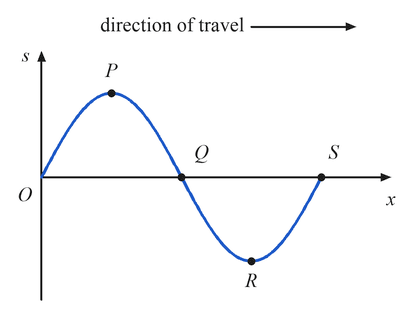
At which of the marked points is the air compressed (a region of higher pressure)?
- 62 marks
Question 6
A window maker builds a "vacuum glazing" unit: two glass panes with a very narrow gap between them, from which nearly all the air has been pumped out. Tiny pillars keep the panes apart, and an edge seal closes the gap all round, as shown (not to scale).
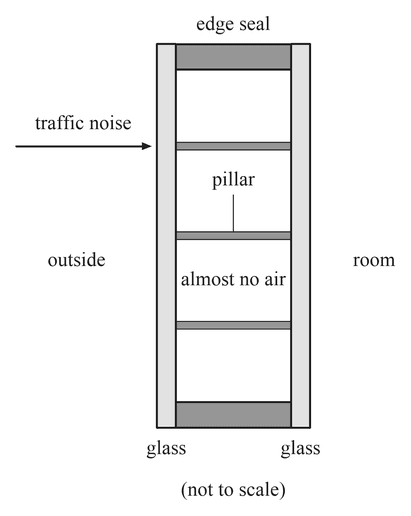
(i) Why does very little traffic noise cross the gap itself?
(ii) Give one reason why some noise still reaches the room.
- 73 marks
Question 7
A student stands on level ground between two tall parallel walls A and B, nearer to wall A, as shown. The student claps once and hears the first echo after the clap and the second echo after the clap. Take the speed of sound in air as . (Hypothetical data.)
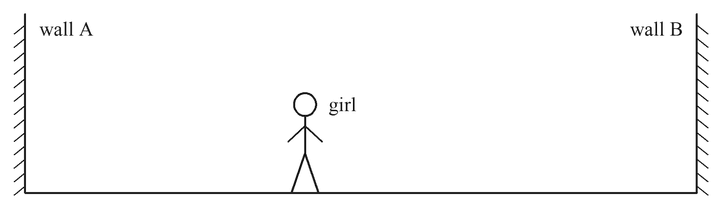
(i) Find the distance between the two walls.
(ii) A third echo follows. Explain how it is produced, and find how long after the clap it reaches the student.
- 81 mark
Question 8
Sound travels more slowly in carbon dioxide than in air, so a thin rubber balloon filled with carbon dioxide acts as a converging lens for sound. A student repeats the experiment with the same balloon filled with helium, in which sound travels about three times as fast as in air. Plane sound waves from a distant source fall on the balloon, and a microphone is placed on the far side, as shown.
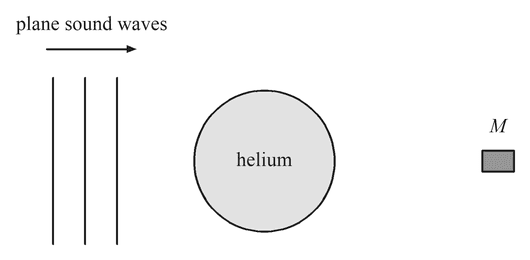
The helium-filled balloon
- 93 marks
Question 9
Sound travels at in air and at in water. For sound crossing a boundary, the law of refraction reads , where and are the speeds of sound in the first and the second medium.
(i) Find the critical angle for sound going from air into water.
(ii) Sound from a boat's horn meets the surface of a lake at an angle of incidence of . Find the angle of refraction in the water.
(iii) What happens to sound from the horn that meets the surface at ?
- 101 mark
Question 10
In a Quincke's tube, sound from a source enters at one end and splits between a fixed tube A and a sliding U-shaped tube B; the two parts meet again at a detector, as shown. The detector shows maximum loudness at one setting. Tube B is then pulled out slowly, and the loudness first falls to a minimum after B has moved out by . The speed of sound in the air of the tube is . (Hypothetical data.)
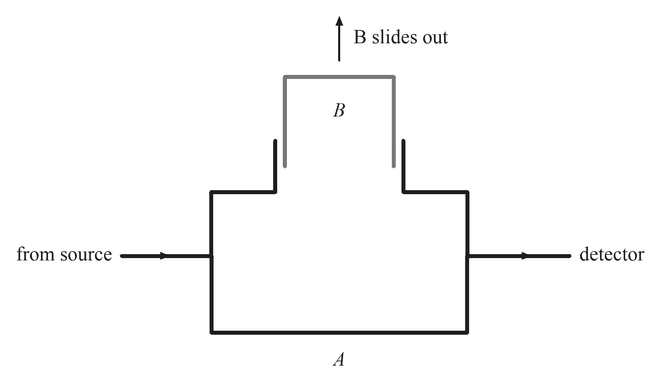
The frequency of the source is
- 113 marks
Question 11
A teacher talking in a corridor can be heard clearly by a student sitting inside a classroom, out of sight of the open doorway, which is wide; the student cannot see the teacher. Take the speed of sound in air as and a typical wavelength of light as .
(i) Find the wavelength of a sound in the teacher's voice, and compare it with the width of the doorway.
(ii) Use your answer to explain why the voice is heard but the teacher is not seen.
(iii) The voice also contains sounds of frequency about . Explain why the voice heard round the corner sounds a little muffled.
- 121 mark
Question 12
A newly built school hall is empty, with bare plastered walls, a marble floor and wooden benches. Speech in it is hard to follow because each sound goes on echoing (reverberating) for a long time. Which single change will reduce this problem the most?
- 133 marks
Question 13
Two small loudspeakers and are connected to the same amplifier, so they send out sound of the same frequency, in phase. A listener stands at , from and from , as shown. Take the speed of sound as . (Hypothetical data.)
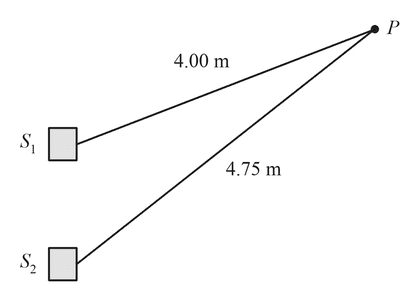
(i) When the frequency is , show that is a point of minimum loudness.
(ii) Find the lowest frequency at which would be a point of maximum loudness.
- 141 mark
Question 14
In an experiment, the speed of transverse pulses on a stretched cord is measured for several values of the tension . The graph of against is a straight line through the origin, as shown. (Hypothetical data.)

The mass per unit length of the cord is
- 153 marks
Question 15
The thinnest string of a guitar is a steel wire of diameter ; the density of the steel is . The string is tuned to a tension of , and its vibrating length is . (Hypothetical data.)
(i) Find the mass per unit length of the string.
(ii) Find the speed of transverse waves on the string.
(iii) How long does a transverse pulse take to travel once along the vibrating length?
- 161 mark
Question 16
A uniform heavy rope long hangs vertically from a ceiling, with its lower end free. At any point of the rope, the tension equals the weight of the part of the rope below that point. Take . (Hypothetical data.)
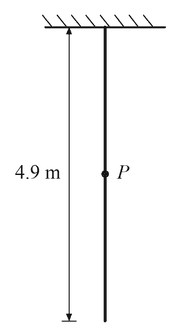
A small transverse pulse is sent up the rope from its lower end. Its speed as it passes , the midpoint of the rope, is
- 172 marks
Question 17
The speed of a transverse wave on a stretched string is thought to depend only on the tension in the string and on its mass per unit length . Taking , where is a dimensionless constant, use the method of dimensions to find and .
- 183 marks
Question 18
A horizontal wire of mass per unit length is fixed to a clamp at one end. It passes over a smooth pulley and carries an aluminium block of mass at its other end; the density of aluminium is . The block hangs fully immersed in water of density , without touching the beaker, as shown. Take . (Hypothetical data.)
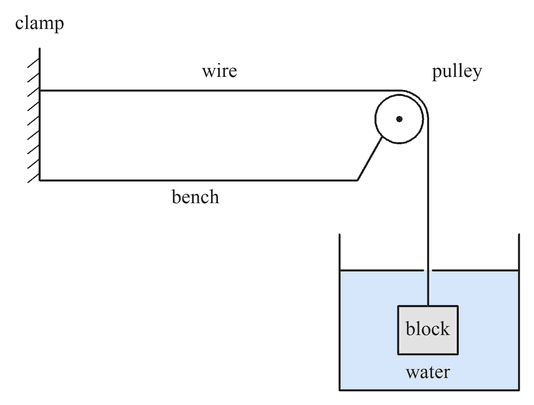
(i) Find the speed of transverse waves on the horizontal part of the wire when the beaker is removed and the block hangs in air.
(ii) Find the speed when the block hangs fully immersed in the water, as shown.
(iii) By what percentage does the speed fall when the block is immersed?
- 191 mark
Question 19
A steel string and a nylon string have the same diameter and are stretched to the same tension. The density of steel is and that of nylon is . On which string do transverse waves travel faster, and by about what factor?
- 201 mark
Question 20
The speed of a longitudinal (sound) wave in a medium of density is , where is a suitable modulus of elasticity of the medium. Which choice of is correct for all three media listed?
- 213 marks
Question 21
Air at a pressure of carries a loud sound. In a compression, the volume of a small parcel of air decreases by the fraction . Take for air. (Hypothetical data.)
(i) Find the rise in pressure in the compression if the change were isothermal, as Newton assumed.
(ii) Find the rise in pressure if the change is adiabatic, as Laplace assumed.
(iii) Give two reasons why the adiabatic assumption is the correct one for sound in air.
- 221 mark
Question 22
At a mountain observatory, the air pressure is and the speed of sound is measured as . (Hypothetical data.) Taking for air, the density of the air at the observatory is about
- 234 marks
Question 23
An earthquake sends two kinds of waves through the rock of the Earth's crust: longitudinal P-waves and transverse S-waves. For this rock take the bulk modulus , the rigidity modulus and the density . In a large body of solid, P-waves travel at and S-waves travel at . (Hypothetical data.)
(i) Find the speed of each kind of wave.
(ii) A recording station receives the S-waves after the P-waves. Assuming that both kinds of wave travel along the same straight path through this rock, find the distance of the station from the source of the earthquake.
(iii) Explain why the P-waves travel faster than the S-waves.
- 241 mark
Question 24
Laplace assumed that the compressions and rarefactions of a sound wave in air are adiabatic. According to this assumption, as a sound wave passes through the air,
- 252 marks
Question 25
Laplace's correction multiplies Newton's value of the speed of sound in a gas by . Find this factor for helium (, a monatomic gas), for air () and for carbon dioxide (). In which of the three gases does the correction raise Newton's value by the largest percentage?
- 261 mark
Question 26
Two identical rigid steel cylinders, A and B, each hold air at and a pressure of . More air is pumped into cylinder A, while its temperature is kept at , until its pressure is . Cylinder B is sealed and heated until its pressure is . Treat air as an ideal gas whose does not change. How does the speed of sound in each cylinder compare with its value before the change?
- 273 marks
Question 27
(Hypothetical data.) On the ground the air is at and , and the speed of sound is . A weather balloon carries a sensor up to a height where the air is at and . Treat air as an ideal gas with the same at both places.
(a) Find the ratio of the density of the air at that height to the density of the air at the ground.
(b) Find the speed of sound at that height.
(c) A student argues: “The air up there is much less dense, so sound must travel faster there.” Explain what is wrong with this argument.
- 283 marks
Question 28
The speed of sound in dry air at is . A quick rule often used is , where is the temperature in degrees Celsius and the speeds are in .
(a) Use , with in kelvin, to find the speed of sound at and at .
(b) Find the speeds at the same two temperatures from the quick rule, and the error of the rule in each case.
(c) Explain why the quick rule gives a slightly larger value than the exact one at both temperatures.
- 291 mark
Question 29
(Hypothetical data.) A factory siren is from a listener. A steady wind of blows at to the line from the siren to the listener, with a part of it towards the listener. The speed of sound in still air is . Using , the time the sound takes to reach the listener is closest to
- 303 marks
Question 30
(Hypothetical data.) On a humid afternoon the air is at , and of its molecules are water molecules (molar mass ); the rest is dry air (molar mass ). Compare this moist air with dry air at the same temperature and pressure, and take to be the same for both.
(a) Find the ratio of the density of the moist air to that of the dry air.
(b) By what percentage is the speed of sound in the moist air greater than in the dry air?
(c) To what temperature would the dry air have to be warmed so that it carries sound as fast as the moist air does at ?
- 311 mark
Question 31
(Hypothetical data.) A student measures the speed of sound in a gas at several absolute temperatures :
(K) 250 300 350 400 () 317.0 347.3 375.1 401.0 The student wants to plot one quantity against another so that the points lie on a straight line through the origin. Which plot should the student choose?
- 323 marks
Question 32
On a still night a layer of warmer air lies over cold air at . Treat the boundary between them as sharp and flat. Sound obeys the same law of refraction as light, , where and are the speeds of sound in the first and the second medium. A sound wave travelling through the cold air meets the boundary at to the normal, as shown.
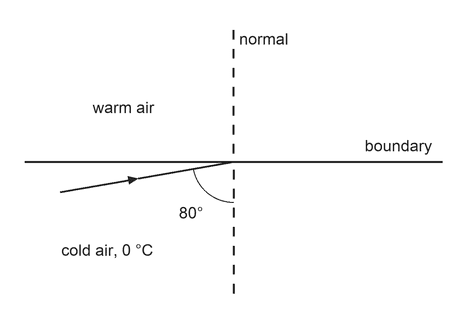
(a) Using , show that the sound is totally reflected back into the cold air if , where and are the absolute temperatures of the warm and the cold air and is the angle of incidence.
(b) Find the lowest temperature of the warm layer, in degrees Celsius, for which this sound is totally reflected.
(c) Explain why the sound most easily turned back down by such a layer is sound travelling nearly parallel to the ground.
- 331 mark
Question 33
(Hypothetical data.) A hiker stands from a steep rock face and gives one short shout. A steady wind of blows from the hiker towards the rock face, and the speed of sound in still air is . Compared with a calm day at the same temperature, when does the echo reach the hiker?
- 341 mark
Question 34
A small cork floats on deep water while a train of gravity waves passes beneath it. Ignoring any slow drift, which path does the cork follow?
- 353 marks
Question 35
(Hypothetical data.) A storm far out at sea sends out gravity waves (swell) of many different wavelengths across the deep ocean. Take and use the formula for gravity waves on deep water, .
(a) Find the speed and the period of swell of wavelength .
(b) Find the speed of swell of wavelength .
(c) Both kinds of swell leave the storm together and cross of deep ocean to an island. Which arrives first, and how much earlier, if each travels at the speed given by this formula?
- 361 mark
Question 36
Gravity waves of wavelength travel across a deep pool of water on the Earth (). Using , how would the speed of waves of the same wavelength compare on a deep pool of mercury (density times that of water) on the Earth, and on a deep pool of water imagined on the Moon ()?
- 373 marks
Question 37
(Hypothetical data.) A ripple tank shows short waves of wavelength on water of surface tension and density . Take . The speed of water waves is given by .
(a) Treating the waves as pure ripples (capillary waves), find their speed.
(b) Find the speed from the full formula, and the frequency of the vibrator making the waves.
(c) By what percentage does the ripple formula underestimate the speed?
- 381 mark
Question 38
According to the formulas for water waves in this chapter, how does the speed of a wave depend on its wavelength for gravity waves (long waves) and for ripples (very short waves)?
- 393 marks
Question 39
(Hypothetical data.) A fish-finder on a boat sends short pulses of ultrasound straight down into the sea, where sound travels at . Two fish swim one directly below the other, apart.
(a) Find the wavelength of the ultrasound in the sea water.
(b) Find the time between the echoes from the two fish.
(c) The two echoes can be told apart only if each pulse lasts less than this time. At most how many complete cycles of the wave can each pulse contain?
- 401 mark
Question 40
(Hypothetical data.) An ultrasound scanner can show details only about as small as one wavelength of the waves it uses. Sound travels through soft body tissue at . What is the lowest frequency that can show details across in soft tissue?
- 413 marks
Question 41
(Hypothetical data.) A diver's hand-held locator finds objects under water by sending out sound and listening for the echo. Sound travels at in the water. The locator must detect a rope thick.
(a) Find the wavelength in the water of sound of frequency , and of sound of frequency .
(b) Explain which of these two frequencies the locator should use to detect the rope.
(c) Will the diver hear the waves? Give a reason.
- 421 mark
Question 42
(Hypothetical data.) A rifle bullet leaves the barrel at on a day when the speed of sound is . Using the ranges of Mach number given in the chapter (below 0.75 subsonic; 0.75 to 1.2 transonic; 1.2 to 5.0 supersonic; 5.0 to 10.0 hypersonic), what are the bullet's Mach number and flight regime?
- 433 marks
Question 43
(Hypothetical data.) An aircraft flies at a steady speed of relative to the air, first near the ground, where the air is at , and later at a height of about , where the air is at . The speed of sound in air at is .
(a) Find the speed of sound at each height.
(b) Find the Mach number of the aircraft at each height.
(c) At which height is the aircraft flying faster than sound? Explain why its Mach number changes although its speed does not.
- 441 mark
Question 44
Concorde, the supersonic airliner that carried passengers until 2003, cruised at about Mach 2.0 at a height of about , where the speed of sound is about . Its cruising speed relative to the air was closest to
- 452 marks
Question 45
When a body moves through air faster than sound, the sound waves it sends out pile up on a cone with the body at its tip. The half-angle of this cone is given by , where is the speed of sound and the speed of the body. A bullet flies at through air at . The speed of sound in air at is . Find the Mach number of the bullet and the half-angle of its cone.
- 461 mark
Question 46
Which statement correctly tells apart the terms “ultrasonic” and “supersonic”?
- 473 marks
Question 47
(Hypothetical data.) A car's parking sensor sends out ultrasonic pulses and times their echoes. Its electronics always take the speed of sound as , the value at about . The speed of sound in air at is . A wall is really behind the sensor.
(a) On a morning at , find the echo time and the distance that the sensor displays.
(b) Repeat for an afternoon at .
(c) On which occasion is the error more dangerous for the driver, and why?
- 482 marks
Question 48
“Bats can ascertain distances, directions, nature and size of the obstacles without any eyes”. How?
- 492 marks
Question 49
“The velocity of sound is generally greater in solids than in gas at N.T.P.” Why?
- 501 mark
Question 50
The velocity of sound in a tube containing air at 27°C and a pressure of 76 cm of mercury is 330 m/s, what will be the velocity when pressure is increased to 100 cm of mercury and the temperature is kept constant?
- 511 mark
Question 51
“We cannot hear the explosions on other planets.” Why?
- 521 mark
Question 52
“During thunder, we can hear a rolling sound.” Why?
- 532 marks
Question 53
“The bells are made of metals and not of wood.” Why?
- 542 marks
Question 54
“When one person hammers at one end of a metal pipe, if a listener places his ear at the other end of the pipe, two distinct sounds are heard.” Why?
- 552 marks
Question 55
“During the filling of an empty bottle with water, the pitch of the sound heard goes on changing.” Why?
- 562 marks
Question 56
Why does an empty vessel produce more sound than a filled one?
- 573 marks
Question 57
The density of a solid is and its young's modulus is 117 GPa. What is the velocity of sound in the solid?
- 583 marks
Question 58
A stone dropped from the top of a tower 300 m high splashes into the water of a pond near the base of the tower. When is the splash heard at the top? Velocity of sound
- 593 marks
Question 59
The speed of a wave in a medium is . If 3600 waves are passing through a point in the medium in one minute, then calculate the wavelength.
- 603 marks
Question 60
The speed of a sound in an aluminium bar is 5.1 km/s. If its density is , what is its Young's Modulus?
- 613 marks
Question 61
The bulk modulus of mercury is and the density is . What is the speed of sound in mercury?
- 623 marks
Question 62
Two persons stand near a railway line separated by a distance 2 km. A detonator is exploded by the first person. The second person 2 km away hears two sounds, one from the sound that has travelling through the rail and the other through the air. What is the interval between them? Given Young's modulus of steel . Density of steel . Density of air . Atmospheric pressure . for air
- 633 marks
Question 63
The density of water at 29°C is and an increase of pressure of diminishes the volume of of water by . What is the velocity of sound in water at 29°C?
- 643 marks
Question 64
What is the ratio of specific heats for hydrogen? Given density of hydrogen at STP . Velocity of sound in hydrogen at STP m/s.
- 653 marks
Question 65
What is the percentage increase in the speed of sound when temperature increases from −5°C to 32°C?
- 663 marks
Question 66
Find the velocity of sound in at NTP. Given that the velocity of sound in at NTP is 1880 m/s and the density of oxygen is 16 times the density of hydrogen for both the gases.
- 673 marks
Question 67
At what temperature, will the speed of sound in be equal to the speed of sound in at 0°C? Given of is 1.4 and that for is 1.31
- 683 marks
Question 68
At normal temperature and pressure, the speed of sound in air is . What will be the speed of sound in hydrogen (i) at normal temperature and pressure and (ii) at 819°C temperature and 4 atmospheric pressure? Given air is 16 times heavier than hydrogen.
- 693 marks
Question 69
The speed of longitudinal waves in a mixture of He and Ne was found to be at 30°C. Find the composition of the mixture. Both He and Ne are monoatomic. Assume their molecular masses. Molar mass of He kg, Molar mass of Ne kg.
- 703 marks
Question 70
Speed of sound in gas is . Calculate the speed of sound in the mixture of gas and gas in which they are mixed in 1:8 ratio, given ratio of densities of the two gases is 16:1
- 713 marks
Question 71
In a gas sound travels at a speed of at NTP. If , identify the gas.
- 723 marks
Question 72
On a certain day sound is found to travel 1.4 km in 4 second in air. Calculate the average temperature of air. m/s at 0°C.
- 733 marks
Question 73
Compare the velocities of sound in Argon and Oxygen. of and Argon are 1.4 and 1.67 respectively.
- 743 marks
Question 74
Calculate the wavelength of sound emitted by a tuning fork which makes 240 vibrations per second at 27°C. Velocity of sound in air at 0°C is .
- 753 marks
Question 75
An observer saw a flash of lightning and after 8 seconds heard the thunder. If the average temperature of air is 17°C, how far away did the lightning occur? Velocity of sound in air at 0°C is .
- 763 marks
Question 76
Find the velocity of sound in air at NTP. The density of air is . for air is 1.42.
- 771 mark
Question 77
Speed of sound in mercury at a certain temperature is . Given the density of mercury as , the bulk modulus of mercury is
- 781 mark
Question 78
A big explosion on the Moon cannot be heard on the Earth because
- 791 mark
Question 79
Sound waves travel at through a warm air and at through brass. The wavelength of a acoustic wave as it enters brass from warm air
- 801 mark
Question 80
The speed of sound in a gas of density at a pressure is proportional to
- 811 mark
Question 81
The speed of sound in air is . The speed of sound in air in units of km per hour will be
- 821 mark
Question 82
Two monoatomic ideal gases 1 and 2 of molecular masses and respectively are enclosed in separate containers kept at the same temperature. The ratio of the speed of sound in gas 1 to that in gas 2 is given by
- 831 mark
Question 83
The condition under which a microwave oven heats up a food item containing water molecules most efficiently is
- 841 mark
Question 84
The frequency of sound wave is and its velocity is . If the frequency is increased to , the velocity of the wave will be
- 851 mark
Question 85
Velocity of sound in air
I. Increases with temperature
II. Decreases with temperature
III. Increase with pressure
IV. Is independent of pressure
V. Is independent of temperature
Choose the correct answer.
- 861 mark
Question 86
The temperature at which the speed of sound in air becomes double of its value at is
- 871 mark
Question 87
It takes seconds for a sound wave to travel between two fixed points when the day temperature is . If the temperature rise to , the sound wave travels between the same fixed points in
- 881 mark
Question 88
The phenomenon of sound propagation in air is
- 891 mark
Question 89
Two sound waves having a phase difference of have path difference of
- 901 mark
Question 90
A source of sound of frequency is placed inside water. The speed of sound in water is and in air is . The frequency of sound recorded by an observer who is standing in air is
- 911 mark
Question 91
Equation of travelling wave on a stretched string of linear density is where distance and time are measured in SI units. The tension in the string is
- 921 mark
Question 92
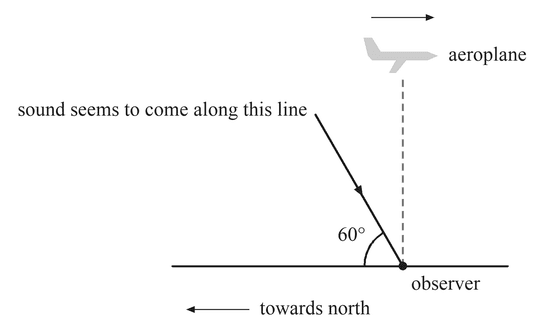
A person standing on an open ground hears the sound of a jet aeroplane, coming from north at an angle with ground level. But he finds the aeroplane right vertically above his position. If is the speed of sound, speed of the plane is
- 931 mark
Question 93
The pressure wave, , corresponds to the sound produced by a vibrating blade on a day when atmospheric temperature is . On some other day, when temperature is , the speed of sound produced by the same blade and at the same frequency is found to be . Approximate value of is
- 941 mark
Question 94
Speed of a transverse wave on a straight wire (mass , length and area of cross-section ) is . If the Young's modulus of wire is , the extension of wire over its natural length is
- 951 mark
Question 95
A transverse wave travels on a taut steel wire with a velocity of when tension in it is . When the tension is changed to , the velocity changed to . Then value of is close to
- 961 mark
Question 96
A longitudinal wave is represented by . The maximum particle velocity will be four times the wave velocity if the determined value of wavelength is equal to
- 971 mark
Question 97
A steel wire with mass per unit length is under tension of . The speed of transverse wave in the wire will be